


Listen to this article · ~24 min

The 5Ms of lean manufacturing are Manpower, Methods, Machines, Materials, and Measurement, five categories that structure root cause analysis by organizing potential problem sources into defined domains rather than allowing unstructured brainstorming that misses systematic causes. Originally developed by Kaoru Ishikawa as the organizing framework for fishbone diagrams in the 1960s, the 5Ms ensure that manufacturing teams investigate all major causal domains when analyzing quality problems, equipment failures, or process deviations. The framework prevents the investigation bias that occurs when teams focus exclusively on the most obvious or familiar causes while neglecting less visible but equally significant contributors.
Without the 5Ms structure, root cause analysis sessions consistently produce incomplete causal maps because participants gravitate toward the domains they know best. The 5Ms framework forces balanced attention across all domains by making each category a mandatory investigation area, which is why the 5Ms appear as the standard bone labels on fishbone diagrams across manufacturing quality management systems worldwide and why organizations using the framework consistently identify root causes that unstructured brainstorming sessions miss.
Where the 5Ms Framework Comes From
Kaoru Ishikawa developed the cause-and-effect diagram in the 1960s while working with quality control teams at Kawasaki shipyards in Japan. The diagram's visual structure resembles a fish skeleton: the problem statement forms the head, a central spine extends from it, and major cause categories branch off as bones. The 5Ms emerged as the standard category set because they cover the fundamental input domains manufacturing processes depend on: people performing tasks (Manpower), following procedures (Methods), using equipment (Machines), processing materials (Materials), and verifying conformance (Measurement).
The framework spread globally as lean manufacturing and Six Sigma methodologies formalized it as the standard approach to cause-and-effect analysis. The American Society for Quality defines root cause analysis as a range of approaches used to uncover problem causes, and the 5Ms fishbone structure appears consistently across ASQ training materials. The framework's effectiveness comes from forcing teams to investigate domains they might otherwise overlook, making each M a mandatory category that must be addressed during every analysis.
Key Insight: The 5Ms framework originated with Kaoru Ishikawa's fishbone diagram as the systematic structure that prevents manufacturing teams from concentrating on familiar causes while missing less visible but equally significant root contributors.
The Five Ms Explained
Each of the five M categories represents a distinct domain of potential causes that manufacturing processes depend on to function correctly. Understanding what each category covers and what questions it prompts during root cause analysis ensures that the framework is applied with the depth required to identify genuine root causes rather than surface-level contributors.
Manpower
The Manpower category addresses all human-related factors: operator skill and training levels, workforce staffing adequacy, employee motivation and engagement, communication effectiveness between shifts and departments, and physical or cognitive limitations affecting task performance.
Manpower causes include systemic workforce issues such as inadequate cross-training creating single points of failure when skilled workers are absent, unclear role definitions producing gaps in responsibility, or high turnover preventing institutional knowledge development. A machine malfunction traced to an operator skipping a lubrication step may reveal a training gap, procedural clarity issue, or staffing pressure forcing operators to choose between completing the task and meeting production targets.
Questions to ask when investigating Manpower causes:
- Was the operator who performed this task trained and certified for it?
- Were staffing levels adequate for the production volume at the time?
- Did the operator understand the consequences of deviating from the procedure?
- Was communication between shifts sufficient to transfer relevant information about equipment condition or material quality?
Methods
The Methods category covers all procedural and process-related factors: documented procedures operators follow, informal practices that develop when procedures are unclear or incomplete, process design decisions making certain failure modes more likely, and consistency with which methods are applied across shifts and production lines.
Methods causes appear when standard operating procedures are absent, outdated, or written at insufficient detail for task complexity. They also appear when procedures exist but conflict with production pressure or when operators discover through experience that documented methods produce inferior results compared to undocumented workarounds.
Questions to ask when investigating Methods causes:
- Does a documented procedure exist for this operation?
- Is the procedure current and accurate?
- Does the procedure specify all parameters that affect quality?
- Are operators able to follow the procedure as written without creating other problems?
- When procedures are not followed, what systemic barriers make compliance difficult?
Machines
The Machines category addresses equipment-related causes: machine condition and maintenance history, equipment capability relative to process requirements, tool wear and replacement schedules, calibration status and frequency, process parameter settings and stability, and automation or control system performance.
Machines causes are often investigated first because equipment malfunctions are visible and measurable. However, attributing a problem to the machine without examining why it was in that condition misses the deeper systemic cause. A bearing failure stopping production is symptomatic. Root cause investigation asks why the bearing failed: was preventive maintenance overdue, was the lubrication system malfunctioning, was the bearing operated outside design load, or was vibration from an adjacent machine contributing to accelerated wear?
Questions to ask when investigating Machines causes:
- Is the machine capable of holding the required tolerance under normal operating conditions?
- When was the last preventive maintenance performed?
- Are process parameters set correctly and monitored for drift?
- Has the tooling been changed or worn since the last good production run?
- Is the control system functioning as designed?
Materials
The Materials category covers all input-related factors: raw material specifications and supplier consistency, incoming material inspection effectiveness, material handling and storage conditions, material lot traceability and change management, and material properties such as moisture content, hardness, or chemical composition affecting processability.
Materials causes appear when supplier lots vary in ways the process cannot accommodate, when material specifications are incomplete or incorrect, when storage conditions degrade material quality before use, or when material substitutions occur without process validation.
Questions to ask when investigating Materials causes:
- Has the material supplier or lot changed recently?
- Are material specifications complete and verified against process requirements?
- Is incoming inspection detecting the characteristics that affect process performance?
- Are materials stored in conditions that prevent degradation?
- Is material traceability sufficient to identify when lot changes correlate with quality shifts?
Measurement
The Measurement category addresses all aspects of how conformance is verified and performance is monitored: gauge and instrument capability and calibration status, measurement system repeatability and reproducibility, inspection procedure adequacy and operator consistency, sampling plans and their statistical validity, and data collection and recording accuracy.
Measurement causes are the most frequently overlooked category because teams assume that if a defect was detected, the measurement system is functioning correctly. However, a gauge capable of detecting severe defects may not be sensitive enough to detect marginal ones, allowing borderline nonconforming product to pass inspection. Inspection procedures relying on operator judgment may produce different results depending on who performs them, creating false failures or undetected escapes.
Questions to ask when investigating Measurement causes:
- Is the measurement system capable of reliably distinguishing conforming from nonconforming product for this characteristic?
- When was the gauge last calibrated?
- Has a gauge repeatability and reproducibility study confirmed that measurement variation is small relative to product tolerance?
- Are inspection procedures specific enough to eliminate operator judgment?
- Is the sampling plan statistically valid for the defect rate being monitored?
Key Insight: Each of the five Ms represents a distinct causal domain that manufacturing processes depend on. Systematic investigation of all five categories prevents the investigative bias that concentrates on familiar causes while missing equally significant contributors in overlooked domains.
The Sixth M: Mother Nature (Environment)
Many manufacturing organizations expand the 5Ms framework to six by adding Mother Nature or Environment as the sixth category. This addresses ambient and environmental conditions affecting process performance: temperature and humidity, vibration and noise, lighting and cleanliness, power quality and stability, and seasonal or weather-related variations.
Environmental causes become relevant when processes are sensitive to conditions varying throughout the facility, across shifts, or seasonally. A coating application process performing correctly in winter may produce defects in summer if ambient humidity affects drying time. The decision to use 5Ms or 6Ms depends on whether environmental factors are likely contributors to the problem being investigated.
Questions to ask when investigating environmental causes:
- Does the problem occur more frequently during specific times of day, seasons, or weather conditions?
- Are temperature, humidity, or other ambient conditions monitored and controlled within the range the process requires?
- Does the problem correlate with facility location, suggesting environmental differences between production areas?
- Are environmental conditions at the point of use the same as those where the process was originally validated?
Organizations operating processes with known environmental sensitivities should use the 6M framework as standard practice. Those operating in controlled environments where ambient conditions are stable may find the additional category unnecessary for most investigations.
Key Insight: The sixth M addressing environment and ambient conditions is added when processes show sensitivity to temperature, humidity, or other environmental factors that the original five categories do not explicitly cover. The choice between 5Ms and 6Ms depends on process sensitivity to ambient variation.
How the 5Ms Structure Root Cause Analysis
The 5Ms framework structures root cause analysis by transforming unstructured brainstorming into systematic domain-by-domain investigation. The typical application combines the 5Ms with the fishbone diagram visual format and the 5 Whys iterative questioning method to produce a comprehensive causal map that identifies root causes rather than surface symptoms.
Define the Problem Statement
The process begins with a clearly defined problem statement placed at the head of the fishbone diagram. The problem statement must be specific: "Bore diameter out of tolerance on CNC Machine 4, afternoon shift, 14 percent of production over three weeks" rather than "quality issues on the machining line." A vague problem statement produces vague causal investigation.
Construct the Fishbone Structure
The team draws the fishbone structure with the five M categories as the major bones branching from the central spine. The facilitator works through each category systematically, asking the team to identify potential causes within that domain. This prevents teams from clustering contributions in familiar domains while leaving other bones empty.
Apply 5 Whys to Drill Deeper
For each potential cause identified, the 5 Whys method drills deeper. A cause listed as "operator error" under Manpower prompts "why did the operator make this error?" revealing "the setup sheet was unclear," prompting "why was the setup sheet unclear?" revealing "the fixturing torque sequence was not specified." The investigation continues until reaching a systemic condition addressable through process or management change.
When multiple branches converge on the same underlying cause, that cause is prioritized for corrective action because addressing it prevents recurrence across multiple failure modes.
Convert to Kaizen Projects
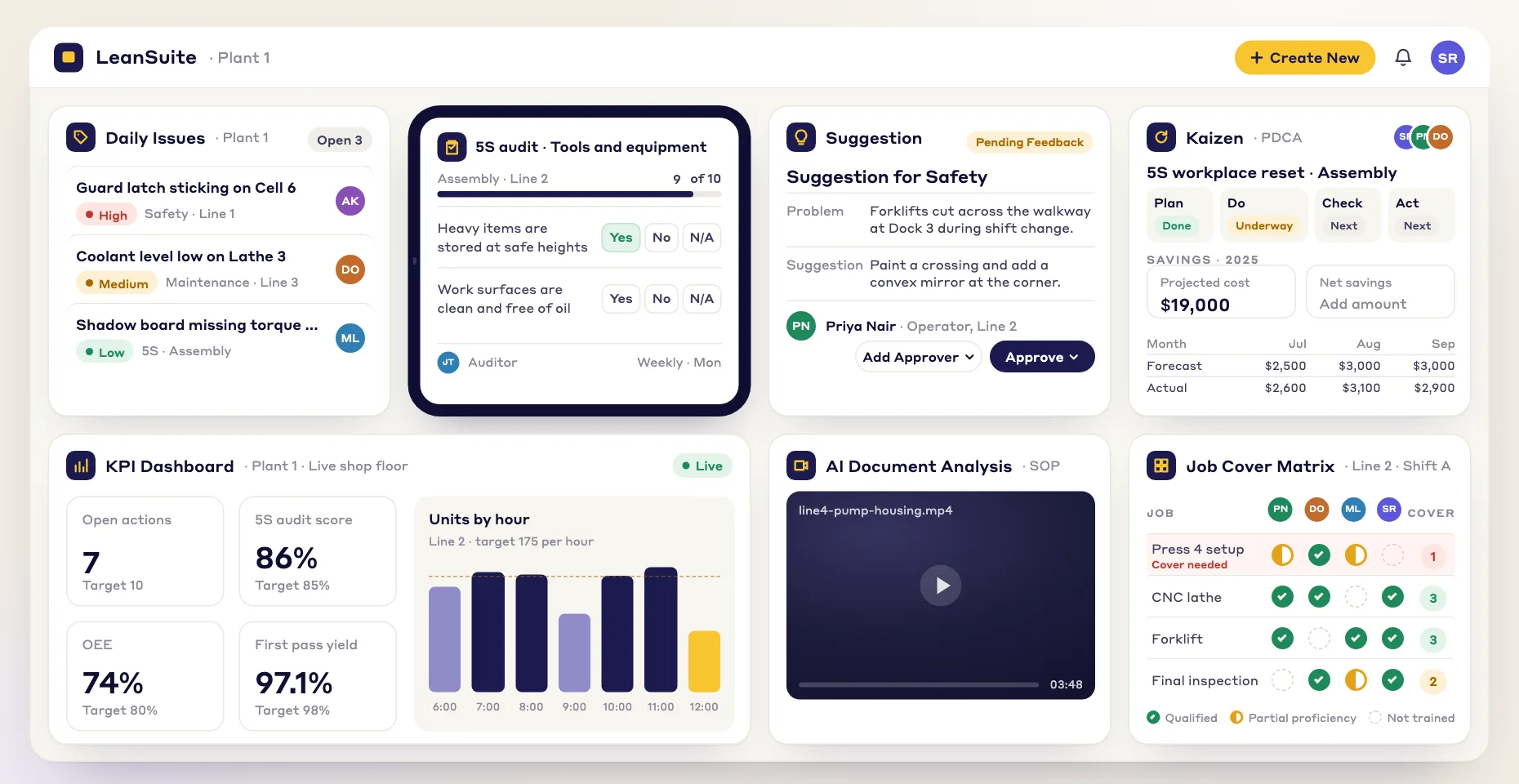
The LeanSuite Kaizen module supports this structured investigation by providing digital fishbone diagram templates with the 5Ms pre-populated, integrated 5 Whys drilling capability, and the ability to convert prioritized root causes directly into kaizen projects with assigned owners and implementation tracking.
Develop Corrective Actions
After the fishbone diagram is complete and causes are prioritized, corrective actions are developed for the root causes identified. These actions must address the systemic condition revealed by the investigation, not the symptomatic cause visible at the surface level. A corrective action that retrains one operator who made an error is symptomatic treatment. One that revises the setup sheet to specify the fixturing torque sequence and adds a verification step to the procedure addresses the systemic cause and prevents recurrence regardless of which operator performs the task.
Key Insight: The 5Ms structure transforms root cause analysis from random brainstorming into systematic domain investigation. Combined with 5 Whys depth drilling and fishbone visual mapping, the framework produces comprehensive causal analysis that identifies systemic conditions rather than surface symptoms.
Applying the 5Ms in Manufacturing Problem Solving
The 5Ms framework becomes operational when combined with fishbone diagram visual mapping and 5 Whys depth drilling. The practical application sequence begins with assembling a cross-functional team that brings expertise across all five M categories, then defining the problem with precision before constructing the fishbone structure with the 5Ms as major bones. Each category is investigated systematically, with the facilitator ensuring balanced attention across all domains rather than allowing familiar causes to dominate while less visible categories remain superficially explored. Potential causes identified under each M are then drilled deeper using 5 Whys to trace surface symptoms to underlying systemic conditions, and root causes are prioritized based on evidence strength and explanatory power for the problem pattern.
The full methodology for facilitating effective fishbone diagram sessions using the 5Ms structure, including team composition guidance, question sequencing techniques, evidence verification methods, and common facilitation pitfalls to avoid, is covered in Fishbone Diagrams: Effective Facilitation Techniques for Manufacturing Teams.
Key Insight: The 5Ms framework application combines cross-functional expertise, systematic category investigation, and 5 Whys depth drilling. Complete facilitation methodology including session structure and evidence verification is covered in the fishbone diagram facilitation guide.
Within the Lean System
The 5Ms framework sits at the intersection of lean manufacturing's problem-solving loop and quality management layer. As the categorical structure that organizes fishbone diagram root cause analysis, the 5Ms connect directly to the broader problem-solving methodology documented in How Lean Manufacturing Works: A Complete System Map, where systematic cause identification is the second step in the detect-define-find-fix-verify cycle that drives continuous improvement.
The framework integrates with other root cause analysis tools in the lean system:
- Fishbone Diagram: A Root Cause Analysis Visual Tool provides the visual structure the 5Ms organize
- 5 Whys: When It Works and When It Doesn't supplies the depth-drilling method applied to each M category
- A3 Problem Solving: A Practical Guide to Root Cause Analysis incorporates the 5Ms fishbone as the cause analysis section within the complete problem-solving report
Understanding how the 5Ms fit within the complete lean system prevents isolated tool application and ensures that root cause findings convert into corrective actions tracked through Kaizen: A Complete Guide to Continuous Improvement in Manufacturing.
The next tool in the learning sequence after mastering the 5Ms is 8D Problem Solving: The Eight Disciplines Method for Manufacturing, which formalizes the complete problem-solving workflow from team formation through root cause verification and prevention.
Frequently Asked Questions
Q: What is the difference between the 5Ms and the 6Ms in manufacturing?
The 5Ms framework covers Manpower, Methods, Machines, Materials, and Measurement. The 6Ms adds Mother Nature (Environment) as the sixth category to address ambient conditions like temperature, humidity, vibration, and cleanliness that affect process performance. Organizations use the 6Ms when processes are sensitive to environmental variation or when problems show time-of-day, seasonal, or location-based patterns suggesting environmental causes. For processes operating in controlled environments with stable ambient conditions, the 5Ms framework is typically sufficient.
Q: How do you decide which M category a cause belongs in during fishbone analysis?
Most causes have a natural home based on the domain they address. Causes related to workforce capability, training, or staffing go under Manpower. Procedural or process design causes go under Methods. Equipment condition or performance causes go under Machines. Input material or supplier-related causes go under Materials. Inspection or verification causes go under Measurement. When a cause could fit multiple categories, place it where it is most directly controlled. A cause that appears relevant to multiple domains should be listed under each, as this pattern often signals a high-priority systemic issue.
Q: Can the 5Ms framework be used for non-manufacturing problems?
The 5Ms categorical structure applies to any process where inputs from multiple domains combine to produce an output. Service industries, administrative processes, software development, and healthcare operations all use variations of the framework with category names adapted to their context. Marketing teams use Market, Message, Media, Money, Management, and Measurement. Software teams use People, Process, Technology, Data, and Integration. The systematic category-based investigation structure transfers across industries even when the specific M terminology does not. What matters is comprehensive domain coverage, not adherence to manufacturing-specific category names.
Q: What is the relationship between the 5Ms and the 5 Whys in root cause analysis?
The 5Ms and 5 Whys serve complementary roles in root cause analysis. The 5Ms provide the categorical structure that ensures all major causal domains are investigated systematically. The 5 Whys provide the depth-drilling method applied within each category to trace surface symptoms to underlying systemic causes. A fishbone diagram structured with the 5Ms but populated with surface-level causes that were not drilled with 5 Whys produces incomplete analysis. Similarly, applying 5 Whys without the 5Ms categorical structure produces deep investigation in familiar domains while missing causes in overlooked categories. Used together, they produce both comprehensive breadth and sufficient depth.
Q: How do you prevent the 5Ms fishbone analysis from becoming speculation instead of evidence-based investigation?
Require that every cause listed on the fishbone diagram must be supported by one of three evidence types: direct observation at the point of the problem, measurement data showing correlation between the cause and the effect, or logical inference from verified conditions that makes the cause highly probable. During brainstorming, accept all contributions without filtering. During the evidence anchoring phase that follows brainstorming, review each cause and mark it as confirmed by evidence, contradicted by evidence, or requiring additional investigation. Causes contradicted by evidence are removed. Causes requiring investigation are assigned for verification before corrective actions are developed. This discipline separates grounded analysis from speculative theorizing.
Free for this topic: 5W1H template, 5 Whys template


