



Lean leadership is the management philosophy and practice of developing people's capability, judgment, and ownership while guiding them toward continuous improvement, and it is the organizational foundation that determines whether lean tools produce lasting change or temporary results that regress when management attention moves elsewhere. Most lean implementations fail at the leadership layer, not the tool layer. Value stream maps get drawn, 5S gets implemented, standard work gets documented, and six months later the facility looks the same as before. What failed was not the kaizen event or the standard work document. What failed was the absence of leaders who knew how to develop the people operating within those systems to own them, improve them, and sustain them without being driven from outside.
The distinction matters because most lean implementations fail at the leadership layer, not the tool layer. Value stream maps get drawn. 5S gets implemented. Standard work gets documented. Six months later the facility looks the same as before and the initiative is described as having not worked. What failed was not the kaizen event or the standard work document. What failed was the absence of leaders who knew how to develop the people operating within those systems to own them, improve them, and sustain them without being driven from outside.
This guide covers what lean leadership actually means in manufacturing, how it differs from conventional management, and what developing people looks like as a practical daily discipline rather than a training program.
The Two Pillars That Define Lean Leadership
The Toyota Way, the formalized philosophy behind the Toyota Production System that gave rise to lean manufacturing, identifies two pillars as equally foundational: continuous improvement and respect for people. Jeffrey Liker's documentation of these principles in The Toyota Way describes the system as "designed to provide the tools for people to continually improve their work," placing people development at the center of what lean tools exist to accomplish.
Most manufacturing organizations that implement lean focus heavily on the continuous improvement pillar and apply the respect for people pillar superficially, if at all. The tools receive the investment: kaizen events, 5S, visual management, standardized work. The people development receives the language: "we respect our people," "our people are our greatest asset." The gap between the statement and the practice is where lean implementations break down.
Respect for People Is Not Courtesy
Respect for people in the lean context is not about politeness or recognition programs. It is a specific operational practice with observable behavioral markers. Gemba Academy's analysis of the Respect for People principle describes it as placing people and their capability first out of genuine recognition that operational excellence cannot be achieved without it, not as a cultural nicety that accompanies the pursuit of results.
In practical terms, respect for people in lean leadership means: developing each person's capability to identify and solve problems rather than solving problems for them, designing work systems that allow people to succeed rather than demanding performance within systems that make success difficult, and treating frontline knowledge as an operational asset rather than an administrative inconvenience.
Continuous Improvement Is a People Practice, Not a Tool Practice
Continuous improvement in lean leadership is not a calendar of kaizen events. It is the daily discipline of every person in the organization applying their knowledge to make their work slightly better, and of leaders creating the conditions in which that discipline is possible and valued. LeanBlog's reflection on TPS philosophy makes this distinction clearly: organizations that copy lean tools without the underlying philosophy get activity instead of a system for learning and improvement.
The practical implication for lean leaders is that their primary job is not to drive improvement projects. It is to develop the people who will identify, propose, and implement improvements as part of their normal daily work. A lean leader who must initiate every kaizen event has not yet developed a team that practices continuous improvement. A lean leader whose team surfaces improvement opportunities without being prompted has.
Key Insight: Lean leadership rests on two equally weighted pillars: continuous improvement and respect for people. Organizations that implement lean tools without both pillars get short-lived results. The tools work when the people who operate them are genuinely developed to own and improve them.
How Lean Leadership Differs From Conventional Manufacturing Management
Conventional manufacturing management is built on a control model: leaders set targets, direct activity toward those targets, monitor compliance, and intervene when deviations occur. It produces compliance and, at its best, efficient execution of defined processes. It does not produce the autonomous problem-solving and continuous improvement capability that lean manufacturing requires.
Lean leadership is built on a development model: leaders create the conditions for people to think, identify problems, propose solutions, and implement improvements within a defined framework. The leader's job shifts from directing activity to building capability. The target shifts from hitting this quarter's numbers to developing the people who will consistently achieve results across all quarters through better processes.
From Problem-Solver to Problem-Solving Developer
The most fundamental shift in lean leadership is the leader's relationship to problems. In conventional management, a leader who solves problems quickly and decisively is considered effective. In lean leadership, a leader who always solves problems themselves is considered a developmental failure because they have not built the team capability that makes their own problem-solving sustainable.
The lean leadership approach to problems is to use them as development opportunities. When a problem surfaces, the lean leader asks questions that guide the team member to identify the cause and develop a solution rather than providing the answer directly. This approach takes longer per problem than conventional management. It produces a team that handles similar problems independently in the future, which is more productive over time than any individual leader's problem-solving capacity.
From Results Focus to Process Focus
Conventional management measures leaders by results: production output, quality rates, cost performance. These are the right outcomes to care about. Lean leadership differs in recognizing that results are outputs of processes and that improving results sustainably requires improving the processes that produce them.
A lean leader who achieves this quarter's production target by pushing operators harder is managing results. A lean leader who achieves this quarter's production target by identifying and removing three process constraints that slowed the line is managing processes. The first approach produces variable results dependent on effort. The second produces improving results dependent on process quality. Over time, the process-focused leader's operation outperforms the results-focused leader's operation without requiring more effort from the people doing the work.
Key Insight: Lean leadership shifts from directing activity to building capability, from solving problems to developing problem-solvers, and from managing results to improving the processes that produce them. Each shift produces compounding returns that conventional management cannot sustain.
Leader Standard Work: The Discipline That Makes Development Consistent
Developing people requires consistent behavior from leaders. Not intensive behavior, not dramatic behavior, but a predictable daily pattern of presence, observation, coaching, and recognition that accumulates over time into genuine capability development. Leader Standard Work is the structure that makes this consistency possible.
Leader Standard Work is the defined set of routine activities that a lean leader performs at a specific frequency: daily floor presence, structured team interactions, review of visual management boards, coaching conversations connected to observed work, and review of leading indicators rather than only lagging ones. It is standardized for the same reason operator standard work is standardized: consistency produces better outcomes than variation driven by the urgency of the moment.
Daily Floor Presence With Developmental Intent
The daily Gemba Walk in lean leadership is not a compliance check. It is a developmental interaction. The leader arrives with questions designed to help team members articulate what they observe, what they think is causing it, and what they would do about it. The leader's observation of the work is secondary to the observation of the team's thinking about the work.
A lean leader who walks the floor and identifies problems to fix is performing inspection. A lean leader who walks the floor and asks team members what they have noticed, what they think it means, and what they think should be done about it is performing development. The behavioral distinction is visible to operators within the first few minutes and determines what they share in subsequent interactions.
Coaching Rather Than Directing
Coaching in lean leadership is a specific interaction style where the leader guides the team member's thinking through questions rather than providing answers. The questions follow the PDCA structure: what is the current condition, what is the target condition, what obstacles are preventing the move from current to target, what experiments will be tried, and what will success look like.
This structure, which Rother's Toyota Kata framework formalizes as the Improvement Kata, is practiced so frequently at Toyota that it becomes the natural language of operational problem-solving at every level of the organization. When the leader consistently coaches in this structure, team members begin applying the same thinking to problems before they bring them to the leader, which is the organizational capability lean leadership is designed to build.
Key Insight: Leader Standard Work makes people development consistent rather than occasional. Daily floor presence with developmental intent and structured coaching conversations build team capability that accumulates over time into operational excellence.
Developing Leaders, Not Just Operators
Lean leadership development does not stop at the frontline operator level. A lean manufacturing organization requires lean thinking and lean leadership behavior at every level: team leaders, supervisors, area managers, and plant management. Developing only operators while conventional management continues at the supervision and management levels produces a capability gap that makes sustained improvement impossible.
The Cascade Principle
Lean leadership development cascades downward through the organization from senior leadership. Leaders can only teach what they practice. A plant manager who has not developed lean leadership capability cannot develop supervisors who practice it. Supervisors who are not coached in lean thinking cannot develop team leaders who apply it. The capability development must begin at the level of the most senior leader who will be expected to model it, not at the frontline.
This principle explains why lean implementations that begin with operator training and kaizen events frequently stall. Operators develop the capability to identify and propose improvements. Supervisors trained in conventional management evaluate those proposals through a control-model lens rather than a development lens. The improvement ideas surface and disappear. Operators stop proposing them. The lean initiative stagnates at precisely the level where leadership development was absent.
Teaching as a Leadership Responsibility
In lean organizations, teaching is not a function delegated to a training department. It is a core leadership responsibility. Every leader at every level is expected to actively develop the capability of the people reporting to them: explaining the thinking behind decisions, coaching problem-solving rather than directing solutions, sharing operational knowledge that would otherwise remain tacit, and creating the deliberate development challenges that build judgment rather than just skill.
Lean leadership literature identifies this teaching responsibility as one of the distinguishing characteristics of lean leaders: they develop teams that follow the lean philosophy rather than teams that use lean tools. The distinction is between people who know how to run a kaizen event and people who think continuously about how their work could be better. The second is built through leadership behavior, not training events.
Key Insight: Lean leadership development must cascade from senior leadership downward. Teaching is a core leadership responsibility at every level, not a training department function. Leaders who do not practice lean thinking cannot develop teams that do.
Measuring Lean Leadership Effectiveness
Lean leadership effectiveness is not measured by the leader's individual performance metrics. It is measured by the operational and developmental performance of the team the leader has developed. Three indicators together reflect whether lean leadership is producing genuine organizational capability.
Team Problem-Solving Autonomy
The most direct measure of lean leadership effectiveness is how much problem-solving the team handles autonomously versus how much requires leader involvement. A team that escalates most problems to the leader has not developed the capability to handle them. A team that escalates selectively, bringing the leader into decisions that genuinely require broader authority while resolving routine issues independently, demonstrates the problem-solving capability lean leadership is designed to develop.
Tracking escalation frequency over time, specifically the ratio of problems the team resolves independently to those it escalates, provides a leading indicator of team capability development. A falling escalation ratio indicates growing team autonomy. A stable or rising ratio indicates that capability development has stalled or that the leader's behavior has not shifted from directing to developing.
Improvement Idea Generation Rate
Continuous improvement at scale requires that frontline workers generate improvement ideas as a routine behavior, not as a response to management initiative. The rate at which team members proactively identify and submit improvement opportunities, compared against the rate of leadership-initiated improvement projects, reflects the degree to which continuous improvement has become a shared operational practice rather than a management program.
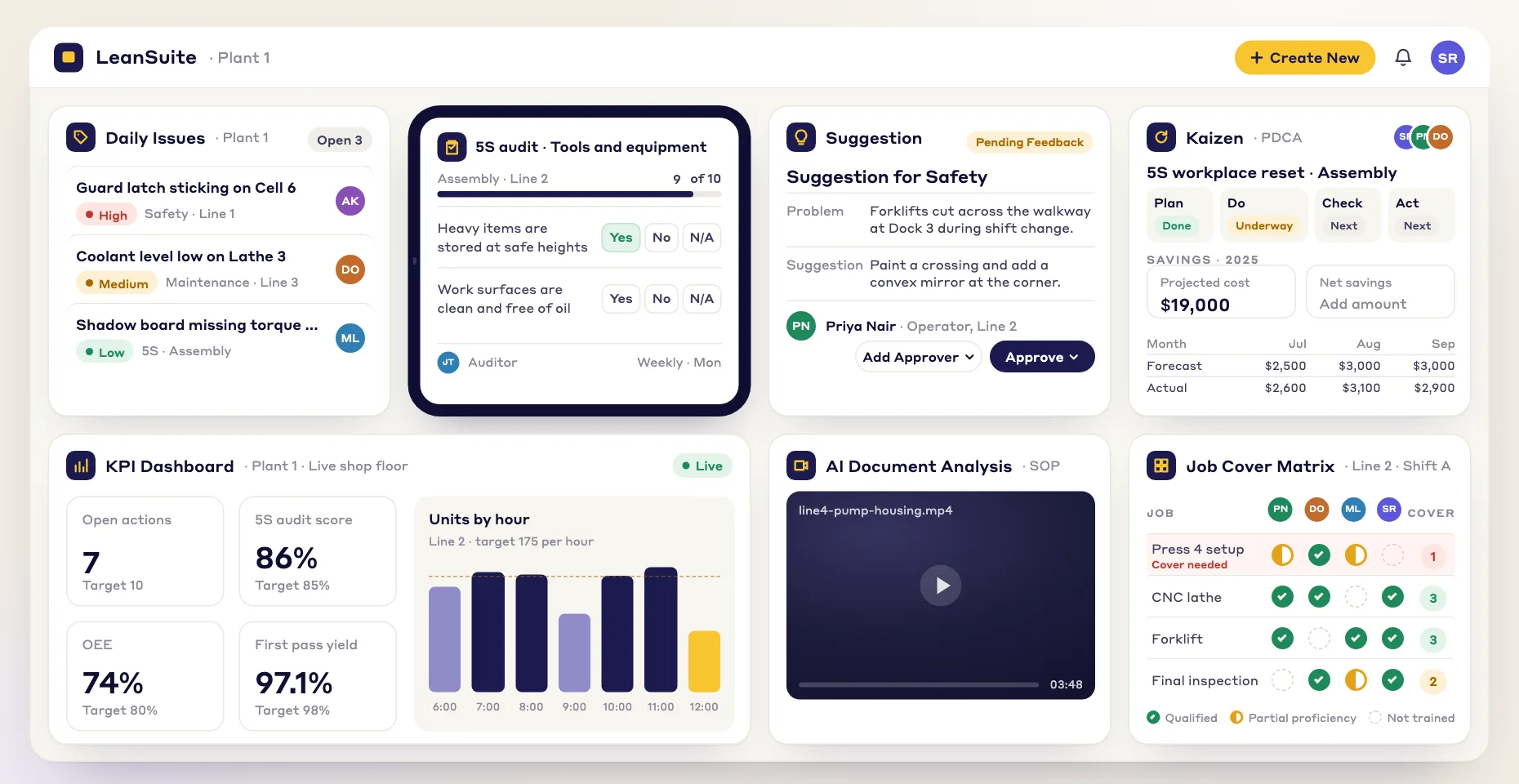
Teams with lean leadership that is genuinely developing people consistently generate more improvement ideas per person per month than teams operating under conventional management. The ideas may be smaller in scope, but their cumulative operational impact exceeds the impact of fewer, larger management-initiated projects. Connecting this to the LeanSuite continuous improvement platform creates the tracking infrastructure that makes this trend visible and accountable.
Retention and Engagement
Lean leadership produces higher workforce retention than conventional management in manufacturing environments. The development orientation, the coaching interaction style, and the genuine respect for frontline expertise create a work environment where skilled workers experience their knowledge as valued rather than managed. Retention of experienced manufacturing workers is itself a competitive advantage in an industry where the skills gap is among the most significant strategic challenges organizations face.
Key Insight: Lean leadership effectiveness is measured by team problem-solving autonomy, improvement idea generation rate, and workforce retention, not by the leader's individual performance metrics. The leader's results are the team's results.
Q&A
Q: What is the difference between lean leadership and conventional manufacturing management?
Conventional management is built on a control model: leaders direct activity, monitor compliance, and intervene on deviations. Lean leadership is built on a development model: leaders build capability in their teams, coach problem-solving rather than providing solutions, and manage processes rather than only outcomes. The practical difference is that conventional management produces compliance and lean leadership produces autonomous improvement capability that does not depend on constant management intervention.
Q: How does a plant manager begin practicing lean leadership if the organization has only implemented lean tools so far?
Begin with Leader Standard Work: define a daily floor presence routine with a developmental intent rather than an inspection intent. Ask questions during floor walks rather than providing observations. Identify one team member per week to coach through a problem using the Plan-Do-Check-Act structure rather than directing the solution. Consistency of these small behavioral changes over 90 days produces observable changes in how the team engages with problems.
Q: Why do lean implementations fail even when lean tools are correctly implemented?
Because lean tools produce improvement only when people understand the thinking behind them, have the capability to apply and improve them, and are led by people who develop that capability rather than directing compliance. Tools without the lean leadership philosophy produce a set of techniques being performed by people who do not own them. Ownership requires development, and development requires lean leaders, not just lean tools.
Q: How do you measure whether lean leadership development is working?
Three metrics provide the clearest signal: the ratio of problems teams resolve autonomously to those escalated to the leader, the rate at which frontline workers proactively submit improvement ideas without management prompting, and workforce retention among experienced operators and team leaders. All three improve when lean leadership development is genuine. All three stagnate when lean tools are present but lean leadership is absent.
Free for this topic: Plant manager leader standard work template, Leader standard work template, Lean maturity self-assessment
Want our lean manufacturing guides first in Google? Add us as a preferred source.
Add LeanSuite as a preferred source on Google (opens in a new tab)


