


Listen to this article · ~21 min

The Six Big Losses in lean manufacturing are unplanned stops, planned stops, small stops, slow cycles, production rejects, and startup rejects, six categories of equipment-based waste that directly reduce Overall Equipment Effectiveness by causing availability loss, performance loss, or quality loss. Developed by Seiichi Nakajima in 1971 as part of the Total Productive Maintenance framework, the Six Big Losses provide a more granular breakdown of where OEE is lost than the three OEE components alone, making it possible to identify which specific types of equipment waste are causing the greatest productivity impact and target improvement efforts accordingly.
The Six Big Losses are not a separate metric from OEE. They are the detailed categorization structure that explains what causes OEE to be less than 100 percent. Every percentage point of OEE loss traces to one or more of the six categories, which is why TPM programs and OEE improvement initiatives use the Six Big Losses as the standard framework for loss attribution and corrective action prioritization.
Why the Six Big Losses Matter
Manufacturing organizations measure OEE to understand equipment effectiveness, but OEE scores alone do not reveal where to focus improvement efforts. An OEE score of 65 percent indicates that 35 percent of potential production capacity is being lost, but it does not specify whether that loss is coming from equipment breakdowns, changeover time, quality defects, or some combination of all six loss categories. The Six Big Losses framework answers that question by breaking down the three OEE components into six specific, measurable loss types, making corrective action targeting possible. A facility with an OEE of 65 percent caused primarily by unplanned stops requires a different improvement strategy than one with the same OEE score caused primarily by slow cycles or quality rejects.
The framework also creates a common language between operations, maintenance, and quality teams. When availability loss, performance loss, and quality loss are further broken down into the six specific categories, cross-functional teams can identify which losses fall within their domain of responsibility and which require collaboration across departments. Unplanned stops require maintenance and operations to work together on equipment reliability. Small stops require operations to identify root causes and maintenance to implement permanent fixes. Production rejects require quality and operations to address process control together.
Key Insight: The Six Big Losses provide the granular loss categorization that makes OEE improvement actionable. Without this breakdown, teams know equipment effectiveness is low but do not know which specific waste category to target first.
The Three Loss Categories
The Six Big Losses map directly to the three components of OEE: Availability, Performance, and Quality. Each OEE component is reduced by two specific loss types.
Availability Losses
Availability measures the percentage of planned production time that equipment is actually running. Availability loss occurs when equipment is scheduled to run but is not running due to either unplanned stops (equipment breakdowns, tool failures, and unexpected events requiring unscheduled intervention) or planned stops (changeovers, scheduled maintenance, quality inspections, and setup adjustments). Unplanned stops are typically higher priority for elimination because they disrupt production schedules unpredictably.
Performance Losses
Performance measures how fast equipment runs relative to its ideal cycle time. Performance loss occurs when equipment runs slower than this ideal rate due to either small stops (brief interruptions under five minutes that operators resolve without maintenance, such as jams or sensor blockages) or slow cycles (equipment operating below ideal speed due to wear, suboptimal settings, or poor lubrication).
Quality Losses
Quality measures the percentage of production meeting specifications the first time. Quality loss occurs when defective units are produced, either during steady-state production (production rejects caused by process drift, incorrect settings, or material variation) or during startup and changeover periods (startup rejects created before the process stabilizes at target parameters).
Key Insight: The Six Big Losses map two specific loss types to each OEE component. Availability is reduced by unplanned and planned stops. Performance is reduced by small stops and slow cycles. Quality is reduced by production and startup rejects.
The Six Losses Explained
Each of the six loss categories has distinct characteristics, common causes, and typical countermeasures. Understanding what drives each loss type clarifies where to investigate when that loss appears as a significant contributor to OEE reduction.
1. Unplanned Stops
Unplanned stops occur when equipment is scheduled for production but stops unexpectedly due to equipment failure, tool breakage, component wear, control system malfunctions, or any other event requiring unscheduled intervention. These are availability losses and typically the largest single source of OEE reduction in facilities without mature TPM programs. Common causes include mechanical wear and tear, lack of preventive maintenance, operator-induced damage, inadequate lubrication, component failures, and tooling breakage. Unplanned stops create schedule disruptions that cascade through downstream processes, require emergency maintenance response, and often reveal deferred maintenance that has compounded into major failures.
2. Planned Stops
Planned stops occur when equipment is scheduled for production but stops for a planned event such as changeovers, setup adjustments, scheduled cleaning, preventive maintenance, or quality inspections. These are availability losses, and while they are necessary for production variety and equipment health, excessive planned stop time indicates opportunities for SMED application, setup standardization, or maintenance schedule optimization. Common causes include changeovers between product variants, tooling adjustments, calibration, scheduled cleaning, and preventive maintenance tasks. Planned stops reduce available production time and create the batch size pressure that pushes facilities toward longer runs and higher inventory.
3. Small Stops
Small stops are brief interruptions lasting less than five minutes that operators typically resolve without maintenance support. These include sensor blockages, material misfeeds, jams, minor equipment adjustments, and quick cleanings. Small stops are performance losses and are often undercounted because they do not trigger formal downtime tracking but accumulate into significant OEE impact over a shift. Common causes include material handling issues, sensor fouling, debris accumulation, improper material presentation, worn guides or fixtures, and process variability creating marginal conditions. Small stops fragment operator attention and prevent sustained production rhythm.
4. Slow Cycles
Slow cycles occur when equipment runs at a speed below its ideal cycle time. The equipment is running, but not at the rate it is capable of under optimal conditions. These are performance losses caused by equipment wear, suboptimal process settings, inadequate lubrication, material quality variation, or operator decisions to reduce speed to avoid quality problems. Common causes include equipment wear reducing maximum capable speed, conservative speed settings to protect quality, poor lubrication increasing friction, and inexperienced operators running equipment cautiously. Slow cycles reduce throughput continuously and often go unnoticed because the equipment appears to be running normally.
5. Production Rejects
Production rejects are defective units produced during steady-state production. These are quality losses caused by process drift, incorrect settings, material variation, equipment wear, or operator error during normal production runs. Common causes include process parameter drift, incorrect equipment settings, incoming material variation, tooling wear, contamination, and inadequate process control creating conditions where the process operates outside specification limits intermittently. Production rejects reduce first pass yield, increase rework and scrap costs, and consume quality inspection resources.
6. Startup Rejects
Startup rejects are defective units produced during the initial period after equipment starts or after changeovers, before the process reaches stable operating conditions. These are quality losses caused by incomplete warmup, transient process conditions, operator learning curves on new setups, or equipment not yet stabilized at target parameters. Common causes include insufficient warmup time, aggressive changeover targets that rush stabilization, process parameters not yet at steady state, and operator adjustments during the learning phase of a new setup. Startup rejects create pressure to minimize changeovers, which drives longer production runs and higher inventory.
Key Insight: Each of the six losses has distinct root causes and requires different countermeasures. Unplanned stops require TPM and equipment reliability. Planned stops require SMED and setup optimization. Small stops require operator-led problem solving and equipment condition restoration. Slow cycles require process parameter optimization and equipment capability recovery. Production and startup rejects require process control and quality system improvements.
How to Prioritize the Six Big Losses
Not all six losses contribute equally to OEE reduction in every facility. Prioritizing which loss to address first requires data collection, Pareto analysis, and strategic judgment about which improvements will deliver the greatest OEE gains with available resources.
Accurate loss tracking is the first step. Every minute of downtime, every cycle running below ideal speed, and every defect must be categorized into one of the six loss types. Many facilities discover during initial tracking that small stops and slow cycles, which often go unmeasured, account for a larger portion of OEE loss than originally believed. Once loss data is collected, Pareto analysis reveals which losses are creating the greatest impact. A Pareto chart ranking the six losses by their contribution to total OEE loss typically shows that one or two categories account for 60 to 80 percent of total loss.
Strategic prioritization also considers improvement difficulty and resource availability. Unplanned stops may be the largest loss category, but reducing them requires cross-functional TPM implementation and potentially capital investment. Small stops may be a smaller loss category but can often be reduced quickly through operator-led problem solving. The optimal improvement sequence balances impact with feasibility.
Key Insight: Prioritize the Six Big Losses through data collection, Pareto analysis showing which categories contribute most to OEE loss, and strategic judgment balancing improvement impact against implementation difficulty and resource availability.
Applying the Six Big Losses Framework
The Six Big Losses become operational when integrated into daily management, OEE tracking, and continuous improvement project selection. Daily production meetings use Six Big Losses data to identify which loss categories caused the greatest OEE impact during the previous shift or day. Teams review Pareto charts showing loss distribution and assign corrective actions to address recurring patterns.
OEE tracking systems capture loss events in real time and categorize them into the six loss types automatically or through operator input. Accurate real-time categorization makes it possible to generate loss reports by shift, product, equipment, or time period, revealing patterns invisible in aggregate OEE scores alone.
Continuous improvement projects are selected based on Six Big Losses Pareto analysis. If unplanned stops dominate, TPM initiatives focused on autonomous maintenance and planned maintenance become the priority. If planned stops dominate, SMED projects targeting changeover time reduction take precedence. If small stops are the issue, operator-led problem-solving teams investigate root causes and implement countermeasures.
For detailed guidance on OEE calculation, component breakdowns, and how to implement OEE tracking systems that capture Six Big Losses data accurately, see Overall Equipment Effectiveness: A Complete Manufacturing Guide.
Key Insight: The Six Big Losses framework becomes operational through daily loss review meetings, real-time OEE tracking systems that categorize losses automatically, and improvement project selection prioritized by Pareto analysis of which loss categories contribute most to OEE reduction.
Within the Lean System
The Six Big Losses framework sits within the TPM enabler of the lean manufacturing system and connects directly to OEE measurement, the problem-solving loop, and continuous improvement project execution.
Connection to TPM
The Six Big Losses originated as part of Total Productive Maintenance and remain one of TPM's core frameworks. TPM's goal is to eliminate the Six Big Losses through autonomous maintenance, planned maintenance, focused improvement, and quality maintenance pillars. Autonomous maintenance addresses small stops and slow cycles through operator-led equipment care. Planned maintenance addresses unplanned stops through systematic preventive and predictive maintenance. The Six Big Losses provide the measurement structure that tells TPM teams where to focus improvement efforts.
See Total Productive Maintenance: A Complete Manufacturing Guide for the complete TPM framework.
Connection to OEE
OEE provides the overall equipment effectiveness score. The Six Big Losses explain where that score is coming from. An OEE of 60 percent could result from dozens of different loss combinations, and the Six Big Losses categorization reveals which combination is actually occurring, making OEE scores actionable rather than descriptive.
See OEE Calculation: Step-by-Step Guide for Manufacturing Teams for detailed OEE formulas and Six Big Losses tracking.
Connection to Continuous Improvement
The Six Big Losses drive kaizen project selection by identifying which equipment-based waste categories are reducing productivity most significantly. Each kaizen project targeting a specific loss type contributes to overall OEE improvement and TPM maturity.
The next learning step after mastering the Six Big Losses framework is The Eight Pillars of TPM Explained.
Q&A
Q: What is the difference between the Six Big Losses and OEE?
The Six Big Losses are not separate from OEE. They are the detailed categorization framework that explains where OEE loss comes from. OEE has three components: Availability, Performance, and Quality. The Six Big Losses break those three components down into six specific loss types: two availability losses (unplanned stops and planned stops), two performance losses (small stops and slow cycles), and two quality losses (production rejects and startup rejects). OEE tells you equipment effectiveness is 65 percent. The Six Big Losses tell you why.
Q: Which of the Six Big Losses should be addressed first?
The loss category contributing the most to OEE reduction should be addressed first. This is determined through Pareto analysis of loss data collected over a representative time period. For most facilities without mature TPM programs, unplanned stops are the largest contributor and should be the initial focus. Facilities with mature maintenance systems often find that small stops, slow cycles, or quality losses become the dominant categories once unplanned stops are under control. The priority changes as losses are systematically eliminated.
Q: How do you collect Six Big Losses data accurately?
Accurate data collection requires three elements: clear definitions of what qualifies as each loss type, operator discipline in categorizing events as they occur, and automated tracking systems that minimize manual data entry burden. Many facilities use OEE tracking software that prompts operators to select the loss category when equipment stops or produces defects. The key is making categorization simple enough that operators can do it in real time without disrupting their work, while providing enough detail that losses can be traced to specific root causes.
Q: Can you achieve 100 percent OEE if all Six Big Losses are eliminated?
Theoretically yes. 100 percent OEE means the equipment runs at ideal cycle time during all planned production time and produces only good parts. This requires zero unplanned stops, zero planned stops during production windows, zero small stops, equipment always running at ideal speed, and zero defects. In practice, 100 percent OEE is unattainable because some minimal level of changeovers, maintenance, and process variation is unavoidable. World-class OEE is typically 85 percent or higher, representing systematic elimination of the Six Big Losses to the extent economically and technically feasible.
Q: How do the Six Big Losses relate to the eight wastes of lean manufacturing?
The Six Big Losses are equipment-based waste categories specific to TPM and OEE improvement. The eight wastes of lean manufacturing are broader operational waste categories covering all processes, not just equipment-related losses. There is overlap: unplanned stops create waiting waste, slow cycles create waste of time, and production rejects create defect waste. However, the Six Big Losses provide more granular equipment-focused categorization than the eight wastes, making them more actionable for TPM initiatives. Both frameworks are used together in comprehensive lean implementations.
How LeanSuite can help you reduce the Six Big Losses
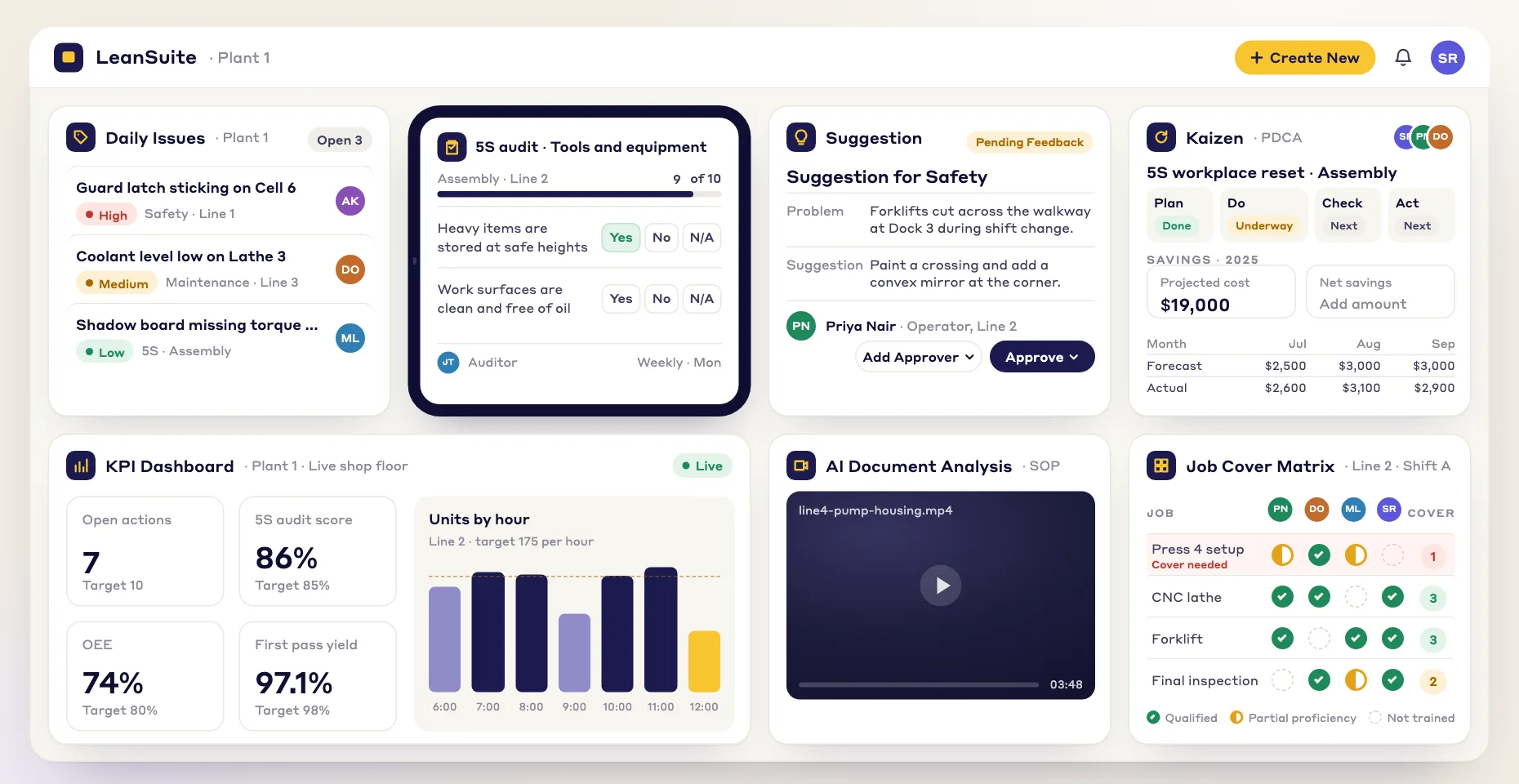
Today’s workforce is constantly evolving. That is to say, employees need continuous learning and performance support to do their job well. But, there’s no need to worry — improve the performance of your frontline workers and reduce the Six Big Losses in lean manufacturing with our connected worker platform. LeanSuite offers a variety of different solutions to help you ultimately accelerate your continuous improvement program:
Idea Management System
Collect suggestions and ideas on improvement opportunities for your shop-floor to minimize some, if not all, of the Six Big Losses in lean manufacturing.
Daily Issue Management System
Use the Daily Issue Management System to tag and quickly close critical problems on your shop-floor, helping you to minimize the Six Big Losses in lean manufacturing as much as possible.
Kaizen and Project Management System
Open a quick or complex Kaizen so that you can simplify, standardize, and spread your best practices to mitigate some, if not all, of the Six Big Losses in lean manufacturing as much as possible.
Free for this topic: Focused improvement 90-day model area plan, Autonomous maintenance (CILR) checklist


