
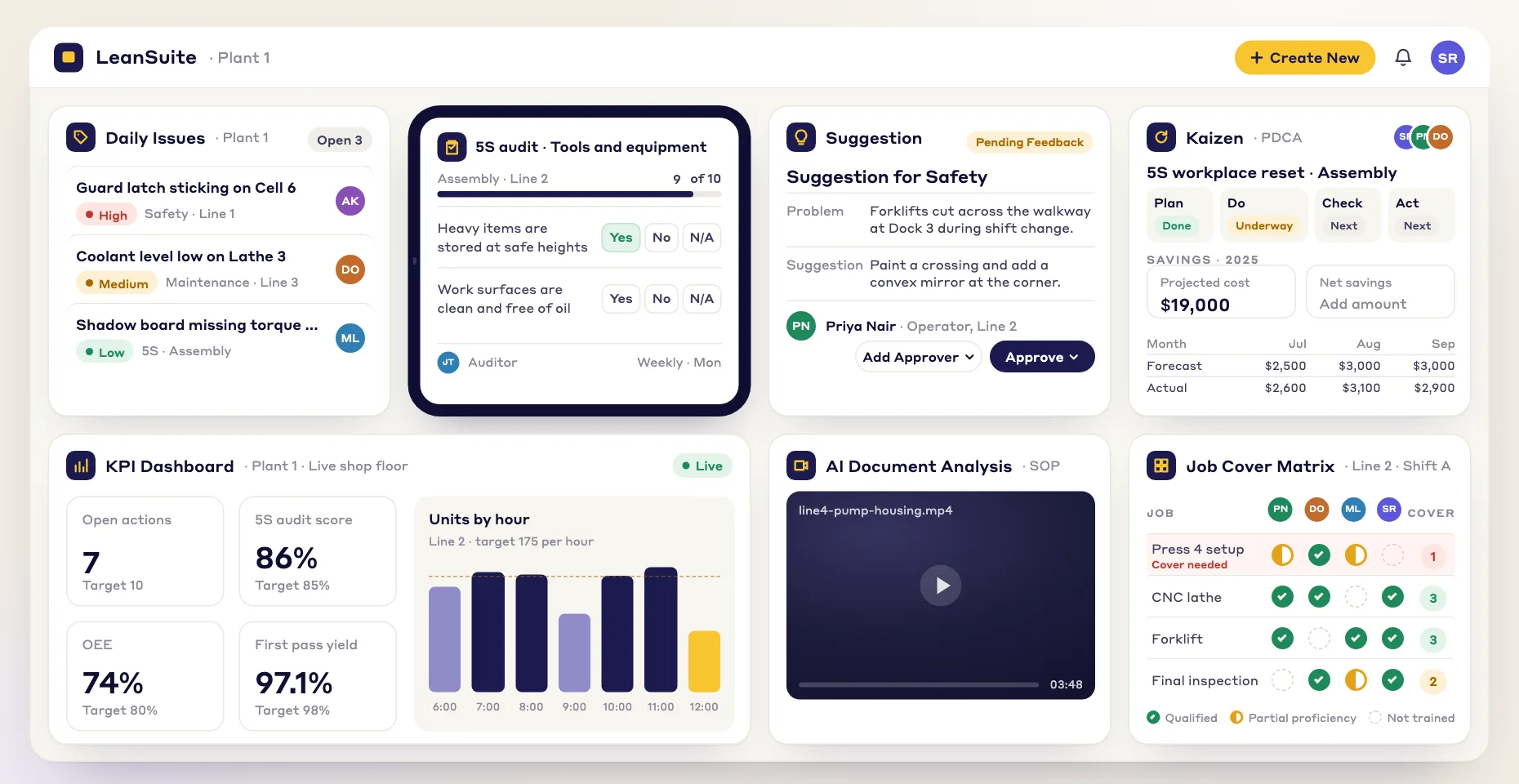



A 5S audit is a structured evaluation of a manufacturing work area against the visual standards established during 5S implementation, producing a numerical score for each of the five steps that tracks compliance trends, identifies gaps, and triggers the corrective actions that prevent the workplace from reverting to its pre-5S condition. The audit is not an inspection. It is the operating mechanism of the Sustain step. Without a structured audit system, 5S implementation produces a result that lasts until the next production crisis overrides the discipline it requires. With it, 5S becomes a permanent operating standard that holds across shifts, leadership changes, and production pressures.
Research confirms the stakes clearly. Facilities that skip monthly 5S scoring see gradual erosion back to baseline conditions within 90 days. Manufacturing plants sustaining structured 5S audits report 30 percent fewer safety incidents and 25 percent faster material retrieval within the first six months compared to pre-5S baseline. The difference between a 5S implementation that compounds and one that fades is almost entirely attributable to audit system discipline, not to the quality of the initial Sort, Set in Order, Shine, and Standardize execution.
The Purpose of 5S Audits and What They Are Not
Understanding what a 5S audit is designed to do, and what it should not be used for, prevents the two most common failures in 5S audit programs: audits that become compliance theater rather than improvement tools, and audits that damage the frontline culture they are meant to sustain.
A 5S audit is designed to:
- Measure the actual workplace condition against the visual standard established in Standardize
- Produce a numerical score that allows trend tracking across weeks and months
- Identify specific findings that require corrective action with defined owners and due dates
- Generate data that leadership can use to prioritize support, training, and resources for areas that are struggling
A 5S audit is not:
- A surprise inspection designed to catch operators not following standards
- A tool for disciplining individuals whose areas score poorly
- A one-time event conducted before leadership visits
- A pass-fail assessment with no corrective action mechanism
Good to Know: The difference between a 5S audit and a gemba walk is one of purpose and output. A gemba walk is observational: its purpose is learning and coaching, and it produces conversations. A 5S audit is evaluative: its purpose is measurement and accountability, and it produces a scored finding record with corrective actions. Both belong in a complete lean management system but they serve different functions. Running gemba walks as if they were audits produces data without insight. Running audits as if they were gemba walks produces conversation without accountability.
Key Insight: A 5S audit measures the gap between the standard and the actual condition. It is not a judgment of the team. It is a measurement of the system.

Designing the 5S Audit Scoring System
The scoring system is the foundation of a functional 5S audit program. A scoring system that is too complex creates auditor inconsistency. One that is too simple produces scores that do not differentiate between areas or track meaningful progress.
The most widely used 5S audit scoring scale assigns 0 to 5 points per audit item:
Score 0: Standard does not exist or area is in total non-compliance.
Score 1: Major non-compliance: standard exists but is almost entirely not followed.
Score 2: Significant non-compliance: standard followed in some areas but not consistently.
Score 3: Partial compliance: standard followed in most areas with notable exceptions.
Score 4: Good compliance: standard followed consistently with minor exceptions.
Score 5: Full compliance: standard followed completely with no deviations observed.
Each of the five S steps receives a set of audit items scored on this scale. The total score across all items produces a percentage that allows comparison across areas, shifts, and time periods. ProjectManager notes that this scale highlights gaps, prioritizes corrective actions, and supports consistent audit reporting across departments.
The audit checklist for each step covers the specific visual standards established in that area's Standardize deliverables:
- Sort items: unnecessary items absent, red-tag area cleared within schedule, only current-run materials present
- Set in Order items: all items in designated locations, shadow boards complete, floor markings intact and legible, labels visible and accurate
- Shine items: equipment surfaces clean, cleaning schedule completed and signed, abnormalities documented and actioned
- Standardize items: photo standard posted and current, 5S map accurate, color code reference displayed
- Sustain items: previous audit corrective actions closed, audit cadence maintained, recognition system active
Key Insight: Score trends matter more than individual scores. A zone improving from 45 to 65 percent over three months is more valuable than a zone holding at 80 percent with no improvement history.
Audit Frequency and the Layered Audit Structure
Audit frequency should match the maturity of 5S practice in each area, not a single plant-wide schedule. Areas in early implementation need more frequent measurement than areas with demonstrated sustained compliance.
The layered 5S audit structure mirrors the layered process audit system covered in Layered Process Audit: The Benefits and Implementation Guide:
Operator self-check (daily): The operator completes a brief self-assessment of their workstation at the start of each shift using a simplified checklist covering the most critical compliance points. This is not a scored audit, it is a daily habit-building activity that reinforces the visual standard and surfaces issues before the supervisor audit.
Supervisor audit (weekly): The direct supervisor conducts a full scored audit of their area using the complete 5S checklist. All findings are documented with scores, photos where deviations are visible, and corrective actions assigned to named owners with due dates. The supervisor audit score is posted in the area for team visibility.
Manager or cross-functional audit (monthly): A department manager or lean coordinator audits the area using the same checklist. Cross-functional audits introduce an independent perspective that catches blind spots the supervisor and team develop from familiarity with their own area. Monthly scores are reviewed in the department management meeting.
Plant-level review (quarterly): Quarterly, all area scores are aggregated and reviewed by plant leadership. Areas with consistently low scores receive focused support. Areas with sustained high scores are recognized and identified as potential sources of best practice for other areas.
This frequency structure produces continuous improvement in audit scores over time. Oxmaint confirms that supervisors who walk the floor with their teams and explain the reasoning behind each standard improve scores 30 percent within two audit cycles, because the audit conversation becomes a coaching activity rather than a compliance check.
Key Insight: Daily self-checks build habits. Weekly supervisor audits create accountability. Monthly cross-functional audits catch blind spots. Quarterly reviews drive recognition and resource allocation.
Writing Effective Corrective Actions from Audit Findings
An audit finding without a corrective action is a documented problem with no path to resolution. The corrective action system is what converts audit scores from data into improvement.
Every finding from a 5S audit requires:
- A specific description of the deviation: not "shadow board non-compliant" but "three tools missing from shadow board at Station 4, no indication of where tools are located"
- A named owner responsible for correcting the finding: not "the team" or "maintenance" but a specific individual
- A due date by which the correction will be completed and verified
- A verification method confirming the finding is closed: photo evidence, re-audit of the specific item, or supervisor sign-off on the corrected condition
Corrective action completion rate is the metric that distinguishes functioning audit programs from paperwork exercises. EviView notes that areas scoring consistently low indicate where targeted training or process changes are needed. The audit finding is not always the operator's failure to follow a standard. Sometimes it is the standard's failure to be practical, visible, or adequately trained.
When the same finding appears in the same area across two or more consecutive audits, the appropriate response is not to assign the same corrective action again. The appropriate response is to investigate why the corrective action is not holding: whether the standard is unclear, the storage solution is impractical, or the operator responsible for maintaining it has not received adequate support.
Key Insight: Recurring findings are not operator discipline failures. They are signals that the standard, the layout, or the training requires improvement.
Evolving the Audit as 5S Matures
A 5S audit program that uses the same checklist at six months as it does at six weeks is not evolving. As areas achieve and sustain high scores, the audit must develop to maintain its value as an improvement tool rather than becoming a scoring exercise with predictable outcomes.
Three mechanisms evolve a maturing 5S audit program:
Raising the standard: When an area consistently scores above 90 percent on the current checklist, the visual standards in Standardize should be updated to reflect an improved expected condition. The photo standard is updated, the checklist reflects the new standard, and the audit resets to measure compliance against the higher bar. This is the mechanism through which 5S compounds over time rather than plateauing.
Shifting audit responsibility: In early 5S, supervisors audit their own areas. As 5S matures, audit responsibility shifts to operators performing peer audits of adjacent areas, and eventually to the area team auditing themselves against the standard. Operator-led audits develop deeper ownership of the standard than supervisor-led audits and are more likely to generate the workstation improvement suggestions that kaizen programs depend on.
Connecting audit findings to improvement projects: High-frequency findings across multiple areas in the same category indicate a systemic condition — a tooling design that makes storage impractical, a material flow pattern that creates clutter, or a cleaning frequency that is too low for the contamination rate. These systemic findings are inputs to the improvement project pipeline covered in Prioritization Matrix in Lean Manufacturing: Impact vs Effort and Running Lean Improvement Projects: From Scope to Verified Results.
Key Insight: A 5S audit that produces the same findings month after month has stopped driving improvement. Evolve the standard, shift the auditor, or investigate the system behind the finding.
Within the Lean System
Connection to Lean Principles
The 5S audit operationalizes the lean principle of perfection by making the gap between the current condition and the standard condition visible and measurable at regular intervals. The 5 Core Principles of Lean Manufacturing positions perfection as the ongoing pursuit of the ideal condition through continuous, incremental improvement. The 5S audit scoring trend is the operational measure of how close each area is to the 5S standard and how quickly it is closing the gap. An area improving its audit score month over month is pursuing perfection in workplace organization. An area holding a static score without improvement has stopped improving and needs intervention to restart the cycle.
Connection to Lean Tools
The 5S audit connects directly to Layered Process Audit: The Benefits and Implementation Guide as a specific application of the layered audit principle. The daily self-check, weekly supervisor audit, monthly cross-functional audit, and quarterly plant review structure mirrors the LPA tier structure exactly. The 5S audit also connects to Kaizen Event Tracking: Status, Roles, and Process Management through the corrective action system: 5S audit findings that recur across areas become kaizen project candidates, and the tracking system that manages kaizen projects is the same infrastructure that can manage 5S corrective action portfolios at scale.
Connection to Continuous Improvement
The 5S audit is the Check phase of the PDCA cycle applied to workplace organization. The PDCA Cycle: The Foundation of Continuous Improvement requires that every improvement be measured after implementation to confirm whether the intended result was achieved and held. The 5S audit performs this measurement for the 5S Implementation: Step-by-Step Workplace Organization Guide's Sort through Standardize results, confirming whether the Sustain step is functioning or whether intervention is needed. The evolution of the audit as 5S matures (raising standards, shifting auditor responsibility, connecting findings to projects) is the Act phase of PDCA applied to the audit system itself: continuously improving the mechanism that drives workplace improvement.
Frequently Asked Questions
What is a 5S audit in manufacturing? A 5S audit is a structured evaluation of a manufacturing work area against visual standards established during 5S implementation, producing numerical scores for Sort, Set in Order, Shine, Standardize, and Sustain that track compliance trends, identify gaps, and trigger corrective actions. It is the operating mechanism of the Sustain step. Without regular audits, 5S implementation results typically erode back to baseline within 90 days.
How often should 5S audits be conducted? 5S audits should follow a layered frequency matched to implementation maturity. Daily operator self-checks build habits. Weekly supervisor audits produce accountability and trend data. Monthly cross-functional audits catch blind spots. Quarterly plant-level reviews drive recognition and resource allocation. Areas in early implementation benefit from more frequent audits. Mature areas can extend intervals while maintaining the layered structure.
How is a 5S audit scored? Most 5S audits use a 0 to 5 scale per item: 0 for total non-compliance, 1 for major non-compliance, 2 for significant non-compliance, 3 for partial compliance, 4 for good compliance with minor exceptions, and 5 for full compliance. Scores across all items produce a percentage that enables comparison across areas and time periods. Trend direction matters more than any single score.
What happens when the same 5S finding recurs across audits? A recurring finding is not an operator discipline problem. It signals that the standard, the physical layout, or the training requires improvement. The correct response is to investigate why the corrective action is not holding rather than reassigning the same action. The finding may indicate that the storage solution is impractical, the cleaning standard is too demanding for the contamination rate, or the visual cue is not visible enough to prompt compliance.
How does a 5S audit differ from a gemba walk? A gemba walk is observational: its purpose is learning and coaching, and it produces conversations. A 5S audit is evaluative: its purpose is measurement and accountability, and it produces a scored finding record with assigned corrective actions. Both belong in a lean management system but serve different functions. Gemba walks without audits produce insight without accountability. Audits without gemba walks produce scores without understanding.
Free for this topic: Gemba walk checklist
Want our lean manufacturing guides first in Google? Add us as a preferred source.
Add LeanSuite as a preferred source on Google (opens in a new tab)


