
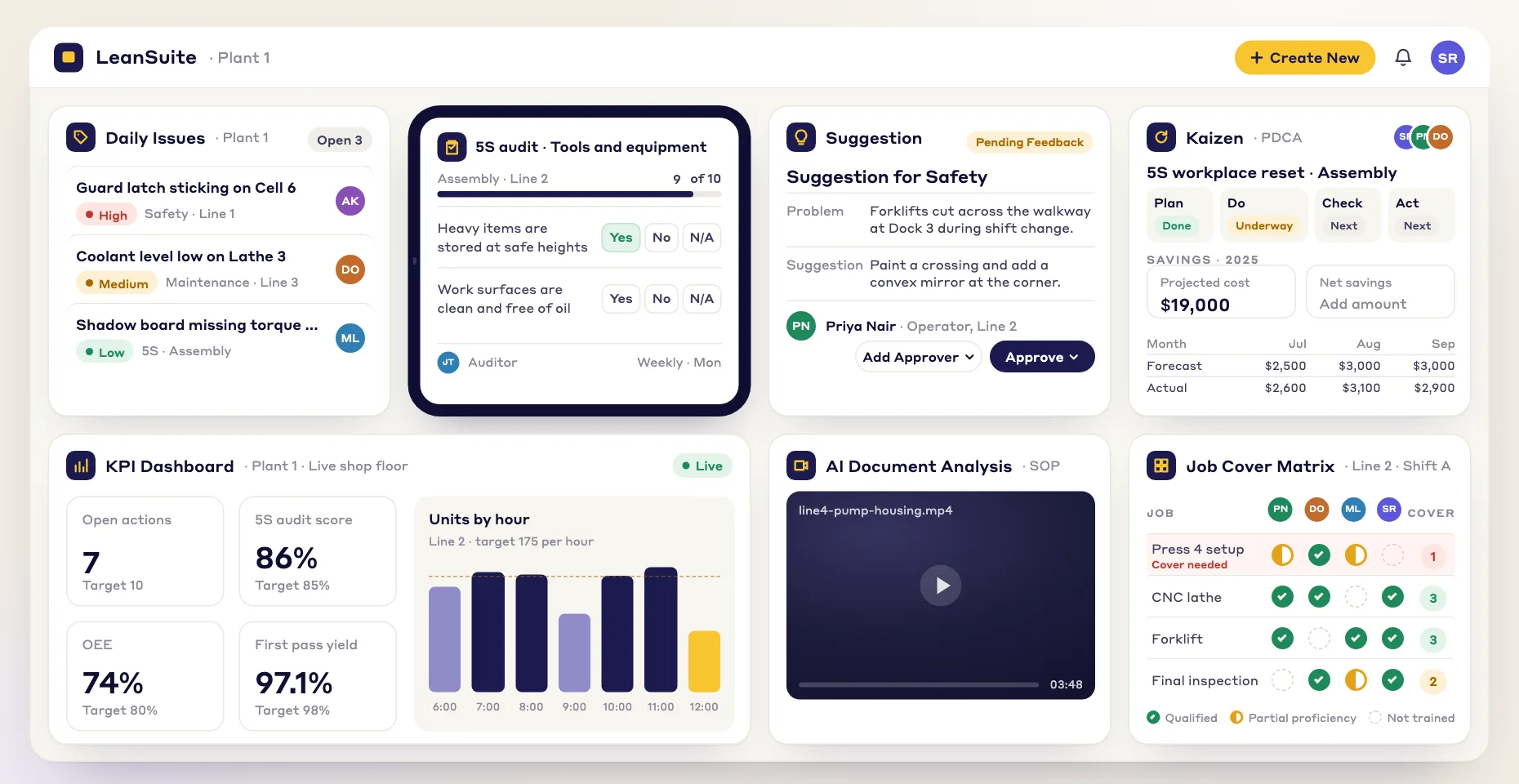



5S implementation is the structured process of applying the Sort, Set in Order, Shine, Standardize, and Sustain methodology to a manufacturing work area in a sequence that builds each step on the foundation the previous one creates. The sequence cannot be reordered. Implementing Standardize before Sort produces visual standards for a disordered workplace. Implementing Shine before Set in Order produces clean clutter. Each step must be completed to a defined standard before the next begins, and the entire implementation must be anchored in a pilot area before expanding plant-wide.
Learn Lean Sigma notes that the most common reason 5S implementations fail is not lack of effort. It is skipping steps or compressing the sequence to produce visible results faster than the discipline can sustain. Physical supplies for a pilot area including floor tape, labels, shadow board materials, red tags, and cleaning supplies typically cost between $2,000 and $5,000. The larger investment is training time and sustained management commitment, both of which the implementation sequence in this guide is designed to make productive from the first week.
Step 1: Select the Pilot Area and Build the Implementation Team
5S implementation begins with scope selection, not with Sort. Attempting plant-wide 5S implementation simultaneously produces inconsistent results and overburdens the teams responsible for sustaining the changes. A well-executed pilot area becomes the internal showcase that demonstrates what 5S produces and builds the organizational confidence to expand.
Pilot area selection criteria:
- High visibility to plant leadership and operators not yet involved in 5S
- Motivated supervisor and team who understand what 5S requires and are willing to lead it
- Representative of the production environment: the pilot should reflect real production conditions, not be chosen because it is already relatively organized
- Contained enough to complete Sort through Standardize within a focused one-week implementation event
The implementation team for the pilot area should include:
- The area supervisor as the primary Accountable owner for the implementation and sustainment
- Two to three operators who work in the area daily and whose participation builds the workstation ownership that Sustain requires
- A lean coordinator or 5S champion who has conducted at least one prior 5S implementation
- A maintenance representative for equipment-related Shine activities and shadow board installation
Good to Know: The pilot area selection decision has a second-order effect that most implementation guides do not address. If the pilot area is chosen because it is the easiest or already the most organized, the results will not demonstrate what 5S can do in a challenging environment. Leadership and operators evaluating the pilot will conclude that 5S only works in favorable conditions. Choose an area representative of the real production environment, and the results will be credible to the entire plant.
Key Insight: A pilot area that represents real production conditions produces results that the rest of the plant believes. An easy pilot produces results nobody trusts.

Step 2: Conduct the Sort Phase and Red-Tag Event
Sort begins with a baseline 5S audit of the pilot area to document the current condition. This audit establishes the before measurement that will be compared against post-implementation results to quantify the improvement. Without a baseline, the results are visible but not measurable.
The red-tag event runs over one to two days with the full implementation team present. Every item in the work area is evaluated against the Sort criterion: is this item needed here, in this quantity, right now? Items that cannot satisfy all three conditions receive a red tag.
Red-tag procedure:
- Create a red-tag register documenting each tagged item with tag number, item description, category, and reason for tagging
- Tag each identified item and move it to the designated local red-tag holding area near the work zone
Hold tagged items for a defined evaluation period, typically 30 days, during which owners can claim needed items with justification
- After the evaluation period, disposition unclaimed items: return to central stores, transfer to another area, repair, or dispose of
- Document all dispositions in the red-tag register for audit trail purposes
The red-tag holding period is not optional. QualityCoach.net notes that skipping the holding period and disposing immediately creates resistance and mistakes. Operators who see items disposed without evaluation lose trust in the process and resist subsequent 5S activities. The 30-day period provides the organizational assurance that necessary items are not accidentally removed.
Key Insight: The 30-day red-tag holding period is not bureaucracy. It is the mechanism that builds operator trust in the Sort process without which Sustain fails.
Step 3: Execute Set in Order With Visual Location Standards
Set in Order begins immediately after the red-tag items have been removed from the work area. The cleared space makes the Set in Order decisions visible. It is significantly easier to assign logical locations for remaining items when the excess has been removed.
Set in Order execution sequence:
- Map the workflow — observe how operators move through the work area, what they reach for most frequently, and what sequence tasks follow. Location decisions should follow workflow logic, not storage convenience
- Assign designated locations — place frequently used items within immediate reach of the work position. Less frequently used items are stored progressively further from the primary work position
- Install shadow boards — create outlines in the shape of each tool on the storage board. Missing tools are immediately visible without counting or searching. DuraLabel recommends vinyl cutouts matching the tool profile for the most precise visual identification
- Apply floor markings — tape or paint defines locations for equipment, carts, WIP zones, and walkways. Color coding assigns consistent meaning: yellow for walkways and traffic lanes, blue or green for storage areas, red for red-tag areas and safety equipment zones
- Label all storage locations — bins, shelves, and drawers are labeled with item name, part number where relevant, and maximum quantity. Labels make the expected content visible to any operator, not just the one who knows the area
The goal of the completed Set in Order is the 30-second rule: any person entering the work area can locate any item within 30 seconds without asking for directions.
Key Insight: Set in Order is complete when any visitor can find any item in 30 seconds. That standard, not the supervisor's satisfaction with the layout, confirms the step is done.
Step 4: Establish Shine Routines and Cleaning Standards
Shine execution in the first implementation is a deep-clean of the entire work area and all equipment. The purpose of this initial deep-clean is not cosmetic. It is to establish the baseline condition that the subsequent daily Shine routine will maintain, and to surface the equipment abnormalities that have accumulated under the layers of production residue.
Initial deep-clean checklist:
- Clean all equipment surfaces, including the undersides of machines, conveyor frames, and equipment legs where contamination accumulates unseen
- Clean all storage areas, shadow boards, and floor marking surfaces to confirm the Set in Order installation is visible and complete
- Inspect all equipment during cleaning for leaks, worn seals, loose fasteners, cracked housings, and unusual wear patterns
- Document all abnormalities found during the Shine activity and assign them to maintenance for corrective action with defined completion dates
Following the initial deep-clean, the Shine routine is documented for the area:
- What surfaces and equipment are cleaned in each routine
- How each item is cleaned: method, materials, and safety requirements
- Who is responsible for each cleaning activity by role
- Frequency: daily, weekly, or monthly depending on contamination rate
The Shine documentation becomes the reference standard that supervisors use during daily management routines to verify compliance. 5S Audits: Conducting Effective Workplace Reviews covers how Shine compliance is measured in the ongoing audit system.
Key Insight: The abnormalities found during the initial Shine deep-clean are the equipment reliability dividend of 5S. Each one prevented is a breakdown avoided.
Step 5: Build the Standardize Infrastructure
Standardize converts the Sort, Set in Order, and Shine results into a defined visual standard that any person entering the work area can verify against the actual condition without judgment or experience. The standard must be visual, not procedural.
Standardize deliverables for each work area:
- Photo standard board posted at the workstation entrance showing the expected condition of all storage areas, shadow boards, floor markings, and equipment surfaces. The photo standard is updated whenever the layout or cleaning requirement changes
5S map showing the floor layout of the area with all designated locations marked — equipment positions, material staging zones, walkway boundaries, and red-tag area
- Cleaning schedule posted in the area with operator name, cleaning task, frequency, and a sign-off column for each shift
- Visual color code reference posted at the area entrance defining the meaning of each floor marking color used in the area
The photo standard is the most critical Standardize deliverable. It establishes what correct looks like in a form that requires no interpretation. A supervisor walking into the area can compare the actual condition against the photo standard in seconds and identify any deviation without asking the area operator for an explanation.
Key Insight: A photo standard eliminates the subjectivity from 5S compliance assessment. Either the area matches the photo or it does not.
Step 6: Build the Sustain Infrastructure Before Expanding
Sustain infrastructure must be in place in the pilot area before the 5S implementation expands to additional areas. Most 5S programs fail at Sustain not because teams lack discipline but because the infrastructure required to hold the standard was never built.
Sustain infrastructure for the pilot area:
- Weekly 5S audit with a structured scoring checklist covering all five steps. The 5S Audits: Conducting Effective Workplace Reviews blog covers audit design, scoring, and corrective action tracking in detail
- Corrective action system that converts audit findings into assigned tasks with owners and due dates — findings without owners are findings that will not be corrected
- Leader standard work that includes a daily 5S observation for the area supervisor and a weekly 5S review for the department manager
- Recognition mechanism that makes 5S performance visible — area scores posted publicly, inter-area comparisons on the department board, acknowledgment of areas sustaining high scores over time
The pilot area Sustain infrastructure is the template that all subsequent areas follow when the implementation expands. Expanding 5S to a second area before the first area has demonstrated sustained compliance at an audit score above 70 percent defeats the purpose of the pilot. The pilot exists to prove that Sustain works, not to produce an impressive week-one photo.
The 5S Methodology: A Complete Guide for Manufacturing covers the full system context for each step. How 5S Creates a More Productive Manufacturing Environment covers the productivity mechanisms that the implementation sequence in this guide is designed to capture.
Key Insight: Expand 5S only after the pilot area demonstrates sustained compliance. A second area launched before the first one holds multiplies the failure risk, not the success rate.
Within the Lean System
Connection to Lean Principles
5S implementation operationalizes the lean principle of flow at the workplace level by systematically removing the physical barriers to uninterrupted production. The 5 Core Principles of Lean Manufacturing identifies flow as dependent on the elimination of waste. The implementation sequence in this guide produces flow by eliminating search waste in Sort, motion waste in Set in Order, equipment downtime in Shine, and standard deviation in Standardize. The pilot-first approach reflects the lean principle of pull: 5S expands to the next area when that area's team pulls it in, not when a central implementation schedule pushes it regardless of readiness.
Connection to Lean Tools
The 5S implementation sequence connects directly to Standard Work in Manufacturing: A Complete Guide through the Standardize and Sustain steps. The photo standard, cleaning schedule, and 5S map produced in Standardize are forms of standard work applied to workplace organization. The audit infrastructure built in Sustain mirrors the layered audit system covered in Layered Process Audit: The Benefits and Implementation Guide. Daily operator self-checks, weekly supervisor audits, and monthly cross-zone reviews reflect the same tier structure. The connection also runs to Total Productive Maintenance: A Complete Manufacturing Guide through the Shine step: the equipment abnormalities found and corrected during implementation are the first autonomous maintenance activities the operator team performs.
Connection to Continuous Improvement
The 5S implementation sequence is the first application of the PDCA Cycle: The Foundation of Continuous Improvement that many manufacturing operators experience directly. The baseline audit is the Plan phase measurement. The Sort through Standardize implementation is the Do phase. The Sustain audit scoring is the Check phase. The corrective actions from audit findings and the layout refinements based on operator feedback are the Act phase: improving the 5S standard itself based on what the audit reveals. Kaizen: The Complete Beginner's Guide to Continuous Improvement positions 5S implementation as the first kaizen activity that operators participate in as authors rather than recipients, making it the entry point for the frontline ownership that sustains continuous improvement programs long-term.
Frequently Asked Questions
How long does 5S implementation take in manufacturing? A pilot area implementation covering Sort through Standardize typically runs over one focused week with the full team dedicated to the area. Sustain infrastructure including the audit system, leader standard work, and recognition mechanism requires an additional two to four weeks to establish and validate. Plant-wide expansion from a proven pilot follows at a pace determined by team availability, typically one to two new areas per month.
What supplies are needed for 5S implementation? A pilot area implementation requires red tags, a red-tag register, floor tape in color-coded variants, label makers and label stock, shadow board materials, cleaning supplies, a camera for photo standard documentation, and audit scoring sheets. Physical supply costs for a pilot area typically range from $2,000 to $5,000. The larger investment is in team time and management attention during implementation and sustain.
How do you select a pilot area for 5S implementation? Select a pilot area that is high-visibility to plant leadership and operators, has a motivated supervisor and team, and is representative of real production conditions rather than the easiest area available. A pilot in a representative area produces results that the rest of the plant believes. A pilot in an already-organized area produces results that generate the objection that 5S only works in favorable conditions.
Why must 5S steps be completed in sequence? Each step builds the foundation the next requires. Sort removes the unnecessary items that would make Set in Order location decisions arbitrary. Set in Order establishes the location standards that Shine maintains through cleaning. Shine establishes the baseline condition that Standardize defines as the visual standard. Standardize defines the expected condition that Sustain's audit system measures compliance against. Skipping any step means the following step operates without its required foundation.
When should 5S expand from the pilot area to the rest of the plant? Expand 5S to additional areas only after the pilot area has demonstrated sustained compliance at an audit score above 70 percent for a minimum of 30 days. Expansion before sustained compliance is confirmed multiplies the failure risk because the Sustain infrastructure has not been proven. The pilot area's sustained results also provide the internal evidence that builds organizational confidence in the methodology before committing additional resources.
Free for this topic: Gemba walk checklist
Want our lean manufacturing guides first in Google? Add us as a preferred source.
Add LeanSuite as a preferred source on Google (opens in a new tab)


