



Real-time metrics are the measurements of a Kaizen event's results, such as OEE, defects per hour and cycle time, that are captured and displayed during the shift instead of compiled in a spreadsheet days later. Five low-tech methods do the job without new software: floor boards, mobile pulse checks, before and after timing, leaderboards and threshold alerts.
Let's turn raw data into daily decisions that stick. Imagine operators glancing at a board, spotting trends mid-shift, and adjusting on the fly. That's the power of real-time metrics done right.
- Method: Visual floor boards
- Four KPIs (OEE, defects per hour, cycle time, uptime); red and green magnets updated each shift in a 2-minute huddle; a daily photo to leadership
- Method: Mobile pulse checks
- A 3-tap survey (time saved, issues fixed, ideas); timestamp in phone notes or a form; hourly roll-up huddles
- Method: Before and after process timing
- Day 1 baseline of 20 full cycles; daily re-measure in a running tally; a hand-drawn bar chart of the gains
- Method: Gamified leaderboards
- Points for beating targets and for implemented ideas; a live whiteboard ranking; weekly coffee cards or shoutouts
- Method: Threshold alerts
- A red-line rule such as OEE under 85%; a 5-minute huddle to assign fixes; log every resolution for the weekly review
| Method | Setup in brief |
|---|---|
| Visual floor boards | Four KPIs (OEE, defects per hour, cycle time, uptime); red and green magnets updated each shift in a 2-minute huddle; a daily photo to leadership |
| Mobile pulse checks | A 3-tap survey (time saved, issues fixed, ideas); timestamp in phone notes or a form; hourly roll-up huddles |
| Before and after process timing | Day 1 baseline of 20 full cycles; daily re-measure in a running tally; a hand-drawn bar chart of the gains |
| Gamified leaderboards | Points for beating targets and for implemented ideas; a live whiteboard ranking; weekly coffee cards or shoutouts |
| Threshold alerts | A red-line rule such as OEE under 85%; a 5-minute huddle to assign fixes; log every resolution for the weekly review |
Method #1: Visual Floor Boards for Instant Visibility
Paper logs gather dust while production lines grind non-stop, but physical or digital floor boards bring metrics to life right where the action happens. This low-tech powerhouse transforms abstract numbers into something operators can touch, move, and own. Teams that see their OEE climb from red to green mid-shift don't just report data—they live it, sparking ownership that spreadsheets never could.
Quick Setup Steps:
- Select 4 core KPIs: OEE, defects per hour, cycle time, and uptime—keep it laser-focused.
- Use magnets or sticky notes: Red for issues, green for wins, updated every shift in 2-minute huddles.
- Photo-share daily: Snap progress pics sent straight to leadership via group chat for instant buy-in.
Method #2: Mobile Pulse Checks Mid-Event
End-of-day reports capture yesterday's news, but the real magic happens mid-shift when operators spot a cycle time drop or defect pattern emerging. Mobile pulse checks turn phones into real-time data capture devices, letting you catch gains as they unfold and pivot before problems compound. This keeps energy high and proves Kaizen's impact while it's still fresh.
Quick Setup Steps:
- Launch a 3-tap survey: "Time saved today? Issues fixed? Ideas sparked?"
- Timestamp everything using phone notes, Google Forms, or a shared notepad app.
- Hourly roll-up huddles: Quick voice review reveals trends faster than any spreadsheet could.
Think of it as the shop floor's heartbeat monitor—small inputs, massive insights.
Method #3: Before/After Process Timing
Vague "it feels faster" claims crumble under scrutiny, but hard before/after numbers silence every doubter and light up ROI discussions. By timing key processes live from day one, you baseline reality then watch improvements stack up visually. This method turns skeptics into evangelists when they see the math: 15% faster cycles = thousands in monthly savings.
- 1Before
Day 1 baseline
Stopwatch 20 full cycles and calculate the average - 2Daily
Daily re-measure
Time the same process and log variances in a simple running tally - 3After
Show the gain as dollars saved
A hand-drawn bar chart shows % improvement = dollars saved
The post's point: hard before and after numbers silence "it feels faster" claims.
Quick Setup Steps:
- Day 1 baseline: Stopwatch 20 full cycles, calculate the average.
- Daily re-measure: Same process, log variances in a simple running tally.
- Visualize gains: Hand-drawn bar chart shows "% improvement = dollars saved."
Numbers don't lie. Your event's story tells itself.
Method #4: Gamified Leaderboards
Dry metrics bore even the most dedicated teams, but gamified leaderboards turn tracking into friendly competition that fuels sustained engagement. Operators chase points for fixes and ideas, creating a viral energy where data entry feels like winning.
Quick Setup Steps:
- Simple point system: +15 points for beating metric targets, +25 for implemented ideas.
- Live whiteboard ranking: Update after every break to keep the buzz alive.
- Weekly rewards: Coffee cards or shoutouts for top teams—motivation on a budget.
Competition uncovers hidden potential. Spreadsheets can't compete with that thrill.
Method #5: Threshold Alerts (Low-Tech Version)
Silent failures sneak up and erase gains overnight, but threshold alerts flag drops the moment they happen, triggering instant fixes. Whether it's a buzzer for OEE dips or a visual alarm, this keeps your Kaizen event proactive rather than reactive. Patterns emerge in days, not weeks.
Quick Setup Steps:
- Define red-line rules, for example OEE under 85% triggers an audible or visual alert.
- Immediate 5-minute huddle: Assign fixes on the spot.
- Log every resolution: Weekly review spots recurring culprits.
Common Pitfalls to Dodge:
- Metric overload: Max out at 5 KPIs or analysis paralysis kicks in.
- Skipping Day 1 baselines: Without them, gains dissolve into "guesses."
- Ignoring soft metrics: Morale and engagement decide whether the gains last.
- Bonus Win: Layer issue tagging atop metrics to uncover root causes automatically.
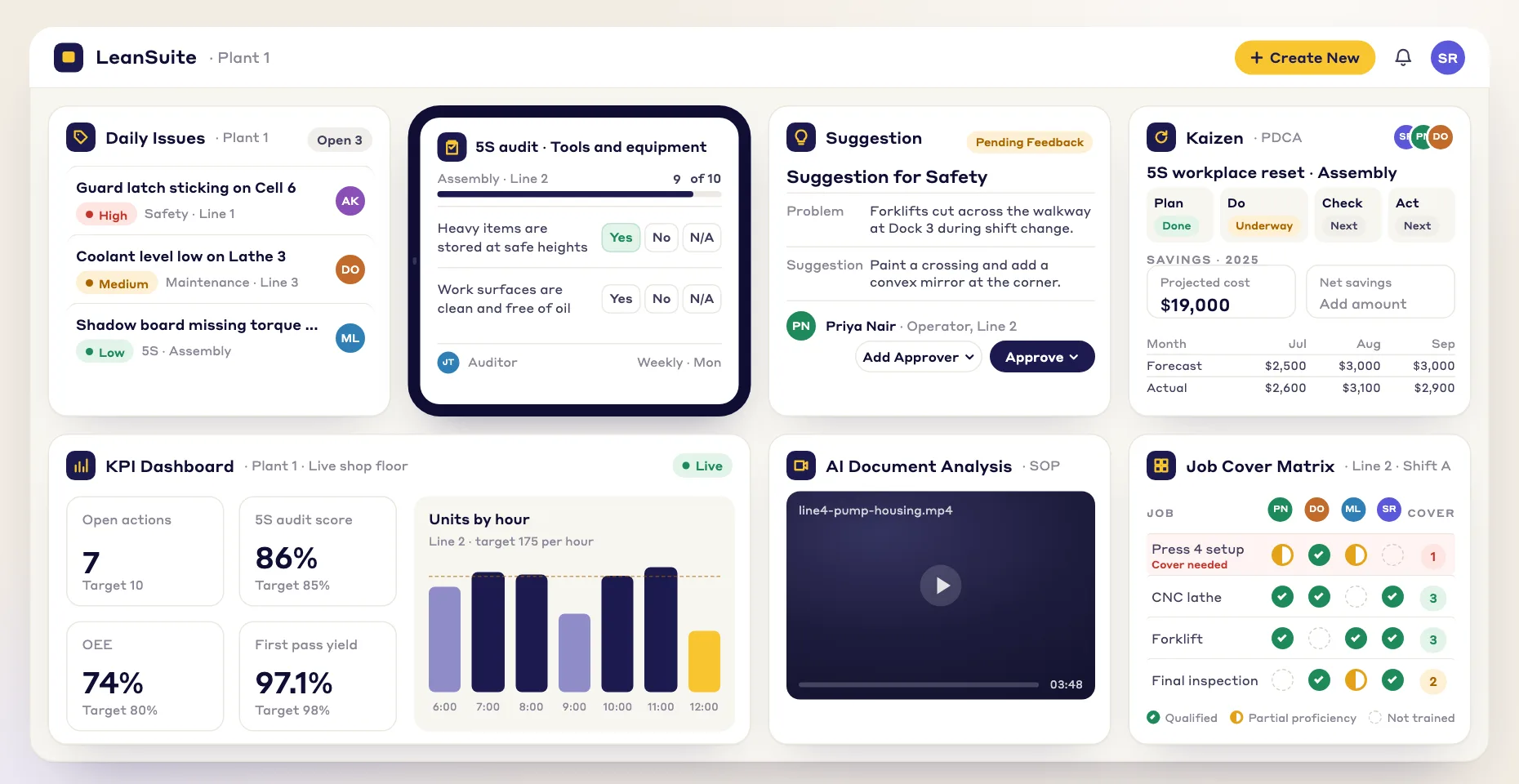
Live metrics don't just track Kaizen—they make it addictive, embedding continuous improvement into your factory's DNA. Pro Tip: Scale this effortlessly with purpose-built tools like LeanSuite's Kaizen Module. It keeps each kaizen’s action plan, owners and results in one place, so the gains stay visible after the event.
Choose one method today. Deploy it Monday. What's currently killing your Kaizen tracking? Share your biggest headache below—we're all in this together!
Cap the KPIs at five
More brings analysis paralysis
Take the Day 1 baseline
Without it, gains dissolve into guesses
Watch soft metrics too
Morale and engagement carry the gains long term
Tag issues alongside metrics
Recurring culprits and root causes show up
Frequently Asked Questions
How do you track Kaizen results in real time without software?
Use a floor board, physical or digital, that shows a few core KPIs such as OEE, defects per hour, cycle time and uptime right where the work happens. Mark issues in red and wins in green with magnets or sticky notes, update it every shift in a short huddle, and photograph it daily for leadership. Operators who watch their numbers move during the shift own the result in a way a spreadsheet never produces.
What is a mobile pulse check during a Kaizen event?
A mobile pulse check is a very short survey operators answer on their phones mid-shift: time saved today, issues fixed, ideas sparked. Everything is timestamped in phone notes, a form or a shared notepad app, and the team reviews the trend in quick hourly huddles. It catches gains and emerging defect patterns while they are happening rather than in an end-of-day report that describes yesterday.
How do you prove a Kaizen event saved time?
Time the process before you change anything. On day one, stopwatch a set of full cycles and work out the average. Re-measure the same process daily and log the variance in a running tally. Then draw a simple bar chart that turns the improvement into dollars saved. Hard before and after numbers end the arguments about whether it feels faster and give the ROI discussion something to stand on.
How do gamified leaderboards help a Kaizen event?
They turn tracking into friendly competition. Operators earn points for beating metric targets and more for ideas that get implemented, a whiteboard ranking is updated after every break, and the top team gets a small weekly reward such as coffee cards or a public shout-out. Data entry starts to feel like winning, which keeps engagement up for the length of the event.
What are the common mistakes when tracking Kaizen metrics?
Tracking too many KPIs, which leads to analysis paralysis; cap the list at a handful. Skipping the day one baseline, which turns every gain into a guess. Ignoring soft metrics such as morale and engagement, which decide whether improvements last. Letting metrics lag behind the floor, which is how hard-won gains fade into memory. Threshold alerts, such as a buzzer when OEE dips below a red line, keep the event proactive.
Free for this topic: Kaizen event charter template, RACI matrix template, Kaizen savings calculator
Want our lean manufacturing guides first in Google? Add us as a preferred source.
Add LeanSuite as a preferred source on Google (opens in a new tab)


