
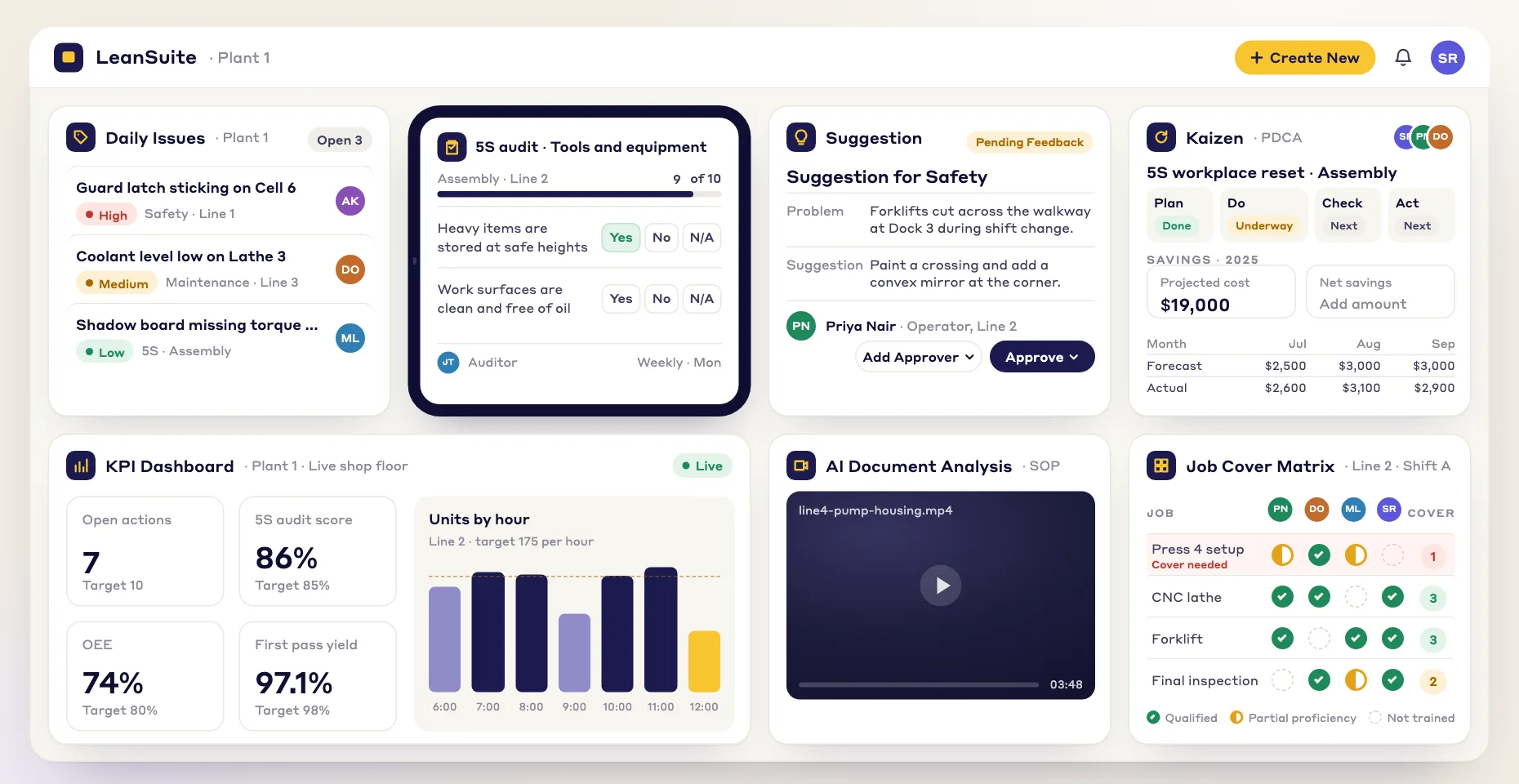



Kaizen (改善) is a Japanese manufacturing philosophy meaning "change for the better," which in practice refers to the systematic, ongoing improvement of processes, quality, and workplace conditions through the participation of every person in the organization. The term combines the Japanese words kai (change) and zen (good), and it functions not as a project methodology but as a management system that runs continuously across all levels of the production environment. Manufacturing organizations that treat kaizen as a discrete program, launching it with training, running a few events, and then stepping back, invariably find that improvement activity slows, gains erode, and the workforce returns to previous operating patterns within months.
The distinction between kaizen as a program and kaizen as a philosophy carries real operational consequences. A program has a start date, a champion, and an end. A philosophy has no end. It changes how production supervisors observe their lines, how operators report problems, and how managers allocate attention during gemba walks. Organizations that establish kaizen as a philosophy achieve the compounding improvement effect the Toyota Production System was designed around. Taiichi Ohno, the architect of that system, stated directly that there can be no kaizen without a standard, meaning that improvement requires a defined baseline against which change can be measured and validated.
Understanding kaizen fully requires examining its origins, its structural requirements, the different improvement scales it encompasses, and the tools that translate philosophy into daily operational practice. This guide covers each of those dimensions and links to the dedicated cluster blogs for deeper coverage of each component.
The Origins of Kaizen and Why They Matter for Manufacturing
Kaizen did not originate in a consulting firm or a business school. It emerged from the post-World War II rebuilding of Japanese manufacturing, specifically from industrialization programs that transferred quality and improvement practices to the factory floor in ways that large-batch Western manufacturing had never systematized.
From Post-War Japan to the Toyota Production System
The formal development of kaizen as a management approach is attributed to Masaaki Imai, whose 1986 book Kaizen: The Key to Japan's Competitive Success introduced the concept to Western audiences. The underlying practices, however, were operational at Toyota and its supplier base decades earlier. The Toyota Production System: A Complete Guide treats kaizen not as one tool among many but as the mechanism through which the entire system evolves. Standardized work establishes the current best method, and kaizen improves it. That cycle, standardize and then improve the standard repeats indefinitely.
Why the Origins Define the Deployment Model
The manufacturing context from which kaizen emerged shapes how it must be deployed. It was designed for environments where production workers perform repetitive, observable tasks with measurable outputs. The improvement opportunities are visible to anyone standing on the shop floor with sufficient time, training, and authority to act. This is why kaizen places frontline workers at the center of improvement activity rather than at the periphery. Lean Enterprise Institute research consistently shows that organizations which involve frontline operators directly in improvement work generate more sustainable gains than those that assign improvement responsibility exclusively to engineers or continuous improvement specialists.
Key Insight: Kaizen originated on the production floor, not in management meetings, and deployment models that ignore that origin fail to activate the system's full capacity.
The Five Elements of Kaizen: Structural Requirements for a Functioning System
Kaizen does not function through goodwill or enthusiasm alone. Five structural conditions must exist simultaneously for improvement activity to sustain itself beyond an initial launch period. Each element is covered in full in The Five Elements of Kaizen in Manufacturing.
Teamwork as the Operating Unit
Kaizen improvement happens at the team level, not the individual level. A team shares a process, observes the same problems, and owns the same outcomes, and cross-functional participation surfaces causes that single-discipline analysis consistently misses.
Personal Discipline as the Operating Standard
Personal discipline refers to the consistent application of agreed standards by every member of the team, every shift, without supervision. Without it, improvement baselines drift and new standards erode before the next improvement cycle begins.
Improved Morale as the Participation Signal
Morale in the kaizen context is not a sentiment, it is a measurable signal. When operators see their suggestions implemented and their observations acted on, participation increases. When contributions go unacknowledged, participation drops and the improvement pipeline dries up.
Quality Circles as the Problem-Solving Structure
Quality circles are small, stable teams of operators and supervisors who meet regularly to identify, analyze, and resolve production problems within their area of authority. Quality Circles: Team-Based Problem Solving in Manufacturing covers circle structure, meeting cadence, and facilitation approach in detail.
Suggestions for Improvement as the Input Mechanism
The suggestion mechanism converts frontline observation into recorded improvement activity. Kaizen Teian: Individual Improvement Suggestions covers the full submission-to-implementation process. The critical design requirement is response speed: systems that do not acknowledge and act on submissions quickly destroy participation motivation, and Toyota's suggestion system at its Takaoka plant historically processed tens of thousands of suggestions per year with the majority implemented within days.
Key Insight: The five elements of kaizen are structural requirements, not cultural aspirations. Organizations missing any one of them will find improvement activity sporadic and unsustainable.
Types of Kaizen: Matching the Improvement Scale to the Problem
Kaizen operates across a spectrum of improvement scales, from micro-level daily observations that individual operators act on immediately, to structured multi-day improvement events that reorganize entire production areas. Understanding the difference between these scales and knowing when to deploy each is a prerequisite for effective improvement program management.
- Scale: Daily kaizen
- What it involves:Operators or supervisors in their own area, e.g. repositioning a tool
- Time and resources:Same day or same shift, no approval
- Use it when:The fix is within your own authority
- Scale: Kaizen event
- What it involves:Cross-functional team maps, tests countermeasures, implements
- Time and resources:Three to five days
- Use it when:A defined process problem needs a team
- Scale: Kaikaku
- What it involves:Radical redesign: layout, new equipment, workflow
- Time and resources:Significant resource investment
- Use it when:Incremental change cannot close the performance gap
| Scale | What it involves | Time and resources | Use it when |
|---|---|---|---|
| Daily kaizen | Operators or supervisors in their own area, e.g. repositioning a tool | Same day or same shift, no approval | The fix is within your own authority |
| Kaizen event | Cross-functional team maps, tests countermeasures, implements | Three to five days | A defined process problem needs a team |
| Kaikaku | Radical redesign: layout, new equipment, workflow | Significant resource investment | Incremental change cannot close the performance gap |
Three primary scales of kaizen activity apply in manufacturing environments.
- Daily kaizen: Small, immediate improvements made by operators or supervisors within their own area of authority. No approval process required. Implementation is same-day or within the same shift. Examples include repositioning a tool, adjusting a label, or standardizing a micro-sequence that had drifted.
- Kaizen events (kaizen blitz): Focused, structured improvement workshops lasting three to five days. A cross-functional team concentrates on a defined process problem, maps the current state, develops and tests countermeasures, and implements changes before the event closes. Kaizen Events: Planning and Execution Guide covers the full planning and execution process.
- Kaikaku: Radical process redesign requiring significant resource investment, often involving layout changes, new equipment, or fundamental workflow restructuring. Kaikaku is not everyday improvement. It is used when incremental change cannot bridge the performance gap.
Types of Kaizen: From Daily Improvements to Radical Transformation provides the full spectrum analysis with selection criteria for each type.
Key Insight: Deploying kaizen events as the default improvement mechanism while neglecting daily kaizen produces visible activity without the cultural depth that sustains long-term gains.
Kaizen Tools: The Operational Mechanisms of Continuous Improvement
Kaizen philosophy requires structured tools to convert intention into measurable operational change. Four tools form the core operating kit of any kaizen system.
PDCA: The Improvement Cycle
Plan-Do-Check-Act (PDCA) is the scientific method applied to manufacturing improvement. Every kaizen activity, from a five-minute operator adjustment to a five-day event, follows the PDCA structure even when that structure is informal. The cycle begins with a clear problem statement and a testable hypothesis about what will resolve it (Plan), moves through a controlled implementation (Do), evaluates actual results against the expected outcome (Check), and either standardizes the improvement or returns to Plan with new information (Act). PDCA Cycle: The Foundation of Continuous Improvement covers the full cycle structure and how PDCA integrates with kaizen events and daily improvement routines.
Plan
Clear problem statement and a testable hypothesis for the fix
Do
Controlled implementation
Check
Actual results against the expected outcome
Act
Standardize the improvement, or back to Plan with what was learned
The same cycle runs for a five-minute adjustment and a five-day event.
The 5 Whys
The 5 Whys method drives iterative root cause investigation by asking why a problem occurred, then asking why again about the answer, repeating until the systemic cause becomes visible rather than the surface symptom. It is the primary problem analysis tool for daily kaizen and quality circle problem-solving. What is the 5 Whys Root Cause Analysis Method? covers the technique and its limitations in detail.
Yokoten: Spreading What Works
Improvements that remain confined to the area where they were developed contribute a fraction of their potential value. Yokoten (横展), horizontal deployment, is the disciplined process of identifying improvements worth spreading, documenting them as new standards, and transferring them to other lines, shifts, or facilities where the same process runs. Yokoten: Horizontal Deployment of Kaizen Best Practices covers the document-share-implement-standardize sequence in full. Without yokoten, organizations repeatedly solve the same problems in different areas rather than compounding their improvement returns.
Kaizen Event Tracking
Improvement activity without formal tracking produces anecdotal evidence rather than organizational knowledge. Kaizen Event Tracking: Status, Roles, and Process Management covers the status fields, team role assignments, and multi-event management processes that convert improvement activity into a visible, managed portfolio.
Key Insight: PDCA without yokoten solves problems locally. Yokoten without PDCA spreads solutions of unverified quality. Both tools are required for kaizen to compound value across the organization.
Building a Kaizen Culture: What Sustained Improvement Actually Requires
Research published in peer-reviewed manufacturing journals consistently identifies the same gap between kaizen launch and kaizen sustainment. A 2024 study examining kaizen implementation across multiple manufacturing facilities found significant improvements in cycle time reduction and defect rates during active implementation phases, with gains correlating directly to the depth of management involvement and the consistency of the suggestion system response process. Organizations that achieved and maintained those gains shared three operational characteristics.
The three characteristics that distinguish sustained kaizen cultures from failed programs are:
- Leadership presence at the gemba. Plant managers and production directors who conduct regular structured gemba walks create the conditions under which frontline improvement is taken seriously. Kaizen systems that exist only in conference rooms and tracking spreadsheets disconnect from the production reality they are supposed to improve.
- Fast suggestion response cycles. Improvement submissions that disappear into an approval queue without visible feedback destroy participation motivation. The suggestion-to-response window, covering acknowledgment, evaluation, decision, and feedback to the submitter, must be short enough that operators experience the system as responsive rather than as performative.
- Standardization as the output of every improvement. Improvements that are not captured in standardized work revert to previous practice through the natural variation of shift changes, personnel turnover, and memory drift. Every kaizen improvement that passes verification must update the relevant standard or it does not become organizational knowledge.
Key Insight: Kaizen culture is built through operational systems, fast suggestion response, leadership gemba presence, and disciplined standardization, not through posters, slogans, or annual training sessions.
- Start date, a champion and an end
- Improvement assigned to specialists
- Suggestions wait in an approval queue
- Gains revert once attention moves on
- No end date
- Every employee improves their own work
- Fast response to every suggestion
- Leaders present at the gemba
- Every verified improvement updates the standard
Within the Lean System
Connection to Lean Principles
Kaizen operationalizes the fifth lean principle: pursuit of perfection. The first four lean principles, defining value, mapping the value stream, creating flow, and establishing pull, create the conditions under which waste becomes visible. Kaizen is the mechanism through which that visible waste is systematically eliminated, moving the production system incrementally closer to the ideal state described in 5 Core Principles of Lean Manufacturing.
Connection to Lean Tools
Kaizen connects to lean tools in both directions, drawing on some to identify improvement targets and feeding others with improvement outputs. Value Stream Mapping: A Beginner's Complete Guide surfaces the process gaps and waste concentrations that kaizen events then target; the kaizen burst symbol on a value stream map is a direct instruction to apply kaizen activity to that point in the flow. 5S Methodology: A Complete Guide for Manufacturing provides the workplace organization baseline that makes abnormalities visible and improvement activity more productive, because kaizen cannot systematically improve what operators cannot clearly observe. Standardized work provides the baseline that every kaizen improvement measures against and updates, and without it, improvement gains have no stable reference point to build from. Poka-Yoke: Error Proofing Methods in Manufacturing frequently implements the physical solutions that kaizen root cause analysis identifies, converting the improvement finding into a permanent defect prevention device.
Connection to Continuous Improvement
Kaizen is both a tool within continuous improvement and, in lean manufacturing, a near-synonym for it. The PDCA Cycle: The Foundation of Continuous Improvement provides the scientific iteration structure through which every kaizen activity, regardless of scale, is designed, tested, and verified. Yokoten ensures that improvements compound across the organization rather than remaining isolated at the point of origin, which is the mechanism that converts individual kaizen events into organization-wide capability growth.
Frequently Asked Questions
What is kaizen in manufacturing? Kaizen is a Japanese manufacturing philosophy meaning "change for the better" that drives continuous, incremental improvement through the participation of all employees. It combines daily small improvements, structured improvement events, and a suggestion system to systematically eliminate waste, reduce defects, and improve process performance across every level of the production organization.
How is kaizen different from a one-time improvement project? A kaizen project has a defined end; kaizen as a management philosophy has no end. One-time improvement projects assign improvement responsibility to specialists and close when deliverables are complete. Kaizen distributes improvement responsibility to every employee on an ongoing basis, creating compounding gains rather than point-in-time changes that erode once project attention moves elsewhere.
Why do most kaizen programs fail to sustain results? Most kaizen programs fail because they are deployed as programs rather than as management systems. The three most common failure modes are slow or absent suggestion response processes that kill operator participation, lack of leadership presence at the gemba that signals improvement is optional, and failure to update standardized work after improvements are made, which causes gains to revert through normal operational variation.
What is the difference between daily kaizen and a kaizen event? Daily kaizen refers to small, immediate improvements that operators or supervisors make within their own process authority, typically same-day implementation with no formal approval required. A kaizen event is a structured three-to-five-day workshop where a cross-functional team concentrates on a defined process problem, maps the current state, tests countermeasures, and implements changes within the event window.
What tools does kaizen use in manufacturing? The core kaizen tool set includes the PDCA cycle for structured improvement iteration, the 5 Whys for root cause investigation, value stream mapping for identifying improvement targets, 5S for workplace organization, standardized work for capturing improvement outputs, and yokoten for spreading validated improvements horizontally across the organization.
Free for this topic: Kaizen event charter template, RACI matrix template, Kaizen savings calculator


