
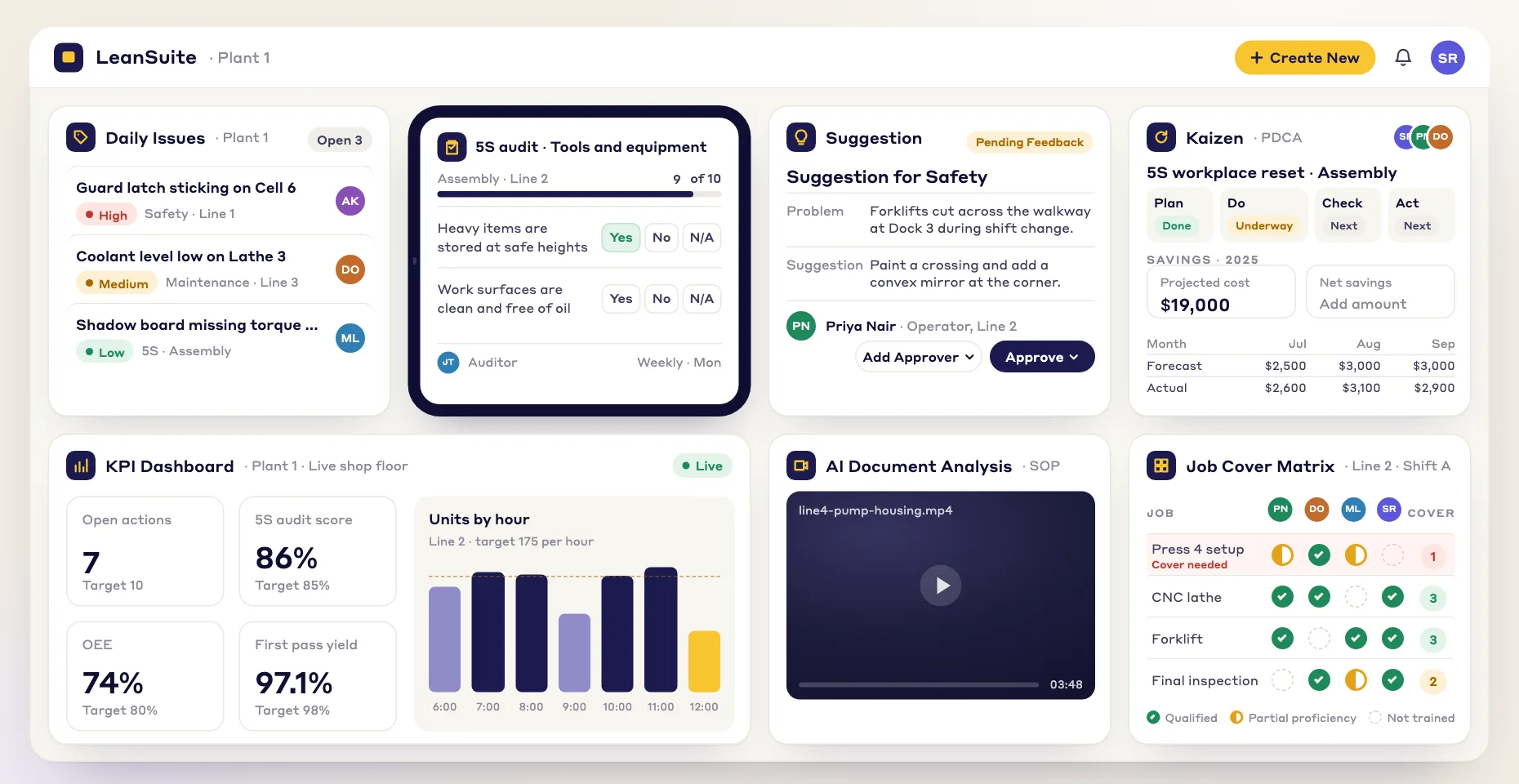



Real-time production tracking closes the gap between what an ERP system planned and what the production floor is actually delivering by capturing, displaying, and acting on production data as it is generated rather than after it has been compiled into a report. A line running at 70 percent efficiency for six hours surfaces that deficit in a real-time system within minutes, while there is still time to intervene and recover the shift. In a report-based system, the same information arrives hours after the production decisions that could have changed the outcome were no longer available.
Most manufacturing organizations have a version of this gap. Production schedules exist. Shift reports exist. The information that connects what was scheduled to what was produced arrives hours after the production decisions that could have changed the outcome were no longer available. A line running at 70 percent efficiency for six hours before the deficit appears in a report has already lost the output. A real-time tracking system surfaces the same information within minutes of the condition developing, while there is still time to intervene and recover the shift.
This guide covers how real-time production tracking works, what it measures, what it replaces, and how manufacturing organizations implement it without disrupting current operations.
What Real-Time Production Tracking Actually Measures
Real-time production tracking is not simply displaying more data faster. It is measuring the right combination of production variables at the right frequency to enable decisions during the shift rather than after it. Three metric categories together provide the operational picture that real-time tracking makes visible.
Output Rate vs Target Rate
The most fundamental real-time production metric is the current output rate compared to the target rate for the active production order. This comparison, updated continuously rather than at shift end, tells supervisors immediately whether the line is ahead, on track, or falling behind the planned schedule.
The value of this metric is not in the number itself but in the timing of its visibility. A line producing at 85 percent of target rate is not an emergency at 7 AM. It becomes one by 11 AM if the gap has not been addressed. Real-time visibility of that gap at 7 AM gives the supervisor four hours to investigate and correct. A shift report showing the same gap at 6 PM gives them nothing except a record of what happened.
OEE: Availability, Performance, and Quality
Overall Equipment Effectiveness, or OEE, is the gold standard metric for manufacturing productivity and the metric most directly transformed by real-time tracking. Industry research consistently identifies OEE as the essential benchmarking metric for manufacturing, measuring three simultaneous dimensions: availability, which captures unplanned downtime; performance, which captures speed losses and minor stops; and quality, which captures the proportion of output that meets specification on the first pass.
Calculated from shift-end data, OEE tells a plant manager what the efficiency was. Calculated in real time, OEE tells the supervisor what the efficiency is right now, which specific loss category is driving it, and whether the current trajectory will meet the shift target. That shift in tense, from was to is, is the operational difference between a lagging indicator and an actionable one.
Downtime Events and Reason Codes
Real-time tracking captures downtime events at the moment they occur and, critically, prompts operators to assign reason codes at the point of the event rather than reconstructing the reason from memory at shift end. This distinction matters enormously for the quality of improvement data the system produces.
A downtime event coded as "machine stopped" at shift end is an incomplete record. A downtime event coded at the moment of occurrence with a specific reason: changeover overrun, material shortage, tooling failure, or quality hold, is an improvement input. Research on manufacturing production intelligence consistently identifies the execution gap as not a data problem but a decision problem, and real-time reason coding as the mechanism that converts raw stop events into actionable root cause information.
Key Insight: Real-time production tracking measures output vs target, OEE components, and reason-coded downtime events simultaneously. Each metric is only actionable when it is current.

Why Shift Reports Cannot Replace Real-Time Tracking
Shift reports are the dominant production tracking mechanism in manufacturing organizations that have not yet implemented real-time systems. Understanding why they fail at the operational task they are supposed to perform clarifies exactly what real-time tracking replaces and why the replacement matters.
The Structural Delay Problem
A shift report compiled at shift end and reviewed at the start of the next shift contains information that is between 8 and 16 hours old by the time anyone acts on it. Production decisions made on that information are decisions made about conditions that no longer exist. The shift that underperformed has ended. The operators who experienced the issues are off the floor. The specific conditions that caused the losses may have already self-resolved or may have worsened.
This structural delay is not a failure of the report or the people compiling it. It is an inherent property of any system that aggregates information at the end of a production cycle. The delay cannot be reduced by improving the report format, writing better summaries, or holding more disciplined shift handover meetings. It can only be eliminated by capturing and displaying information as it is generated.
The Aggregation Loss Problem
Shift reports compress production data into summaries. Summaries necessarily discard the detail that makes information actionable. A report showing average efficiency of 78 percent across a shift hides the distribution: whether efficiency was consistently at 78 percent throughout, whether it was 95 percent for the first six hours and dropped to 45 percent in the final two, or whether it varied by line with one running at 90 percent and another dragging the average down from 65 percent.
Each of these scenarios represents a different operational problem requiring a different response. The summary does not distinguish between them. Real-time tracking preserves the distribution, making the pattern visible alongside the average and enabling the specific response each pattern warrants.
The Accountability Gap Problem
Shift reports create accountability for outcomes but not for the decisions made during the shift that produced those outcomes. A supervisor who saw a line running below target at hour three and chose not to intervene is indistinguishable in the shift report from one who was unaware of the deviation because no real-time visibility existed.
Real-time tracking closes this accountability gap by creating a visible, timestamped record of production conditions throughout the shift. Supervisors who can see current conditions are accountable for responding to them. The accountability is not punitive but structural: it is the difference between a management system that measures what happens and one that shapes what happens.
Key Insight: Shift reports fail at production control because they introduce structural delay, compress information into summaries that lose actionable detail, and create accountability for outcomes but not decisions.
The Infrastructure of a Real-Time Production Tracking System
A real-time production tracking system has three components that together convert raw production activity into visible, actionable operational intelligence. Each component is necessary. None is sufficient alone.
Data Capture at the Source
Real-time tracking begins with data capture directly from the equipment or the operator at the point of production, not from manual transcription after the fact. Two capture methods are used depending on the equipment and process type.
Automated capture uses machine connectivity, sensors, or PLC integration to collect cycle counts, speeds, stop events, and output quantities directly from the equipment without operator involvement. This method produces high-frequency, high-accuracy data with minimal administrative burden. It works best for automated or semi-automated production processes where machine state directly reflects production state.
Manual capture uses digital operator interfaces, typically tablets or dedicated terminals at the workstation, where operators log output counts, downtime events, and reason codes in real time. This method works across all process types including manual assembly and inspection operations. The accuracy depends on operator compliance, which is why the interface must be simpler to use than not using it.
Processing and Calculation
Raw capture data requires processing before it becomes operational intelligence. The processing layer calculates OEE in real time from the captured inputs, compares actual output against planned targets, identifies deviations beyond defined thresholds, and generates alerts when conditions require attention.
This processing is what converts a stream of machine signals and operator inputs into the efficiency percentages, target gaps, and downtime summaries that supervisors and plant managers can act on. Without it, the data capture produces numbers. With it, it produces meaning.
Display and Escalation
The processed data must reach the right people in the right format at the right time. Industry analysis of OEE dashboard programs consistently identifies the display layer as the point where real-time visibility transforms operations: dashboards that surface production trends as they happen allow supervisors to catch slowdowns early rather than react hours later.
Effective display systems use role-differentiated views. Operators see their current cycle time, shift output count, and immediate target status. Supervisors see line-level OEE, downtime event log, and target vs actual across all lines in their area. Plant managers see facility-wide performance, area comparisons, and trend data. Each role receives the information relevant to the decisions available to them, not the full data set produced by the system.
Key Insight: Real-time production tracking requires three connected components: source-level data capture, a processing layer that calculates operational metrics, and role-differentiated display that reaches decision-makers before decisions are no longer available.
Implementing Real-Time Production Tracking in Three Phases
Implementation sequenced incorrectly produces either a system nobody uses or a system that disrupts operations without delivering the visibility it promises. The three-phase approach builds capability progressively and creates adoption before adding complexity.
Phase One: Pilot on One Line or Cell (Weeks 1 to 4)
Select the production line or cell where the gap between planned and actual performance is most visible and most costly. This selection matters for two reasons. First, it ensures the implementation addresses a real and recognized problem, which drives adoption. Second, it produces a documented improvement that justifies scaling the system to additional lines.
Configure the data capture, processing, and display components for the pilot area only. Run the pilot system alongside existing shift reporting for two weeks before retiring the paper or manual process. The parallel operation period is not optional. It gives operators and supervisors time to build the habit of using the new system before the old one disappears.
Phase Two: Define Response Standards (Weeks 3 to 6)
Real-time visibility is operationally valuable only when it triggers defined responses. A dashboard showing a line at 65 percent OEE has no operational impact unless there is a standard for what happens when OEE drops below a defined threshold. Without that standard, the information is visible but not acted upon.
Response standards define: what deviation from target triggers a response, who is responsible for that response, what the expected response is, and what the escalation path is if the initial response does not resolve the deviation. These standards are developed collaboratively with the supervisors who will be using the system, not imposed from above. Supervisors who help define the standards apply them consistently.
Phase Three: Scale and Connect (Weeks 6 to 12)
After the pilot demonstrates consistent adoption and measurable improvement on the first line, scale the system to additional lines using the pilot configuration as the template. Each additional line benefits from the learning built into the pilot without repeating the full discovery process.
The connection step links real-time production data to adjacent systems: the maintenance work order system, so downtime events automatically generate maintenance requests; the quality system, so first-pass yield tracking connects to defect investigation; and the LeanSuite production management platform for integrated visibility across all operational data streams in a single environment.
Key Insight: Real-time production tracking implementation succeeds when it starts on a single high-impact line, defines response standards before scaling, and connects production data to maintenance and quality systems in phase three.
Measuring Whether Real-Time Tracking Is Working
Implementation completion is not the measure of success. Three operational indicators confirm whether real-time tracking is producing the improvements that justified the investment.
OEE Trend Over 90 Days
The most direct measure of real-time tracking effectiveness is the OEE trend on tracked lines over the first 90 days of operation. IndustryWeek research on manufacturing productivity shows that facilities implementing real-time OEE monitoring consistently report 20 to 30 percent improvements in OEE scores within the first quarter as the visibility of losses drives targeted improvement action that was previously blocked by inadequate data.
The OEE improvement is not caused by the tracking system itself. It is caused by the decisions that the tracking system enables. A line running at 70 percent OEE with real-time visibility generates specific improvement action on its specific loss categories. The same line at 70 percent OEE visible only through shift reports generates general improvement intent without specific direction.
Shift Recovery Rate
Shift recovery rate measures the percentage of shifts where a production deficit detected during the shift was partially or fully recovered before shift end. This metric does not exist in a shift-report environment because the deficit is not detected until after the shift has ended and recovery is no longer possible.
In a real-time tracking environment, a shift recovery rate above 40 percent in the first 90 days indicates that supervisors are using real-time data to intervene and recover performance during shifts, which is the operational behavior the system is designed to enable.
Decision Response Time
Decision response time measures the average time between a production deviation becoming visible in the system and a supervisor initiating a defined response. A system displaying deviations that take 45 minutes to produce a response is producing visibility but not the behavioral change visibility is supposed to drive.
Target response time is defined during the Phase Two response standards work and tracked as a leading indicator of system effectiveness. Falling response times indicate adoption and operational discipline. Stagnant or rising response times indicate that the display is being observed but not acted on, which is an adoption problem that requires investigation.
Key Insight: Real-time production tracking effectiveness is confirmed by OEE improvement over 90 days, a measurable shift recovery rate, and falling decision response times. Tracking without behavioral change is display without impact.
Q&A
Q: What is the difference between real-time production tracking and an MES?
A Manufacturing Execution System is a broader platform that manages production orders, scheduling, labour, materials, and quality across the full production cycle. Real-time production tracking is a specific capability within or alongside an MES focused on live visibility into output rate, OEE, and downtime. Many plants implement real-time tracking independently of a full MES deployment, starting with visibility and expanding capability as adoption matures.
Q: How much does real-time production tracking typically improve OEE?
Industry data consistently indicates 20 to 30 percent OEE improvement within the first 90 days of consistent real-time tracking implementation. The improvement is driven by the decisions the visibility enables rather than by the tracking itself. Plants that implement real-time tracking but do not define response standards for deviations see lower improvement because visibility without response protocols does not produce behavioral change.
Q: Can real-time production tracking work on older equipment without modern connectivity?
Yes. Manual capture methods using operator-facing digital interfaces work on any equipment regardless of age or connectivity. The operator logs output counts and downtime events in real time through a tablet or terminal at the workstation. Accuracy depends on operator compliance rather than machine signals. Many plants run hybrid systems: automated capture on newer equipment and operator-logged capture on older lines, with both feeding the same real-time dashboard.
Q: How do you build supervisor adoption of real-time tracking systems?
Adoption is built during implementation, not after. Supervisors who participate in defining the response standards for their areas develop ownership of the system before it goes live. The parallel operation period, running the real-time system alongside existing shift reports for two to three weeks, allows supervisors to build the habit of checking the dashboard before the shift report disappears. Systems that replace the familiar process overnight without a transition period consistently face adoption resistance that the parallel approach avoids.
Free for this topic: OEE calculator, 5S audit checklist template, Gemba walk checklist
Want our lean manufacturing guides first in Google? Add us as a preferred source.
Add LeanSuite as a preferred source on Google (opens in a new tab)


