



Closing plant-wide skill gaps within 90 days is achievable when the effort follows a structured sequence that identifies, prioritizes, and addresses the gaps most directly affecting operational performance rather than attempting to train everything at once. McKinsey research on workforce skill building shows organizations following a programmatic approach see substantially stronger outcomes across performance, retention, and operational resilience compared to those relying on reactive training. Skill gaps in manufacturing are rarely discovered proactively. They surface under pressure: during an unplanned absence when no qualified replacement exists, during a quality escape tracing back to a process nobody else was trained to perform correctly, during an audit revealing certifications have lapsed across multiple roles.
The challenge is not that plant managers do not know skill gaps exist. Most do. The challenge is that closing skill gaps feels like a large, diffuse problem with no clear starting point. Training everything at once is not feasible. Training the wrong things first wastes capacity on low-risk gaps while high-risk ones continue generating operational exposure. The result is a cycle of reacting to skill gap consequences rather than systematically addressing their causes.
This 90-day framework gives plant managers a structured sequence for identifying, prioritizing, and closing the skill gaps that most directly affect operational performance. According to McKinsey research on workforce skill building, organizations that follow a programmatic approach to closing skill gaps see substantially stronger outcomes across performance, retention, and operational resilience compared to those relying on reactive training. The 90-day structure makes that approach achievable without requiring a dedicated learning and development function to execute it.
Why Skill Gaps Persist in Manufacturing Plants
Skill gaps in manufacturing are structural problems, not training problems. Most plants have access to training resources. What they lack is the system that identifies which training is needed, connects it to operational risk, and ensures it reaches the right people before a gap produces a consequence. Three structural failures keep skill gaps persistent despite good intentions.
No Visible Map of Current Capability
The most fundamental failure is the absence of a current, accurate picture of what skills the workforce actually has. Most manufacturing plants can tell you what training was completed. They rarely can tell you which workers are currently capable of performing which roles at which proficiency level, across all shifts, for all critical processes.
Without that map, training decisions are made from memory and habit. Leaders deploy workers to roles based on who is available and who they believe to be qualified. That belief is frequently out of date. A worker qualified three years ago who has not performed a role since may no longer hold the practical capability the historical training record suggests. The gap between what the record shows and what the worker can reliably deliver is invisible until something goes wrong.
Gaps Prioritized by Visibility Rather Than Risk
When skill gaps do surface, the ones that receive training investment tend to be the ones that were recently visible rather than the ones that carry the highest operational risk. A near-miss on a specific piece of equipment generates immediate training attention for that role. A chronic capability thin spot across constraint roles that has not yet produced a visible incident receives no attention at all.
Deloitte's research on manufacturing workforce development consistently identifies reactive training investment as one of the primary reasons skill gaps persist despite significant training spend. Training resources directed at the most recently visible gaps rather than the highest-risk ones produce activity without systematic risk reduction.
Training Not Connected to Role Coverage
The third failure is disconnecting training completion from the operational question training is supposed to answer: can this role be covered when needed? A worker who completes a training module is not necessarily capable of performing the role in a production environment without support. A plant that tracks training completion without verifying operational capability has documentation of training activity, not assurance of coverage depth.
Key Insight: Skill gaps persist because plants lack a current capability map, prioritize gaps by visibility rather than risk, and confuse training completion with operational coverage.
The 90-Day Framework: Overview
The 90-day framework is structured in three phases of thirty days each. Each phase builds on the previous one. The phases are designed to be sequential because the output of each phase is the input to the next. Attempting to run them simultaneously or in a different order reduces the quality of the outcome at each stage.
Phase One: Assess and Map (Days 1 to 30)
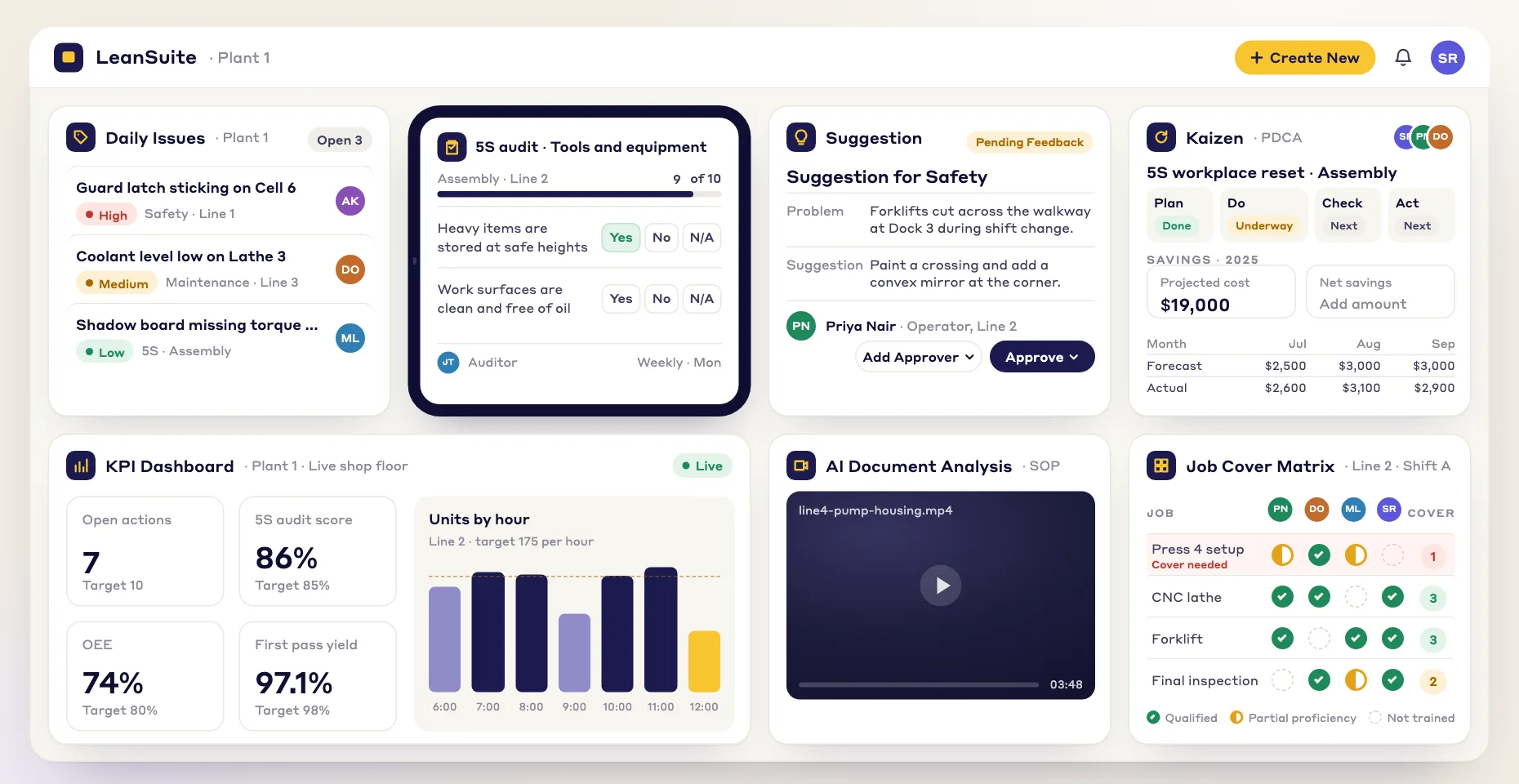
Phase One builds the capability map that does not currently exist. The output of this phase is a plant-wide skills matrix showing current capability by worker, role, and proficiency level across all shifts for all operationally critical positions.
The assessment does not need to start from scratch. Existing training records provide a baseline. The work of Phase One is converting that baseline into an accurate current-state picture by validating historical training against observed capability, identifying roles with no current qualified backup on at least one shift, and flagging certifications and qualifications approaching expiry.
The practical method for this validation is supervisor assessment rather than formal testing. Supervisors who manage the work daily have the most accurate view of which workers can perform which roles reliably without support. A structured supervisor survey covering each critical role, asking for a simple three-level rating of each worker's current capability, produces a useful first draft of the skills matrix in a week.
Phase Two: Prioritize and Plan (Days 31 to 60)
Phase Two converts the skills matrix into a prioritized training plan. Not all gaps are equal. The prioritization framework ranks gaps by two dimensions simultaneously: the operational consequence of the gap being exposed and the current coverage depth for the affected role.
A gap in a non-critical role with two qualified backups on every shift is low priority regardless of how visible it is. A gap in a constraint role with no qualified backup on the night shift is high priority regardless of whether it has produced a visible incident. Ranking gaps by this framework produces a training investment priority list that reflects actual operational risk rather than organizational noise.
Phase Two also produces the training plan for the identified high-priority gaps. For each gap, the plan specifies the worker to be trained, the method to be used, the trainer or resource required, the timeline to assessed competency, and the verification method that will confirm the gap has been closed.
Phase Three: Execute and Verify (Days 61 to 90)
Phase Three executes the training plan and verifies that the training produced genuine capability rather than documentation of activity. Verification is the step most training programs skip and the step that determines whether the 90-day investment produces durable coverage or durable records.
Verification methods vary by role. For equipment operation, the worker performs the task under observation with the trainer present. For quality inspection procedures, the worker identifies a set of defect samples correctly. For safety procedures, the worker demonstrates compliance in the relevant work environment. The verification is the evidence that a gap has been closed, not the training completion record.
Key Insight: The 90-day framework runs in three sequential phases: assess and map in the first 30 days, prioritize and plan in the second, and execute and verify in the third. Skipping verification converts training activity into training documentation without operational impact.
Phase One in Practice: Building the Skills Matrix
The skills matrix is the foundational tool of the entire framework. Its quality determines the quality of every decision made in Phases Two and Three. Three design requirements separate a useful skills matrix from a compliance document.
Three Proficiency Levels, Not Two
A binary qualified or not-qualified matrix misses the critical distinction between a worker who can perform a role with supervision and one who can perform it reliably without it. Three levels capture the operationally relevant spectrum: in training, capable with support, and independently capable. The third level is the one that counts for coverage planning. A worker at level two adds value but does not resolve a coverage gap.
Shift-Level Visibility, Not Plant-Level
A skills matrix that shows coverage at the plant level obscures shift-level gaps that are operationally significant. A role with three qualified workers total may have all three on the day shift, leaving the night shift with no coverage. The matrix must show proficiency by shift to reflect the actual coverage picture rather than the aggregate headcount.
Regular Update Cadence, Not One-Time Snapshot
A skills matrix built in Phase One that is not updated becomes inaccurate within weeks as workers change roles, complete additional training, take extended leave, or leave the organization. The matrix produces value only as a living document updated on a defined cadence. Monthly updates for high-turnover environments, quarterly for stable ones, and immediate updates when a worker's qualification status changes.
Key Insight: A useful skills matrix uses three proficiency levels, shows coverage by shift not by plant, and has a defined update cadence that keeps it current rather than becoming a historical artifact.
Phase Two in Practice: Prioritizing Gaps by Risk
The prioritization step is where most training planning fails. Ranking gaps by visibility, recency, or management interest produces a training plan that satisfies organizational noise rather than operational risk. Two tools together produce a prioritization that reflects actual exposure.
The Coverage Depth Assessment
For each critical role, count the number of workers at proficiency level three, independently capable, on each shift. A role with two or more qualified workers per shift has adequate coverage depth. A role with one qualified worker on any shift is a single-point-of-failure risk. A role with zero qualified workers on any shift is an immediate production risk.
This count, done for every critical role across every shift, produces a visual picture of where coverage depth is adequate and where it is dangerously thin. The roles with the thinnest coverage depth and the highest operational consequence when exposed become the training priority list regardless of whether they have recently been visible as a problem.
The Consequence Weighting
Not all single-point-of-failure gaps carry equal operational consequence. A constraint role with one qualified worker per shift carries higher consequence than a non-constraint role with the same coverage depth because the constraint determines total system throughput. A role requiring a safety certification carries higher consequence than a role without formal qualification requirements because an unqualified replacement creates both quality and compliance risk.
Weighting gaps by their consequence multiplier, applying a higher multiplier to constraint roles, safety-critical roles, and quality-critical roles, reorders the priority list in ways that often surprise plant managers who have been allocating training resources by different criteria.
Key Insight: Gap prioritization by operational consequence and coverage depth produces a training investment sequence that systematically reduces production risk rather than responding to organizational visibility.
Sustaining Progress Beyond 90 Days
The 90-day framework closes the highest-priority gaps. Sustaining that progress and preventing new gaps from accumulating requires two structural changes that outlast the 90-day cycle.
Embedding the Skills Matrix in Workforce Planning
A skills matrix that informs only training decisions is underutilized. The same matrix should inform shift scheduling, absence coverage, new hire onboarding sequencing, and succession planning for critical roles. When the coverage picture is visible in all workforce planning decisions, skill gaps surface earlier and get addressed as part of normal operational management rather than accumulating until they produce a consequence.
A Quarterly Gap Review as a Standard Process
The 90-day framework is a one-time reset. Making that reset durable requires a quarterly gap review that reassesses coverage depth at critical roles, updates the skills matrix for workforce changes, identifies new gaps introduced by process changes or product introductions, and launches targeted training for any gaps that have reached single-point-of-failure status.
This quarterly cadence takes a fraction of the time the initial 90-day effort required because the infrastructure, the matrix, the prioritization method, and the verification protocols, is already in place. The investment compounds over time as the organization becomes faster at identifying and closing gaps rather than restarting the effort each time operational risk surfaces.
Key Insight: Sustaining skill gap closure beyond 90 days requires embedding the skills matrix in all workforce planning decisions and running a quarterly gap review that prevents new single-point-of-failure risks from accumulating undetected.
Q&A
Q: How do you build a skills matrix quickly when no formal competency records exist?
Start with supervisor assessments rather than formal testing. Ask each supervisor to rate every worker on their team against each critical role using three levels: in training, capable with support, and independently capable. One week of structured conversations with supervisors produces a first-draft skills matrix that is more accurate than training records alone. Refine it over the following weeks as production observations provide additional evidence.
Q: How do you prioritize which skill gaps to close first when resources are limited?
Identify every role where only one worker per shift is independently capable and cross-reference with roles that are production constraints, safety-critical, or quality-critical. The intersection of thin coverage and high consequence defines the training priority list. Start there before addressing any other gap regardless of how recently it was visible or how loudly it is being raised.
Q: How long does it take to close a skill gap once training has been assigned?
It depends on the complexity of the role and the starting proficiency of the worker. Simple operational tasks with an experienced worker starting at proficiency level two can reach independent capability in two to four weeks of structured practice. Complex roles requiring certification or extensive process knowledge may require sixty to ninety days. The 90-day framework is calibrated for the highest-priority gaps, which typically fall in the moderate complexity range achievable within the timeframe.
Q: What is the most common reason a 90-day skill gap closure effort fails to sustain results?
The verification step is skipped. Training is assigned and completed, the record is updated, and the gap is considered closed. But without a structured verification that the training produced operational capability rather than training completion, the coverage depth picture remains inaccurate. The gap appears closed on paper while the operational risk it represents continues unchanged. Requiring verified capability demonstration before marking a gap closed is the single most important quality control in the framework.
Free for this topic: Skills matrix template, Standard work sheet template, Takt time calculator
Want our lean manufacturing guides first in Google? Add us as a preferred source.
Add LeanSuite as a preferred source on Google (opens in a new tab)


