
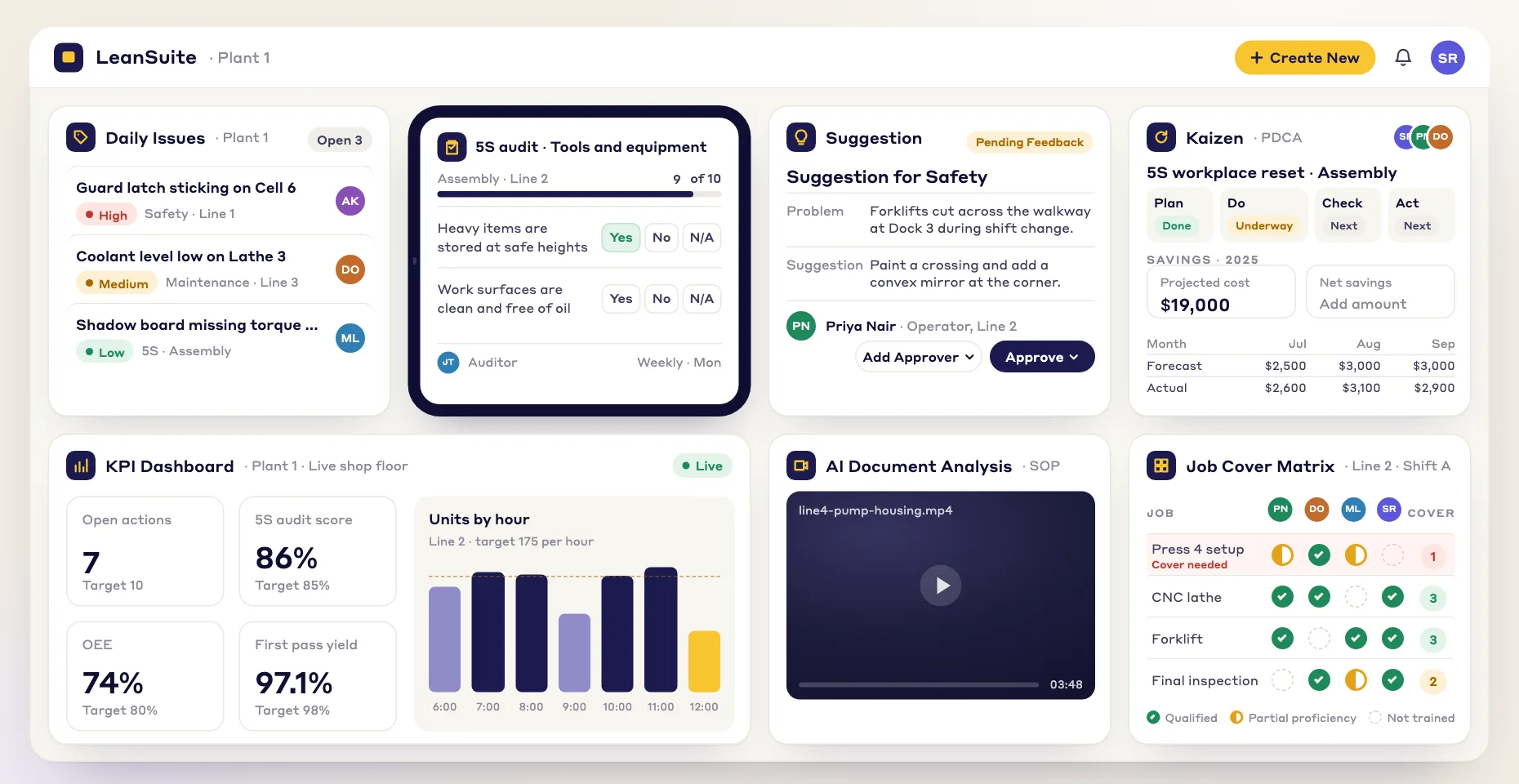



Turning a suggestion box into a manufacturing profit generator requires the same structural design that made Toyota's employee suggestion program generate billions in cumulative value: fast submission, immediate review, and implementation as the default outcome rather than the exception. Toyota's program received 789 ideas in its first year after launching in 1951 and grew to more than 250,000 annual suggestions by the early 1970s with over 70 percent implemented. Most manufacturing suggestion programs produce the opposite result because they are built in the opposite direction, with high submission friction, slow or absent review, and implementation as a rare event requiring sustained advocacy to achieve.
Most manufacturers look at that result and conclude that their own suggestion programs must be missing something cultural. The assumption is that Toyota's workforce was more engaged, more invested, or more aligned with company success. The actual difference is structural. Toyota built a system designed to make idea submission fast, review immediate, and implementation the default outcome rather than the exception. Most manufacturing suggestion programs are built in the opposite direction, with high submission friction, slow or absent review, and implementation as a rare event that requires sustained advocacy to achieve.
The gap between a suggestion box and a profit generator is not culture. It is design.
Why Traditional Suggestion Programs Fail
Understanding what makes suggestion programs fail is more useful than cataloguing what makes them succeed, because the failure patterns are consistent across manufacturing environments of different sizes, industries, and management philosophies. Three failure mechanisms appear so reliably that they can be predicted before a program launches based on how it is designed.
The Submission-to-Silence Pathway
The most damaging failure in any suggestion program is the gap between submission and response. A worker submits an idea. Weeks pass. Nothing happens. No acknowledgment. No status update. No decision. Eventually, an email arrives saying the idea was reviewed and will not be moving forward, with no explanation of why.
That sequence does not just waste one idea. It communicates to every worker who submitted that participation produces nothing. The next idea that worker has, and every idea they observe in colleagues who had the same experience, stays in their head rather than reaching the system. The program continues to exist. Participation quietly collapses.
The Evaluation Bottleneck
The second failure is structural: idea review routed through a central committee, a department head, or a process that requires formal approval before any action is taken. Committees meet monthly. Department heads have competing priorities. Formal approval processes have compliance requirements that slow everything down.
By the time an idea completes the evaluation process, the problem it was designed to solve may have already been addressed by other means, the worker who submitted it may have changed roles, and the production context that made the idea relevant may have shifted. Ideas have a freshness window. Evaluation systems that do not respect that window consistently produce decisions about ideas that have already lost their operational relevance.
The Reward-Without-Result Pattern
The third failure is rewarding submission rather than implementation. Programs that give points, recognition, or small financial rewards for submitting ideas create a submission economy without an improvement economy. Workers optimize for the reward, not the outcome. Submissions increase. Implementation rates fall. The program produces engagement activity metrics that look healthy while operational improvement rates remain flat.
Toyota's approach inverted this entirely. Rewards were modest, approximately five dollars in most cases, and tied not to the submission but to the implementation. The idea was considered complete only when it was working, not when it was written down.
What a Profit-Generating Idea System Looks Like
The difference between a suggestion box and a profit generator is in the architecture of what happens after an idea is submitted. Three design principles separate programs that generate measurable returns from those that generate compliance activity.
Immediate Acknowledgment as a Non-Negotiable Standard
Every idea submitted must receive acknowledgment within twenty-four hours. Not a decision. Not an evaluation. An acknowledgment that confirms the idea was received, who is reviewing it, and when the submitter can expect a response.
This single design requirement changes the submitter's experience from entering a void to entering a process. The idea does not disappear. It has a home and a timeline. Workers who receive timely acknowledgment submit more ideas. Workers who receive silence submit fewer, and eventually none.
Review at the Lowest Level Possible
The most effective suggestion systems push the review function as close to the floor as possible. Team leaders review ideas from their direct teams. Supervisors review ideas that require resources beyond the team level. Only ideas requiring significant capital or cross-functional coordination reach management review.
This design principle, which is central to how Toyota structured its system, ensures that the people most qualified to evaluate an idea's operational merit are the ones doing the evaluation. A team leader who understands the specific machine, product, and process context of an idea can assess it in minutes. A central committee reviewing that same idea without that context requires the submitter to reconstruct the entire operational picture, which adds delay, friction, and the risk of misunderstanding.
Implementation as the Default Outcome
The most productive idea systems are designed around the assumption that ideas will be implemented unless there is a specific reason not to, rather than around the assumption that ideas will be evaluated and occasionally approved. This inversion changes the culture of the program.
When implementation is the default, review becomes a question of how to implement rather than whether to implement. Workers know their ideas will find their way into practice unless something prevents it. Submission becomes a credible act rather than a gesture made in hope.
Connecting Ideas to Financial Outcomes
The gap between a suggestion program that generates participation metrics and one that generates profit is the connection between idea implementation and financial tracking. Most programs do not track the financial impact of implemented ideas. As a result, the value they create is invisible to leadership, which in turn makes investment in the program difficult to justify and sustains the perception that suggestion programs are engagement initiatives rather than operational investments. Two changes close that gap and make the financial case visible to everyone who needs to see it.
Building a Simple Financial Tracking Framework
Every implemented idea should be assigned a financial category and an estimated annual impact before it is closed. The categories do not need to be complex. Four categories cover most manufacturing improvement ideas: labor time saved, material cost reduced, quality cost avoided, and safety incident cost avoided.
The estimates do not need to be precise. A conservative estimate that the team agrees on is sufficient to build a cumulative picture of program value over time. Twelve months of implemented ideas with conservative financial estimates attached tells a story that participation counts alone cannot tell. It converts the program from a human resources initiative to an operational value generator with a documented return.
Reporting Impact at the Team Level
Financial impact reported at the team level rather than only at the plant or program level creates accountability and motivation that aggregate reporting cannot produce. When a team can see that their ideas collectively generated a specific financial value over the past quarter, the connection between their participation and the plant's performance becomes concrete rather than abstract.
IndustryWeek research on employee engagement in manufacturing consistently identifies the visibility of individual contribution to collective outcomes as one of the strongest drivers of sustained engagement. Idea programs that make this connection visible at the team level sustain participation at higher rates than those that aggregate results at the program level where individual contribution disappears.
Designing the Feedback Loop That Sustains Participation
The single biggest driver of long-term participation in any idea program is what happens after an idea is implemented. Workers who see their ideas produce visible changes, and who are specifically acknowledged for that contribution, submit more ideas. Workers who implement changes that are never connected back to them publicly contribute once and stop. Two practices build the loop that keeps participation self-sustaining.
Closing the Loop on Every Implemented Idea
Every implemented idea should generate a visible output that connects the result to the person who submitted it. The output does not need to be elaborate. A brief posting on the team board noting the idea, who submitted it, what changed, and what the estimated impact was, takes minutes to produce and generates disproportionate engagement value.
This practice serves two functions simultaneously. It recognizes the individual contribution, which sustains the submitter's participation. It also demonstrates to every other team member that ideas submitted through this program produce real changes that are visible and credited, which lowers the psychological barrier to submission for workers who have not yet participated.
Using Recognition to Drive the Next Submission
Recognition that is specific, timely, and publicly connected to a concrete outcome drives more future submissions than generic appreciation programs. The specificity matters because it signals that the contribution was understood, not just counted. The timing matters because recognition separated from the action it is recognizing loses its motivational connection. The public element matters because it signals to the entire team that this is what participation looks like and what it produces.
Kaizen Sensei Akinori Hyodo's documentation of Toyota's suggestion scheme describes the supervisor's role precisely in these terms: the supervisor is the idea coach, not the idea gatekeeper. When supervisors review ideas with the intent of helping them succeed rather than evaluating whether they should proceed, the program's implementation rate and participation rate both improve significantly.
Scaling the Program Without Losing Quality
The challenge that most successful idea programs eventually face is scaling participation without diluting the quality of the review and implementation process. When submission volume increases, review capacity becomes the constraint, and the temptation is to batch ideas, delay responses, and reduce the specificity of feedback in the interest of throughput. That response recreates the bottleneck that killed the program in its earlier form. Two structural decisions prevent that from happening.
Distributing Review Authority Permanently
The solution to scaling is distributing review authority before scaling becomes a problem, not after. When team leaders have permanent authority to approve and implement ideas within a defined scope, cost threshold, and safety boundary, volume increases do not create review bottlenecks. They create distributed implementation activity.
Defining the scope of team leader authority requires specificity: what categories of ideas, what maximum cost per idea, what process areas, and what escalation path for ideas that fall outside those boundaries. That specificity is a one-time investment that enables indefinite scaling without central review becoming the constraint again.
Maintaining Idea Quality Through Structured Submission
Participation volume and idea quality are not in tension if the submission process includes enough structure to guide the submitter toward clear problem definition. A submission form that asks for the problem observed, the proposed change, and the expected outcome produces ideas that are easier to evaluate and implement than open-ended text submissions.
The structure does not reduce participation. It increases the percentage of submitted ideas that are actionable on first review, which reduces the time reviewers spend seeking clarification and increases the speed at which ideas move from submission to implementation. Faster implementation drives faster next submissions. The program becomes self-reinforcing rather than requiring periodic re-injection of promotional energy to sustain.
Q&A
Q: How do you restart a suggestion program that workers no longer trust because of past failures?
Start small and prove the loop before promoting the program. Pick one team, implement the next three ideas submitted regardless of size, close the loop publicly on each one, and let that team's experience become visible to other teams. Trust is rebuilt through demonstrated follow-through on small commitments, not through program relaunches and communication campaigns. One idea implemented and credited is worth more to trust rebuilding than ten announcements.
Q: What is the right reward structure for a manufacturing suggestion program?
Rewards should be modest and tied to implementation rather than submission. Small consistent rewards for implemented ideas, in the range of a gift card or team recognition, combined with public acknowledgment outperform large infrequent financial bonuses. The goal is reinforcing the behavior of participating, not creating a submission economy where volume is optimized without regard for quality or outcome.
Q: How do you handle ideas that cannot be implemented without explaining why in a way that does not discourage future submissions?
Every declined idea deserves a specific explanation: the reason, the constraint that prevents implementation, and whether the constraint is permanent or temporary. A worker who understands why their idea cannot be implemented right now is more likely to submit the next idea than one who receives a generic decline. If the constraint is temporary, note when it might be reviewed again. The decline itself is not the engagement risk. The unexplained decline is.
Q: How long before a structured suggestion program produces measurable financial returns?
Most programs with structured submission, immediate acknowledgment, and team-level review see implemented ideas within the first thirty days and measurable cumulative financial impact within ninety days. The returns are small initially and compound as participation rates increase and workers develop the habit of identifying improvement opportunities as part of their daily work rather than as an occasional extra activity.
Free for this topic: Leader standard work template, Gemba walk checklist, Lean maturity self-assessment
Want our lean manufacturing guides first in Google? Add us as a preferred source.
Add LeanSuite as a preferred source on Google (opens in a new tab)


