



Defects reach customers despite quality control because most quality control programs are designed to detect defects after they are produced rather than prevent the conditions that generate them, and detection-based systems have structural limitations that sampling statistics, human inspection capacity, and disconnected data systems make impossible to fully overcome. The American Society for Quality estimates the Cost of Poor Quality consumes 15 to 20 percent of total sales revenue in manufacturing organizations relying primarily on detection-based systems. The 1-10-100 Rule quantifies what that means operationally: fixing a defect at the process stage costs one unit of effort, finding it at final inspection costs ten, and addressing it after it reaches a customer costs one hundred. Every escaped defect represents the difference between the ten-unit cost and the one-hundred-unit cost.
The financial consequence of this gap is significant. The American Society for Quality estimates that the Cost of Poor Quality can consume 15 to 20 percent of total sales revenue in manufacturing organizations that rely primarily on detection-based quality systems. The 1-10-100 Rule, a foundational principle in quality cost management, quantifies the compounding: fixing a defect at the process stage costs approximately one unit of effort, finding and fixing it at final inspection costs ten units, and addressing it after it reaches a customer costs one hundred units. Every defect that escapes inspection represents the difference between a ten-unit cost and a one-hundred-unit cost.
Understanding why defects escape requires understanding the six structural failure modes that make detection-based quality control insufficient regardless of how diligently it is applied.
The Six Reasons Defects Escape Quality Control
Defect escapes are not random. They follow predictable patterns rooted in the design of the quality system rather than in the effort of the people operating it. Six failure modes account for the majority of defects that reach customers in manufacturing environments.
Sampling Inspection Misses What It Does Not Examine
The most fundamental limitation of any sampling-based inspection program is mathematical: a sampling plan that inspects 10 percent of units will miss defects in the 90 percent it does not examine. Sampling is a rational engineering response to the cost and time constraints of 100 percent inspection, and for stable processes producing consistent output, it is an appropriate tradeoff. It becomes inadequate when defect occurrence is sporadic, clustered, or low-frequency.
A defect that affects one unit in five hundred will statistically escape a standard sampling plan the majority of the time. A defect that affects a cluster of consecutive units during a specific machine condition, an overheating spindle, a worn die, a pressure fluctuation, will be caught only if the sample happens to fall within that cluster. Sampling plans are calibrated for average defect rates across populations, not for the specific detection of low-frequency or episodic defects that represent the highest escape risk.
Human Inspection Degrades With Time and Repetition
Human inspection accuracy degrades predictably across a shift. Research from the Human Factors and Ergonomics Society documents that inspection accuracy can degrade by 20 to 30 percent after just one hour of continuous monitoring. The mechanism is not inattention but a neurological phenomenon called inattentional blindness: inspectors who have seen ten thousand conforming units begin to see what they expect to see rather than what is actually present. A subtle defect in a familiar location on a familiar product becomes progressively harder to detect as the inspection shift extends.
This degradation is not correctable through training, incentives, or closer supervision. It is a property of human visual cognition under repetitive conditions. Quality systems that rely on end-of-line human inspection as their primary defect detection mechanism are designing human perceptual limits into the quality function without acknowledging or compensating for them.
Undefined or Inconsistent Acceptance Criteria Create Inspector Variation
A defect that one inspector rejects, another inspector accepts. This is not a personnel problem. It is a standards problem. When acceptance criteria are defined in general terms, "acceptable surface finish," "within dimensional tolerance," "no visible contamination," individual inspectors interpret those terms through their own judgment and experience. The result is inspection results that vary by inspector, by shift, and by time of day, producing a quality record that reflects inspector interpretation as much as product condition.
Undefined or inconsistently applied criteria also make corrective action impossible. If the acceptance criterion for a surface defect is not precisely specified, a corrective action addressing the most common inspector interpretation may not address the defect that a different inspector would have caught on a different shift.
Quality Data Arrives Too Late to Prevent Further Production
In quality systems where inspection results are compiled at the end of the shift or at the end of the production run, defects are identified after the conditions that caused them have produced more defective units. A process drift that produces a marginal dimension condition at hour three of a shift, identified in a compiled inspection report at shift end, has been producing defective or borderline units for five hours without correction.
This is the quality equivalent of the shift report problem in production management. Compiled reporting of quality results converts quality control from a prevention tool into a documentation tool. The defects are recorded. They are not prevented. And the conditions that caused them may have produced hundreds of additional nonconforming units before the data reached anyone who could act on it.
Corrective Actions Address Symptoms Rather Than Causes
When defects are identified through end-of-line inspection, the corrective action response is typically directed at the defect itself: rework the affected units, hold the suspect lot, adjust the process setting that most plausibly caused the defect. This response addresses the immediate production problem without necessarily addressing the root cause that will produce the same defect again under the same conditions.
Kepner-Tregoe's quality management research identifies this containment cycle as one of the most common and most costly patterns in manufacturing quality management: the same defect recurs because the corrective action addressed the output without changing the process conditions that generated it. Each recurrence repeats the full cost of detection, containment, and correction without approaching the upstream condition that makes those costs unnecessary.
Quality and Production Systems Are Disconnected
In most manufacturing facilities, quality data exists in one system and production data exists in another. Inspection results are in the quality management system. Machine parameters, production rates, shift handover logs, and maintenance records are in separate systems. The connection between a specific defect type and the process condition that caused it requires someone to manually correlate data across systems, which rarely happens in real time and often does not happen at all.
This disconnection means that quality problems are managed without the production context that would reveal their cause, and production decisions are made without the quality feedback that would reveal their consequence. A maintenance event that subtly changed a machine parameter affecting dimensional accuracy is invisible to the quality system. A quality trend that signals a developing process problem is invisible to the production planning system.
Key Insight: Defects reach customers through six structural failure modes: sampling gaps, human inspection degradation, inconsistent criteria, delayed data, symptom-level corrective actions, and disconnected quality and production systems. Addressing any one in isolation produces partial improvement. Addressing all six closes the structural gap.
The Cost Structure of Escaped Defects
Every defect that reaches a customer carries a cost profile that multiplies the internal cost of nonconformance by an order of magnitude. Understanding the full cost structure of defect escapes is the prerequisite for building the business case to invest in the system design changes that prevent them.
Direct Costs: Warranty, Return, and Replacement
The most visible costs of defect escapes are the direct costs of warranty claims, customer returns, replacement product, and logistics. These costs are quantifiable from warranty and returns data and typically appear on the quality cost report as external failure costs. For a manufacturing operation producing 10,000 units monthly at a 3 percent defect rate, with warranty claim costs averaging several hundred dollars per claim, annual external failure costs accumulate rapidly into six-figure or seven-figure losses depending on product value.
These direct costs represent only the fraction of the total cost that appears in the financial records. The indirect and systemic costs are consistently larger and consistently unmeasured.
Indirect Costs: Investigation, Expediting, and Relationship Damage
When a defect reaches a customer, the response consumes resources well beyond the replacement cost of the defective unit. Quality engineers investigate the escape. Production supervisors review the records for the affected production run. Customer service manages the communication. Shipping expedites replacement delivery. Sales manages the customer relationship through a failure event that was not their responsibility to create but is entirely their problem to repair.
ETQ's 2024 Pulse of Quality in Manufacturing survey found that 73 percent of manufacturers had experienced a product recall within the previous five years, with costs for a single recall ranging from ten million to nearly fifty million dollars in direct financial impact alone. Those figures do not include the customer relationship costs, the market position costs, or the internal resource costs of investigation and response.
The 1-10-100 Compounding Effect
The 1-10-100 Rule makes the investment case for prevention-based quality systems concrete. Prevention costs, investing in process design, supplier development, poka-yoke, and in-process monitoring, represent the one-unit investment. Appraisal costs, inspection, testing, and verification, represent the ten-unit investment. External failure costs, warranty claims, returns, recalls, and customer relationship damage, represent the one-hundred-unit investment.
Organizations that invest heavily in appraisal while underinvesting in prevention are spending ten times more than the alternative to catch defects that a prevention investment would have made. World-class manufacturers spend fewer than 5 percent of total sales on total quality costs according to the American Productivity and Quality Center, compared to more than 20 percent for organizations still operating on detection-based quality models.
Key Insight: The cost of a defect that reaches a customer is approximately ten times the cost of catching it in final inspection and one hundred times the cost of preventing it at the process level. Every escaped defect represents a preventable cost that was paid at the highest possible rate.
Building the System That Prevents Escapes
The structural failure modes that allow defects to reach customers are addressable through system design changes that shift quality from detection to prevention. Four system elements together close the structural gaps that inspection alone cannot.
In-Process Quality Monitoring
In-process quality monitoring places measurement at the point of production rather than at the end of the line. Process parameters are measured in real time, dimensions are checked at the workstation, and quality data enters the system at the moment of production rather than hours later. This timing shift converts quality data from a record of what happened into a signal about what is happening.
Statistical Process Control applied to in-process data identifies process drift before it produces nonconforming units. A dimension trending toward the tolerance limit over forty consecutive parts is a detectable pattern that in-process monitoring surfaces and that end-of-line inspection would never see because it catches only units that have already crossed the limit.
Precise and Shared Acceptance Criteria
Acceptance criteria that eliminate inspector variation require two properties: they must be defined in measurable, unambiguous terms, and they must be consistently available to every inspector at every inspection point. Criteria defined as "acceptable surface finish" produce variation. Criteria defined as "no scratches exceeding 0.5mm in length in Zone A" produce consistency.
Digital inspection systems that present criteria alongside the inspection task at the point of inspection, including reference images of conforming and nonconforming examples, eliminate the interpretation variability that shift-to-shift and inspector-to-inspector differences otherwise produce. The criterion is the same for every inspector on every shift.
Connected Quality and Production Data
The connection between quality outcomes and production conditions requires that both types of data exist in a system where they can be correlated in real time. When a nonconforming dimension is recorded in the quality system and automatically cross-referenced against the machine parameters, operator, tooling age, and production sequence active at the time of production, the investigation that would otherwise take hours of manual data correlation takes minutes.
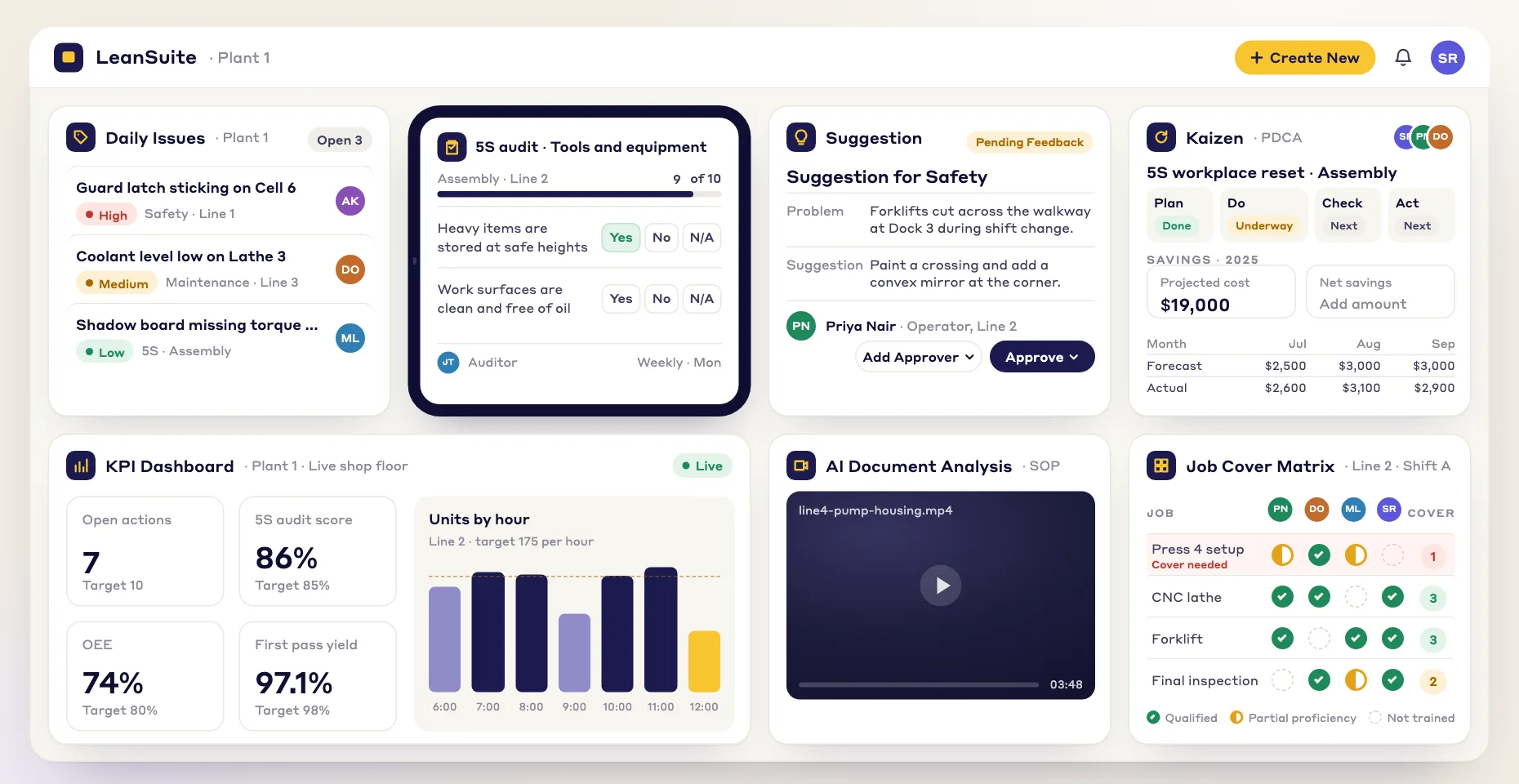
The LeanSuite quality management platform keeps quality events, root cause investigations and corrective actions in one system, so teams can investigate nonconformance patterns while the relevant conditions are still observable and correctable, rather than reconstructing them after the fact.
Corrective Actions Tracked to Root Cause Verification
Corrective actions that do not reach the root cause of the defect will not prevent its recurrence. A corrective action system that requires root cause documentation before a nonconformance can be closed, and that tracks corrective action effectiveness through follow-up verification at defined intervals, produces lasting improvement rather than a documented cycle of containment and recurrence.
The verification requirement is the most frequently missing element in manufacturing corrective action systems. A corrective action that was implemented but not verified as effective is identical, from the system's perspective, to a corrective action that changed nothing. Only tracked follow-up confirms whether the condition that produced the defect has been genuinely changed.
Key Insight: Prevention-based quality systems require four connected elements: in-process monitoring that signals developing problems before nonconforming units are produced, precise shared acceptance criteria, connected quality and production data, and corrective actions tracked to verified root cause resolution.
Measuring Quality System Effectiveness
A quality system's effectiveness is not measured by how many defects it catches. It is measured by the trend in defects it prevents and the reduction in defect escapes it produces over time. Three metrics together provide the operational picture of whether the quality system is improving.
Internal Defect Rate vs Escape Rate
Tracking both the internal defect rate, defects caught within the facility, and the defect escape rate, defects that reached customers, reveals the quality system's detection efficiency. A high internal defect rate with a low escape rate indicates a quality system that catches most of what the process produces but has not yet addressed the upstream conditions generating defects. A low internal defect rate with a recurring escape rate indicates a detection gap: defects are being produced but not caught.
The target trajectory is declining internal defect rates as process improvement reduces defect generation, alongside declining escape rates as in-process monitoring and connected data improve detection of the defects that do occur.
First-Pass Yield by Process Stage
First-pass yield measures the percentage of units that complete each production stage without requiring rework or rejection. Tracking first-pass yield by stage rather than only at final inspection identifies which process stages are generating the most nonconformance and where prevention investment will produce the highest return.
A facility with 98 percent overall first-pass yield at final inspection may have 85 percent first-pass yield at a specific intermediate stage that rework is masking before final inspection. The overall metric hides the problem. The stage-level metric reveals it.
Corrective Action Closure and Recurrence Rate
Corrective action effectiveness is measured by two metrics in combination: the percentage of nonconformances closed with documented root cause corrective action within a defined timeframe, and the rate at which the same defect type recurs after corrective action closure. A high closure rate with a high recurrence rate indicates that corrective actions are being completed without reaching the root cause. A declining recurrence rate confirms that corrective actions are addressing the conditions that generate defects rather than the defects they produce.
Key Insight: Quality system effectiveness is measured by declining internal defect rates, declining escape rates, improving first-pass yield by stage, and falling corrective action recurrence rates. The direction of these trends over time is more informative than any single measurement at a single point.
Q&A
Q: What is a defect escape rate and how is it calculated?
A defect escape rate is the proportion of defects produced that are not detected before reaching the customer. The formula divides escaped defects by total defects, which is internal defects plus escaped defects. A facility that catches 95 defects internally and has 5 customer returns from the same production run has an escape rate of approximately 5 percent. Tracking escape rate over time alongside internal defect rate reveals whether quality system improvements are reducing defect generation, improving detection, or both.
Q: Why does end-of-line inspection fail to prevent defects from reaching customers?
End-of-line inspection fails for three structural reasons. First, sampling plans mathematically cannot examine every unit, which means low-frequency or clustered defects regularly escape undetected. Second, human inspection accuracy degrades by 20 to 30 percent within an hour of continuous monitoring, creating a fatigue-driven escape pathway that intensifies across the shift. Third, detecting a defect at end of line means the process that generated it has continued producing nonconforming units throughout the shift. None of these limitations are correctable through more diligent inspection. They are properties of the detection model itself.
Q: What is the 1-10-100 Rule in manufacturing quality management?
The 1-10-100 Rule quantifies the cost of quality at different detection points. Preventing a defect at the process level costs approximately one unit of effort. Catching it at final inspection costs ten units, reflecting the inspection, sorting, rework, and administrative effort required. Addressing it after it reaches a customer costs one hundred units, including warranty claims, replacement logistics, customer relationship management, and potential regulatory or reputational consequences. The rule makes the investment case for prevention-based quality systems concrete: every dollar invested in prevention avoids ten dollars in appraisal and one hundred dollars in failure.
Q: How do you build a corrective action system that actually prevents recurrence?
A corrective action system that prevents recurrence requires three elements that most manufacturing CAPA systems are missing. First, root cause documentation must be required before a nonconformance can be closed, not as an optional field but as a mandatory completion criterion. Second, the identified root cause must be at the latent cause level, the systemic condition that made the defect possible, not at the physical or symptom level. Third, a follow-up verification task must be scheduled at an appropriate interval after closure to confirm that the corrective action changed the conditions that generated the defect. Without verification, corrective action completion and corrective action effectiveness are indistinguishable in the system record.
Free for this topic: Quality control pillar 90-day model area plan, 8D report template, First pass yield (FPY) calculator
Want our lean manufacturing guides first in Google? Add us as a preferred source.
Add LeanSuite as a preferred source on Google (opens in a new tab)


