
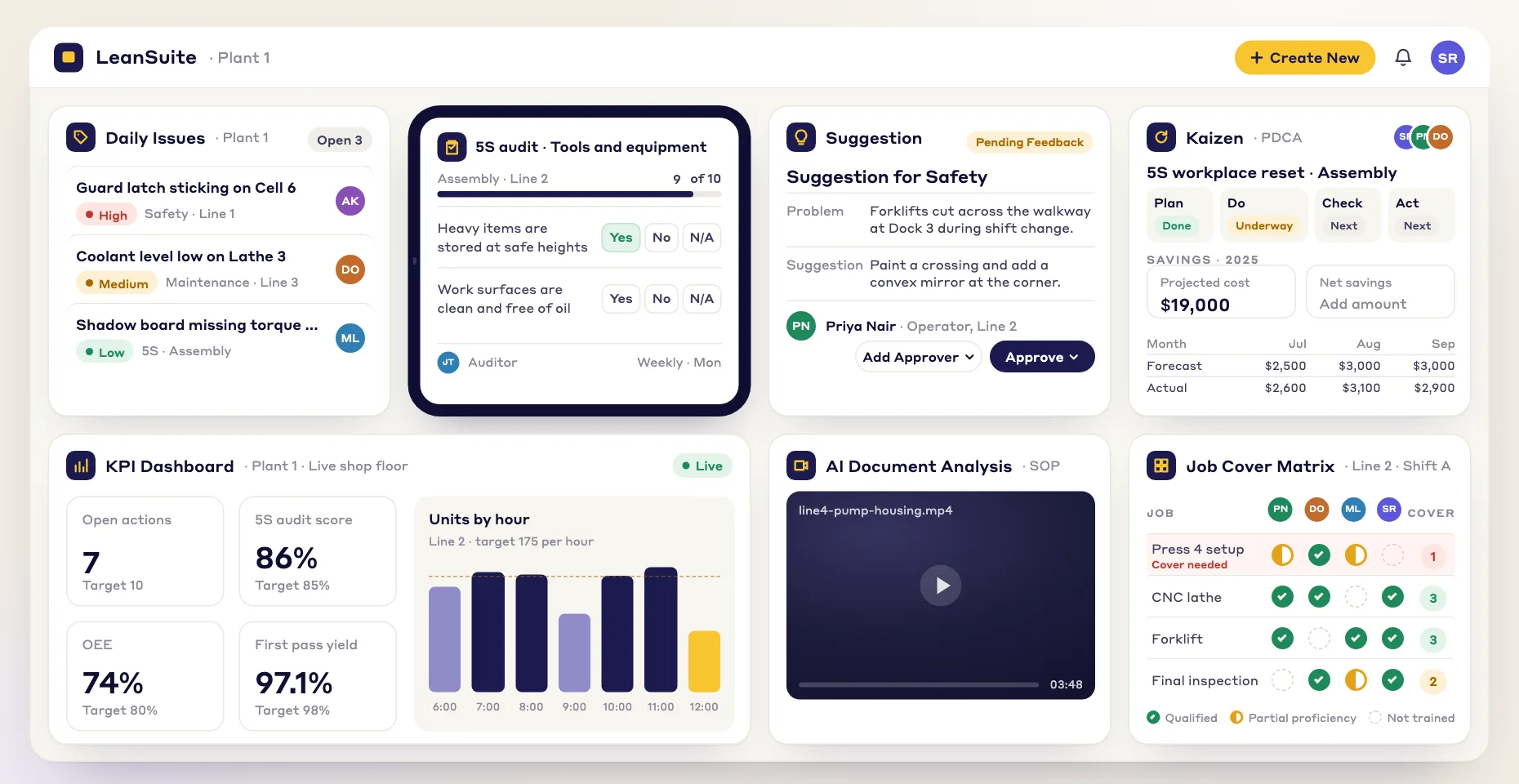



Manual documentation systems quietly crush manufacturing profit margins by consuming supervisor capacity, fragmenting operational information, and creating the coordination waste that prevents proactive decision-making. Facilities operating with manual frontline systems incur 30 to 50 percent higher operational costs compared to digitally integrated operations while delivering 15 to 25 percent lower productivity, according to the Manufacturing Institute. A production supervisor spending 90 minutes daily handwriting shift reports, transcribing production counts, documenting quality issues on paper forms, and making phone calls to locate responsible personnel is not creating operational value. That capacity is being consumed by the information infrastructure itself.
Research from the Manufacturing Institute indicates that facilities operating with manual frontline systems incur 30-50% higher operational costs compared to digitally integrated operations while delivering 15-25% lower productivity. The cost differential stems not from manual process execution but from the coordination waste, information fragmentation, delayed decision-making, and recurring problems that manual systems create. When operators cannot document issues instantly, supervisors cannot access real-time operational status, and leadership cannot intervene proactively, profit margins erode through invisible waste that never appears in traditional cost accounting.
Digital frontline systems eliminate this margin erosion by enabling instant problem capture, automatic information routing, centralized operational visibility, and data-driven decision-making that manual processes cannot provide.
The Hidden Cost Structure of Manual Operations
Manufacturing facilities operating with manual frontline systems incur costs extending beyond obvious documentation time. The complete economic impact encompasses supervisor capacity consumption, coordination waste from information fragmentation, response delays multiplying problem severity, and quality losses from delayed intervention. Four distinct cost categories quantify the manual operations penalty.
Supervisor Capacity Consumed by Documentation
Manual documentation consumes 15-25% of frontline supervisor capacity through shift report creation, production log compilation, quality documentation, equipment status tracking, and safety observation recording. One electronics manufacturer calculated that supervisors spent 105 minutes daily on manual documentation across three shifts, equivalent to having 2.5 fewer supervisors available for operational leadership and problem-solving. The documentation burden occurs during shift transitions when supervisor attention should focus on handoff quality and startup preparation.
Coordination Waste From Information Fragmentation
Manual operations fragment information across multiple sources including shift reports, production logs, quality forms, maintenance notebooks, and safety clipboards. When problems requiring cross-functional coordination arise, supervisors spend significant time aggregating scattered information to understand complete context. One automotive supplier found that equipment issues requiring maintenance coordination consumed 35 minutes average supervisor time gathering information from multiple paper sources, locating qualified technicians, and verbally communicating problem details that written records inadequately captured.
Response Delay Multiplication Effect
Information fragmentation and manual communication create response delays that multiply problem severity. Equipment degradation noted in operator logs but not communicated until shift report compilation remains unaddressed for hours while conditions worsen. Quality trends visible in inspection data but requiring manual aggregation for pattern recognition go undetected until defect rates spike. Research from Purdue University indicates that manual operation response delays increase problem remediation costs by 4-8 times compared to immediate digital notification enabling same-shift intervention.
Quality Losses From Delayed Decision-Making
Manual information systems delay leadership awareness of developing quality issues preventing proactive intervention. Quality data documented on paper forms reaches engineering review hours or days after production completion when corrective action cannot salvage affected batches. One food processing facility calculated that manual quality documentation delayed engineering awareness by an average 14 hours, resulting in $280,000 annual scrap costs from batches that could have been salvaged through real-time intervention during production.
Key Insight: Manual operations cost 15-25% supervisor capacity, create coordination waste requiring 35min per issue, delay response 4-8x multiplying costs, lose $280K annually from delayed quality intervention.

Why Manual Operations Persist Despite Cost
Manufacturing facilities continue manual frontline operations despite recognizing inefficiency because several interconnected factors create organizational resistance to digital alternatives. The persistence stems from how manual systems accommodate established workflows, avoid perceived technology complexity, maintain operational continuity during transitions, and align with existing management practices.
Established Process Familiarity
Manual operations integrate into established workflows where supervisors, operators, and stakeholders understand exactly how documentation and communication occur. The familiarity creates comfort even when efficiency suffers. Supervisors know which forms to complete, operators understand logging procedures, and management expects specific report formats. This process integration creates switching costs where digital alternatives require learning new systems and modifying documentation habits that feel burdensome compared to continuing familiar practices.
Technology Deployment Anxiety
Digital frontline system deployment raises concerns about complexity, training requirements, device management, and operational disruption. Facilities worry that introducing technology creates dependencies that may fail during critical operations. The anxiety intensifies when operations managers lack technology implementation experience and imagine deployment requiring extensive IT support, complicated training programs, and significant operational downtime that manual systems avoid.
Capital Investment Hesitation
Manual operations require minimal capital investment beyond paper, clipboards, and filing cabinets. Digital systems require device acquisition, software licensing, and potential infrastructure upgrades that create budget approval hurdles. The capital comparison appears unfavorable when organizations fail to quantify the ongoing operational costs that manual systems create through supervisor capacity waste, coordination burden, and margin erosion from delayed response.
Change Management Resistance
Transitioning from manual to digital frontline operations requires changing how supervisors document information, how operators report problems, and how leadership accesses operational status. The behavioral changes create resistance particularly among experienced personnel comfortable with manual methods who view digital systems as unnecessary complexity rather than efficiency improvements. The resistance intensifies when organizations attempt wholesale transformation rather than incremental adoption proving value before broad deployment.
Key Insight: Manual persists through process familiarity, technology anxiety exceeding actual complexity, capital investment hesitation, and change resistance from experienced personnel.
How Digital Frontline Systems Work
Digital frontline systems eliminate manual operation waste through four integrated capabilities that fundamentally change how facilities capture information, coordinate activities, access operational status, and make decisions. The transformation occurs not through automation of manual processes but through enabling new workflows that manual systems cannot support.
Instant Information Capture at Point of Observation
Digital systems enable operators and supervisors to document problems, production status, quality observations, and equipment conditions instantly using mobile devices at locations where events occur. The capture requires minimal input through predefined selection fields, dropdown menus, and photo documentation taking 30-90 seconds compared to manual documentation requiring written descriptions and later transcription. The instant capture eliminates information loss when problems get remembered hours later and prevents the coordination waste from verbal communication requiring supervisor availability.
Automatic Information Routing and Assignment
Digital systems automatically route documented information to appropriate stakeholders based on issue type, severity, equipment, and location. Equipment problems notify maintenance with automatic technician assignment based on skills and availability. Quality issues alert quality engineers and production management simultaneously. Safety observations route to safety coordinators and plant leadership. The automatic routing eliminates the coordination waste where supervisors manually communicate problems through phone calls and radio dispatch while information fragmentation prevents stakeholder awareness.
Centralized Operational Visibility
Digital systems provide centralized visibility where all stakeholders access current operational status regardless of shift, department, or physical location. Production managers view output performance across all lines simultaneously rather than aggregating individual shift reports. Maintenance coordinators see all open equipment problems with current resolution status rather than tracking scattered maintenance notebooks. Quality engineers monitor defect trends in real-time rather than reviewing historical data from compiled inspection forms. The centralized visibility enables proactive intervention during problem development rather than reactive response after escalation.
Data-Driven Decision Making
Digital systems generate operational analytics that manual processes cannot provide efficiently including response time measurement, problem resolution effectiveness tracking, recurring issue identification, and performance trend analysis. The analytics enable data-driven continuous improvement by revealing patterns invisible in fragmented manual records. One aerospace manufacturer identified through digital analytics that 40% of equipment problems occurred during specific production sequences, enabling targeted preventive action that manual tracking never revealed despite years of similar problem documentation.
Key Insight: Digital systems enable instant mobile capture in 30-90 seconds, automatic routing eliminating coordination waste, centralized visibility across operations, and analytics revealing patterns manual tracking cannot detect.
Quantifying the Margin Recovery Opportunity
Systematic measurement of manual operation costs versus digital system benefits quantifies margin recovery opportunity while justifying transition investment. The assessment requires calculating supervisor capacity liberation, coordination waste elimination, response acceleration value, and quality loss prevention. Four calculation approaches provide comprehensive economic justification.
Supervisor Capacity Liberation Value
Calculate supervisor time spent on manual documentation and information coordination activities, multiply by loaded labor cost, and extend across all supervisors and shifts. One automotive components manufacturer with 12 frontline supervisors spending average 95 minutes daily on manual activities at a $45 loaded hourly rate calculated annual capacity waste of $249,000. Digital systems liberating this capacity enable supervisors to focus on operational improvement, team development, and proactive problem-solving creating value exceeding the time cost itself.
Coordination Waste Elimination Savings
Measure time supervisors spend aggregating information from scattered manual sources and coordinating stakeholder communication for problem resolution. Calculate frequency of coordination activities, average time per coordination event, and loaded labor cost. The same automotive manufacturer found supervisors spent an average of 28 minutes coordinating each equipment problem requiring maintenance intervention with 15 coordination events daily across three shifts, creating $94,000 annual coordination waste that automatic digital routing eliminates.
Response Acceleration Value
Calculate the cost differential between delayed manual response and immediate digital intervention for equipment problems, quality issues, and safety concerns. Measure problem frequency, average response delay under manual operations, remediation cost under delayed response, and estimated remediation cost under immediate intervention. The manufacturer calculated that equipment problems costing average $3,200 under delayed manual response would cost $1,100 under immediate intervention, creating $84,000 annual savings from response acceleration across 40 monthly equipment issues.
Quality Loss Prevention Value
Quantify scrap and rework costs from quality issues that delayed manual information systems prevented from real-time intervention. Calculate batch sizes affected by delayed quality awareness, scrap rates when intervention occurs post-production versus during production, and annual frequency of preventable quality losses. The manufacturer calculated that real-time quality issue visibility would prevent average $21,000 monthly scrap from delayed intervention awareness, creating $252,000 annual savings.
Key Insight: Margin recovery: $249K supervisor capacity, $94K coordination waste elimination, $84K response acceleration, $252K quality loss prevention total $679K annually for mid-size operation.
Building Business Case for Digital Transition
Successful digital frontline system adoption requires building comprehensive business cases that quantify manual operation costs, project digital system benefits, calculate ROI timelines, and address implementation concerns. The business case development follows a structured approach ensuring leadership confidence in transition investment.
Conducting Baseline Cost Assessment
Begin transition planning with two-week baseline assessment quantifying current manual operation costs. Track supervisor time spent on documentation and coordination, measure response delays from information fragmentation, document quality losses from delayed awareness, and calculate recurring problem costs from inadequate pattern visibility. The baseline provides concrete data on margin erosion from manual operations that theoretical discussions cannot convey. One food processing facility discovered through baseline assessment that manual operations consumed $47,000 monthly in quantifiable waste, creating urgency for digital transition that general efficiency discussions never achieved.
Projecting Digital System Benefits
Calculate expected benefits from digital implementation based on documented capabilities including supervisor capacity liberation from automated documentation, coordination waste elimination through automatic routing, response acceleration from real-time notification, and quality loss prevention through immediate awareness. Use conservative assumptions rather than best-case scenarios to ensure achievable projections. The food processing facility projected 60% documentation time reduction, 70% coordination waste elimination, 50% response delay reduction, and 65% preventable quality loss elimination, creating $376,000 annual benefit projection from $47,000 monthly baseline costs.
Calculating ROI and Payback Period
Compare projected annual benefits against digital system implementation costs including software licensing, mobile device acquisition, training delivery, and implementation support. Calculate simple payback period and multi-year ROI considering ongoing subscription costs and potential benefit increases as adoption matures. The facility calculated $89,000 first-year implementation cost against $376,000 projected annual benefits, creating a 2.8-month payback period and 322% first-year ROI that exceeded leadership approval thresholds.
Addressing Implementation Risk Concerns
Anticipate and address common implementation concerns including operational disruption during deployment, training time requirements, device management complexity, and adoption resistance. Propose phased implementation starting with pilot departments, demonstrate minimal training requirements through mobile interface simplicity, and commit to proven change management practices ensuring adoption. The facility addressed concerns through a 30-day pilot plan in a single production area and a 15-minute per-person training commitment.
Key Insight: Business case quantifies baseline costs through 2-week assessment, projects benefits conservatively, calculates ROI with payback under 3 months typical, addresses implementation concerns through phased approach.
Getting Started with Margin Recovery
Facilities can begin margin recovery without immediate technology investment by implementing simple improvements that reduce manual operation waste while demonstrating value justifying subsequent digital system deployment. Three straightforward actions cost nothing while establishing the foundation for digital transition.
Conduct Manual Operations Cost Audit
Implement two-week audit where supervisors track time spent on manual documentation, information coordination, and problem aggregation activities. Document specific waste examples including coordination time for individual problems, response delays from information fragmentation, and quality losses from delayed awareness. The audit creates concrete data quantifying margin erosion that leadership can visualize and stakeholders can validate. One electronics manufacturer discovered through an audit that manual operations consumed 18% of supervisor capacity, created average 4.2-hour equipment response delays, and cost $31,000 monthly in preventable quality losses.
Establish Digital Quick Wins
Identify high-impact areas where simple digital tools can demonstrate value before comprehensive system deployment. Implement mobile messaging for urgent equipment problems eliminating radio communication fragmentation, use shared spreadsheets for production tracking replacing individual shift logs, or deploy basic problem tracking apps reducing coordination waste. The quick wins provide technology experience reducing deployment anxiety while generating stakeholder advocates who experienced efficiency improvements. The manufacturer implemented mobile group messaging for equipment problems and saw average response time drop from 4.2 hours to 1.7 hours within two weeks.
Build Stakeholder Advocacy
Engage frontline supervisors and operators in manual waste identification and digital solution development. Conduct workshops where stakeholders document specific frustrations with manual operations, identify information they need but cannot access, and propose digital capabilities addressing pain points. The engagement creates ownership in digital transition while ensuring solution design addresses actual operational needs rather than theoretical requirements. The manufacturer workshops revealed that supervisors valued response time acceleration more than documentation time savings, shaping digital system requirements toward notification and coordination capabilities.
Key Insight: Start with a 2-week cost audit revealing 18% supervisor capacity waste, implement digital quick wins proving value, engage stakeholders building advocacy and shaping requirements.
Free for this topic: Standard work sheet template, One point lesson (OPL) template, Takt time calculator
Want our lean manufacturing guides first in Google? Add us as a preferred source.
Add LeanSuite as a preferred source on Google (opens in a new tab)


