


Listen to this article · ~20 min
Real-time problem dashboards eliminate the information lag that makes shift reports obsolete by capturing problems digitally at the moment and location of observation, making issues immediately visible to all stakeholders regardless of shift or department. Research from the Manufacturing Leadership Council shows conventional shift reports delay problem visibility by 4 to 8 hours on average, with critical information frequently lost during handoff. A shift supervisor spending 35 minutes transcribing problems from memory at shift end, a maintenance coordinator who will not see the report until the following morning, an incoming supervisor scanning it quickly during startup coordination: this is the sequence that allows critical equipment degradation to go unaddressed for 16 hours.
This information lag between problem occurrence and response defines traditional shift report operations. Research from the Manufacturing Leadership Council indicates conventional shift reports delay problem visibility by 4-8 hours on average, with critical information frequently lost during handoff. The delay occurs because paper-based systems inherently separate problem observation from information availability.
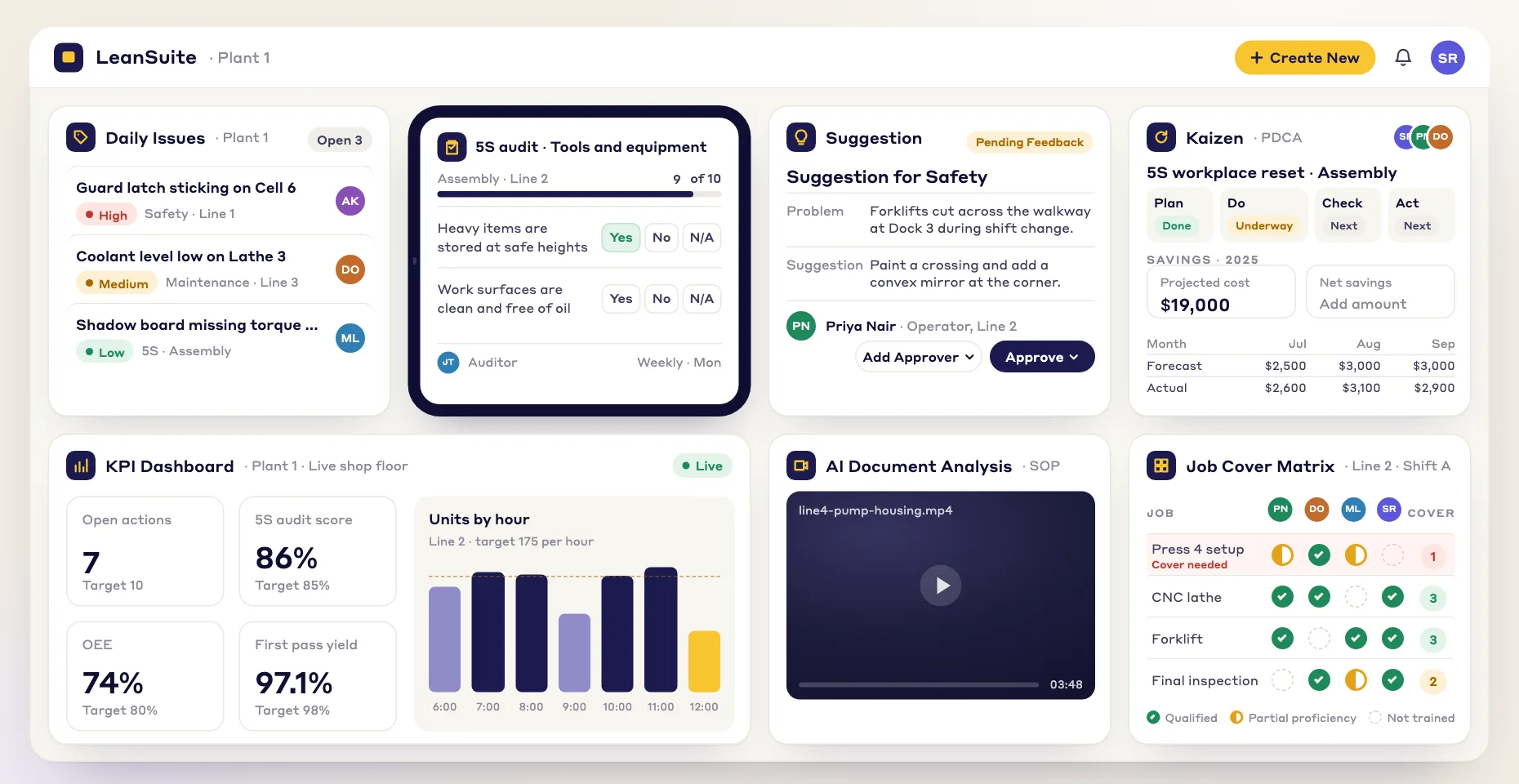
Real-time problem dashboards eliminate this lag by capturing problems digitally at the moment and location of observation, making issues immediately visible to all stakeholders regardless of shift or department.
The Economic Cost of Information Delay
Manufacturing facilities operating with traditional shift reports incur costs beyond supervisor documentation time. Four distinct cost categories quantify the shift report penalty.
Direct Supervisor Capacity Consumption
Shift report creation consumes 20-40 minutes at shift end when operational demands peak during equipment shutdown and personnel transition. One automotive components manufacturer calculated this consumed 18% of total supervisor capacity, equivalent to having two fewer supervisors available. Incoming supervisors spend additional 15-25 minutes reviewing documentation during the critical startup window when equipment issues require immediate attention.
Response Delay Multiplication Effect
Information lag between problem observation and stakeholder awareness multiplies problem severity. Research from Purdue University indicates response delay increases remediation costs by 3-7 times compared to immediate intervention. A bearing vibration detected during operation but reported hours later progresses to complete failure requiring emergency breakdown rather than scheduled replacement.
Information Loss During Handoff
Studies from Georgia Tech show shift handoff processes lose 40-60% of operational context compared to continuous visibility. Loss occurs through selective documentation where supervisors record only major issues, interpretation filtering where significance gets assessed differently, and format constraints where templates cannot capture operational complexity.
Leadership Visibility Gap Creating Reactive Management
Shift report systems create leadership visibility gaps where plant managers, maintenance coordinators, and quality engineers lack real-time operational awareness. One electronics manufacturer discovered their quality engineering team learned about in-process defects an average of 11 hours after operator detection, preventing real-time investigation when production context remained fresh.
Key Insight: Shift reports cost 18% supervisor capacity, delay response 4-8 hours multiplying costs 3-7x, lose 40-60% context, force reactive management.
Why Paper Based Shift Reports Persist Despite the Inefficiencies
Manufacturing shift reports persist because several interconnected factors create organizational resistance to digital alternatives. Understanding these persistence mechanisms explains why transformation requires deliberate system replacement rather than incremental improvement.
Established Workflow Integration
Shift reports integrate into established workflows where supervisors and stakeholders understand exactly how information flows. This workflow familiarity creates switching costs where digital alternatives require learning new systems. The result is organizational inertia where known inefficiency gets tolerated because transition effort appears costlier than ongoing waste.
Technology Deployment Concern
Digital dashboard deployment raises concerns about complexity, training requirements, and connectivity reliability. These technology concerns often exceed actual deployment complexity, but perception drives behavior. The anticipated complexity creates resistance even when modern dashboard solutions operate with consumer-grade simplicity requiring minimal training.
Audit Trail and Compliance Requirements
Regulated industries require documented shift operations for compliance verification. Paper reports provide physical evidence that feels safer than digital systems. However, this concern reflects unfamiliarity with digital audit capabilities rather than regulatory limitations. Modern dashboard systems provide superior audit trails with timestamped entries, user attribution, and modification history.
Management Review Habit Dependency
Plant managers have established habits around reviewing shift reports during morning meetings. Digital dashboards disrupt these habits by making information continuously available rather than delivered in periodic batches. The management practice changes feel destabilizing even when improved information access would enhance decision quality.
Key Insight: Reports persist through workflow familiarity, technology fears, compliance concerns favoring paper, and management habits around periodic batches.
How Real-Time Problem Dashboards Work
Real-time problem dashboards replace delayed shift report cycles with continuous digital capture making problems visible to all stakeholders at the moment issues occur. Four integrated capabilities fundamentally change how facilities detect, communicate, track, and resolve operational problems.
Immediate Problem Capture at Source
Real-time dashboards enable operators to document problems instantly using mobile devices at problem locations. The immediate capture occurs through simple interfaces requiring minimal input: problem type, location, severity rating, and optional photo. Entry takes 30-90 seconds. One food processing facility reported immediate capture increased problem documentation by 340% compared to shift reports because operators could record minor issues previously undocumented.
Automatic Stakeholder Notification and Assignment
Dashboard systems automatically notify relevant stakeholders when problems get reported based on issue type, severity, and location. Equipment problems route to maintenance with automatic assignment to qualified technicians. The notification system operates continuously rather than waiting for shift transitions. Research from MIT indicates immediate notification reduces average response time by 75% compared to shift report cycles.
Centralized Visibility Creating Operational Transparency
Real-time dashboards provide centralized visibility where all stakeholders access current operational status regardless of shift or location. Plant managers view developing issues across the facility without waiting for shift reports. When dashboard visibility shows three similar equipment issues across different lines, maintenance recognizes systemic problems requiring root cause investigation.
Comprehensive Digital Audit Trail Replacing Paper Documentation
Dashboard systems create comprehensive digital audit trails documenting problem identification, stakeholder notification, response actions, and resolution verification. Every entry includes timestamp, user attribution, location data, and modification history. Average response time from identification to technician arrival becomes measurable. The comprehensive documentation transforms operations management from anecdotal assessment to quantitative analysis.
Key Insight: Dashboards eliminate lag through mobile capture at source, automatic routing, centralized visibility, and digital trails without manual burden.
Building Dashboard Systems That Get Used
Successful dashboard implementation depends on designing systems that accommodate frontline operational realities rather than imposing technology requirements that conflict with production demands. Four design principles determine whether dashboards transform operations or join failed technology initiatives.
Minimal Input Requirements Reducing Documentation Burden
Effective dashboard systems require minimal information input, typically three-five fields taking 30-90 seconds. Required fields include problem type from predefined categories, equipment identifier from dropdown menus, severity rating, and brief description with optional photo. One aerospace manufacturer reduced dashboard input fields from 18 to 5 and saw problem reporting increase from 12 to 47 entries per shift as documentation friction dropped below adoption threshold.
Closed-Loop Feedback Demonstrating Reporter Value
Dashboard systems must provide immediate feedback showing problem reporters that their entries create action. The feedback occurs through automatic stakeholder notification, status updates visible to reporters, and resolution confirmation. When operators document equipment issues and see maintenance assignment notifications followed by technician arrival and problem closure updates, the value proposition becomes obvious.
Single-Device Simplicity Eliminating Training Barriers
Manufacturing dashboard systems must operate through single-device simplicity where mobile phones or tablets provide complete functionality. The mobile-first design enables problem documentation at locations where issues occur. The single-device approach eliminates training barriers by leveraging familiar consumer technology interaction patterns. One automotive supplier reported successful dashboard adoption with 15-minute training sessions because mobile interface matched everyday device usage.
Offline Capability Respecting Connectivity Reality
Manufacturing facilities face connectivity challenges in metal buildings and equipment-dense environments. Effective dashboard systems include offline capability where mobile devices cache problem entries during connectivity interruptions and automatically synchronize when connection restores. The offline functionality prevents operational disruptions during connectivity gaps that would otherwise block problem documentation.
Key Insight: Adoption requires minimal input (30-90s, 3-5 fields), closed-loop feedback, mobile simplicity, and offline capability during connectivity gaps.
Measuring Dashboard Effectiveness
Systematic measurement validates transformation value while identifying performance improvement opportunities. Four metrics provide comprehensive visibility into dashboard effectiveness while remaining simple enough for daily operational tracking.
Problem Documentation Volume and Timeliness
Problem documentation volume measures how many issues get captured daily compared to traditional shift report baselines. Successful dashboard implementation typically increases documented problem volume by 200-400% as reduced documentation burden enables recording of minor issues previously unreported. Documentation timeliness tracks average delay between problem occurrence and entry creation, with target performance showing 90%+ of problems documented within 30 minutes of observation.
Average Response Time From Problem Identification to Action
Response time measures elapsed duration from problem entry creation to qualified stakeholder assignment and initial response action. Successful dashboard systems reduce average response time from 4-8 hours under shift report cycles to under 2 hours with high-priority issues receiving response within 30 minutes. One electronics manufacturer reduced average equipment response time from 6.2 hours to 1.4 hours through dashboard implementation, preventing 65% of emergency breakdowns.
Shift Handover Effectiveness and Continuity
Shift handover effectiveness measures whether incoming shifts start with complete operational awareness. The assessment includes percentage of ongoing problems known to incoming supervisors and average time required to achieve operational awareness. Successful dashboards reduce handover preparation time from 20-30 minutes to under 10 minutes while increasing operational awareness from 60-70% to 95%+ of active issues.
Supervisor Capacity Liberation for Leadership Activities
Supervisor capacity liberation quantifies time freed from documentation and coordination activities. The assessment tracks supervisor time spent on shift report creation, information aggregation, and problem coordination. Target performance liberates 60-90 minutes per shift from documentation activities, equivalent to 15-20% capacity increase available for operational improvement. One automotive supplier calculated dashboard implementation freed 140 combined hours weekly across supervisory roles, equivalent to adding three full-time resources without headcount increases.
Key Insight: Metrics: 200-400% documentation increase, response drops from 4-8h to under 2h, 95%+ handover awareness in 10min, 60-90min capacity freed.
Getting Started Without Technology Investment
Facilities can begin dashboard transformation without technology investment by implementing paper-based problem boards that demonstrate value before digital deployment. Three straightforward actions cost nothing while establishing the foundation for eventual digital implementation.
Implement Shift Problem Boards in Production Areas
Install whiteboards or bulletin boards in production areas where operators document problems on index cards immediately upon discovery. Each entry includes problem description, equipment location, time observed, reporter name, and severity rating. The physical board eliminates documentation delay by enabling immediate capture without waiting for shift end reports. One food processing facility reported a 180% increase in documented problems using board systems before digital dashboard deployment because immediate capture eliminated documentation friction.
Establish Color-Coded Status Tracking
Implement simple status tracking using colored dots or markers on problem cards: red for open/unassigned, yellow for assigned/in-progress, green for resolved/verified. The color coding provides instant status visibility enabling supervisors to identify response priorities through visual scanning. The status tracking creates accountability where problems cannot disappear as unresolved issues accumulate visual evidence of delayed action.
Conduct Weekly Problem Board Reviews
Hold weekly 15-minute team meetings reviewing problems documented on boards during previous week, discussing response effectiveness and identifying recurring patterns. The reviews demonstrate management attention to problem reporting encouraging continued documentation. The weekly reviews prepare organizations for dashboard analytics by establishing habits around data-driven problem management. Teams become accustomed to discussing problem frequency and response times creating readiness for dashboard metrics.
Key Insight: Physical boards with card documentation increase reporting 180%, color-coded status creates accountability, weekly reviews build data-driven habits.
Transitioning to Digital Dashboard Systems
Physical problem boards validate the immediate-capture approach while revealing workflow requirements and adoption patterns. Successful board implementation creates the foundation for digital transition by demonstrating stakeholder engagement and quantifying documentation increases. The transition from manual to digital systems preserves proven workflows while eliminating coordination limitations. Three considerations determine successful digital implementation.
Recognizing Digital Readiness Signals
Organizations recognize readiness for digital transition when physical board volume exceeds manual tracking capability requiring significant aggregation time. Multi-location coordination needs emerge when problems span production areas requiring stakeholder notification across departments that physical boards cannot provide. Leadership metric requirements exceed manual compilation capacity when decision-making demands trend analysis or response time measurement. The transition signal occurs not from board failure but from success creating information demands beyond manual capacity. Facilities typically reach digital readiness within 60-90 days of physical board implementation.
Preserving Proven Workflows in Digital Format
Digital dashboard systems build on physical board workflows that demonstrate success, preserving the immediate-capture principle while automating coordination. Mobile problem entry replicates index card documentation using familiar input fields with photo capture replacing written observations. Automatic stakeholder notification automates manual coordination where supervisors previously checked boards and communicated problems verbally. Centralized digital visibility replaces physical board walks, enabling remote access across all production areas simultaneously. One food processing facility preserved the 180% documentation increase achieved with physical boards while reducing supervisor coordination time by 65% through automated routing.
Pilot Implementation Strategy
Successful digital deployment begins with pilot implementation in production areas where physical boards demonstrated highest adoption. The pilot approach validates digital system usability, identifies training requirements, and demonstrates value before facility-wide investment. Pilot departments provide champion users who become advocates during broader deployment and generate success metrics that justify expansion. The pilot typically runs 30-45 days, sufficient to validate adoption patterns without extended deployment risk. Facilities expand from pilot areas using proven implementation patterns including training approaches and workflow integrations that succeeded.
Key Insight: Digital readiness emerges when board volume exceeds manual tracking. Digital preserves immediate-capture workflow, automates coordination, piloting in high-adoption areas.
Free for this topic: 5W1H template, 5 Whys template


