
Free template
8D report template
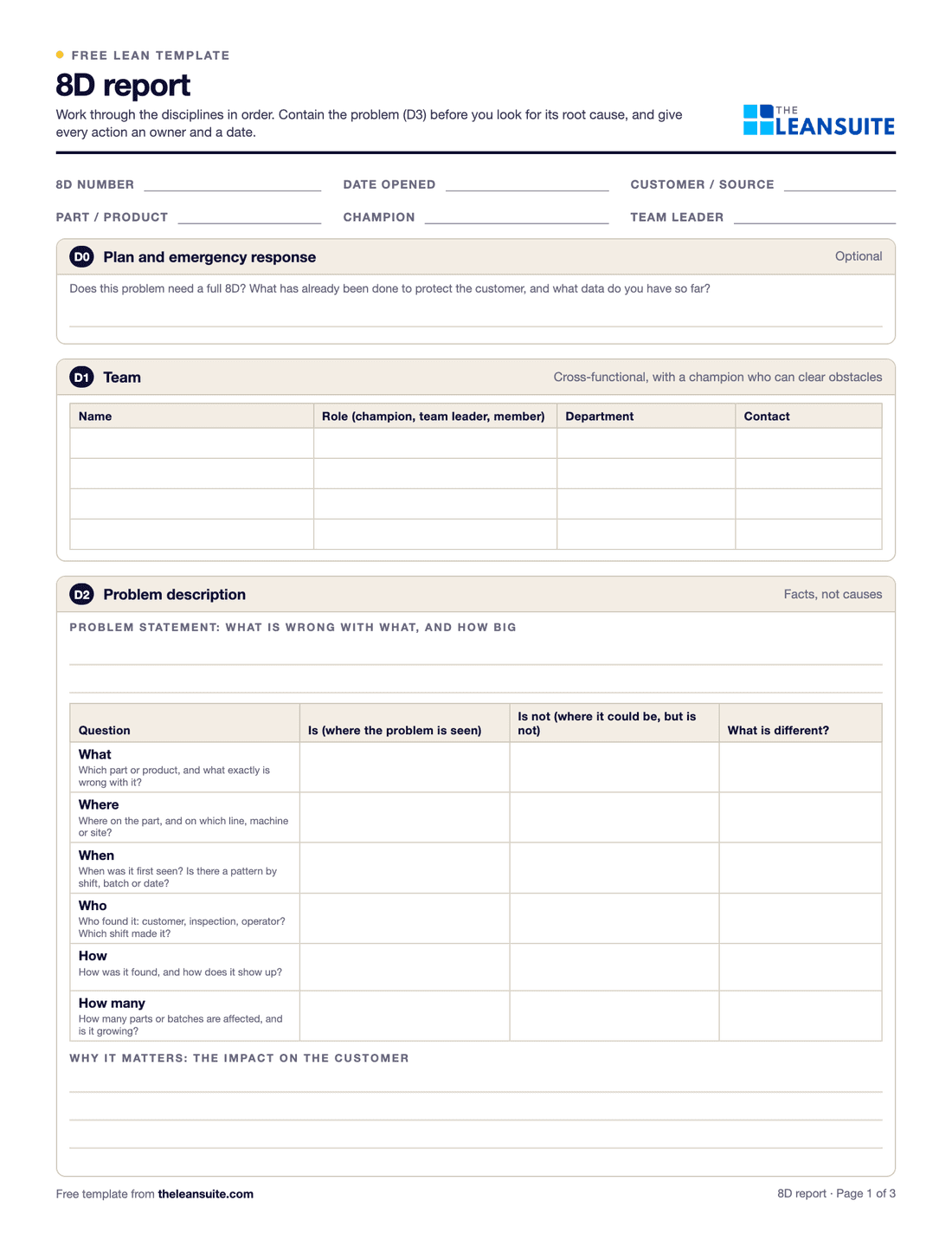
An 8D report is the record of an eight disciplines (8D) problem solve: a cross-functional team describes a serious or recurring problem, contains it to protect the customer, finds and confirms the root cause, puts in permanent corrective actions, proves they work and stops the problem coming back elsewhere. This template takes you through D0 to D8 on three portrait pages, with a 5W2H and is/is not table for the problem description, separate occurrence and escape root causes, and an owner and date for every action.
Free to use: print it, copy it and edit it for your team. Enter your name and work email once to download.
When to use it
When to use an 8D report
- A customer complaint or returned part, especially when the customer asks for a formal corrective action response.
- A problem that has come back after an earlier fix, which usually means the real root cause was missed.
- A problem whose causes cross several departments, such as production, maintenance, quality and a supplier.
- A safety-related or costly failure where the investigation must be documented.
- Not for everyday problems with one obvious cause: a 5 Whys with a small team is faster.
How to fill it in
- 1
Fill in the header and D0
The 8D number, part, customer or source, champion and team leader. In D0, record the emergency response already taken and confirm the problem needs a full 8D.
- 2
Form the team (D1)
People from each function that touches the process, a team leader who runs the 8D and a champion with the authority to free up time and money.
- 3
Describe the problem (D2)
Write a factual problem statement, then fill the is/is not table: what, where, when, who, how and how many, for where the problem is seen and where it could be but is not. The differences point toward the cause.
- 4
Contain it (D3)
Protect the customer while you investigate: sort suspect stock in the process, in the warehouse, in transit and at the customer, and record how many were checked and found bad. Containment is temporary, not the fix.
- 5
Find and confirm the root cause (D4)
Answer two questions separately: why did it happen (occurrence) and why was it not detected (escape). Use a fishbone diagram and the 5 Whys, and confirm each cause with data or a test.
- 6
Choose permanent corrective actions (D5)
At least one action for each confirmed root cause, with how you proved it works before rolling it out. Actions that make the defect impossible beat extra inspection.
- 7
Implement and validate (D6)
Record when each action went in and the data that shows the problem is gone, then remove the containment.
- 8
Prevent recurrence and close (D7 and D8)
Update the process FMEA, control plan, work instructions and training, check similar parts and lines, recognize the team and sign off.
A filled-in example
Illustrative, not a benchmarkAn 8D for a customer complaint about leaking hose assemblies.
- D2: leaks at one crimp on one part number, all from line 2 and all built after a crimp die change. Line 1 builds the same part without leaks.
- D3: suspect stock sorted in the warehouse and at the customer, and every part on line 2 pressure tested while the team investigates.
- D4: occurrence, the new die was set to the wrong crimp diameter because the setup sheet had no value for it; escape, the leak test checked one part per batch.
- D5 and D6: the crimp diameter added to the setup sheet with a first-piece check, and every part leak tested in line. The extra sort stopped only after several weeks of production with no leaks.
- D7: the same setup sheet gap found and fixed on line 1 and at the other crimp stations; process FMEA and control plan updated.
The customer gets one report that shows how they were protected, what caused the leak, why it got out, and why it will not happen again.
Common mistakes
Closing the 8D at containment
Once sorting stops the complaints, the pressure drops and the root cause is never found. The 8D stays open until D6 proves the fix.
Only asking why it happened
Without the escape root cause, the next defect gets out the same way. D4 needs both occurrence and escape.
A root cause nobody confirmed
A plausible cause agreed in a meeting is not a root cause. Confirm it with data or a test before choosing actions.
A team from one department
Causes in maintenance, purchasing or at a supplier stay hidden if nobody from there is on the team.
Skipping D7
The same root cause often exists on similar parts, lines or sites. Check them before they fail the same way.
In LeanSuite
Use this as a Lean Studio board
The same method is one of the 30 ready-made board templates in Lean Studio, LeanSuite's whiteboard: 8D Report, work a structured 8D problem-solving report from team formation through closure.
- Start from the 8D Report template: eight boxes in order, D1 to D8.
- Fill each box with stickies as the discipline completes, and link a fishbone or 5 Whys board for D4.
- Keep the board open until D8 so the team can see the disciplines still empty.
Worked example · sample data
The sample 8D handles a customer return of 14 units with a loose connector. D1 formed a team from quality, assembly and supplier QA. D2 described the problem by count and defect. D3 put a 100% pull test at final assembly from 3 June, so no further loose connectors could reach the customer while the cause was found. D4 traced it to a crimp tool worn past its limit. D5 chose a tool-life counter with replacement at 40,000 crimps, and D6 fitted counters on all three tools by 10 June. D7 added tool life to the PM plan, so the check no longer depends on anyone remembering. D8 closed after eight weeks with zero returns, and the team was recognised. The containment pull test was then withdrawn.
Open this board in LeanSuite
8D Report is one of the 30 ready-made boards in Lean Studio, LeanSuite's whiteboard. Try LeanSuite in your browser, or run it on your own lines for 90 days.
What Lean Studio isHow to run an 8D Report session
- 1D1 to D3 in the first 24 to 48 hours: name the team, describe the problem with what, where, when and how many, and put containment in place so the customer sees no more defects while the cause is found.
- 2D4: prove the root cause with data and an is/is-not comparison; a fishbone or 5 Whys board feeds this box. Ask why the defect was made and why it was not detected.
- 3D5 and D6: choose the corrective action that removes the cause, verify it works before rolling it out, then implement it and remove the containment.
- 4D7: change the system that allowed it: the FMEA, the control plan, the PM plan, the work instruction. This is the box most 8Ds leave thin.
- 5D8: close with the customer, record what was learned and recognise the team. Keep the board until the customer accepts the closure.
Common mistakes
- Leaving containment in place for months as if it were the fix.
- Jumping to D5 with a corrective action before D4 is proven.
- A D4 that says 'operator error'. Ask why the process let the error happen and why it was not caught.
- A thin D7. If the FMEA, control plan or PM plan did not change, the problem will return on a different part.
- Closing D8 without the customer's agreement.
Where it goes next in LeanSuite
- Run an 8D as a Kaizen project with your own defined method: eight phases with owners, due dates and the fields that must be filled in before a project can move on; a CAPA runs as a quality project with its own approval steps and root cause sections. Kaizen & Projects
- The D7 check can become a scheduled audit in Audit Management, so it is done and recorded rather than remembered. Audit Management
Download the template
Free to use: print it, copy it and edit it for your team. Enter your name and work email once to download.
Do this in LeanSuite
In LeanSuite, operators flag a non-conformance from the line with photos, containment is assigned and tracked before root cause analysis starts, and systemic issues run through an 8D template with a time-stamped sign-off at each D-step.
See Non-Conformance ManagementIn the lean glossary
Free tools
FAQ
8D report template: common questions
More free templates
All templates- 5S audit checklist template25 checks, five per S, scored 1 to 5, with a score summary and a chart of the five S's.
- Gemba walk checklistA walk plan and route, 30 prompts in six groups and a findings table with owners and due dates.
- A3 problem solving templateThe standard seven-box A3 on one landscape sheet, from background to follow-up.
- PDCA templateOne improvement cycle on one landscape page: plan, do, check against the goal, then standardize or adjust.
- 5 Whys templateA problem statement, five why rows with evidence, the root cause and the countermeasure.
- Skills matrix templatePeople by skills, a 0 to 4 scale, a training column and a coverage row that shows the gaps.
- Standard work sheet templateTakt time, each element's manual, machine and walk time on a time chart, key points and standard WIP.
- SMED changeover worksheetChangeover steps with times, internal or external, what can move, ideas and before/after totals.
- Kaizen event charter templateScope, team and roles, baseline and target metrics, a five-day schedule, risks and sign-off.