Skip to content
Try LeanSuite for 90 days for $3,000
LeanSuite - Lean Manufacturing Software

Compare

LeanSuite vs spreadsheets and paper

Short answer: Spreadsheets and paper are fine for a small team or a pilot, and plenty of good lean programs start on them. They break down at scale for specific reasons: copies of the same file drift apart, nothing reminds an owner that an action is due, there is no reliable record of who did what, operators on the floor often have no PC or account to open the file, reports are compiled by hand, a tick box can't show a photo of the condition, and every shift or plant ends up with its own version. Software like LeanSuite is worth it when those problems cost you more than the tool does.

This page is for plants running ideas, kaizen, audits and 5S, daily issues, the skills matrix and SOPs on Excel, SharePoint lists, whiteboards and paper. LeanSuite publishes it, so we have also listed the free templates and calculators that make a paper process work better.

Last reviewed September 2026. LeanSuite facts come from our own product pages; tell us if something has changed at info@theleansuite.com.

Where spreadsheets break down

None of these matter much for one team with one file. They start to matter as more people, shifts and sites depend on the same tracker.

  • Version conflicts

    The tracker gets emailed, copied and saved as "final v3". Two people update different copies and nobody is sure which one is current. A shared SharePoint list or online workbook helps, but only while everyone uses it and nobody keeps a local copy.

  • No follow-up or ownership

    A row with a name and a date does not chase anyone. Actions from audits and huddles stay open until someone rereads the sheet, and the due date passes without anyone being told.

  • No audit trail

    Cells can be overwritten, and file version history shows that something changed, not which check was done, by whom, and what they saw. That is hard to show an auditor or a customer.

  • Operators can't use it on the floor

    The file lives on a PC and usually needs a company account. Operators without either write on paper or tell a supervisor, and someone retypes it later, if they get to it.

  • Manual reporting

    Someone copies numbers from several tabs or files into the weekly chart. It takes hours, mistakes creep in, and the report is out of date by the time the meeting starts.

  • No photo evidence

    A tick or a score in a cell can't show what the area looked like. Photos end up on someone's phone, disconnected from the finding they prove.

  • Hard across shifts and plants

    Each shift and each site builds its own version in its own format. Rolling them up means reformatting, and a problem one shift fixed is invisible to the next.

Spreadsheets and paper vs LeanSuite, job by job

The jobs a lean program runs every week. The LeanSuite column says only what our product pages say; the sources are listed at the bottom of the page.

Swipe the table sideways to see every column.

Spreadsheets and paper compared with LeanSuite for each lean program job
JobSpreadsheets and paperLeanSuite
Improvement
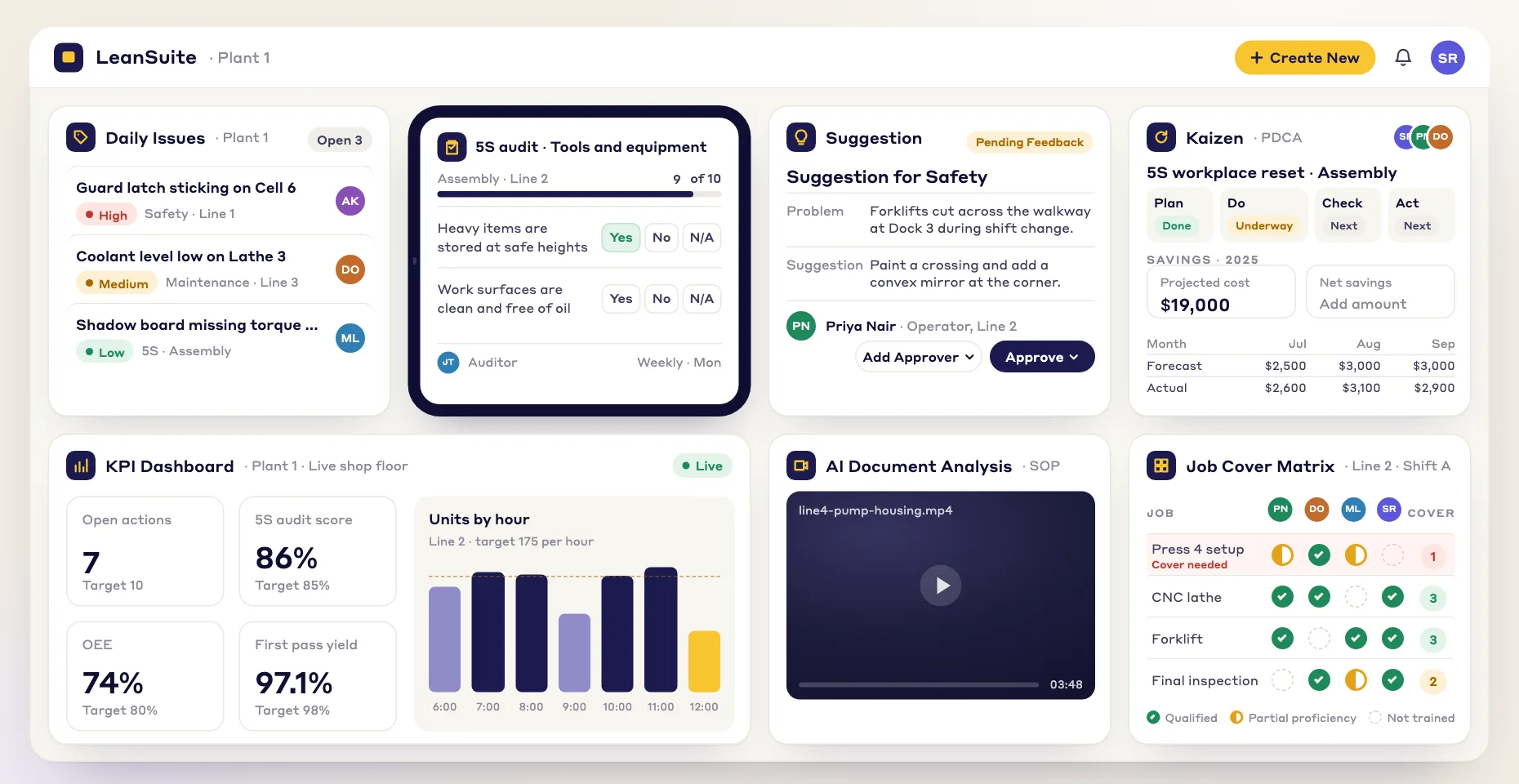
Ideas and suggestionsA suggestion box or a shared sheet. Works while one person reads every idea and replies. When that person is busy, ideas wait and the person who raised one rarely hears back.Idea Management: employees submit ideas from the shop floor, each goes to the right reviewer to approve or reject with feedback, and an approved idea gets an owner and becomes a Kaizen project. Points, a leaderboard and campaigns. Free for teams of 25 and under.
Kaizen and improvement projectsA project tab or an A3 on the wall. Status is whatever was typed last, and actual savings are only as current as the last manual update.Kaizen & Projects: a workflow for each project type, PDCA, A3 and DMAIC templates, due dates set from complexity and team availability, alerts on at-risk projects, and projected against actual savings. Kanban and Gantt views.
Checks and daily management
Audits and 5S checklistsA printed checklist or an Excel scoring sheet. Quick to start. Findings stay on the sheet or in a binder unless someone turns them into actions by hand, and there is no photo of the condition.Audit Management: build any checklist, or upload your Excel or PDF one and Lean AI builds a digital version. Schedule it, complete it on a phone or tablet with photos. Failed items become corrective actions with an owner and due date; a 5S CAPA can't close without a verification photo.
Daily issues and tier boardsA whiteboard by the line or an issues log. Very visible in the room, but the next shift, other areas and anyone looking for trends can't see it, and it is wiped each week.Daily Issue Management: operators scan a QR code, add a photo and a category, and rules route the issue to an owner with a due date and reminders. A recurring issue escalates to a Kaizen or A3 project in one click. Tiered meetings run on live, cascaded SQDCM boards.
People and standards
Skills matrixThe classic grid of people against skills. Clear and familiar, but only as current as the last time someone edited it.Competency Management: a live matrix whose proficiency levels update as employees complete tasks and training, gaps across the whole facility, training assigned in bulk, and shift coverage that shows single points of failure.
SOPs and work instructionsWord files in binders and shared drives. Copies drift out of date and it is hard to know which version is on the floor.AI SOP Creation drafts an SOP from one process video, with approval routing, e-signatures, version history and AI translation into other languages. Digital Work Instructions with numbered steps and photos.
Across the plant
ReportingSomeone copies figures from several files into a chart before each meeting.KPI Dashboards: every form, checklist and audit submitted shows up on dashboards right away. Build your own KPIs with a formula engine and set red-amber-green limits that flag a KPI as soon as new data crosses one. Existing sheets can feed in too: scheduled pulls from Excel on SharePoint or OneDrive and Google Sheets, CSV upload with column mapping, and Power BI or Looker Studio report embeds.
Multiple shifts and sitesEach shift or plant keeps its own files and formats, so a roll-up means reformatting first.A consolidated view of audit performance across all sites, and one standard audit deployed to every facility at once. Best Practice Management rolls an approved standard out to every site.
Operators on the shop floorNeeds a PC and usually a company account, so input often goes through a supervisor or a paper form first.Web, iOS and Android apps. Operators sign in with an employee ID, no company email needed.
CostUsually software you already have, or paper. The cost is the time spent keeping it up to date and chasing actions.Per facility with unlimited users; quote on request. 90-day pilot at $3,000 per facility, credited to the annual plan. Free Starter plan for idea management for teams of 25 and under.

When spreadsheets are enough

  • You run one area or a small team, one person owns the file, and everyone can see the board.
  • You are piloting: still working out what to track, which checklist questions matter and how often to audit. Changing a spreadsheet is faster than configuring any software.
  • Volume is low: a handful of ideas or audits a month that one person can follow up in person.
  • Results reach the file the same day, because the people doing the checks sit at a PC or a supervisor enters them after the shift.
  • Nobody outside the room needs the numbers: no roll-up across shifts or sites, and no auditor or customer asking for evidence.
  • The free templates below already cover what you do, and a good paper process beats a badly used tool.

Signs you've outgrown them

  • There is more than one copy of the tracker and people disagree about which is current.
  • Actions from audits and meetings are written down, then found still open weeks later with no clear owner.
  • Operators hand ideas and issues to a supervisor on paper or by word of mouth because they can't get to the file.
  • Building the weekly or monthly report takes someone hours of copying and pasting.
  • An auditor or customer asks for proof a check was done, and the proof is a tick in a cell.
  • Nobody trusts the skills matrix when you need to know who can cover a station today.
  • A second shift or a second plant keeps its own version in a different format.

Staying on paper? Do it well

If spreadsheets and paper are enough for now, a good format does most of the work. These templates are free, print-ready PDFs; the ones marked Excel also come as a spreadsheet, and each one downloads for your name and work email. See all of them at free lean templates.

How to move over

Moving one process at a time keeps the risk small and shows quickly whether software is worth it for you.

  1. Pick the process that hurts most

    Start with one: the audit whose findings never close, the idea box nobody answers, or the skills matrix nobody trusts. Run it in one area first, not the whole plant.

  2. Bring what you already have

    Your current checklist, skills grid and project list are the starting point. In LeanSuite you can upload an existing Excel or PDF checklist and Lean AI builds a digital version, including paper 5S audit sheets.

  3. Run a 90-day pilot

    LeanSuite's pilot costs $3,000 per facility and is credited to the annual plan if you continue. The first module is typically live in under a week. For idea management alone, teams of 25 and under can use the free Starter plan.

  4. Retire the old file

    Once the new process is running, archive the spreadsheet so there is only one place to look. Two systems in parallel for long is how version conflicts start again.

  5. Compare against where you started

    Look at the numbers you care about, such as audit completion, how long actions take to close, or how many ideas get an answer, and decide on the next module from there.

Details: the 90-day pilot and pricing, including the free Starter plan.

What customers say

  • “Great user-friendly software! It's covering everything that WCM or similar Lean Programs are asking to do, in a very effective way.”
    Marelli logoElena M.Global Head of Marelli Manufacturing System Automotive, Marelli
  • “The Project Tracking System generates significant savings while ensuring seamless delivery... The Global Kaizen Power Pitch completely transformed our ability to share best practices.”
    WhirlpoolRamsey AljahmiSr. Director of NAR Operations Excellence, Whirlpool Corporation
    Read the case study

FAQ

Spreadsheets vs software: common questions

Sources

Last reviewed September 2026. LeanSuite facts come from our own product pages; tell us if something has changed at info@theleansuite.com.

Outgrowing your spreadsheets?

Bring the tracker or checklist you run today. We will show you how the same process works in LeanSuite and what a 90-day pilot would cover.