
Lean and sustainability: Lean is the sustainability program your plant already runs
Every waste lean removes is material, energy or hours. Scrap you no longer make, machines that no longer idle, paper you no longer print. LeanSuite records the Kaizens, digital forms and time studies behind those reductions today. Turning them into carbon, energy and paper figures is the next step, and this page shows what that would look like.
The mechanism
How lean and going paperless reduce waste and emissions
No lean tool was invented for carbon. They were invented to stop making, moving and fixing what the customer never asked for. That is also what an emissions inventory counts.
Scrap and rework
A defective part has already used its material and the energy to make it. Fixing it uses energy again; scrapping it sends the material to waste. Every defect a Kaizen removes takes both out.
Overproduction and inventory
Parts made before they are needed sit in storage, get moved twice, and some go obsolete. Pull systems and takt-paced lines make less that nobody asked for.
Energy
Machines idling through downtime, long changeovers and waiting still draw power. Shorter changeovers, fewer stops and planned shutdowns cut the kilowatt-hours that produce nothing.
Water and utilities
Washdowns, cooling and compressed air scale with how often a line stops and restarts. Stable flow means fewer of each.
Paper
A paper audit, checklist or log is printed, carried, filed and eventually shredded. A digital form is filled on a phone or tablet and never printed at all.
Transport and motion
Forklift trips, walking and searching burn fuel and hours. Layout changes found in a time and motion study remove trips that add nothing to the product.
What exists today
What LeanSuite records that an impact report would draw on
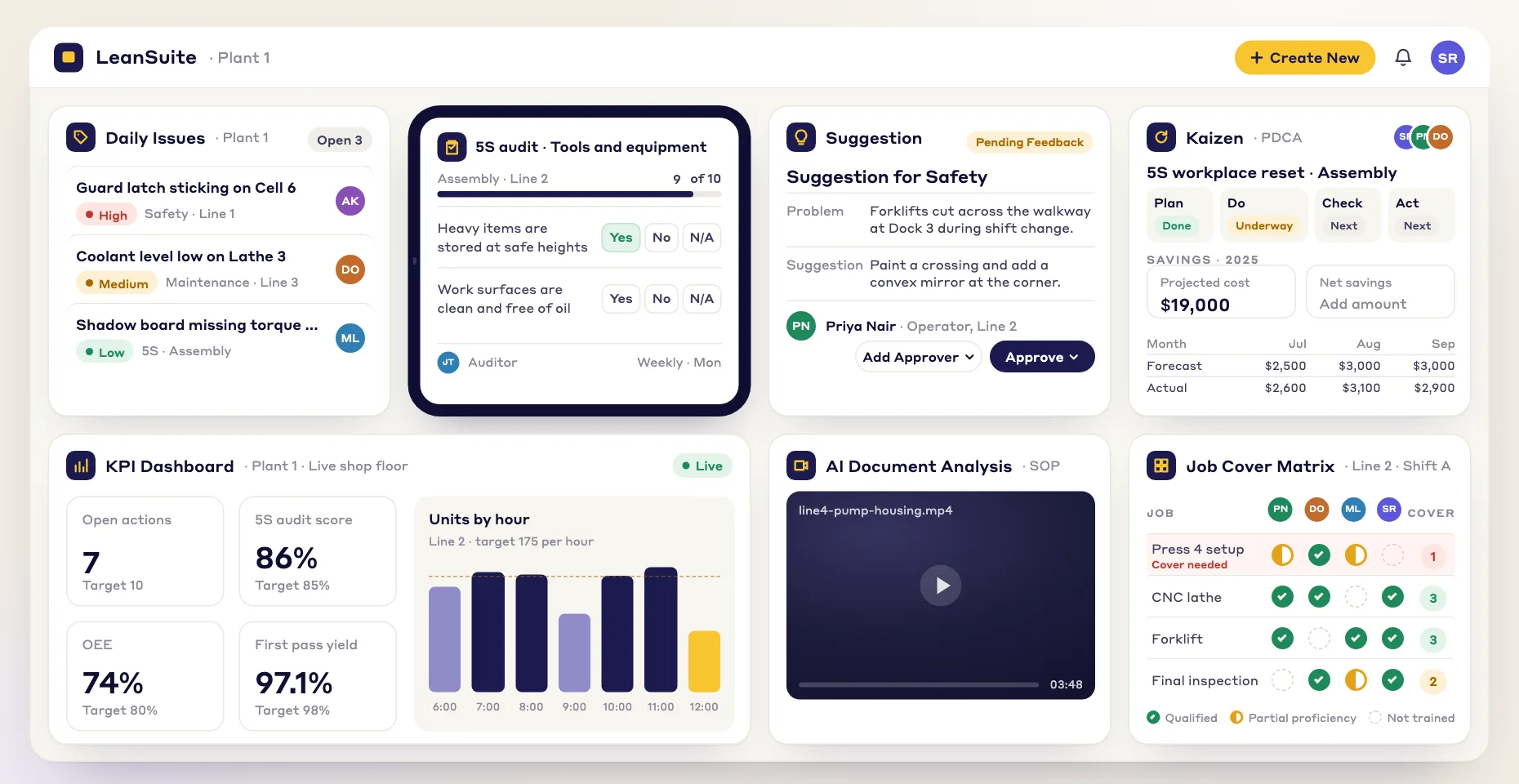
Three modules already hold the activity data: verified Kaizen savings, forms filled digitally instead of on paper, and time studies from video. None of them converts to carbon, energy or water yet.
Kaizen and project savings
Each Kaizen, CAPA, CapEx or engineering project runs from idea to verified savings. Teams record hard and soft savings, cost avoidance and capital spend, and track projected and actual savings against plant and company targets. A scrap-reduction Kaizen is already a scrap record with a date, an owner and a verified saving.
Kaizen and projectsDigital forms in place of paper
Lean Creator turns any paper process into a digital form: inspections and audits, checklists, surveys and trainings. Upload an existing paper form and the AI drafts the digital version. Every completed form is a form that was not printed.
Document builderVision AI time studies
One process video becomes a time and motion study with each operator's time split into value-added, semi-value-added and non-value-added, waste categories (TIMWOODS) detected automatically, and line-balancing scenarios saved with the minutes and cost they save.
AI video analysis
Your Lean Impact
What a Lean Impact report could look like
Carbon avoided, energy saved, scrap cut, water saved, paper removed, hours given back and dollars saved, each traced to the Kaizens and forms behind it. This is an example with sample data: LeanSuite does not produce it today, and no customer figures appear here.
Your Lean Impact
Example plant, one quarter
Carbon avoided
12.4t CO2e
Source: eGRID + WARM factors
Energy saved
18,600kWh
Source: Plant meter readings
Scrap cut
3,150kg
Source: Kaizen scrap records
Water saved
41,000litres
Source: Plant meter readings
Paper removed
26,800sheets
Source: Forms filled digitally
Hours given back
1,240hours
Source: Time studies + Kaizens
Dollars saved
$184,000
Source: Verified Kaizen savings
Sample only
Not a customer result. Shows the shape of the report, not a number anyone achieved.
Kaizens feeding this report (sample)
- Scrap reduction on line 31,900 kg scrap cut
- Digital 5S audits, all areas9,200 sheets paper removed
- Idle-time shutdown on press 27,400 kWh energy saved
Methodology
How the numbers would be worked out
Public emission factors, applied to what the plant enters. The same Kaizen gives different figures on different grids and with different paper, so every number would carry its factor, source and version.
Electricity
EPA's Emissions & Generation Resource Integrated Database publishes emission rates for electricity by grid region and subregion. A kilowatt-hour saved in one subregion avoids a different amount of CO2e than in another, so the plant's location picks the factor.
US EPA eGRIDScrap, waste and paper disposal
EPA's Waste Reduction Model compares greenhouse-gas emissions and energy across materials management practices: source reduction, recycling, combustion, composting and landfilling. Its documentation has chapters for metals and paper products, which is where a scrap or paper figure would be converted.
US EPA WARMPaper production
The Paper Calculator estimates wood use, net energy, greenhouse gases, water and solid waste for a quantity of paper by grade and recycled content. Sheets removed by digital forms would be weighed, then run through it. EPA's paper and paperboard facts page gives the national recycling context.
Environmental Paper Network Paper CalculatorHours and dollars
Hours given back come from time studies and Kaizen records; dollars saved are the verified Kaizen savings already tracked today. No factor is applied to either.
The plant's own records
Three plain rules
- The numbers depend on what a plant enters. No scrap weight, no scrap figure; no meter reading, no energy figure.
- Every figure shows its factor, the public source it came from and the data year, so a sustainability team can check it.
- Nothing is published for a plant without that plant's consent, and nothing is estimated where a record does not exist.
The factors we use today, with the exhibit each was read from, the unit conversions and what is not counted, are on one page: how LeanSuite estimates environmental impact.
Related reading: EPA's paper and paperboard facts and the WARM documentation.
FAQs
Lean, ESG and carbon questions, answered
Put the records in one place first
See the Kaizen, audit and Vision AI modules in the interactive tour, or run a 90-day pilot at your plant for $3,000 per facility, credited in full to the annual plan.