
Free template
5 Whys template
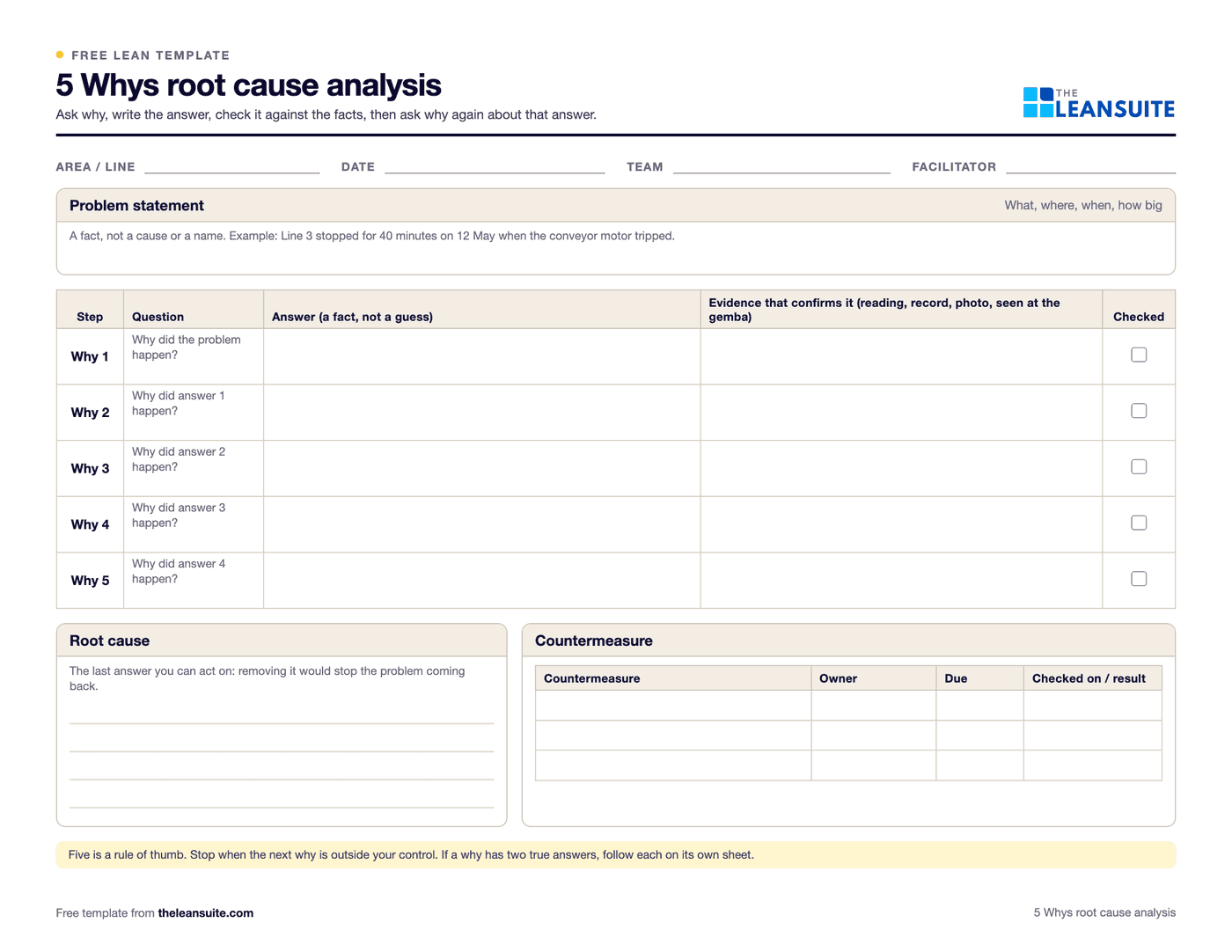
A 5 Whys template is a one-page worksheet for asking “why?” about a problem, one answer at a time, until you reach a cause you can act on. This one has a problem statement, five why rows each with a column for the evidence that confirms the answer, a root cause box, and a countermeasure table with an owner and due date. Five is a rule of thumb: stop when the next why is outside your control or when removing the answer would stop the problem coming back.
Free to use: print it, copy it and edit it for your team. Enter your name and work email once to download.
When to use it
When to use the 5 Whys
- A problem with one clear chain of cause and effect, such as a machine stoppage, a defect or a missed shipment.
- Soon after the problem happens, while the evidence is still there to check.
- Inside a bigger method, for example in the root cause box of an A3 or the root cause step of an 8D.
- Not for problems with many interacting causes: start with a fishbone diagram and use the 5 Whys on its most likely branches.
How to fill it in
- 1
Write the problem statement
What happened, where, when and how big, as a fact rather than a cause or a name. For example: line 3 stopped for 40 minutes on 12 May when the conveyor motor tripped.
- 2
Ask why it happened
Write the answer in the first row.
- 3
Check the answer before moving on
Go to the gemba and write in the evidence column what confirms it: a reading, a record, a photo. Tick the checked box.
- 4
Ask why again about that answer
Repeat until you reach a cause that, if removed, would stop the problem coming back. It may take three whys or seven.
- 5
Write the root cause and the countermeasure
The countermeasure should address the root cause you wrote down. Give it an owner and a due date.
- 6
Check that it worked
After a set time, record whether the problem has come back in the checked on / result column.
A filled-in example
Illustrative, not a benchmarkA packaging line stops because a conveyor motor tripped.
- Why 1: the motor tripped because it overheated. Evidence: the thermal overload log.
- Why 2: it overheated because a bearing was dry. Evidence: maintenance found no grease.
- Why 3: the bearing was dry because it is not on the lubrication route. Evidence: the CILR checklist.
- Why 4: it is not on the route because the conveyor was added after the route was written.
- Why 5: installing equipment has no step to update the maintenance routes.
Root cause: equipment changes do not trigger an update to maintenance routes. Countermeasures: add the bearing to the route now, and add a route update to the installation checklist, each with an owner and a date.
Common mistakes
Stopping at “operator error”
People make mistakes when the process lets them. Ask why the process allowed it.
Guessing answers in a meeting room
Every answer should have evidence next to it. An unchecked answer sends the whole chain the wrong way.
Following one path when there are several causes
If a why has two true answers, follow each one as its own chain.
Jumping to a favourite fix
The countermeasure should remove the root cause on the sheet, not the first idea someone had.
Going past what you can act on
Stop at the last cause within your control. “Because customers want low prices” is not a root cause a team can fix.
In LeanSuite
Use this as a Lean Studio board
The same method is one of the 30 ready-made board templates in Lean Studio, LeanSuite's whiteboard: 5 Whys, drill from a symptom to its root cause in five steps.
- Start from the 5 Whys template: the problem sits at the top and five stickies hang below it, joined by arrows.
- Type each answer on its sticky; add a branch with a second column of stickies when one why has two causes.
- Put the countermeasure on a coloured sticky at the bottom and save the board to My templates for the next problem.
Worked example · sample data
The sample board starts with a 40-minute stoppage on press 2 on Tuesday. Why? The clamp lost pressure. Why? A hydraulic hose split. Why? The hose had been rubbing on the guard. Why? The guard was refitted without its clip. Why? The refit instruction does not mention the clip. Each answer is something the maintenance technician could see or check, and read backwards with 'therefore' the chain holds. Stopping at the hose would have meant a new hose and the same failure in a few months; the fifth why reaches a document the team can change. The countermeasure at the bottom is to update the refit instruction and add the clip to the CILR check, so the next operator inspecting the press looks for it.
Open this board in LeanSuite
5 Whys is one of the 30 ready-made boards in Lean Studio, LeanSuite's whiteboard. Try LeanSuite in your browser, or run it on your own lines for 90 days.
What Lean Studio isHow to run a 5 Whys session
- 1Start from one problem, one occurrence: 'Press 2 stopped for 40 minutes on Tuesday', not 'press 2 keeps stopping'.
- 2Go to where it happened with the people who were there, and answer each why with something they saw or can check, not with an opinion.
- 3Write each answer on its own sticky and read the chain backwards: 'therefore' should link every step. If it does not, the chain has a gap.
- 4Stop when the answer is a process, standard or system the team can change. Five is a guide; some chains need three, some seven.
- 5Write the countermeasure against the last why and give it an owner and a date. Then check, weeks later, that the problem has not returned.
Common mistakes
- Stopping at the first cause that suggests a fix: a new hose is a repair, not a countermeasure.
- Answering a why with a person's name. 'The operator forgot' asks for a next why: why was it possible to forget?
- Branching into three causes at each level, which is a fishbone, not a 5 Whys. Pick the likeliest branch and follow it.
- Doing it at a desk from memory. Each answer should be checkable on the floor.
- Not verifying. A chain that reads well is a hypothesis until the countermeasure holds.
Where it goes next in LeanSuite
- Add a 5 Whys section to any phase of a Kaizen project and push its countermeasure into the action plan with an owner and a due date. Kaizen & Projects
- A tag raised on the floor that keeps coming back can be escalated into a Kaizen or A3 project in one click, keeping the tag's history. Daily Issue Management
- The RCA Agent drafts the 5 Whys from a problem description and attached manuals, for the team to edit. AI Root Cause Analysis
Download the template
Free to use: print it, copy it and edit it for your team. Enter your name and work email once to download.
Do this in LeanSuite
In LeanSuite you describe the problem in plain words and attach what you know, the RCA Agent drafts the 5 Whys, 5W1H and fishbone from it, and you edit the result and send the countermeasures to the action plan.
See AI Root Cause AnalysisIn the lean glossary
Free tools
FAQ
5 Whys template: common questions
More free templates
All templates- 5S audit checklist template25 checks, five per S, scored 1 to 5, with a score summary and a chart of the five S's.
- Gemba walk checklistA walk plan and route, 30 prompts in six groups and a findings table with owners and due dates.
- A3 problem solving templateThe standard seven-box A3 on one landscape sheet, from background to follow-up.
- PDCA templateOne improvement cycle on one landscape page: plan, do, check against the goal, then standardize or adjust.
- 8D report templateD0 to D8 on three pages: team, is/is not, containment, occurrence and escape causes, actions and closure.
- Skills matrix templatePeople by skills, a 0 to 4 scale, a training column and a coverage row that shows the gaps.
- Standard work sheet templateTakt time, each element's manual, machine and walk time on a time chart, key points and standard WIP.
- SMED changeover worksheetChangeover steps with times, internal or external, what can move, ideas and before/after totals.
- Kaizen event charter templateScope, team and roles, baseline and target metrics, a five-day schedule, risks and sign-off.