
Skip to content
Try LeanSuite for 90 days for $3,000
LeanSuite - Lean Manufacturing Software

Time and motion study: Time and motion study software that works from a phone video

LeanSuite's AI time study replaces the stopwatch: film the process, and the AI times every element, splits value-added work from waste and links each figure to the video frame it came from. You review, correct and certify the study.

  • 10x

    faster studies: what took a senior IE 2 weeks now takes an afternoon

  • 90%

    of the stopwatch-study effort eliminated by letting AI watch the video

  • 4 hours

    per single upload; longer studies stitch segments together

  • 1080p

    smartphone footage is all you need; no camera crew

What it is

What a time and motion study measures

A time and motion study times each element of a task and records how the work is done, so you can separate value-added work from waste, set a standard and balance the line against takt.

How it works

An AI time study from a phone video

Record the process, upload it and get the study back, linked to the frames it came from.

  1. Capture

    Record the process on a phone, tablet or fixed camera. No special hardware required.

  2. Upload and tag

    Drop the video into LeanSuite, pick the time and motion study and tag the workstation or line.

  3. Get the analysis

    The AI detects each operator and splits their time into value-added, semi-value-added and non-value-added on a timeline synced to the video.

  4. Review, correct and certify

    Correct anything the AI got wrong, certify the study as the reference for later ones and turn findings into Kaizens in one click.

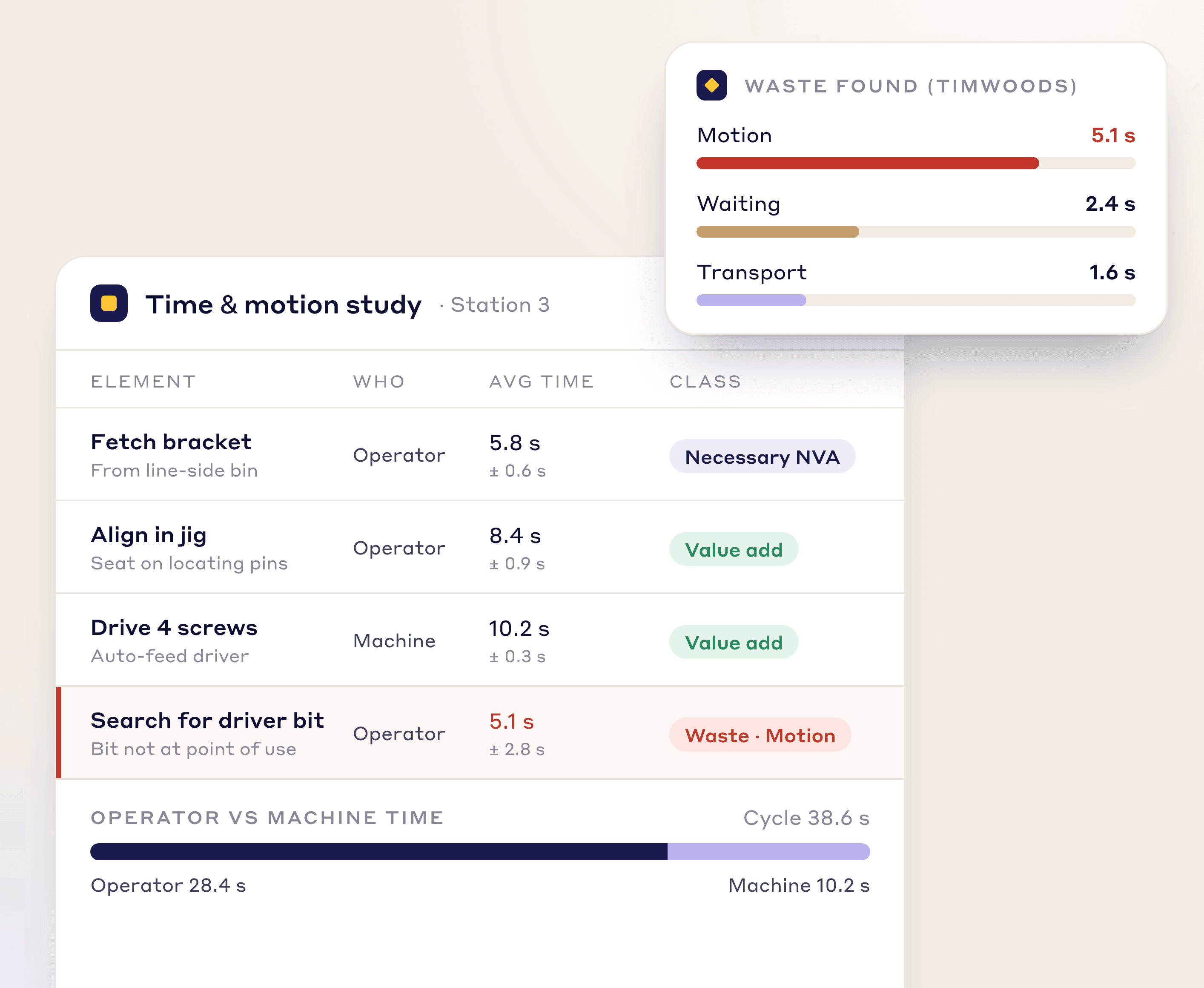
Time and motion study listing each element's average time, whether it is operator or machine time, and its value-add or waste class, with a waste breakdown by type

What you get back

  • Per-element timing with statistical variance
  • Value-added, semi-value-added and non-value-added split
  • Waste categories (TIMWOODS) detected automatically
  • Operator vs. machine time separation
  • Every figure linked to its source frame
  • Findings that become Kaizens in one click

What you get

The outputs of a video time study

Everything a stopwatch study produces, plus the video behind each number.

  • Per-element timing

    Each element's time with its statistical variance, on a timeline synced to the video.

  • Value-added vs. waste

    Every operator's time split into value-added, semi-value-added and non-value-added, with waste categories (TIMWOODS) detected automatically.

  • Operator vs. machine time

    Operator time and machine time separated, so you see who is waiting on what.

  • A certified reference study

    Certify a checked study and it becomes the reference for later studies of the same process.

  • Before-and-after comparison

    Compare two or more studies by operator or for the whole process.

  • Findings that become Kaizens

    Turn a finding into a Kaizen in one click, and go on to line balancing from the same footage.

Manual vs. video

Stopwatch study or video time study

A stopwatch study means timing every element and building charts by hand. LeanSuite eliminates 90% of that effort by letting AI watch the video.

Stopwatch study

  • One element at a time

    An observer times each element by hand, then builds the charts in a spreadsheet.

  • Observer bias

    Operators work differently when watched, numbers get rounded and micro-stops are missed.

  • No record

    Once the study is written up, there is nothing to check a figure against.

Video time study in LeanSuite

  • Every element from one video

    The AI splits each operator's time on a timeline synced to the footage.

  • Zero observer bias

    The AI measures every cycle the same way: no Hawthorne effect, no rounded numbers, no missed micro-stops.

  • Permanent visual record

    Every output links back to its source frame, and six studies run on the same footage with no re-shoots.

FAQs

Time and motion study questions, answered

Ready to replace the stopwatch?

Bring one video of your line and see the time and motion study, Yamazumi chart and findings it produces, or run a 90-day pilot on your own lines.