
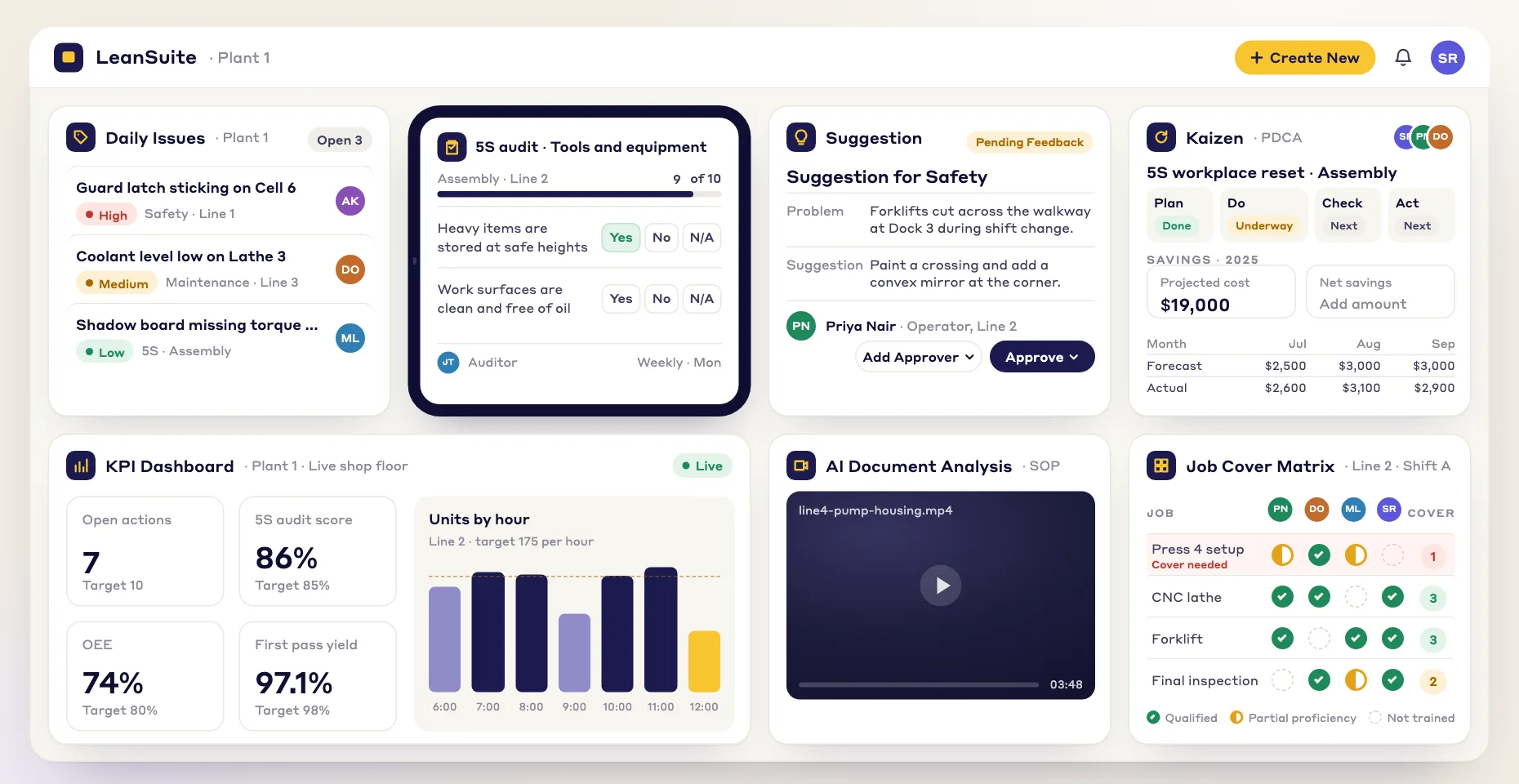



A kaizen event is a structured, cross-functional improvement effort run over three to five days on the shop floor. What determines whether it delivers lasting results or generates activity without lasting change is not the improvement methodology. It is the project management discipline applied before, during, and after the event week. Most kaizen events fail not in execution but in scoping, accountability, and closure: the three project management stages that define whether a verified, sustained result is possible.
Research from the Kaizen Institute shows that kaizen events with properly defined scope, structured facilitation, and 30-day follow-up plans are significantly more likely to sustain their gains than those run informally. Scope is consistently identified as the number-one success factor: too broad and the team cannot finish within the event window; too narrow and the improvement does not justify the investment of cross-functional time and production disruption.
This blog covers how to manage a kaizen event as a structured improvement project, treating each stage as a discrete phase with defined deliverables and accountability.
Kaizen Events vs Daily Kaizen: Understanding the Scope Difference
Before scoping a kaizen event, the right question is whether a kaizen event is the right vehicle for the improvement. Two forms of kaizen (改善) operate at different scales in manufacturing organizations, and confusing them produces events that are either too large to complete or too small to justify.
Daily Kaizen: Small Improvements at the Point of Work
Daily kaizen covers small, incremental improvements made by individuals or small teams as part of normal work. An operator repositions a tool holder to eliminate a reach. A material handler redesigns a cart route to reduce travel distance. These improvements require no formal event structure. They happen continuously as part of the work itself and compound over time into significant operational gains.
Daily kaizen is captured through the suggestion system and kaizen teian (改善提案) process covered in What is a Suggestion System?. It does not require event-level resource allocation.
Kaizen Events: System-Level Improvements Requiring Cross-Functional Effort
Kaizen events address improvements that require multiple functions working together, cannot be completed during normal production, or need physical reconfiguration that requires production downtime. A changeover reduction targeting a specific machine family, a cell layout redesign to improve flow between operations, and a quality escape investigation requiring production, quality, and engineering involvement simultaneously are all appropriate kaizen event targets.
The decision rule is straightforward:
- If one person can implement the improvement alone during normal work, it is daily kaizen
- If the improvement requires cross-functional coordination and dedicated time away from production, it is a kaizen event
Key Insight: Scope is the single most important kaizen event decision. It determines whether the team can finish, and whether the result justifies the investment.

Phase 1: Scoping the Kaizen Event
Scoping a kaizen event means defining three things with precision before any team member is assigned or any production time is allocated: the specific problem the event will address, the measurable target that will define success, and the explicit boundary of what the event will and will not address.
Defining the Problem With Data
Kaizen events scoped from gut feeling produce unfocused events. Kaizen events scoped from data produce targeted improvements. The scoping conversation should begin with production data: OEE trends, defect rates, cycle time measurements, first pass yield records that confirm the problem is real, quantify its magnitude, and identify where in the process it originates.
Value Stream Mapping: A Beginner's Complete Guide provides the process-level view that identifies which areas in the value stream contain the most significant improvement opportunity. The output of a current-state value stream map is one of the strongest inputs to kaizen event selection because it quantifies waste at each process step rather than relying on the loudest current complaint.
Setting a Measurable Target
Every kaizen event requires exactly one primary metric that will confirm success. Not a list of improvements the team hopes to make, but a single number that defines the improvement the event will deliver. Reduce setup time from 47 minutes to under 20 minutes. Increase first pass yield on line 4 from 87 percent to 95 percent. Reduce defects at the final assembly station from 12 per shift to under 3.
A measurable target serves two functions. It focuses the event team on the most direct path to the improvement and it provides the verification criterion for the 30-day follow-up audit that confirms the gain has held.
Defining the Scope Boundary
Scope boundary definition is as important as target definition. The event charter should explicitly state what the team will not address, because kaizen events that allow scope expansion during the event week run out of time before they deliver results.
A useful format: "This event will address [specific process/area/problem]. It will not address [adjacent problems the team may identify but cannot complete within the event window]."
Key Insight: A measurable target and an explicit scope boundary together determine whether a kaizen event delivers a result or generates a report.
Phase 2: Building the Event Team and RACI Structure
A kaizen event team built correctly includes the people closest to the problem, the people with authority to approve changes, and the specialists whose expertise the improvement requires. A team built incorrectly includes managers who will not be present on the shop floor and excludes the operators who run the process being improved.
Core Team Composition
The core kaizen event team typically consists of five to eight people working full-time on the improvement for the event duration. The composition follows a consistent pattern:
- Two to three operators or technicians who run the process being improved daily
- One process engineer or industrial engineer with technical depth on the process
- One quality representative where quality is relevant to the improvement
- One maintenance representative where equipment is involved
- One facilitator trained in lean tools and event management
Operators are not optional additions to a kaizen event team. They are the core. They bring the on-ground reality check that prevents solutions designed in a conference room from failing on the shop floor. An event that designs an improvement without operator involvement will face resistance during implementation and reversion after the event closes.
Applying the RACI Framework to the Event
The RACI Matrix in Lean Manufacturing: Roles, Accountability, and Clarity applies directly to kaizen event management. For each major event deliverable, the RACI assignments clarify:
- Which team member is Responsible for executing each implementation task
- Which supervisor or manager is Accountable for approving each change before it is standardized
- Which specialists are Consulted before changes to safety-critical, quality-critical, or maintenance-critical elements
- Which plant leadership is Informed at each day's close-out meeting
Building this structure before the event starts prevents the accountability gaps that allow gains to erode after the team disperses.
Key Insight: Operators are not optional event participants. A kaizen event that excludes the people who run the process designs improvements that fail on the shop floor.
Phase 3: Executing the Event Week
The event week follows a defined daily structure that balances observation, analysis, design, implementation, and review. The structure varies by event type and scope, but the underlying sequence is consistent.
Day 1: Observe and measure the current state. The team spends day one at the gemba observing the process as it currently operates, not as it is documented. They time the current state, photograph the work area, collect defect samples, and map the current flow. The objective is to understand what is actually happening before designing any change.
Day 2: Analyze and design the future state. The team uses the current state data to identify the specific causes of the gap between current performance and the target. They generate improvement options, evaluate them against the target metric and scope boundary, and select the approach they will implement.
Day 3 and 4: Implement and test. The team physically implements the improvement: reorganizing workstations, updating fixtures, revising procedures, repositioning materials. Implementation is tested against the target metric before the end of day four to confirm the improvement is working before the team closes.
Day 5: Standardize, document, and present. The team updates standard work to reflect the improved process, documents the change rationale, prepares the 30-day action list for items that could not be completed during the event, and presents results to plant leadership.
Key Insight: Day one observation is not optional preparation for the real work. The current state data collected on day one is what makes the improvements designed on day two credible.
Phase 4: Closing the Event and Verifying Results
Event closure is where most kaizen events fail. The team disperses, production resumes, and no one is accountable for confirming that the improvement has held. The Running Lean Improvement Projects: From Scope to Verified Results covers the full closure protocol; the kaizen event-specific closure requirements are worth detailing here.
The 30-Day Action List
Most kaizen events produce a primary improvement and a secondary list of actions the team identified but could not complete during the event week. These actions are documented on the 30-day action list with an owner, a completion date, and a verification method for each item.
The 30-day action list is not a backlog. It is a commitment. Every item on it requires a named owner who is Accountable for completion. Items without owners are items that will not be completed.
The 30-Day Follow-Up Audit
Thirty days after event closure, the event leader or a designated auditor measures the primary metric against the target established in the scope definition. The follow-up audit answers one question: has the improvement held?
If the metric has held, the event is verified and closed. If the metric has regressed, the root cause of the regression is investigated. This typically identifies that standard work was not followed, that the 30-day action items were not completed, or that a condition the team did not control is driving reversion.
Updating Standard Work
No kaizen event is closed until standard work is updated to reflect the improved process. An improvement that is not captured in standard work will erode as operators return to previous habits, new operators are trained to the old method, and supervisors lose visibility into what the correct process looks like.
Standard work update is not a documentation task. It is the mechanism that makes the kaizen event's result permanent rather than temporary.
Key Insight: An event without a 30-day follow-up audit and updated standard work has not delivered a sustained improvement. It has delivered a temporary change.
Within the Lean System
Connection to Lean Principles
The kaizen event as a project operationalizes the lean principle of continuous improvement by converting the improvement philosophy into a structured execution vehicle. The principle of perfection in lean is not aspirational. It is operational, requiring that every improvement project be executed rigorously enough to produce a verified result. The 5 Core Principles of Lean Manufacturing describes continuous improvement as the ongoing discipline of closing the gap between current performance and the ideal condition. The kaizen event is the primary vehicle through which manufacturing organizations close that gap at the system level, rather than only at the individual task level through daily kaizen.
Connection to Lean Tools
The kaizen event connects directly to Value Stream Mapping: A Beginner's Complete Guide as its primary input. The current-state value stream map identifies where in the production system the kaizen event should target and quantifies the waste the event should eliminate. The event's day-one observation produces a process-level current state that complements the value stream level view. The A3 Report as a Project Management Tool: From Problem to Solution provides an alternative project structure for improvements that require longer investigation phases before implementation can begin. Where a kaizen event compresses problem investigation and solution implementation into a single week, the A3 approach separates them, making the A3 more appropriate for complex, multi-cause problems and the kaizen event more appropriate for well-defined process improvements where the problem is visible and the solution space is bounded.
Connection to Continuous Improvement
The kaizen event sits within the PDCA Cycle: The Foundation of Continuous Improvement as the primary execution vehicle for the Do phase in manufacturing improvement programs. The Plan phase produces the event scope and target. The Do phase is the event week itself. The Check phase is the 30-day follow-up audit. The Act phase is the standard work update that standardizes the improvement and spreads it through yokoten (横展) to other applicable processes and facilities. Kaizen: The Complete Beginner's Guide to Continuous Improvement covers the kaizen philosophy and the full range of kaizen forms; the kaizen event as a project is the most structured and resource-intensive form, requiring the greatest preparation and the most rigorous closure to deliver value proportionate to the investment.
Frequently Asked Questions
What is a kaizen event in manufacturing? A kaizen event is a structured, time-boxed improvement effort where a cross-functional team works intensively on a defined process for three to five days to implement a specific improvement. Unlike daily kaizen, which involves small individual improvements during normal work, a kaizen event addresses system-level changes requiring cross-functional coordination, production time allocation, and physical process reconfiguration.
How do you scope a kaizen event? Scoping a kaizen event requires three decisions: identifying the specific problem using production data, setting one measurable target that will confirm success, and defining an explicit boundary for what the event will and will not address. Scope is the number-one success factor. Too broad means the team cannot finish within the event window. Too narrow means the result does not justify the investment of cross-functional time and production disruption.
Who should be on a kaizen event team? A kaizen event team of five to eight people should include two to three operators who run the process daily, one engineer with technical depth on the process, one quality representative where quality is involved, one maintenance representative where equipment is involved, and one facilitator trained in lean tools. Operators are essential, not optional. Improvements designed without operator involvement fail on the shop floor.
Why do kaizen event gains not sustain? Kaizen event gains erode when standard work is not updated to reflect the new process, when 30-day action items are not completed by assigned owners, when the follow-up audit does not occur, or when conditions the team did not control during the event drive reversion to previous patterns. Sustained results require a named Accountable owner for follow-through and a 30-day audit that measures the primary metric against the original target.
What is the difference between a kaizen event and an A3 project? A kaizen event compresses problem investigation and solution implementation into a single event week, making it appropriate for well-defined process improvements where the problem is visible and the solution space is bounded. An A3 project separates investigation from implementation, making it more appropriate for complex, multi-cause problems requiring deeper root cause analysis before the solution can be designed. Both use PDCA logic; the kaizen event applies it within a compressed timeframe.
Free for this topic: RACI matrix template, Kaizen savings calculator
Want our lean manufacturing guides first in Google? Add us as a preferred source.
Add LeanSuite as a preferred source on Google (opens in a new tab)


