
Category guide
What is continuous improvement software?
The definition
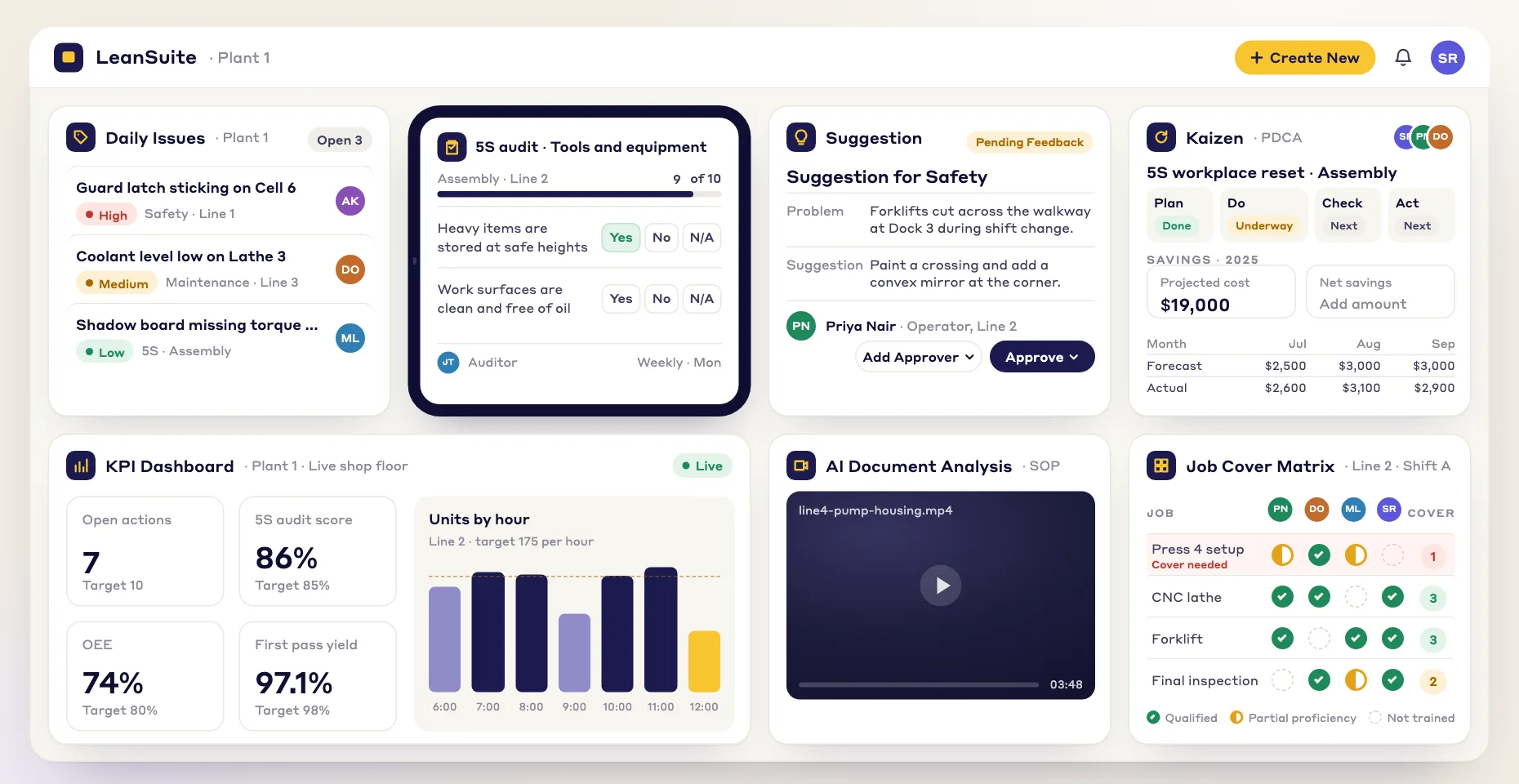
Continuous improvement software is a system that runs an improvement program in one place: it collects ideas and problems from the floor, runs them through a method such as PDCA, A3 or DMAIC with owners and due dates, and reports the results. In a plant it usually also covers audits, daily issues, skills and KPIs, so improvement work sits next to the daily work that produces it.
What it is and what it replaces
Every plant already runs improvement work. It lives in suggestion boxes, spreadsheets, whiteboards, printed A3s and email threads. Continuous improvement software puts that work in one record per improvement, from the first report to the measured result, so nothing depends on one person's file.
- Suggestion boxes and idea emails.
- A kaizen tracker in Excel, with a copy on every desk.
- A3s printed and pinned to a wall.
- Audit checklists on paper, with findings that stay on the sheet.
- Whiteboards by the line that are wiped each week.
- Weekly reports built by copying numbers between files.
It does not replace your ERP, MES or maintenance system. An ERP manages orders, inventory and finance, and an MES manages machines and production. Continuous improvement software manages people and process work: the kaizen events, audits, skills matrices and employee suggestions those systems miss.
What it covers
Tools differ in how much they cover. These are the capabilities to look for, with where to find each one in LeanSuite and our buyer's guide for it.
Projects, kaizen, A3 and DMAIC
Runs each improvement from idea to verified result, with a workflow per project type, PDCA, A3 and DMAIC templates, owners, due dates and projected against actual savings. Buyer's guides: kaizen software, A3 problem solving, Lean Six Sigma.
Kaizen and projectsIdeas and suggestions
Captures ideas from anyone on the floor, sends each to a reviewer to approve or reject with feedback, and turns approved ideas into projects. Buyer's guide: idea management software.
Idea ManagementAudits and gemba walks
Builds and schedules checklists from a gemba walk to a layered process audit, collects answers on a phone with photos, and turns failed items into actions with an owner. Buyer's guides: audit management, gemba walks, 5S audits.
Audit ManagementIssues and tiered meetings
Lets operators raise a problem on the spot, routes it to an owner with a due date and reminders, and runs tiered meetings on live boards. Buyer's guide: tiered meeting software.
Daily Issue ManagementSkills and training
Keeps a live skills matrix with required skills per job, levels that move up as training and sign-offs are completed, and shift coverage that shows single points of failure. Buyer's guides: skills matrix software, LMS for manufacturing.
Competency ManagementKPIs
Shows the numbers next to the work, flags a red metric, and pulls values from forms, Excel, Google Sheets or a CSV. Buyer's guide: manufacturing KPI dashboard software.
KPI DashboardsStandard work
Keeps SOPs, work instructions and one point lessons current, with approvals, version history and sign-off per person. See also AI SOP creation. Buyer's guides: standardized work, digital work instructions.
Digital Work InstructionsSavings and the CI portfolio
Records hard and soft savings next to costs, sets yearly targets per department and shows closed and projected savings against target.
CI portfolioBest practices across sites
Rolls an approved standard or a standard audit out to every facility, so a fix proven in one plant does not stay there.
Best Practice Management
How an improvement moves through it
- 1
Capture
Someone on the floor reports an idea or a problem, with a photo, from a phone or a tablet.
- 2
Review
A reviewer approves, rejects or asks for more, and the person who reported it gets an answer.
- 3
Run it
The work gets an owner, a method such as PDCA, A3 or DMAIC, and due dates. Overdue work is flagged.
- 4
Check the result
The result is measured against a baseline, and savings are confirmed before the work closes.
- 5
Standardize and share
What worked becomes the new standard, and it is copied to the other lines, shifts and sites.
Who uses it
Operators and supervisors
Raise issues, complete checklists and submit ideas on a phone or tablet. In LeanSuite, operators sign in with an employee ID.
Daily Issue ManagementCI and lean leaders
Run the portfolio of projects, set the methods and follow the savings.
For CI leadersQuality and safety
Run corrective actions, audits, incidents and near misses with an owner and a due date.
For qualityEngineering and CapEx
Run engineering and CapEx projects through stage-gates, with an auditable trail.
For engineeringHR and people teams
Run an idea program with approvals, points and recognition.
Idea management for HRIndustries
Food and beverage, automotive, appliances and consumer durables, and industrial equipment plants all run this work.
All industries
For a plant-wide example, read the Whirlpool case study.
How to choose
Ask every vendor the same questions, including us.
Which methods does it run?
Fixed templates, or any method including your own, such as 8D or a company method.
Which project types?
Kaizen events only, or also DMAIC, CAPA, engineering and CapEx projects, and projects outside manufacturing.
Can the floor use it?
A phone app, and sign-in for operators who have no company email.
Does it connect to the daily work?
Can a failed audit question or a daily issue become an improvement project, and can you see who has the skills for it?
How are savings confirmed?
Who verifies them, and can the project close without that check?
Does it work across sites?
Company-level roll-ups, shared templates and one workspace for several plants.
How is it priced?
Per user, per site or by module, what is published, and whether you can test it before you commit.
Who sets it up, and how fast?
The vendor's team or yours, and how long the first module takes to go live.
What do security and support look like?
A SOC 2 report, single sign-on, uptime commitments, support hours and what happens to your data if you leave.
A free scorecard
The CI software evaluation scorecard turns these questions into a weighted score you can compare across tools.
Build, buy or stay on spreadsheets
| Option | Good for | Watch for |
|---|---|---|
| Spreadsheets and paper | One team or area where one person owns the file. | Copies that drift apart, actions nobody chases and reports built by hand. See LeanSuite vs spreadsheets and paper. |
| Build it yourself (Access, SharePoint lists, Power Apps) | A development team that will own the tool for years, with a small and stable scope. | One person who builds and maintains it, no mobile app unless someone builds one, and hand-over when they leave. See homegrown software and Power Apps. |
| Buy a finished product | Several shifts or sites on the same process, operators who need a phone app, and a vendor team that maintains it. | Whether it runs your methods, how it is priced and how much of the setup is yours. |
The full argument, with the pilot, is on Why LeanSuite.
What it costs
Vendors price in different ways, for example per user, per site or by module, and many quote on request. LeanSuite is one flat price per facility with unlimited users, quoted on request. The free Starter plan covers idea management for teams of 25 and under, and the 90-day pilot costs $3,000 per facility, set up by our team. See pricing.
More buyer's guides
- Best continuous improvement software
- Best lean management software
- Best operational excellence software
- Best lean manufacturing software
- Best leader standard work software
- Best CAPA software
- Best root cause analysis software
For the methods behind the software, see the kaizen and continuous improvement topic guides and the lean glossary.
Keep reading
- Continuous improvement softwareThe LeanSuite product page: projects from idea to verified savings.Open
- Why LeanSuiteAgainst spreadsheets, homegrown tools and big suites.Open
- Best continuous improvement softwareHow the main tools compare, from public vendor information.Open
- Kaizen and continuous improvement guidesOur guides on the methods, sorted by subject.Open
- Free templatesKaizen, A3, 5S audit and skills matrix templates.Open
- 90-day pilotTest it on your own lines before you commit.Open
FREE RESOURCES
Free templates and tools
Not ready for software yet? Start with these free resources.
- Continuous improvement software evaluation scorecardCompare CI software vendors: a must-have gate, eight weighted criteria scored 1 to 5, points out of 100 and a rank, with a demo script and reference questions.
- Quick kaizen templateOne page for a small improvement: before and after, the cause, the countermeasure, the results and whether the standard changed.
- A3 problem solving templateThe standard seven-box A3 from background to follow-up, with a filled-in worked example. PDF and Excel.
- 5S audit checklist template25 checks, five per S, scored 1 to 5, with a score summary and a chart of the five S's.
- Idea suggestion formA one-page idea form with the supervisor's answer and points, and an idea log that tracks days to answer.
- Skills matrix templatePeople by skills, a 0 to 4 scale, a training column and a coverage row that shows the gaps.
FAQ
Questions about continuous improvement software
Ready to see it on your own lines?
Book a demo, or start a 90-day pilot that our team sets up for you.