
Free template
RACI matrix template
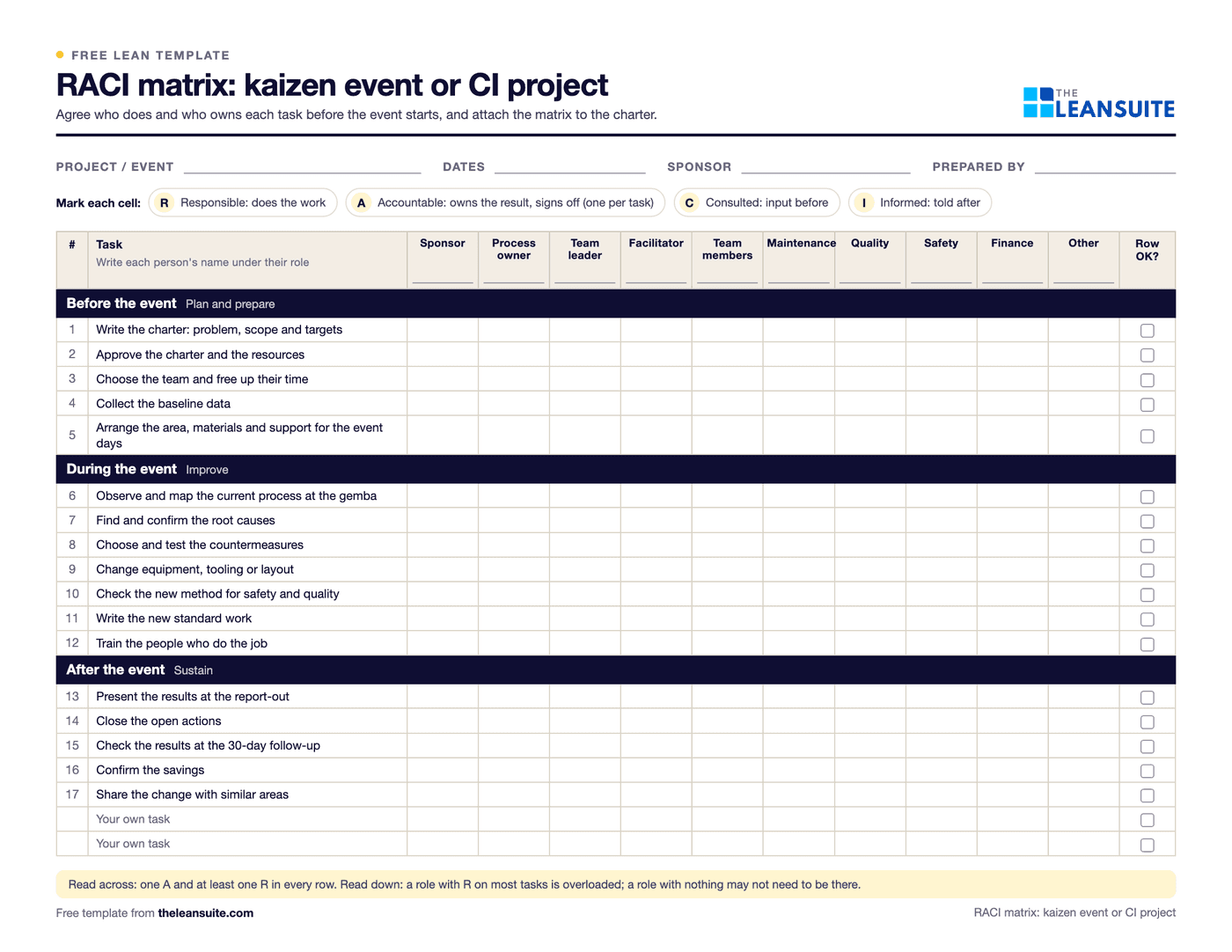
A RACI matrix lists the tasks of a project against the people or roles involved and marks each as responsible (does the work), accountable (owns the result and signs it off), consulted (gives input before) or informed (is told after). Each task should have exactly one accountable person. This template is set up for a kaizen event or continuous improvement project: 17 tasks from writing the charter to the 30-day follow-up and sharing the change, against ten roles, from sponsor and process owner to maintenance, quality, safety and finance. The Excel version has drop-downs, flags any task with no accountable person or more than one, and counts each role's load; the PDF is the same grid for a planning meeting.
Free to use: print it, copy it and edit it for your team. Enter your name and work email once to download.
When to use it
When to use a RACI matrix
- When a kaizen event or CI project is chartered, to agree who does and who signs off each task before the work starts.
- On a project that crosses departments, where maintenance, quality or finance have to help at a set time.
- When actions from past events stalled because everyone thought someone else owned them.
- At a handover, such as the end of an event, when open actions pass from the kaizen team to the process owner.
- Not for every small fix. A quick kaizen by one team only needs an owner and a date.
How to fill it in
- 1
Fill in the header
Project or event name, dates, sponsor and who prepared the matrix. Do it with the team leader and facilitator while the charter is written.
- 2
Adjust the tasks
Start from the 17 tasks, grouped before, during and after the event. Delete what does not apply and add your own in the blank rows. Start each task with a verb, so it is something a person does.
- 3
Name the people
Keep the role columns you need and write the person's name under each role, so everyone knows who to ask.
- 4
Mark the accountable person first
For each task, put an A under the one person who owns the result and signs it off. Exactly one A per task.
- 5
Mark who does the work
Put R under everyone who does the work. The accountable person can do the work too: the Excel version accepts A/R.
- 6
Add consulted and informed
C for people whose input is needed before the task is done, I for people who only need to know it happened. Keep the C's few, since each one means a conversation.
- 7
Check it and share it
Read each row (one A, at least one R) and each column (is anyone overloaded or left out?). Agree it with the sponsor and attach it to the charter.
What's on the matrix
The 17 kaizen project tasks on the RACI matrix
Grouped before, during and after the event. On the sheet each task has a column per role for R, A, C or I; delete the tasks that do not apply and add your own in the blank rows.
Before the event
Plan and prepare
- 1Write the charter: problem, scope and targets
- 2Approve the charter and the resources
- 3Choose the team and free up their time
- 4Collect the baseline data
- 5Arrange the area, materials and support for the event days
During the event
Improve
- 6Observe and map the current process at the gemba
- 7Find and confirm the root causes
- 8Choose and test the countermeasures
- 9Change equipment, tooling or layout
- 10Check the new method for safety and quality
- 11Write the new standard work
- 12Train the people who do the job
After the event
Sustain
- 13Present the results at the report-out
- 14Close the open actions
- 15Check the results at the 30-day follow-up
- 16Confirm the savings
- 17Share the change with similar areas
A filled-in example
Illustrative, not a benchmarkAn illustrative RACI for a five-day kaizen event to cut changeover time on a filling line.
- Approve the charter and the resources: sponsor A, team leader R, process owner C, finance I.
- Change equipment, tooling or layout: process owner A, maintenance R, team members C, safety C.
- Write the new standard work: process owner A, team leader R, team members C, quality C.
- Check the results at the 30-day follow-up: process owner A, team leader R, sponsor I.
- Confirm the savings: sponsor A, finance R, team leader C.
Reading down the columns showed the team leader was R on eleven of the seventeen tasks, so the facilitator took over measuring the baseline and preparing the report-out. Every row had one A before the charter was signed.
Common mistakes
More than one A
With two A's on a task, each person can assume the other has it. If two managers both want to sign off, pick one and consult the other.
Mixing up accountable and responsible
The accountable person owns the result and the responsible people do the work. In a kaizen, the process owner is often accountable for the new standard while the team writes it.
Consulting everyone
Every C adds a conversation and a delay. Consult the people whose input changes the task, and inform the rest.
Departments instead of people
An R under maintenance does not tell anyone who to call. Write a name under each role.
Filling it in and filing it
Look at it in the event's daily meetings and at the handover to the process owner, and change it when the people or the tasks change.
Download the template
Free to use: print it, copy it and edit it for your team. Enter your name and work email once to download.
Run this template in LeanSuite
In LeanSuite's continuous improvement software you set, for each workflow step, who can move a project and what must be filled in first, every action has an owner and a due date, and savings credit can be split between the lead, sponsor, coach and team.
In the lean glossary
Free tools
FAQ
RACI matrix template: common questions
More free templates
All templates- 5S audit checklist template25 checks, five per S, scored 1 to 5, with a score summary and a chart of the five S's.
- Gemba walk checklistA walk plan and route, 30 prompts in six groups and a findings table with owners and due dates.
- Leader standard work templateA team leader's daily, weekly and monthly routine with a box per day, follow-ups and a weekly review.
- Autonomous maintenance (CILR) checklist20 clean, inspect, lubricate and retighten checks with a box per day, an abnormality log and sign-off.
- A3 problem solving templateThe standard seven-box A3 on one landscape sheet, from background to follow-up.
- PDCA templateOne improvement cycle on one landscape page: plan, do, check against the goal, then standardize or adjust.
- 5 Whys templateA problem statement, five why rows with evidence, the root cause and the countermeasure.
- 5W1H templateSix questions with prompts and evidence, turned into a problem statement before the root cause analysis.
- 8D report templateD0 to D8 on three pages: team, is/is not, containment, occurrence and escape causes, actions and closure.
- Poka-yoke worksheetEach step's possible errors, prevention or detection, the method, a device idea and a verified box.
- Skills matrix templatePeople by skills, a 0 to 4 scale, a training column and a coverage row that shows the gaps.
- Standard work sheet templateTakt time, each element's manual, machine and walk time on a time chart, key points and standard WIP.
- One point lesson (OPL) templateOne topic on one page: wrong way and right way pictures, key points, why it matters and a sign-off record.
- SMED changeover worksheetChangeover steps with times, internal or external, what can move, ideas and before/after totals.
- Kaizen event charter templateScope, team and roles, baseline and target metrics, a five-day schedule, risks and sign-off.