
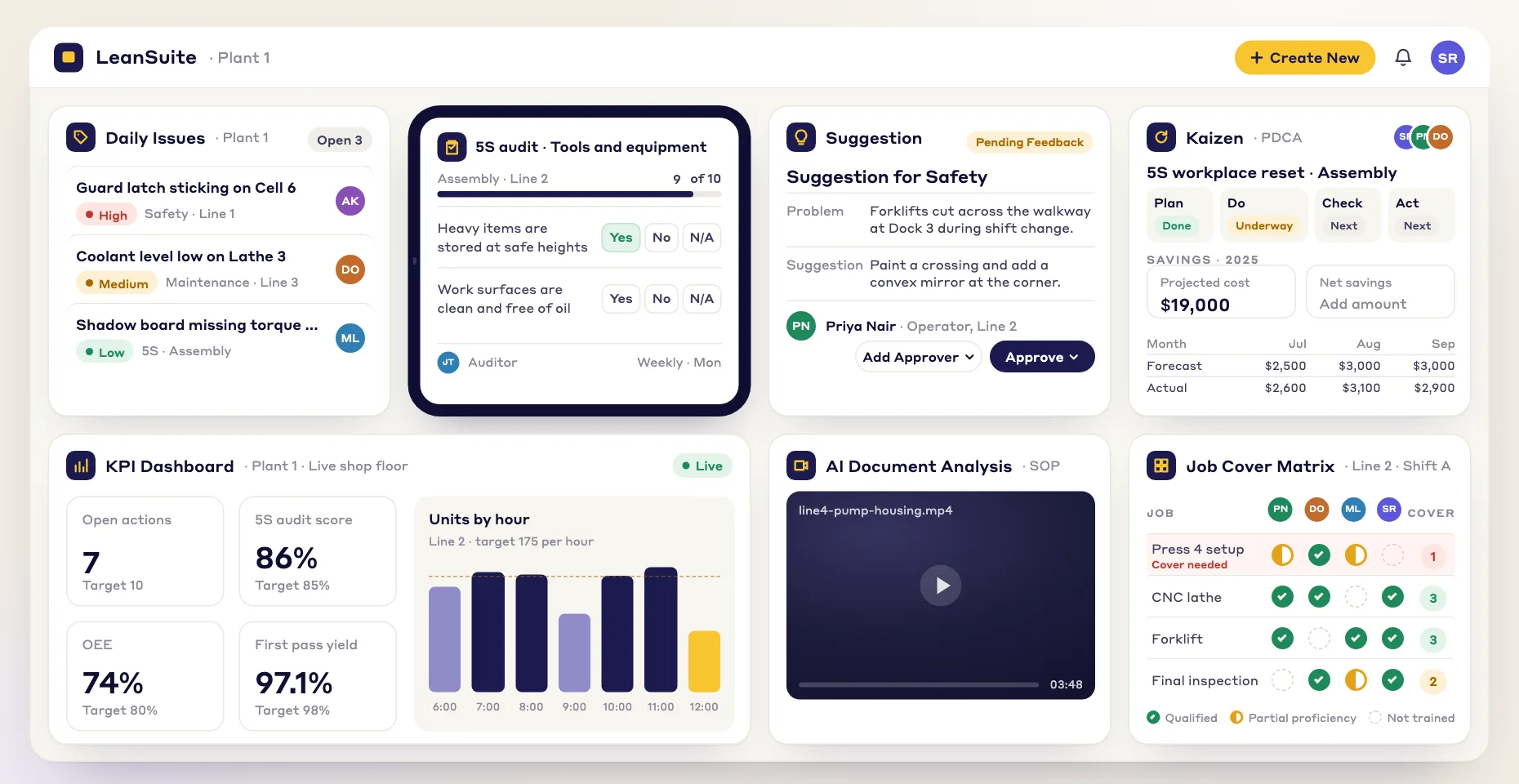



Lean project management is the application of lean manufacturing principles to the planning, execution, and closure of improvement projects, using the same logic of waste elimination, flow, and accountability that governs lean production to govern improvement work itself. In manufacturing, this matters because most improvement projects fail not from methodological weakness but from execution failure: unclear ownership, scope that expands without control, deliverables that are never verified, and results that erode because no one is accountable for sustaining them.
The Project Management Institute defines lean project management as providing "what is needed, when it is needed, with the minimum amount of materials, equipment, labor, and space." Applied to improvement work, this means running kaizen events, A3 investigations, and value stream projects with the same rigor that lean applies to production: eliminating the administrative waste that slows projects without adding value, and ensuring every task connects directly to the improvement outcome.
This blog introduces the lean project management framework and the specific tools that address the most common execution challenges improvement projects face in manufacturing environments.
Why Improvement Projects Fail Without a Project Management Framework
Most lean practitioners understand the improvement methodologies: PDCA, A3 thinking, kaizen events, value stream mapping. What breaks down in manufacturing organizations is the execution layer between identifying an improvement and delivering it. Three failure patterns repeat regardless of company size, industry, or lean maturity.
Unclear Accountability
When multiple people believe they are responsible for the same outcome, no one is. Improvement projects in manufacturing frequently involve operators, supervisors, engineers, quality professionals, and maintenance technicians working on overlapping tasks. Without a documented accountability structure, decisions wait for alignment that never comes, tasks fall between functional boundaries, and projects stall at the point where authority is ambiguous.
The RACI Matrix in Lean Manufacturing: Roles, Accountability, and Clarity is the tool that resolves this failure pattern by assigning exactly one owner to every outcome before the project starts.
Uncontrolled Scope
Improvement projects that begin with a defined scope frequently absorb adjacent problems as they progress. A changeover reduction project expands to include equipment layout, then operator training, then preventive maintenance. Each expansion is individually reasonable. Collectively they make the original objective undeliverable within the original timeline and resources. Scope expansion is waste in project form. It consumes capacity without advancing the primary improvement goal.
No Verified Results
The most common failure point in lean improvement projects is the gap between implementation and verification. A change is made, the team moves to the next project, and no one confirms whether the improvement delivered its intended result. Standard work is not updated. The gains erode within weeks. Six months later, the same problem appears on the improvement priority list again.
Key Insight: Improvement projects fail in execution, not in methodology. The lean project management framework addresses execution, not the improvement tool itself.

How Lean Principles Apply to Project Management
Lean manufacturing is built on five core principles identified by the Lean Enterprise Institute: define value, map the value stream, create flow, establish pull, and pursue continuous improvement. Each principle translates directly into lean project management practice.
Define Value: What Does Project Success Look Like?
In lean production, value is defined by the customer. In lean project management, value is defined by the improvement outcome. A project that closes a nonconformance report without preventing recurrence has completed its administrative deliverable but delivered no value. A project that reduces the defect rate by the targeted percentage and sustains that reduction through updated standard work has delivered value.
Defining value at the project outset means specifying the measurable outcome that will confirm success, not the activities the team will complete, but the operational condition the team will create. This distinction drives everything else in lean project execution.
Map the Value Stream: Which Tasks Add Value?
Value stream mapping applied to improvement projects means distinguishing between tasks that directly advance the improvement and tasks that exist for administrative or reporting purposes. Approval cycles that do not improve decision quality, status update meetings that do not change any action, and documentation that no one reads are waste in project form.
The A3 Report as a Project Management Tool: From Problem to Solution applies this logic directly. The A3 format enforces concision by limiting the entire project narrative to a single page, forcing teams to include only the content that advances understanding and decision-making.
Create Flow: How Does the Project Move Without Stalling?
Flow in production means work moving continuously without interruption. Flow in project management means tasks sequenced so that each one enables the next without waiting, rework, or restart. Improvement projects stall when tasks have unresolved dependencies, when approvals are not staged correctly, or when specialists are consulted too late to change the outcome of decisions already made.
TheThe RACI Matrix: A Simple Guide to Effective Project Management - TheLeanSuitecreates flow by ensuring that the right people are involved at the right stages. Consulted parties are engaged before decisions are made, not after. The Accountable person is positioned to approve work without requiring a meeting to determine who has authority.
Establish Pull: Work Flows Based on Capacity, Not Schedules
Push-based project management assigns deadlines to tasks regardless of team capacity. Pull-based lean project management sequences work based on what the team can genuinely deliver without creating overburden. In manufacturing improvement contexts, this means not launching multiple kaizen events simultaneously, not assigning improvement tasks to operators who are already at production capacity, and not expecting A3 investigations to progress when the investigator lacks access to the data required.
The Prioritization Matrix in Lean Manufacturing: Impact vs Effort is the tool that governs the pull decision: which improvement enters the active project pipeline based on what the organization can actually deliver, not what looks most urgent.
Pursue Continuous Improvement: Close, Learn, and Apply
The final principle of lean project management is that each project closes with a documented lessons-learned process that informs the next project. How long did scope expansion add to the timeline? Which consultation steps were unnecessary? Which verification methods confirmed results reliably? This learning feeds back into the project management framework, making each subsequent project faster and more effective than the last.
Key Insight: Lean project management applies the five lean principles to improvement work itself. It eliminates waste in execution, not just in production.
The Lean Project Management Toolkit
Six lean project management tools together constitute a complete system for manufacturing improvement. Each tool addresses a specific stage of the improvement project lifecycle.
Tool - RACI Matrix in Lean Manufacturing: Roles, Accountability, and Clarity
Stage - Planning
What it solves - Accountability gaps and authority conflicts
Tool - Kaizen Event as a Project: Scoping, Executing, and Closing Improvement Events
Stage - Execution
What it solves - Unstructured event execution and unsustained gains
Tool - A3 Report as a Project Management Tool: From Problem to Solution
Stage - Investigation and closure
What it solves - Unmanaged problem-solving and undocumented decisions.
Tool - Prioritization Matrix in Lean Manufacturing: Impact vs Effort
Stage - Selection
What it solves - Choosing which improvement to pursue first
Tool - Yamazumi Chart: Workload Balancing for JIT Production Lines
Stage - Planning
What it solves - Workload imbalance and operator overburden in improvement teams.
Tool - Running Lean Improvement Projects: From Scope to Verified Results
Stage - Full lifecycle
What it solves - End-to-end project execution from initiation to verified closure
These tools do not replace lean improvement methodologies. They govern the execution of those methodologies. A PDCA cycle still provides the improvement logic. The RACI matrix provides the accountability structure within which that PDCA cycle is executed.
Key Insight: Lean project management tools govern execution. Lean improvement methodologies govern the content of the improvement. Both are required for results.
What Distinguishes Lean Project Management From Traditional Project Management
Traditional project management approaches (Gantt charts, CPM scheduling, WBS decomposition) are covered in Manufacturing Improvement Project Management: Structured Execution From Charter to Results. Lean project management is distinct in three ways that matter specifically to manufacturing improvement teams.
Lean Project Management Eliminates Administrative Waste
Traditional project management generates substantial administrative overhead: status reports, steering committee presentations, change request forms, and closure documentation. Each requires effort to produce and often produces no decision. Lean project management applies the same waste lens to project administration that lean production applies to manufacturing processes. It keeps only what advances the improvement and eliminating everything else.
Lean Project Management Structures Around Standard Work
Lean organizations apply standard work to everything they do consistently, including improvement project execution. Standard project management templates including a standard scope definition format, a standard RACI matrix structure, and a standard closure checklist eliminate the rework that comes from each team designing its own approach to project administration. Running Lean Improvement Projects: From Scope to Verified Results covers the standard work for lean improvement project execution.
Lean Project Management Connects to the Production System
Traditional project management exists as a separate management discipline from production operations. Lean project management is embedded in the production system. Kaizen events run during scheduled production downtime, A3 investigations use production data and gemba observation, RACI assignments include operators and frontline supervisors as Responsible parties rather than positioning them only as subjects of the improvement.
This connection to the production system is what allows lean improvement projects to deliver results that sustain. The people who run production are involved in designing and verifying the improvement, so they understand it and own it rather than receiving it as a management directive.
Key Insight: Lean project management is embedded in the production system. Traditional project management sits above it.
Lean Project Management and the PDCA Connection
The PDCA Cycle: The Foundation of Continuous Improvement provides the improvement logic that lean project management executes. The relationship between the two is precise: PDCA defines what the improvement team should think about at each stage; lean project management defines who does the thinking, how they are accountable for it, and how the project moves from one stage to the next.
At the Plan stage, lean project management contributes scope definition, RACI matrix construction, and prioritization validation. At the Do stage, lean project management contributes the kaizen event structure, task sequencing, and consultation protocols. At the Check stage, lean project management contributes the verification methods and the accountable approver who confirms results. At the Act stage, lean project management contributes the standard work update process and the yokoten mechanism that spreads the improvement.
Without lean project management, PDCA cycles produce insight but not outcomes. Without PDCA, lean project management produces activity but not improvement. Together they produce what manufacturing organizations need: verified, sustained results at scale.
Key Insight: PDCA provides the improvement logic. Lean project management provides the execution structure. Neither delivers results without the other.
Within the Lean System
Connection to Lean Principles
Lean project management operationalizes the lean principle of perfection, the relentless pursuit of better, by treating improvement work itself as a process subject to the same waste elimination and flow optimization that lean applies to production. The 5 Core Principles of Lean Manufacturing describes perfection as the fifth and final lean principle: the recognition that improvement is never complete and that every improvement project reveals the next opportunity. Lean project management creates the organizational capacity to pursue that perfection systematically rather than episodically, by ensuring that each improvement project is executed efficiently enough to make the next one possible.
Connection to Lean Tools
Lean project management connects directly to hoshin kanri strategy deployment covered in Hoshin Kanri: The 7-Step Strategy Deployment Process. Hoshin kanri determines which improvement priorities the organization pursues at the strategic level. Lean project management governs how those priorities are executed at the project level. The X-Matrix identifies breakthrough objectives; the RACI matrix, A3 format, and prioritization matrix execute them. The connection also runs to Value Stream Mapping: A Beginner's Complete Guide. Value stream mapping identifies where in the production system improvements are needed; lean project management structures how those improvements are planned, staffed, and delivered.
Connection to Continuous Improvement
Lean project management is the operational mechanism of Kaizen: The Complete Beginner's Guide to Continuous Improvement. Kaizen as a philosophy requires that everyone improves everything continuously. Kaizen as an operational practice requires projects that are scoped, staffed, executed, and verified. Lean project management is what converts the kaizen philosophy into kaizen results. The lean project management tools covered in this series (RACI matrix, kaizen event project structure, A3 framework, prioritization matrix) collectively answer the question that every manufacturing plant faces after adopting the kaizen mindset: how do we actually run the improvement projects that the mindset demands?
Frequently Asked Questions
What is lean project management in manufacturing? Lean project management is the application of lean principles to improve project execution. It eliminates waste in planning and delivery, assigns clear accountability through tools like the RACI matrix, sequences tasks for flow, and verifies results before closing. It governs how kaizen events, A3 investigations, and value stream projects are run, not the content of the improvement itself.
How is lean project management different from traditional project management? Lean project management eliminates administrative waste, applies standard work to project execution, and embeds improvement projects within the production system. Traditional project management generates more overhead documentation and exists as a separate management discipline. Both approaches use planning and accountability tools; lean project management applies the waste elimination lens to those tools themselves.
Why do lean improvement projects fail without project management structure? Without a project management structure, improvement projects suffer from unclear accountability (multiple people who believe they own the same outcome), scope expansion (the project absorbs adjacent problems), and unverified results (changes are made but never confirmed). These execution failures occur regardless of how sound the underlying improvement methodology is.
What tools does lean project management use in manufacturing? The core lean project management toolkit for manufacturing includes the RACI matrix for accountability, the kaizen event project structure for event-based improvements, the A3 report for investigation-based projects, the prioritization matrix for project selection, the Yamazumi chart for workload balancing, and the lean improvement project lifecycle for end-to-end execution governance.
How does lean project management connect to PDCA? PDCA provides the improvement logic at each project stage. Lean project management provides the execution structure: who is accountable at each phase, how tasks are sequenced, how approvals are staged, and how results are verified. PDCA without lean project management produces insight but not sustained outcomes. Lean project management without PDCA produces activity without improvement direction.
Free for this topic: Kaizen event charter template, RACI matrix template, Kaizen savings calculator
Want our lean manufacturing guides first in Google? Add us as a preferred source.
Add LeanSuite as a preferred source on Google (opens in a new tab)


