

Quick reference poster
Updated · Free to print and share
Which problem-solving tool poster
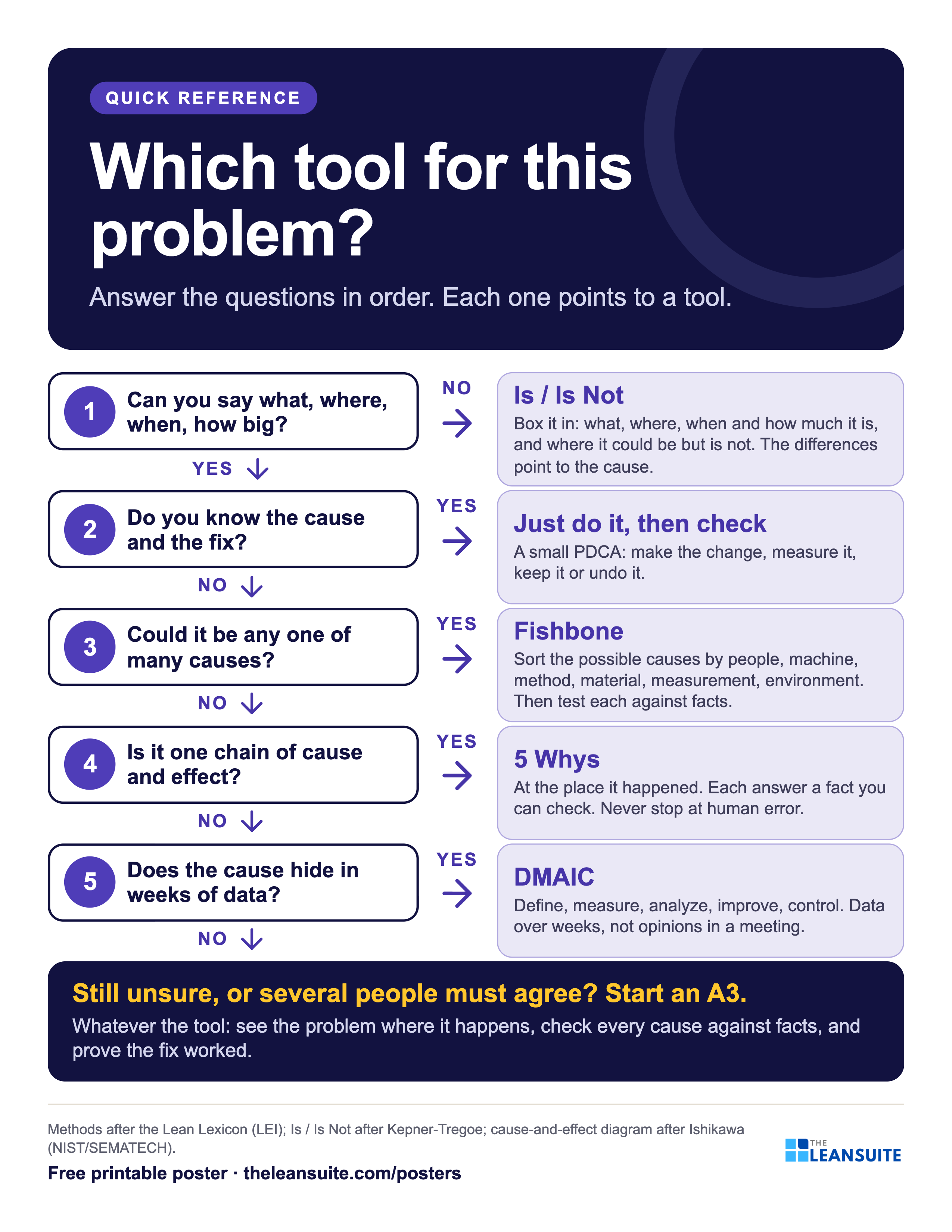
Most problem-solving tools fail because they were the wrong size for the problem: a 5 Whys on a variation problem with several causes guesses, and a DMAIC project on an obvious fix wastes months. This poster is a path of five questions a team answers in order: is the problem described, is the cause known, could it be any of many causes, is it one chain of cause and effect, does the cause hide in data. Each answer points to one tool, from Is/Is Not and fishbone to 5 Whys, DMAIC and the A3, with one line on what that tool does.
Download the poster
The PNG is free to download now. The print-ready vector PDFs open after a short form, once.
Free to print and share with your team. Enter your name and work email once to download.
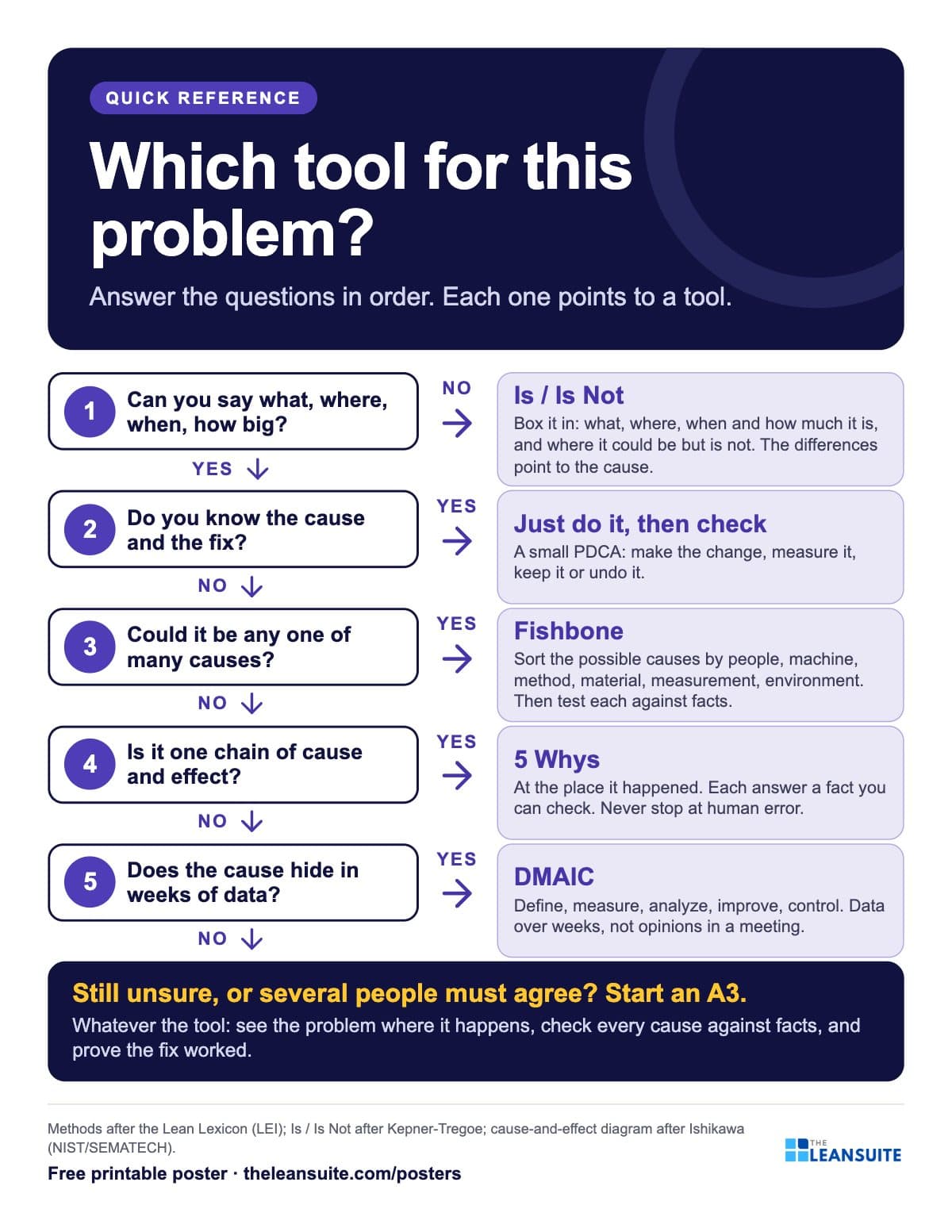 Five yes-or-no questions down the left, each pointing right to one tool, with a rule at the bottom that applies to all of them.
The words on the poster
Which tool for this problem?
Answer the questions in order. Each one points to a tool.
- Can you say what, where, when, how big? No: Is / Is Not. Box it in: what, where, when and how much it is, and where it could be but is not. The differences point to the cause.
- Do you know the cause and the fix? Yes: Just do it, then check. A small PDCA: make the change, measure it, keep it or undo it.
- Could it be any one of many causes? Yes: Fishbone. Sort the possible causes by people, machine, method, material, measurement, environment. Then test each against facts.
- Is it one chain of cause and effect? Yes: 5 Whys. At the place it happened. Each answer a fact you can check. Never stop at human error.
- Does the cause hide in weeks of data? Yes: DMAIC. Define, measure, analyze, improve, control. Data over weeks, not opinions in a meeting.
- Still unsure, or several people must agree? Start an A3. Whatever the tool: see the problem where it happens, check every cause against facts, and prove the fix worked.
Methods after the Lean Lexicon (LEI); Is / Is Not after Kepner-Tregoe; cause-and-effect diagram after Ishikawa (NIST/SEMATECH).
On the floor
How to use it
- 1
Pin it where problems are raised: the tier board, the quality board, the A3 wall.
- 2
Walk a new problem down the path in the huddle before anyone opens a template.
- 3
When a 5 Whys stalls, come back to the path: the answer to the third question has probably changed.
- 4
Pair it with the free method selector, 5 Whys, fishbone and Is/Is Not templates.
Which size to print
- 24 x 36 in or A2: a main wall or team board, read from a few metres away.
- 18 x 24 in or A3: a station or notice board. The A3 file also fits 11 x 17 in paper.
- Letter or A4: a clipboard, binder or handout, on any office printer.
Every PDF is vector, so it stays sharp at full size. Nothing runs to the edge of the page, so no bleed is needed.
Sources and notes
- Lean Enterprise Institute, Lean Lexicon: PDCA, DMAIC and A3 report (see the PDCA, DMAIC and A3 poster).
- Kepner-Tregoe: Is / Is Not, the four dimensions (what, where, when, extent) and distinctions.
- NIST/SEMATECH e-Handbook of Statistical Methods, glossary: cause-effect (Ishikawa, fish-bone) diagram.
Templates, decks and guides to go with it
- Root cause analysis training presentation: 5 whys and fishboneFree training deck: Define, contain, the 5 whys, the fishbone diagram and verifying the cause, in 18 slides with a team activity.
- Process improvement method selectorEight questions about one problem, an example rule that suggests a method and a matrix of nine methods: when each fits, the usual team and time, and the template to start with.
- 5 Whys templateA problem statement, a why chain that can branch, evidence for every answer, root causes and countermeasures that are checked.
- Is / is not analysis templateWhat, where, when and extent with is, is not, distinctions and changes, then each possible cause tested against every pair and ranked.
- Root cause analysis templateOne report from problem statement to proof: containment, evidence, analysis, verified causes, actions and the effectiveness check.
- Topic: Root cause analysis and problem solvingEvery guide we have on the subject, sorted.
A poster reminds. A routine makes it stick.
See how plants run their audits, improvements and follow-ups in LeanSuite, on a call built around your own problem.
Book a 45-minute demo