

37 free posters
Free printable lean, safety and quality posters
Visual aids for plant walls, team boards and notice boards, in five series: safety, quality, environment, lean and continuous improvement, and a quick-reference set with worked numbers. Print them at any size from Letter to 24 x 36 in, or share the PNG.
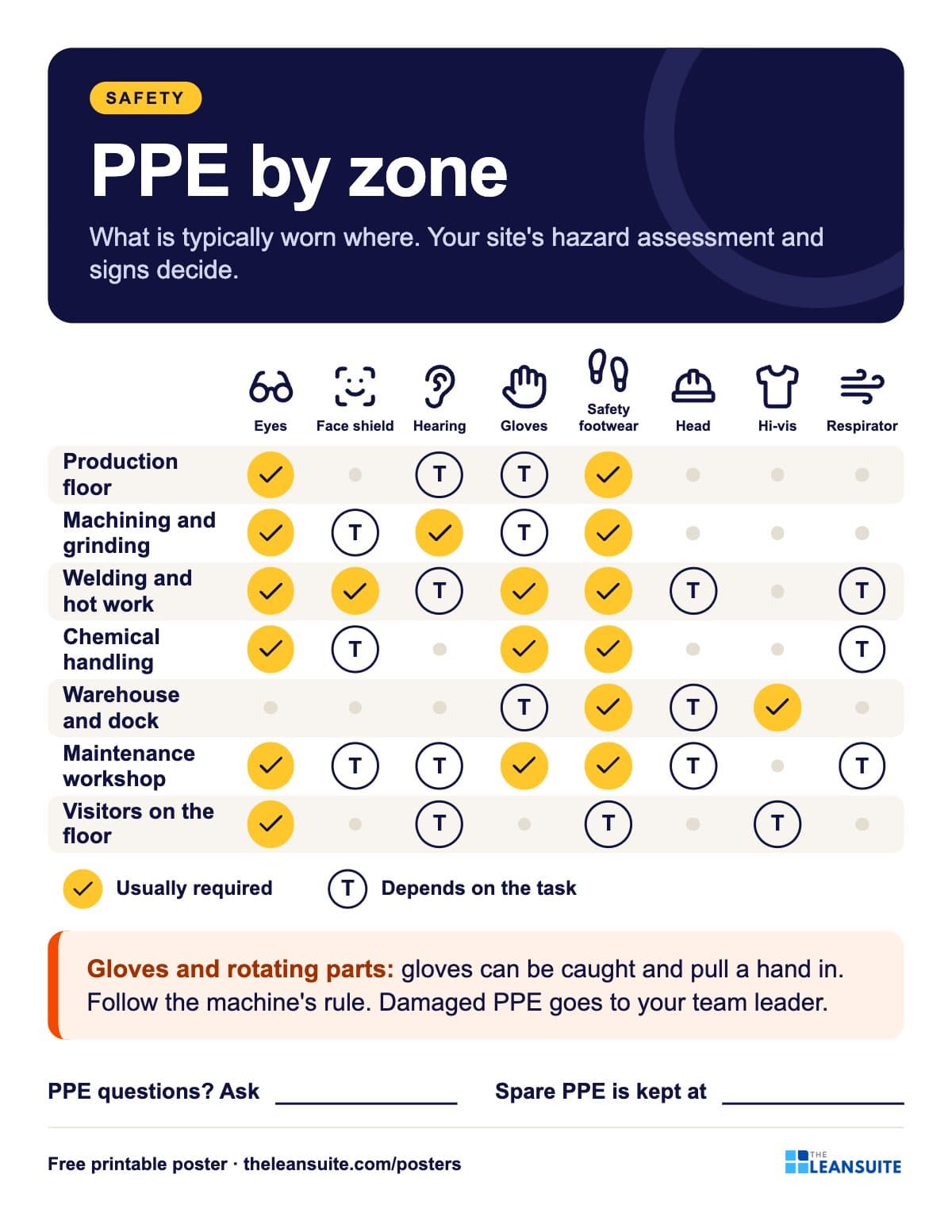 SafetyPPE by zone posterThe PPE typically worn in seven work zones, as a chart you can check at the door.View and download
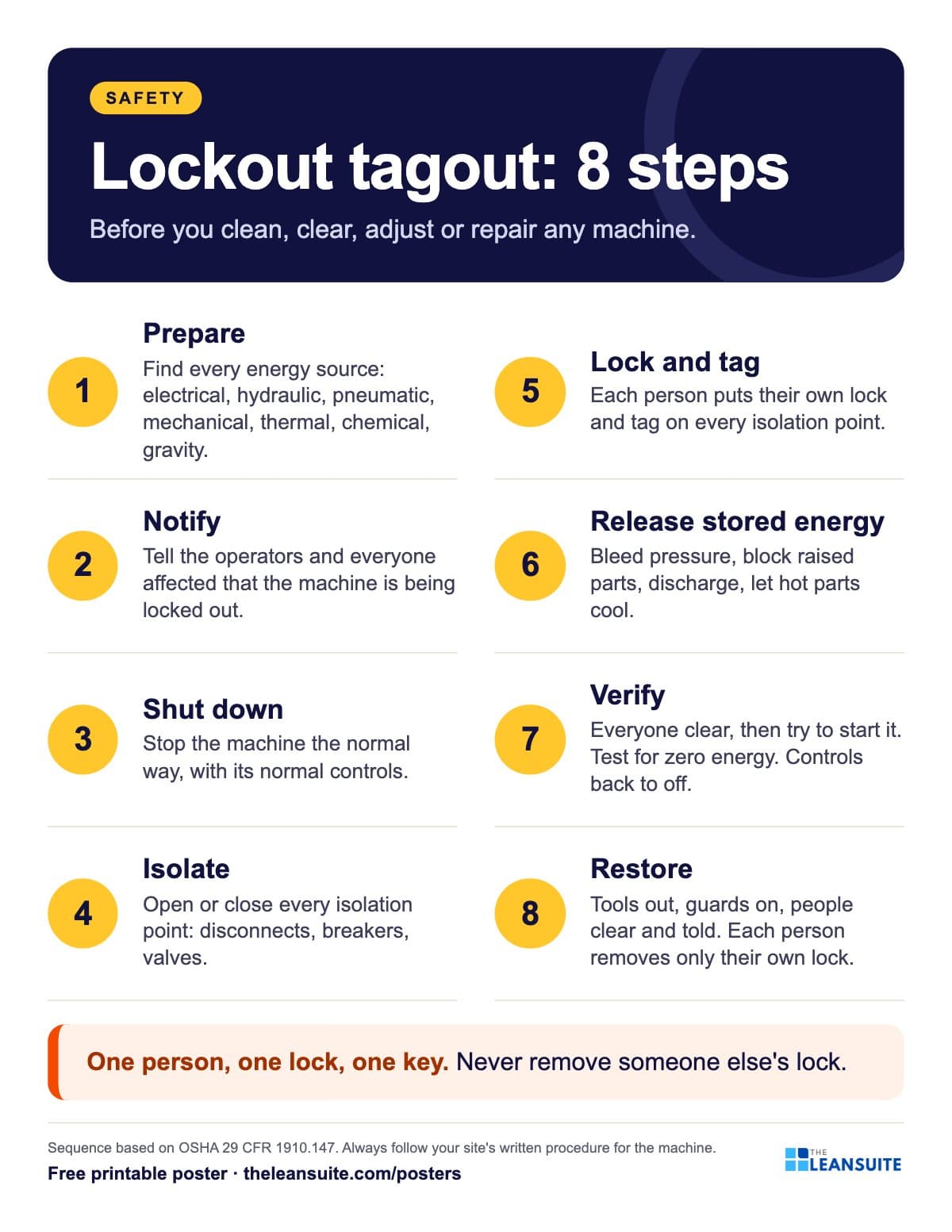 SafetyLockout tagout (LOTO) steps posterThe eight lockout tagout steps, from preparing to restoring, for every machine with stored energy.View and download
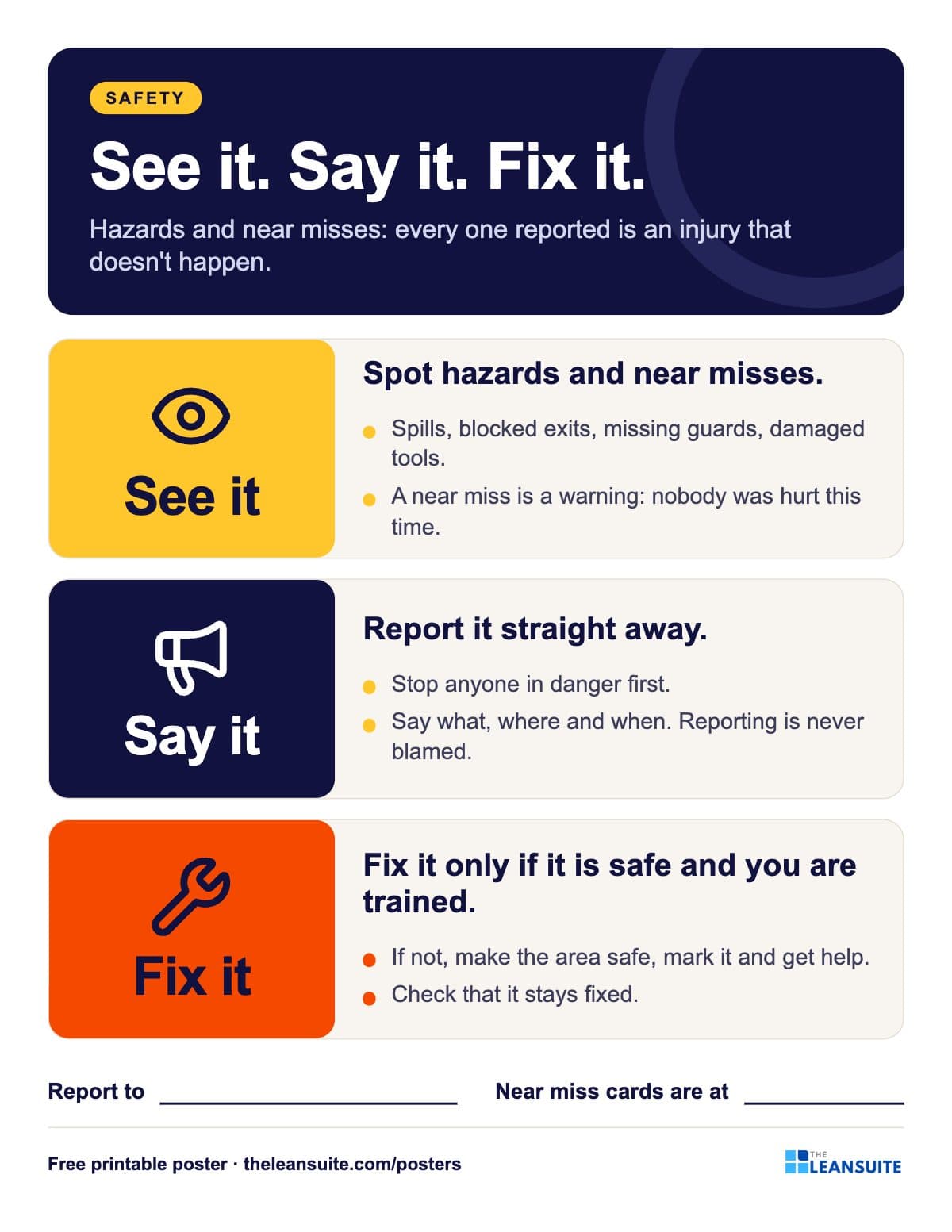 SafetySee it, say it, fix it safety posterHazard and near miss reporting in three words, with what each step means on the floor.View and download
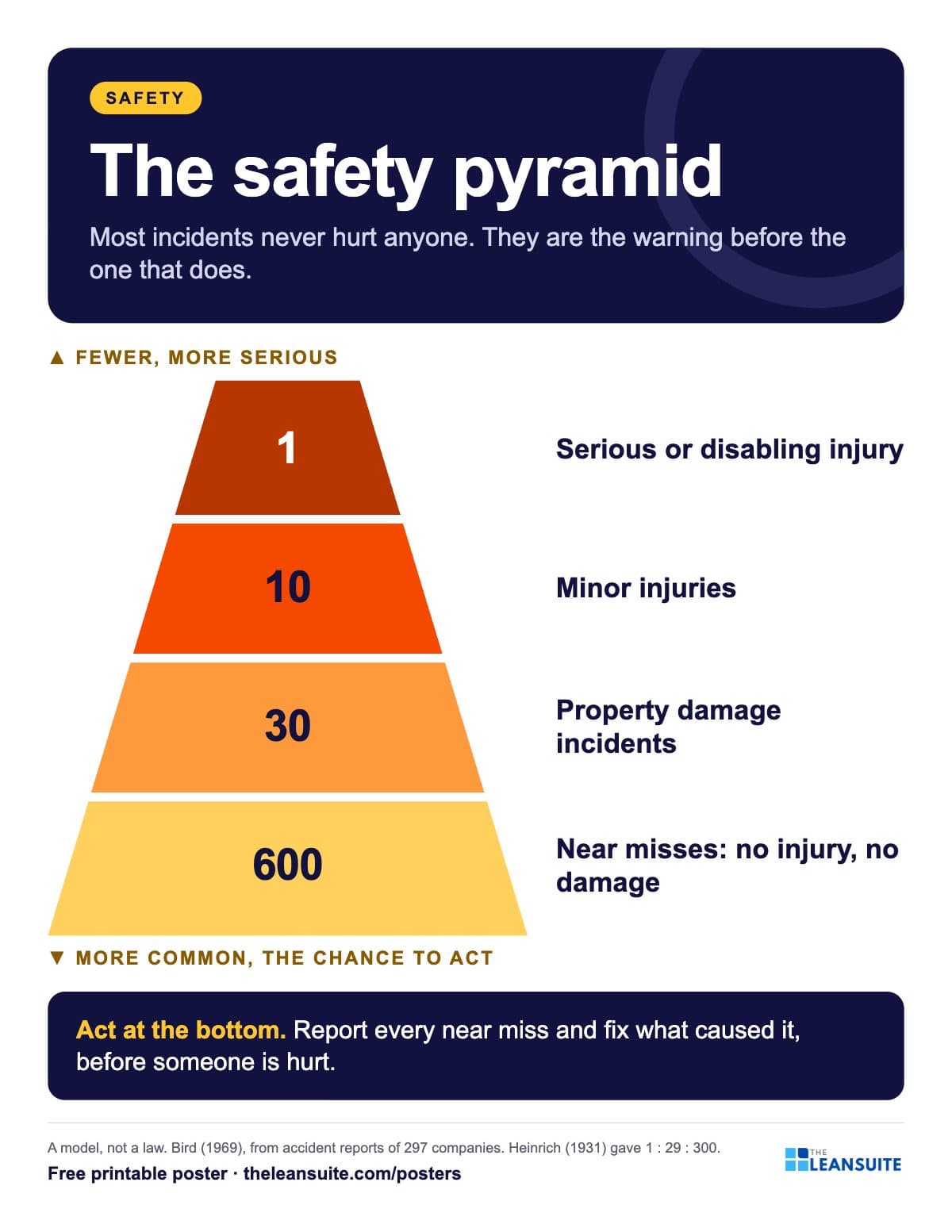 SafetySafety pyramid poster (Bird's triangle)Bird's accident ratio as a pyramid, labelled as a model with its source, and why near misses matter.View and download
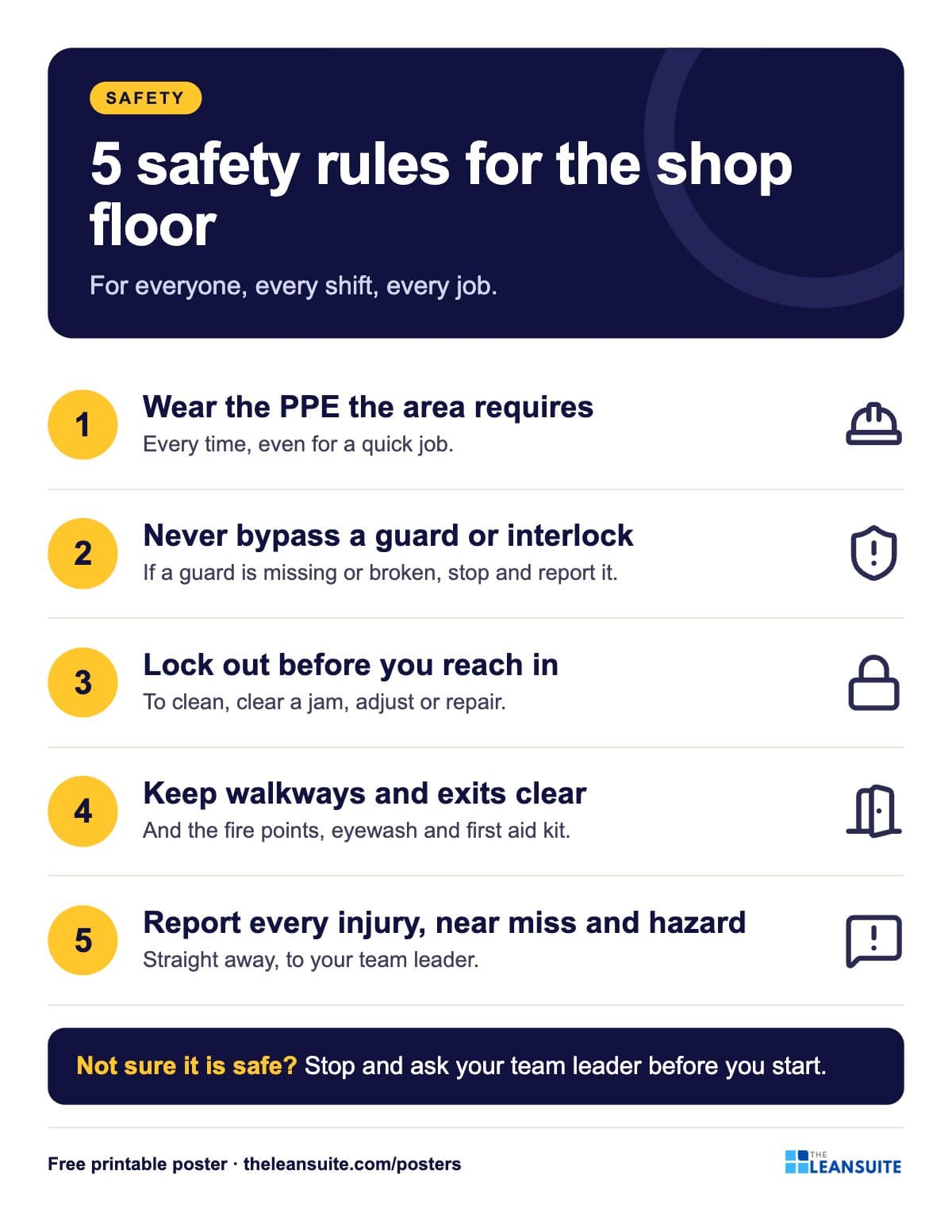 Safety5 shop floor safety rules posterFive basic safety rules that apply in almost every plant, in big type for the wall.View and download
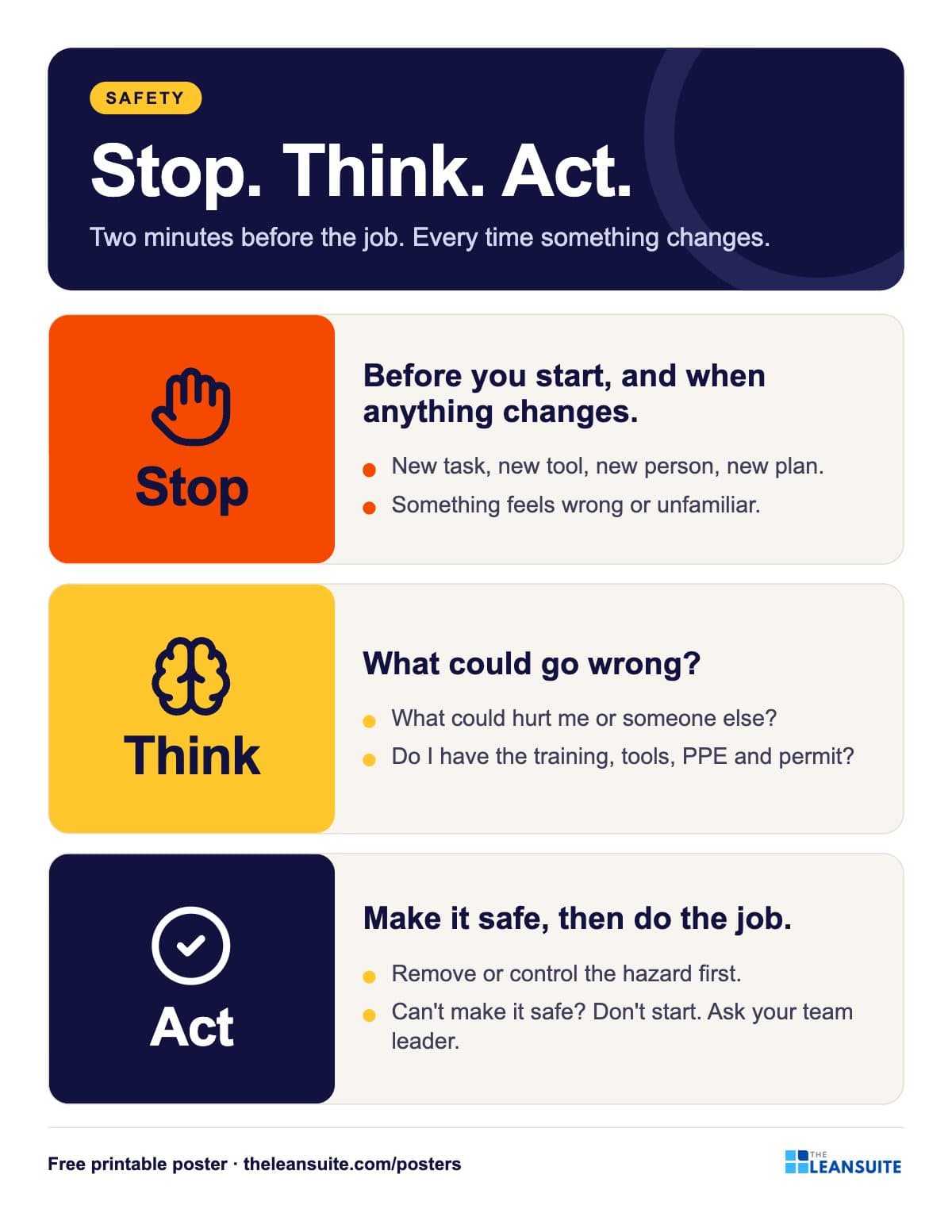 SafetyStop, think, act safety posterA two-minute check before any task: stop, think about what could go wrong, then act.View and download
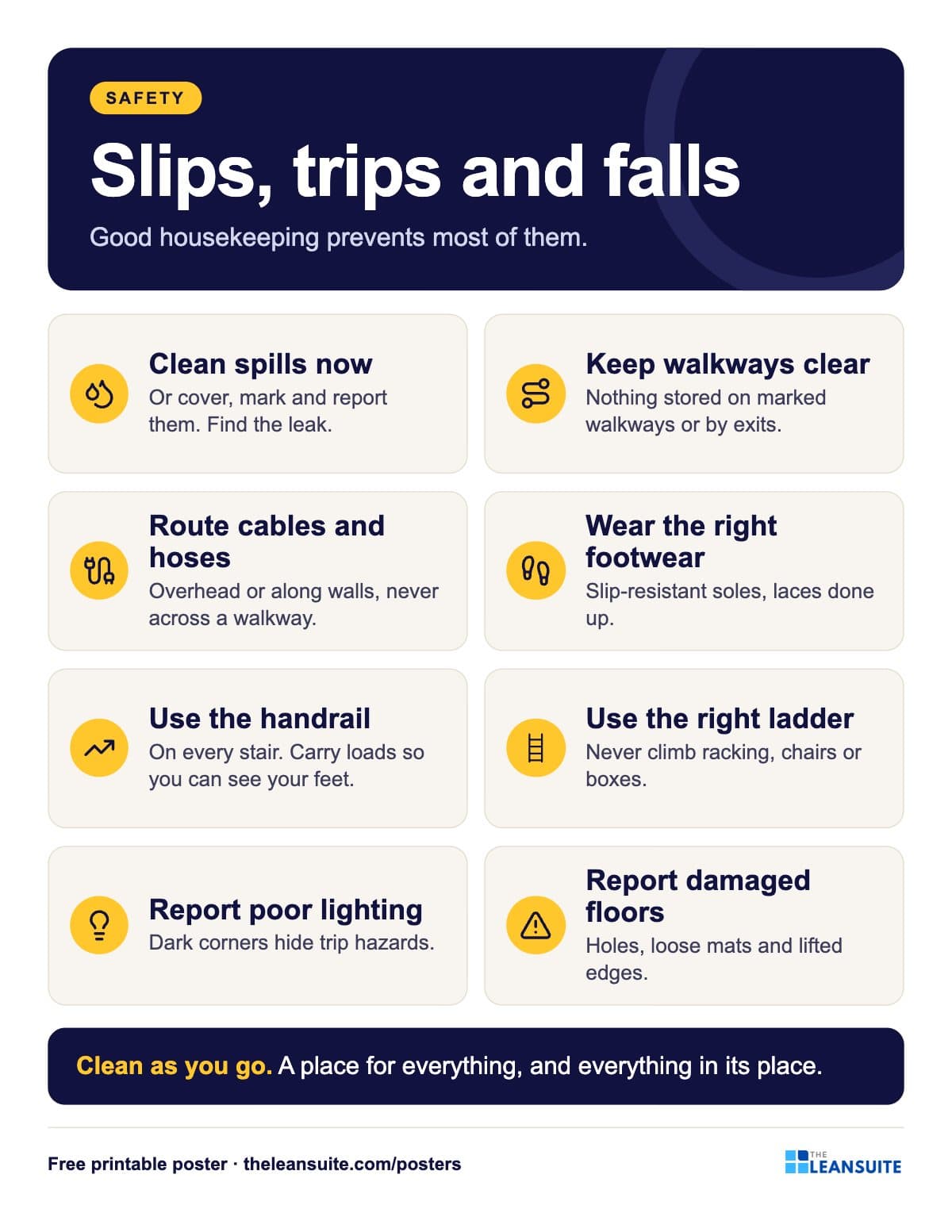 SafetySlips, trips and falls housekeeping posterEight housekeeping habits that prevent slips, trips and falls, from spills to ladders.View and download
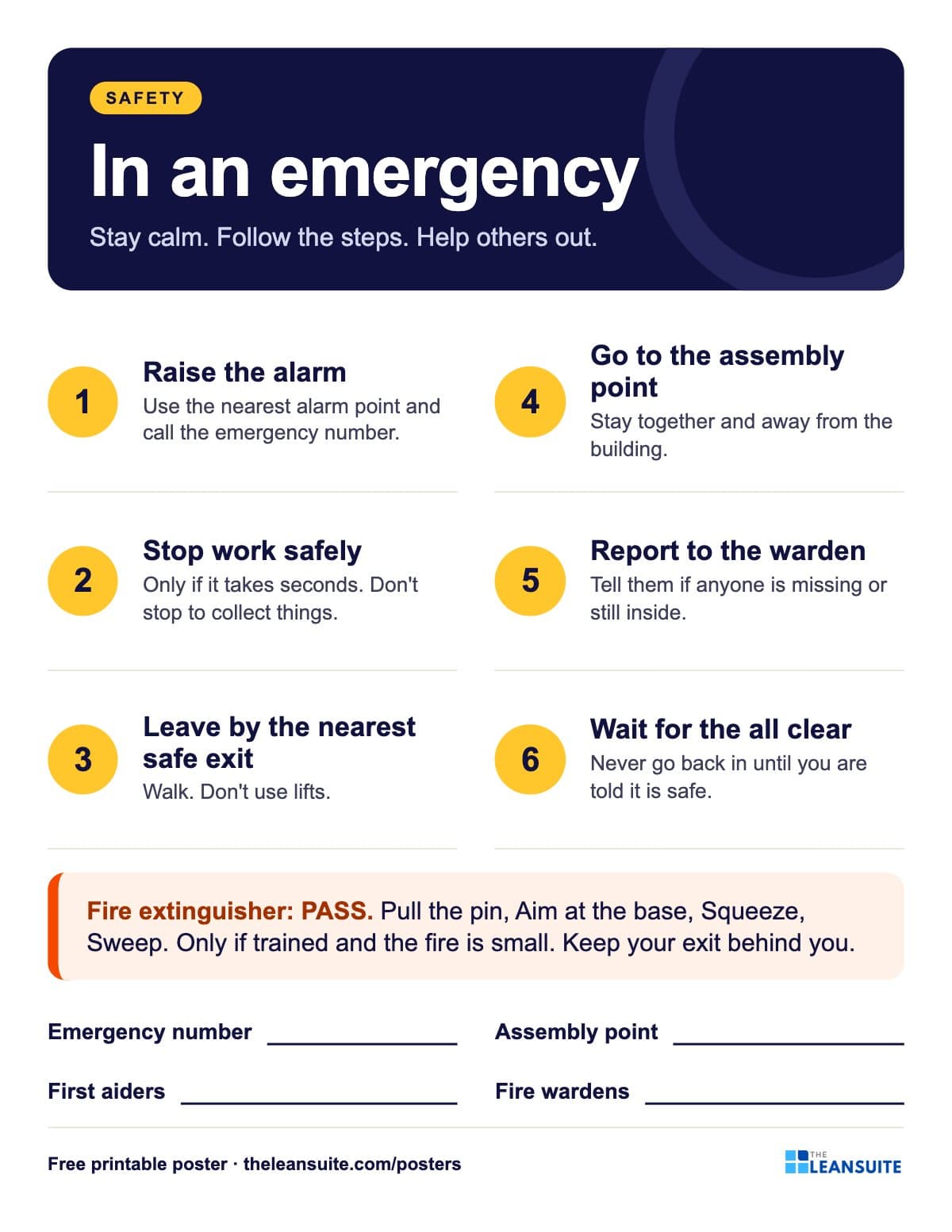 SafetyEmergency response posterSix steps in an emergency, the PASS extinguisher method and blanks for your site's details.View and download
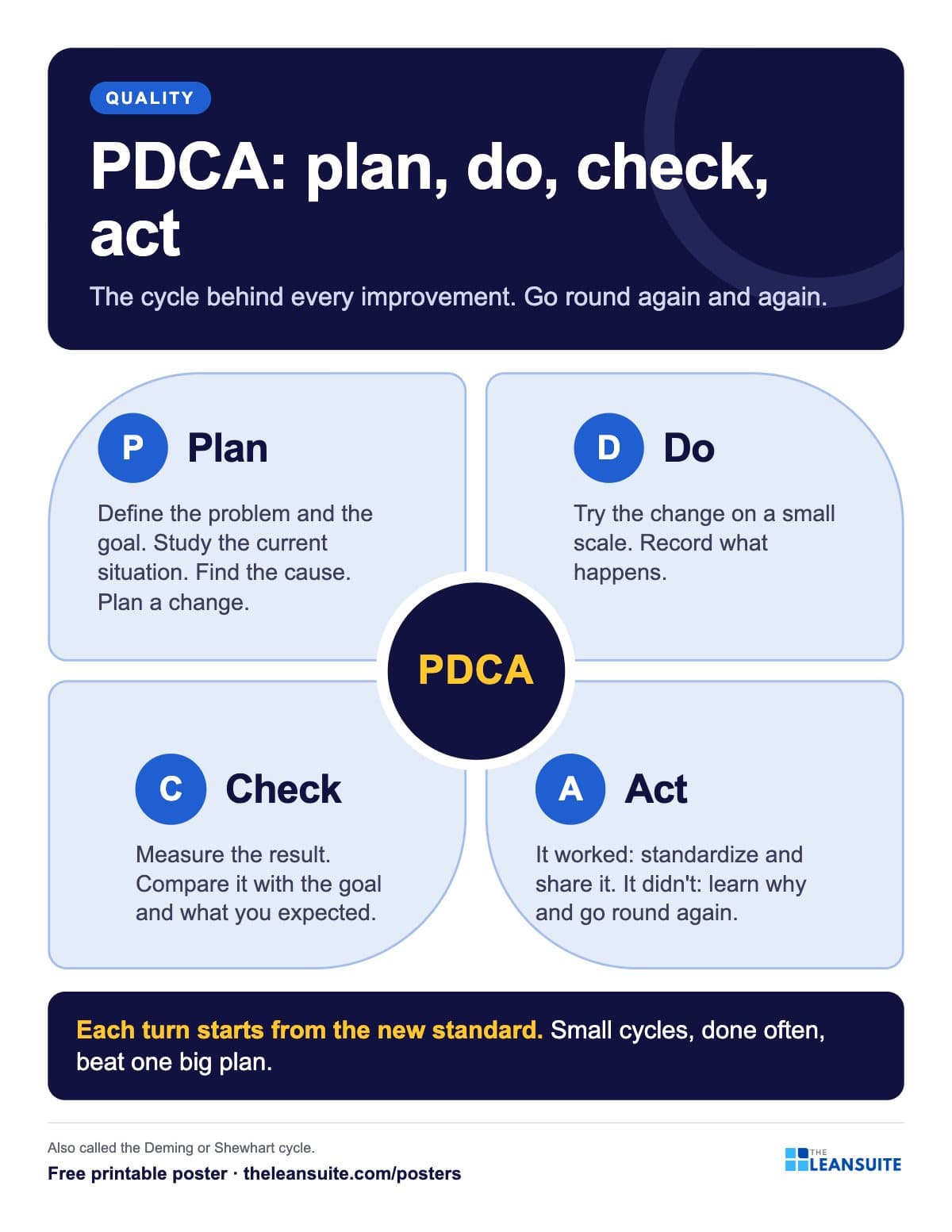 QualityPDCA cycle posterPlan, do, check, act as a cycle, with what to do in each step.View and download
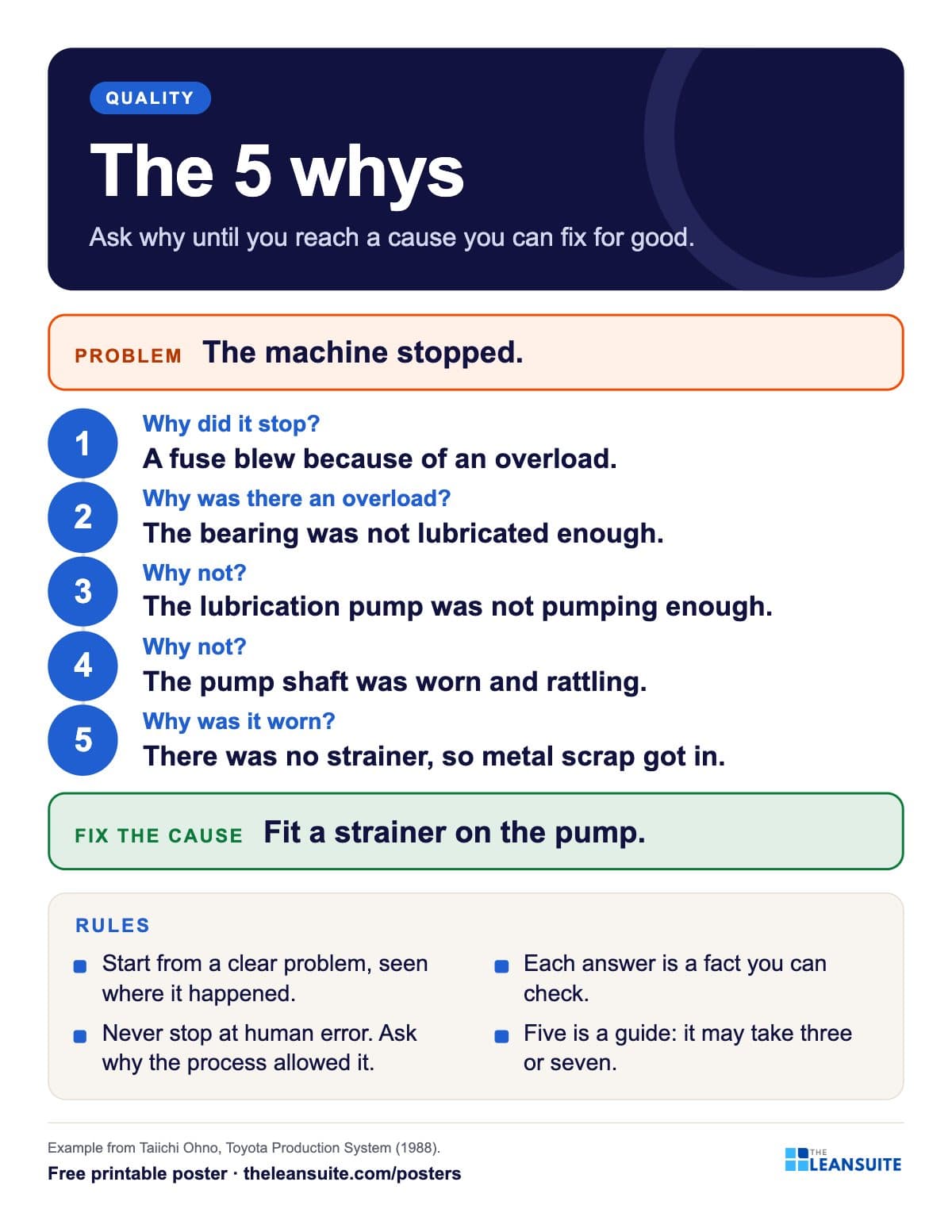 Quality5 whys posterOhno's classic machine example, from a blown fuse to a missing strainer, with the rules for asking why.View and download
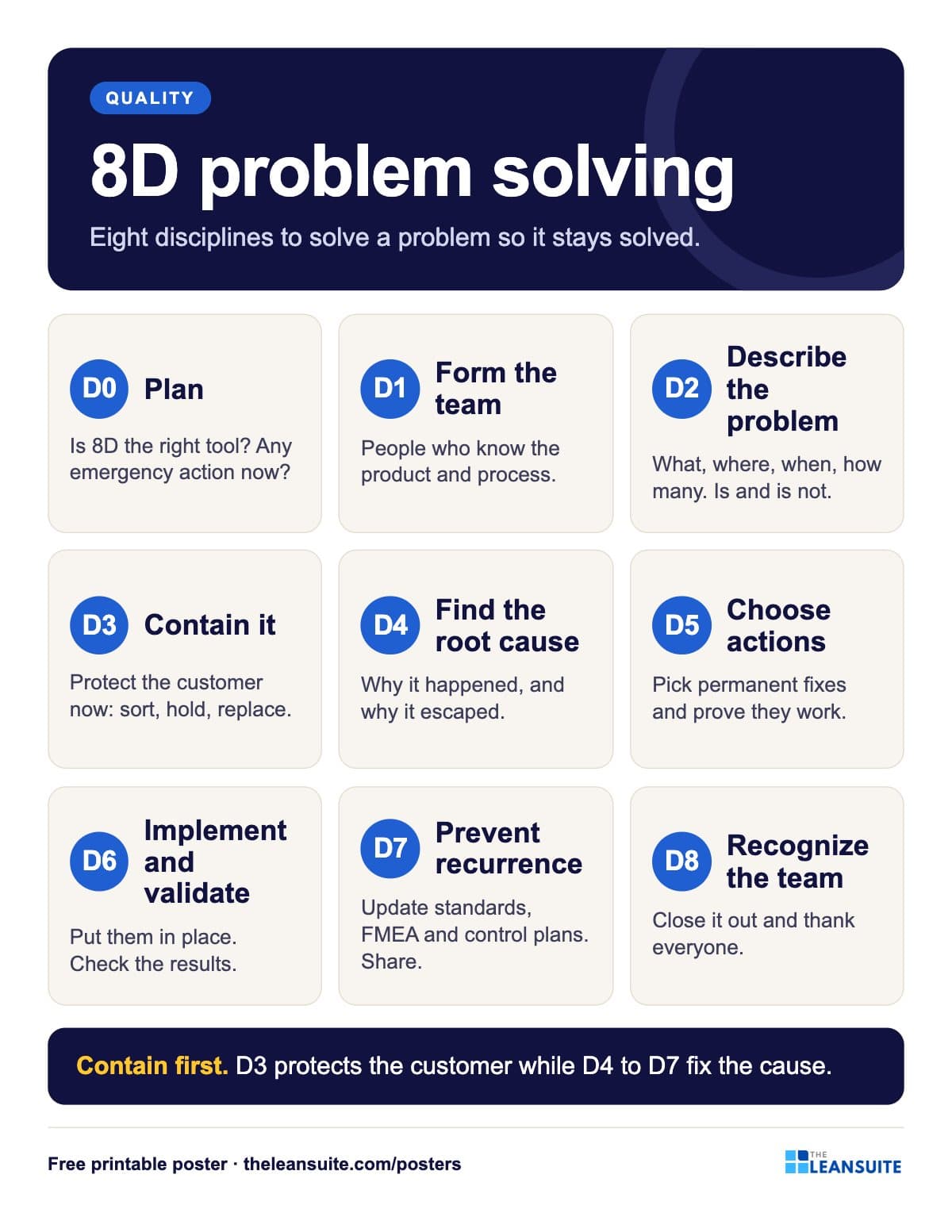 Quality8D problem solving posterThe eight disciplines plus D0, from forming the team to recognizing it, in one view.View and download
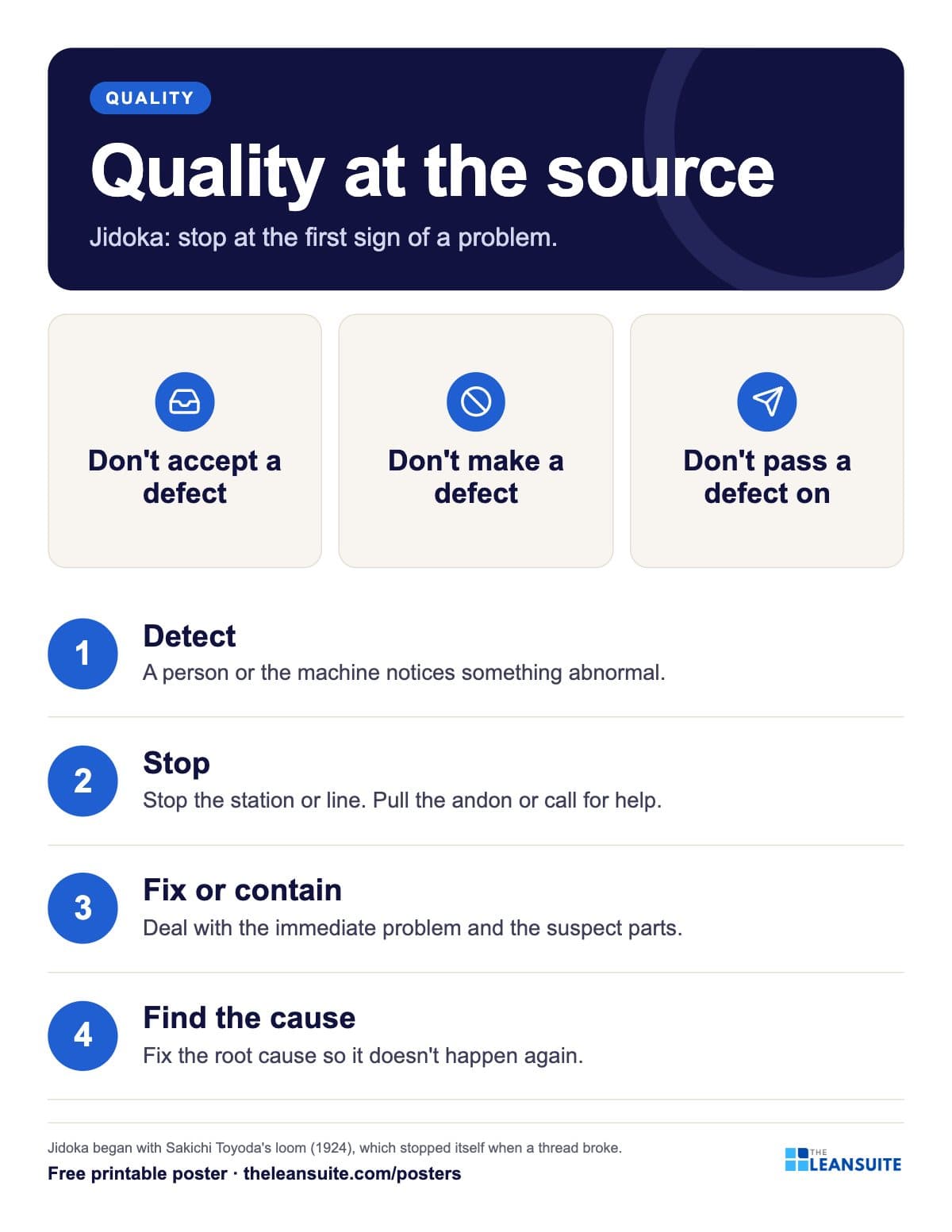 QualityJidoka and quality at the source posterDon't accept, make or pass on a defect, and the four steps of stopping at an abnormality.View and download
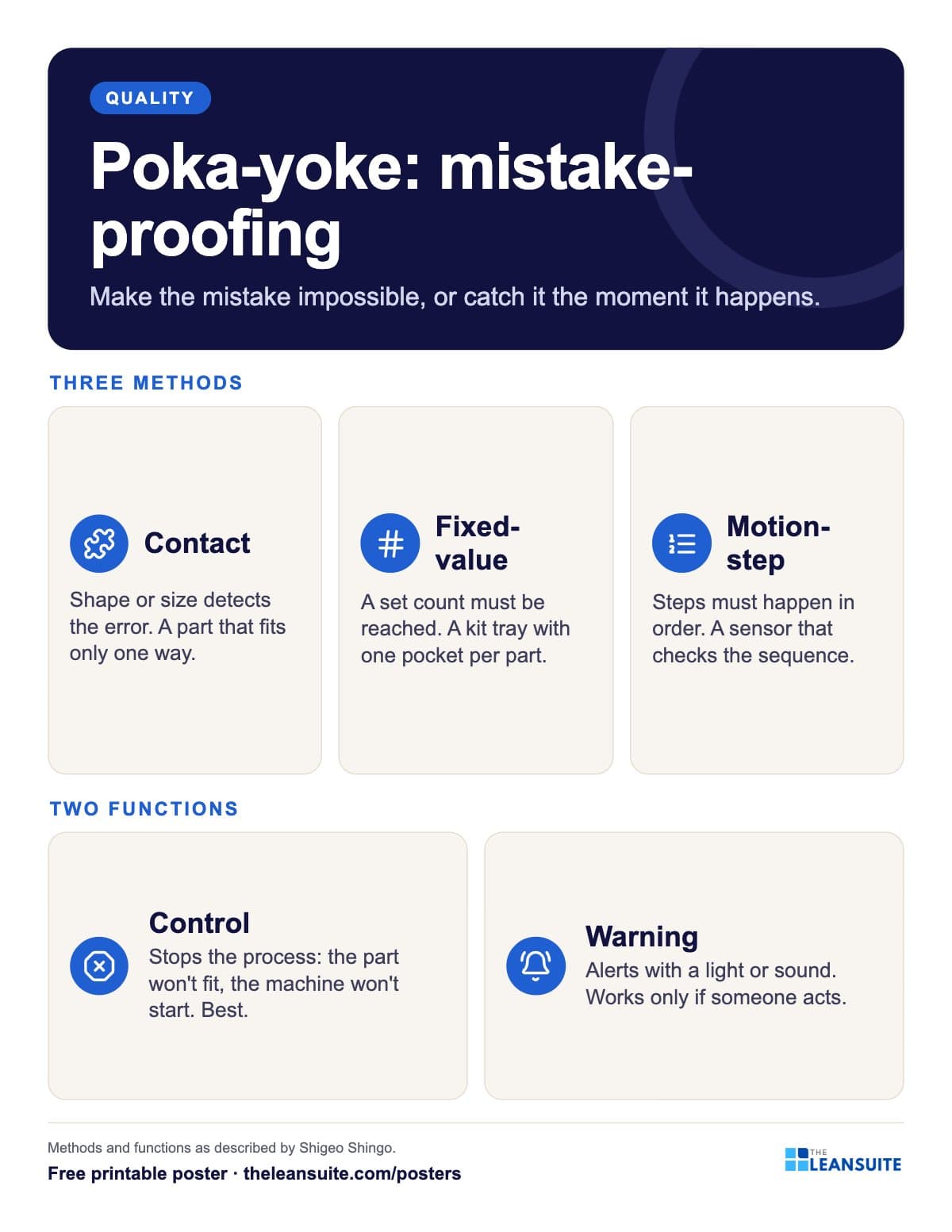 QualityPoka-yoke types posterThe three poka-yoke methods with examples, and control versus warning devices.View and download
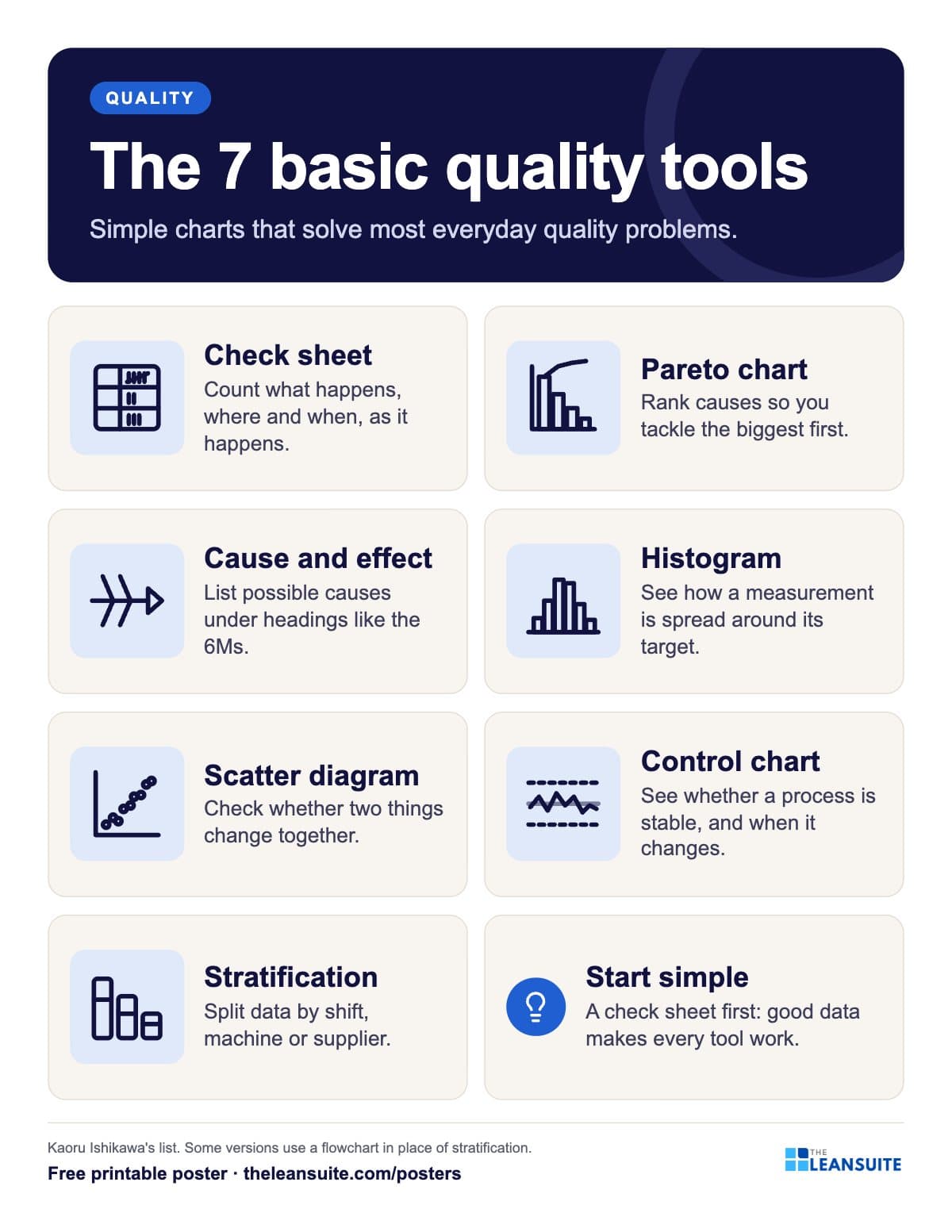 Quality7 basic quality tools posterIshikawa's seven tools, each drawn and explained in one line.View and download
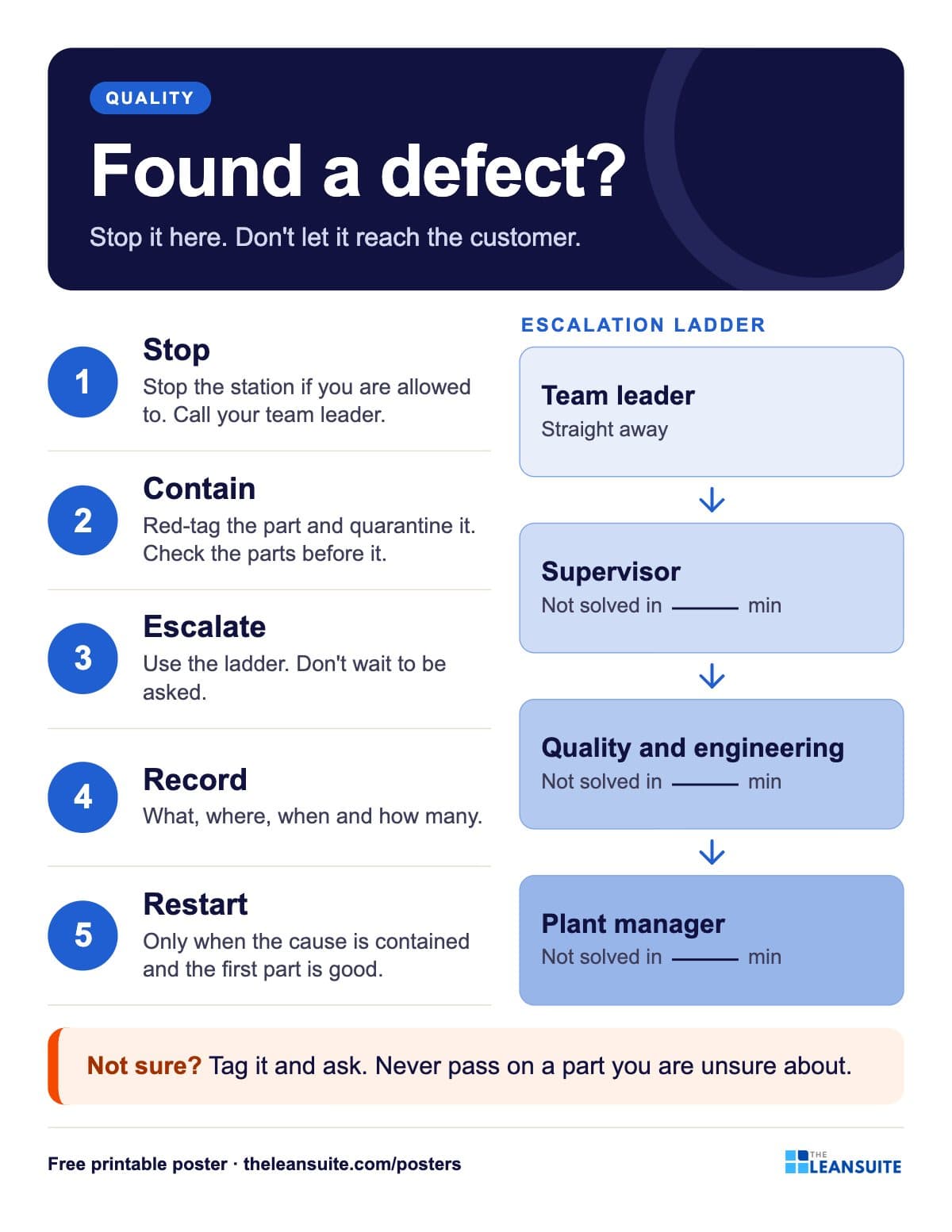 QualityDefect escalation poster (red tag and stop the line)What to do when you find a defect, and an escalation ladder with times to fill in.View and download
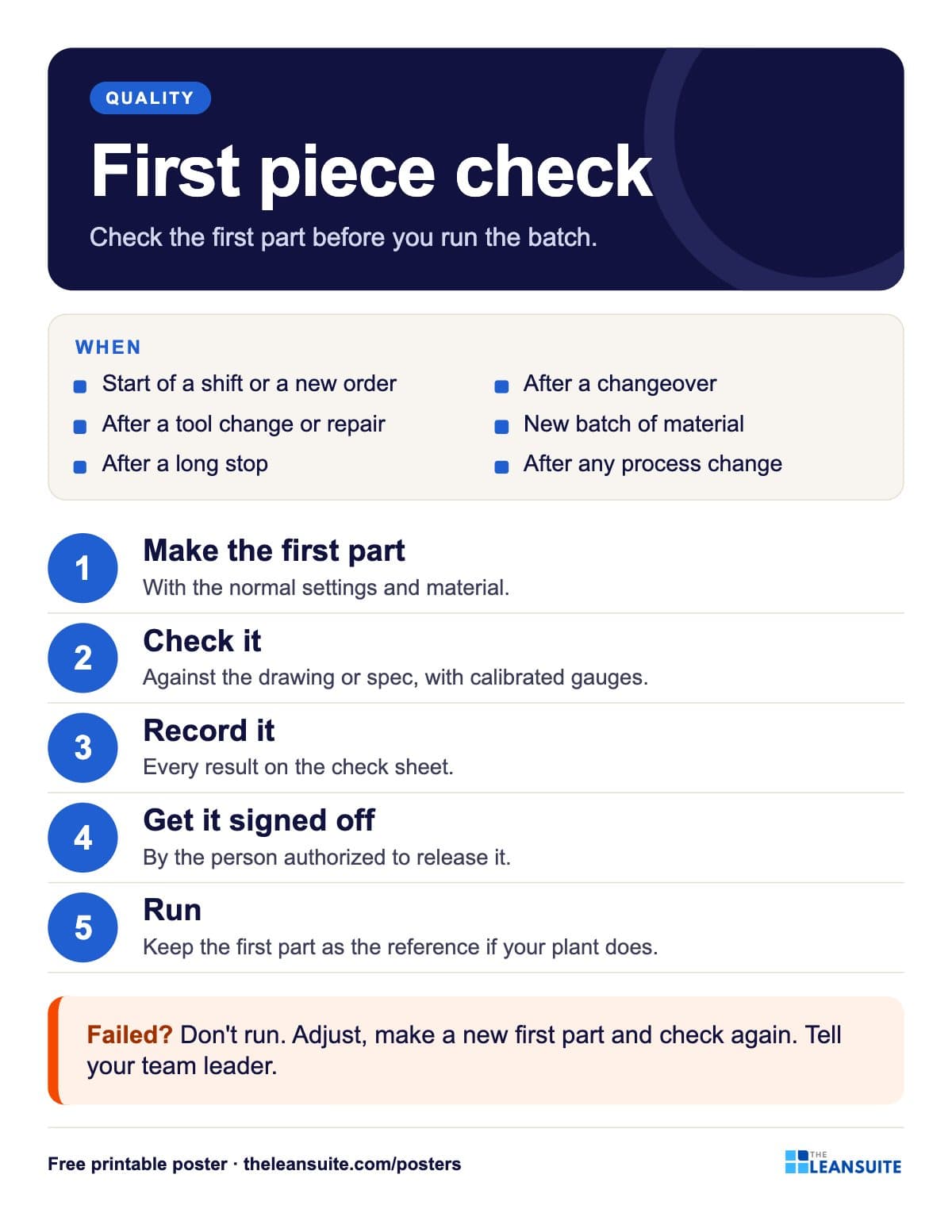 QualityFirst piece (first article) check posterWhen to check the first part, the five steps before you run, and what to do if it fails.View and download
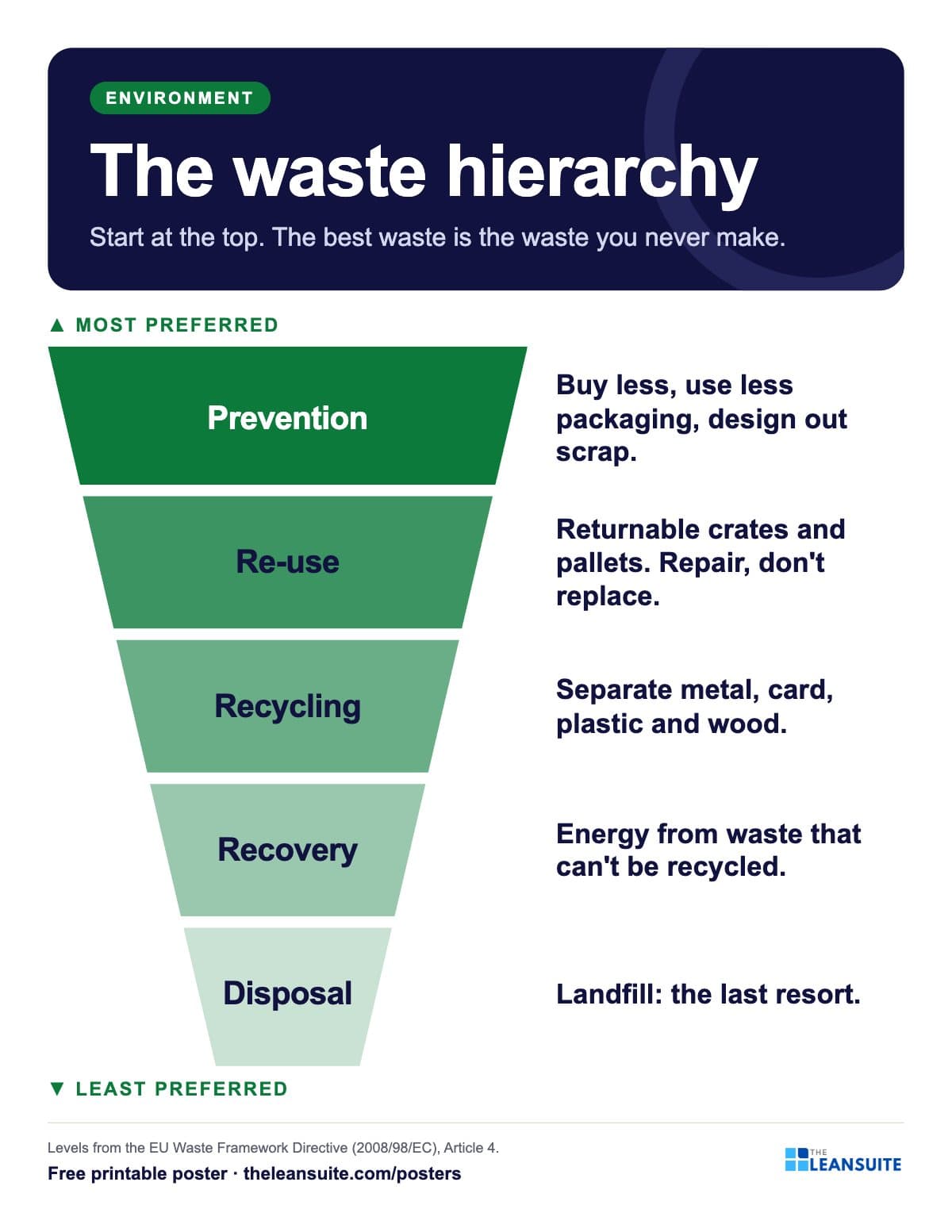 EnvironmentWaste hierarchy posterThe five levels of the waste hierarchy, from prevention to disposal, with plant examples.View and download
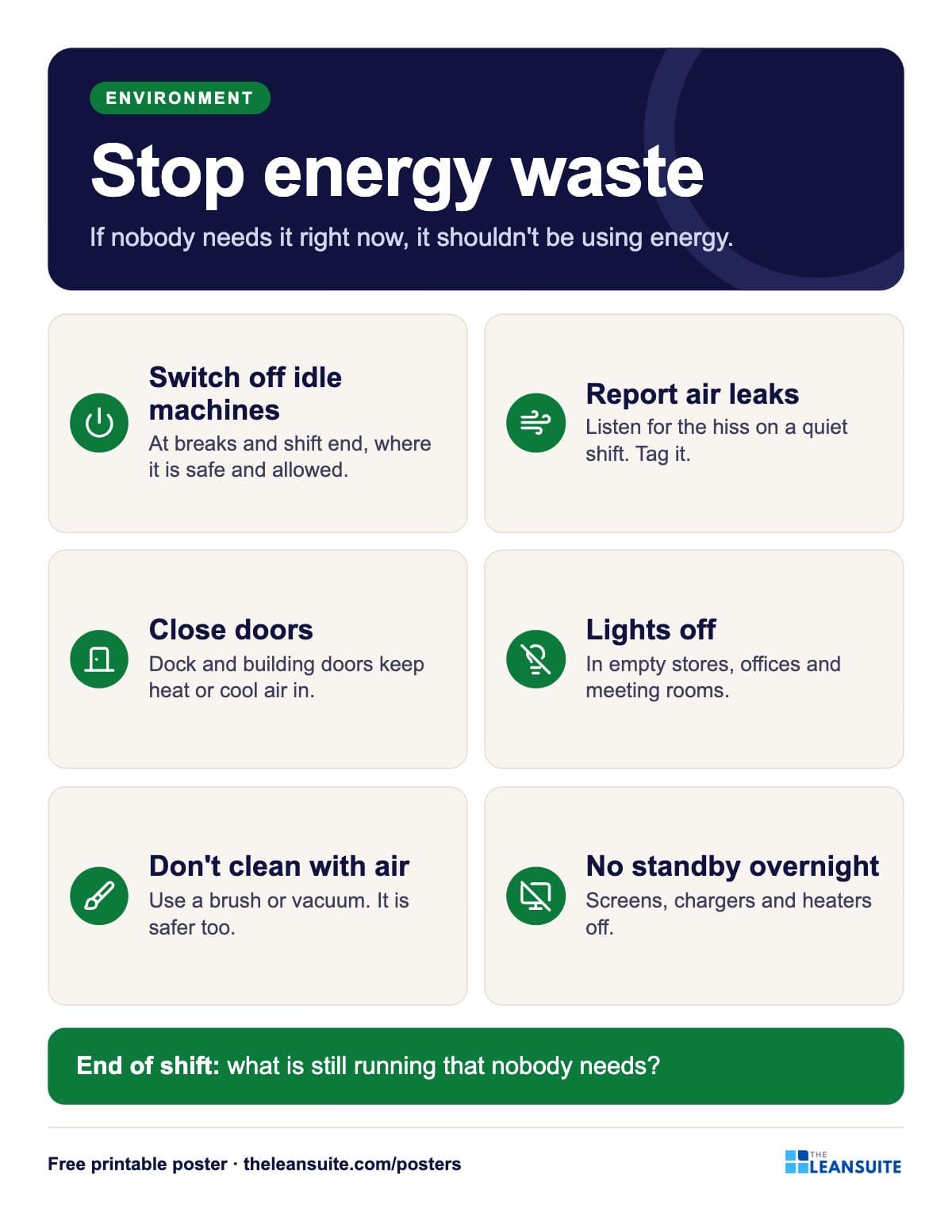 EnvironmentEnergy waste at work posterSix everyday sources of energy waste at work, and the habit that stops each one.View and download
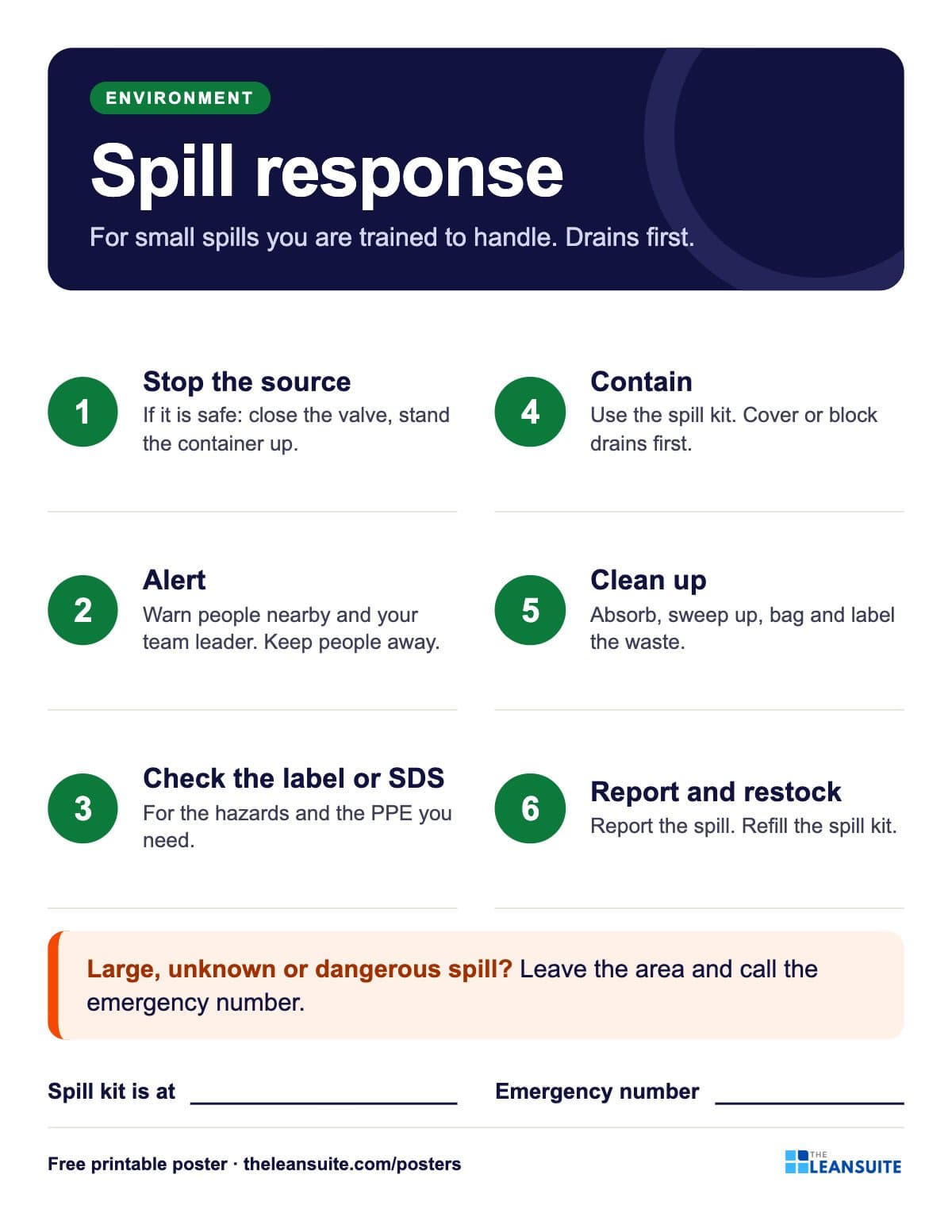 EnvironmentSpill response posterSix steps for a small spill, drains first, with blanks for your spill kit and emergency number.View and download
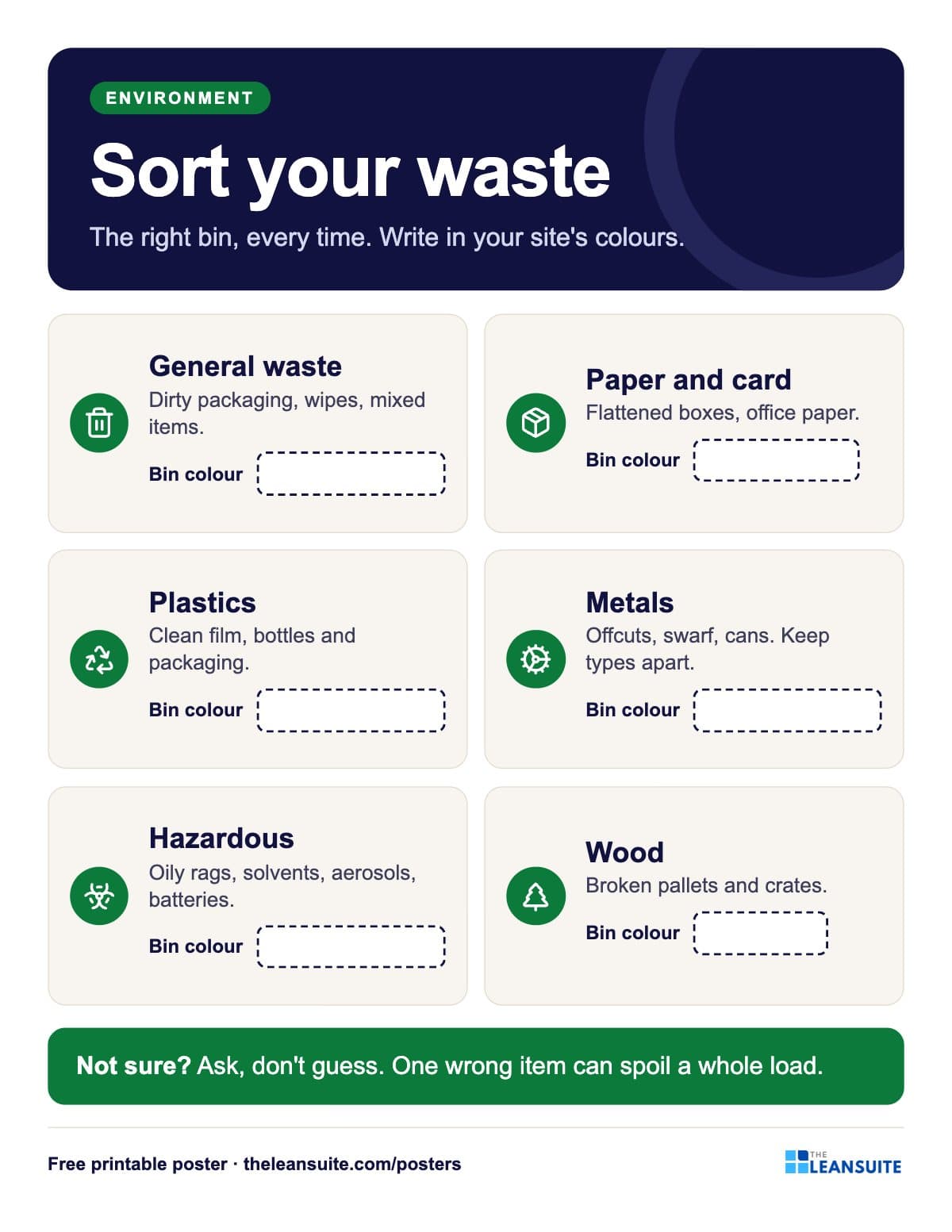 EnvironmentWaste segregation poster (bin colours)Six waste streams with examples, and a box to write in your own bin colour, since colours vary by site.View and download
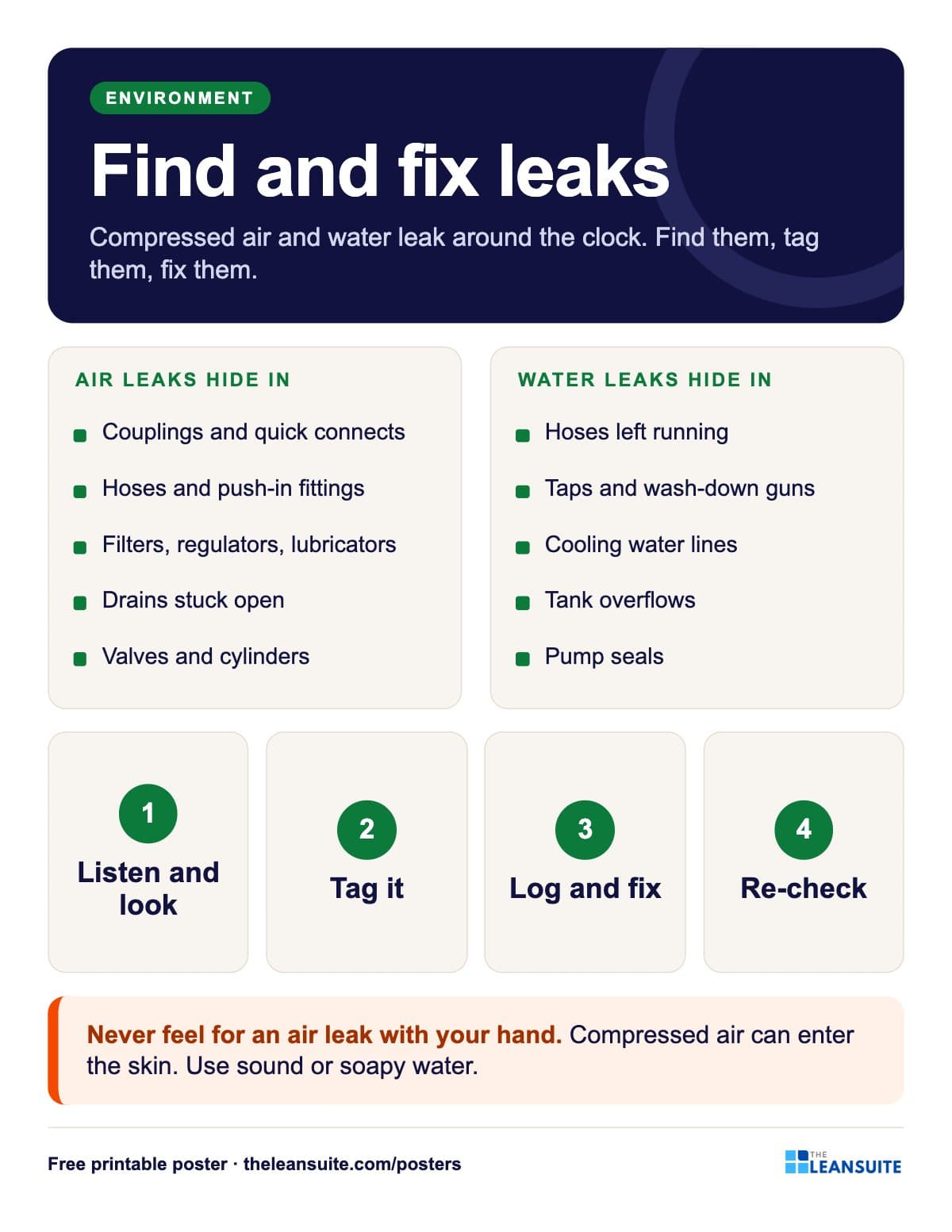 EnvironmentCompressed air and water leaks posterWhere air and water leaks hide, and five steps to find, tag, fix and re-check them.View and download
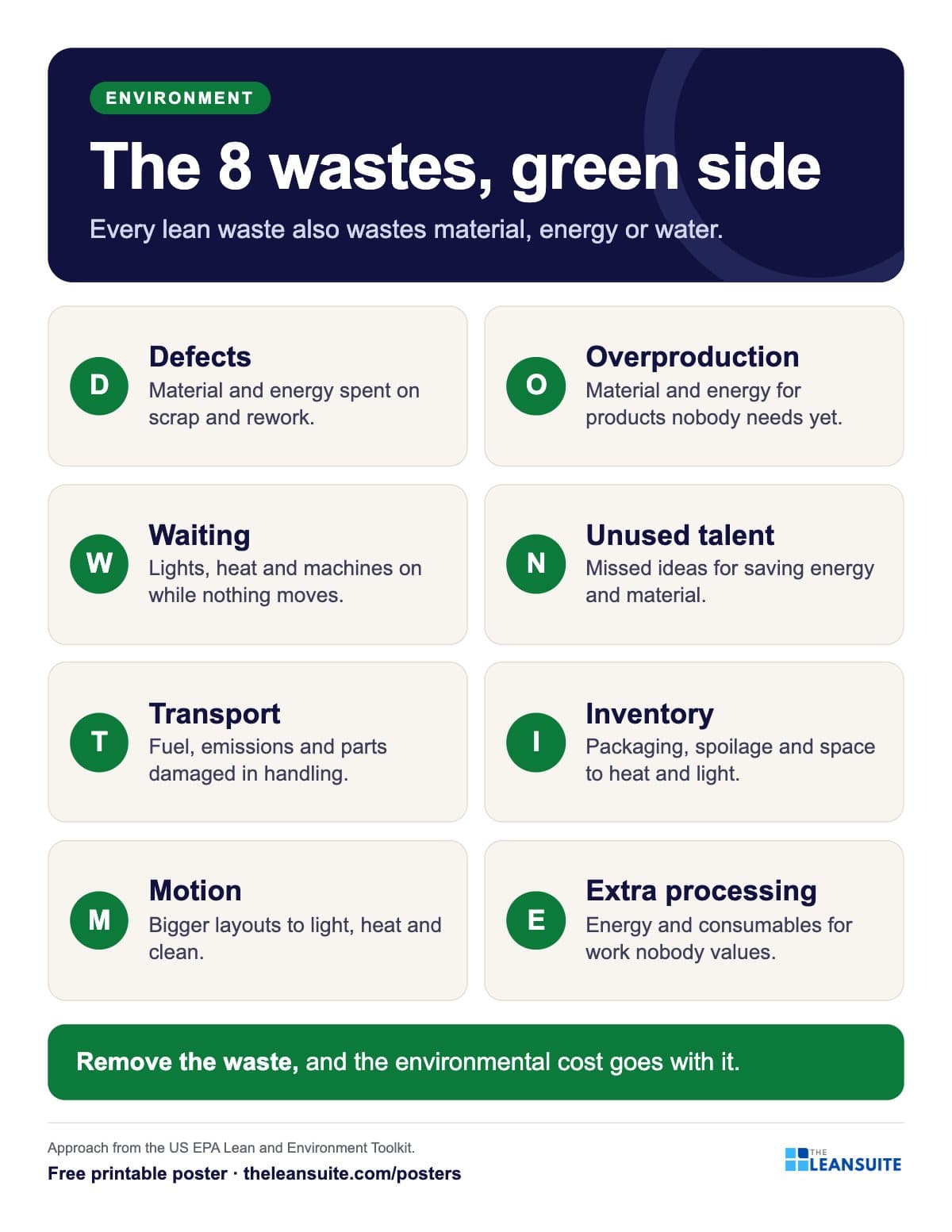 EnvironmentGreen lean poster: the 8 wastes and the environmentThe environmental cost behind each of the 8 wastes, from extra energy to scrapped material.View and download
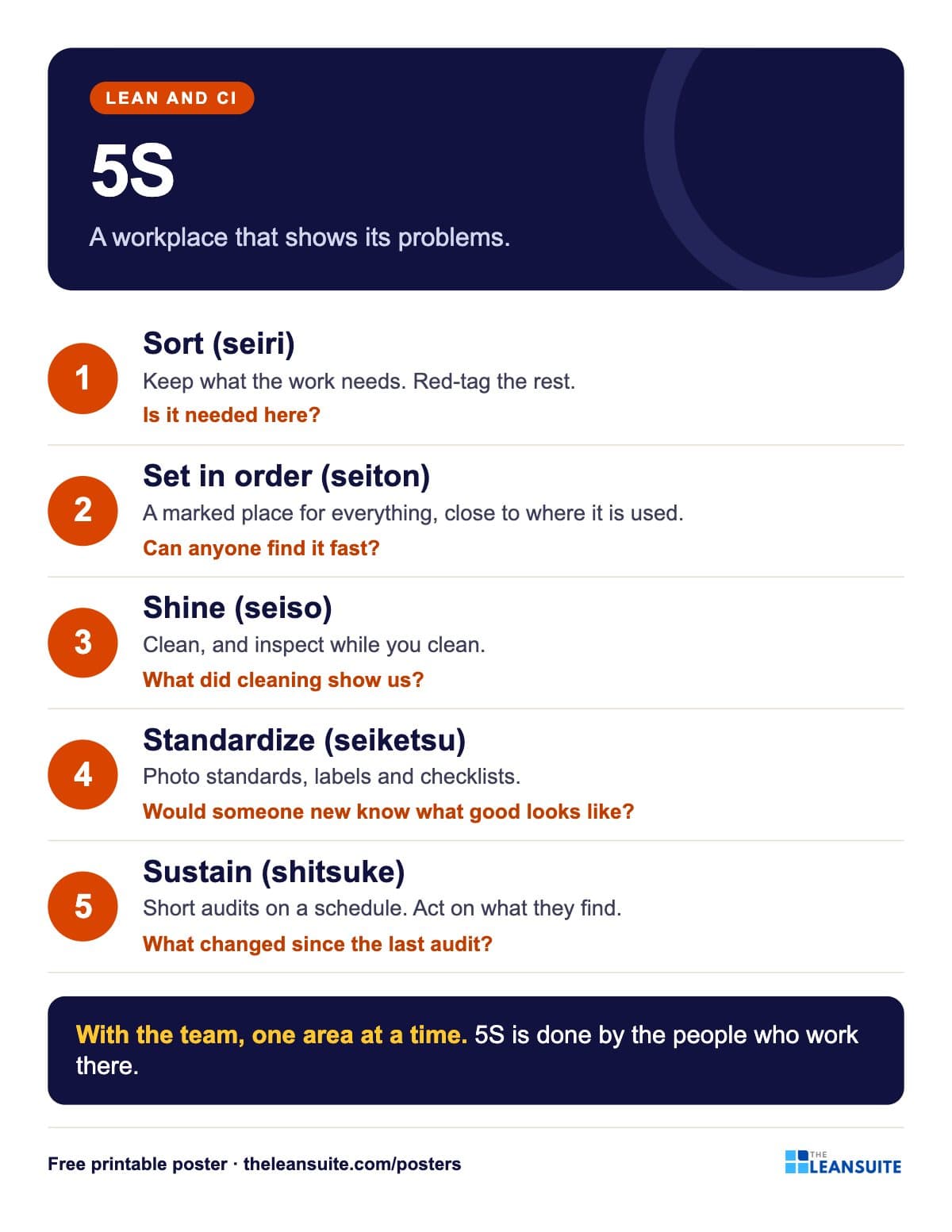 Lean and CI5S posterSort, set in order, shine, standardize and sustain, each with what to do and a question to ask.View and download
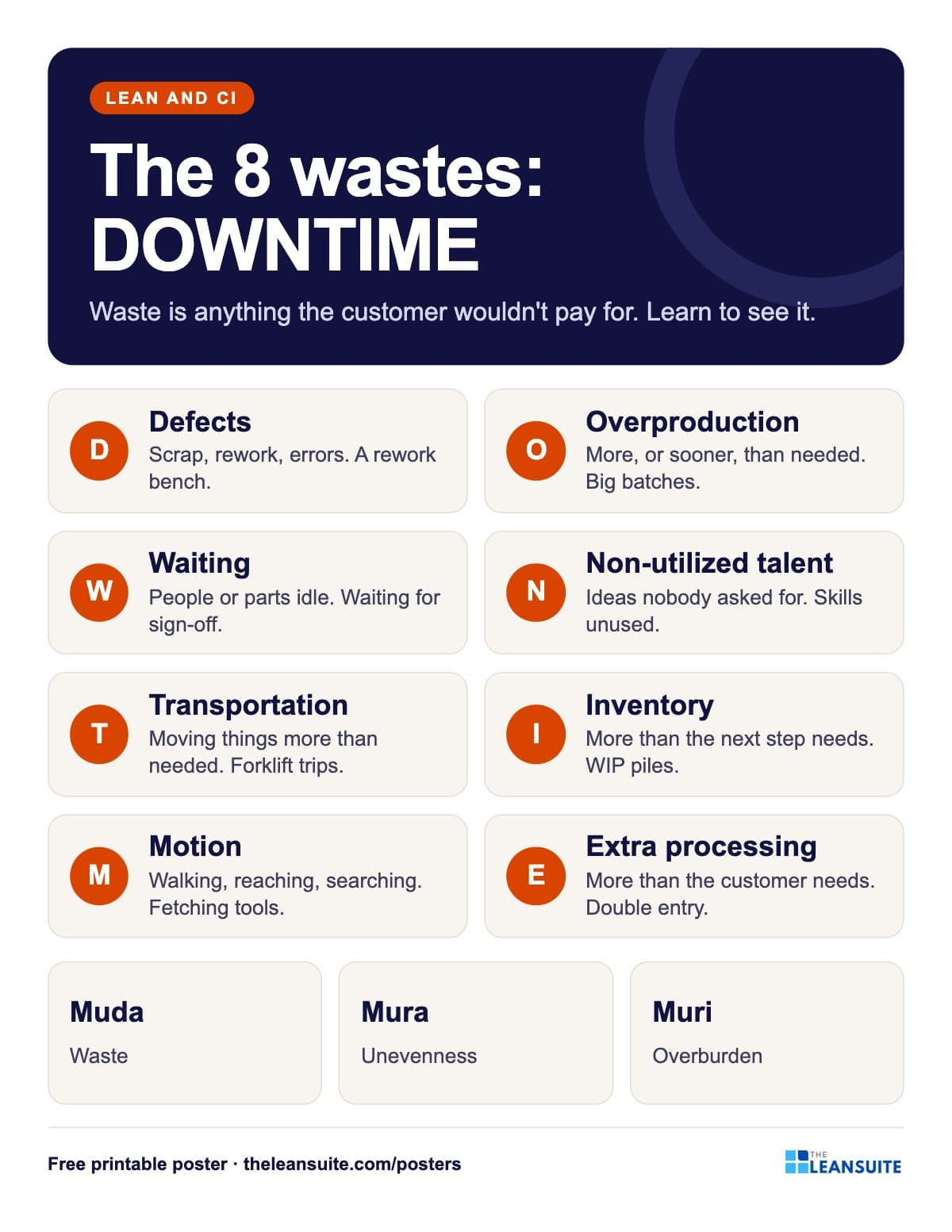 Lean and CI8 wastes of lean poster (DOWNTIME)DOWNTIME: the eight wastes with a definition and an example each, plus muda, mura and muri.View and download
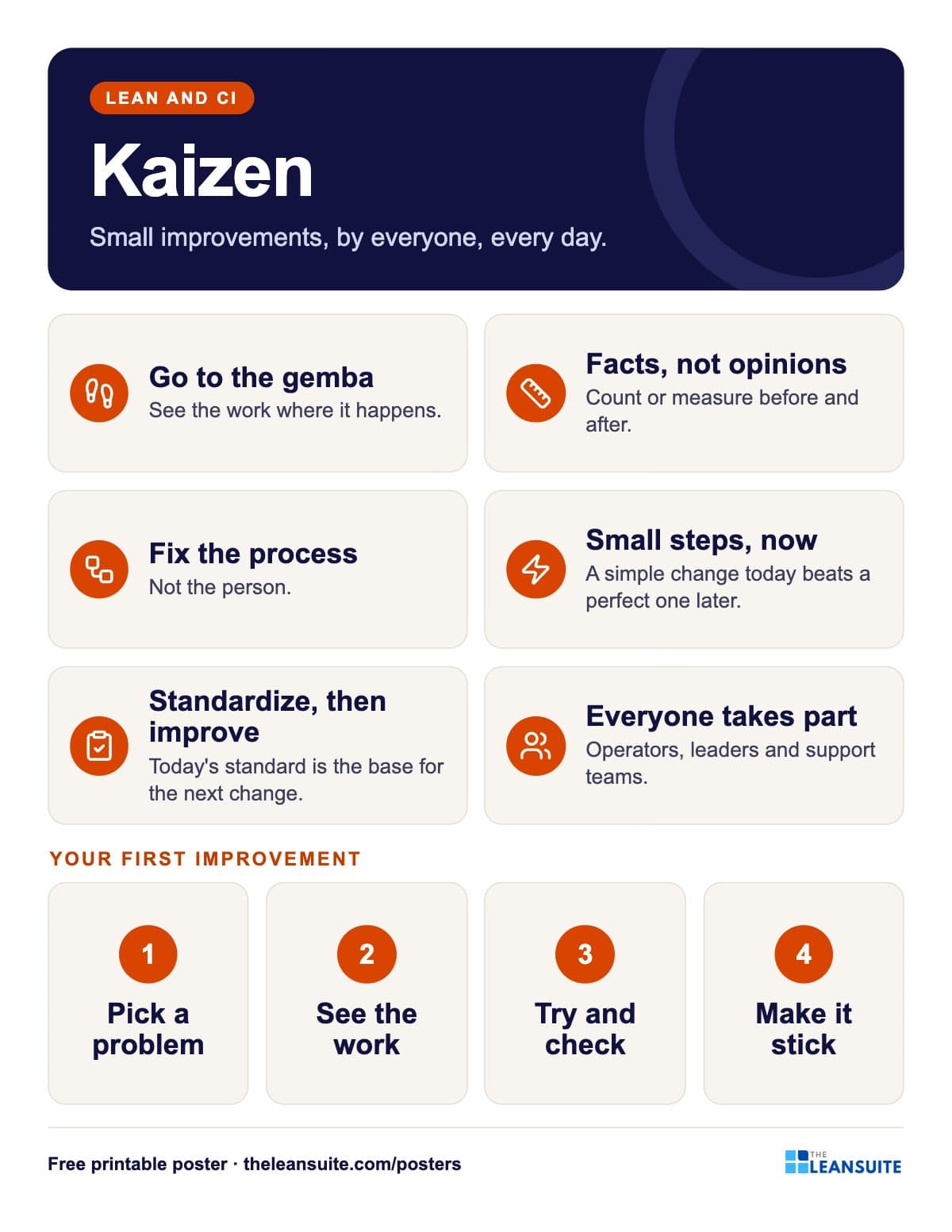 Lean and CIKaizen principles posterSix principles of continuous improvement and four steps to a first improvement.View and download
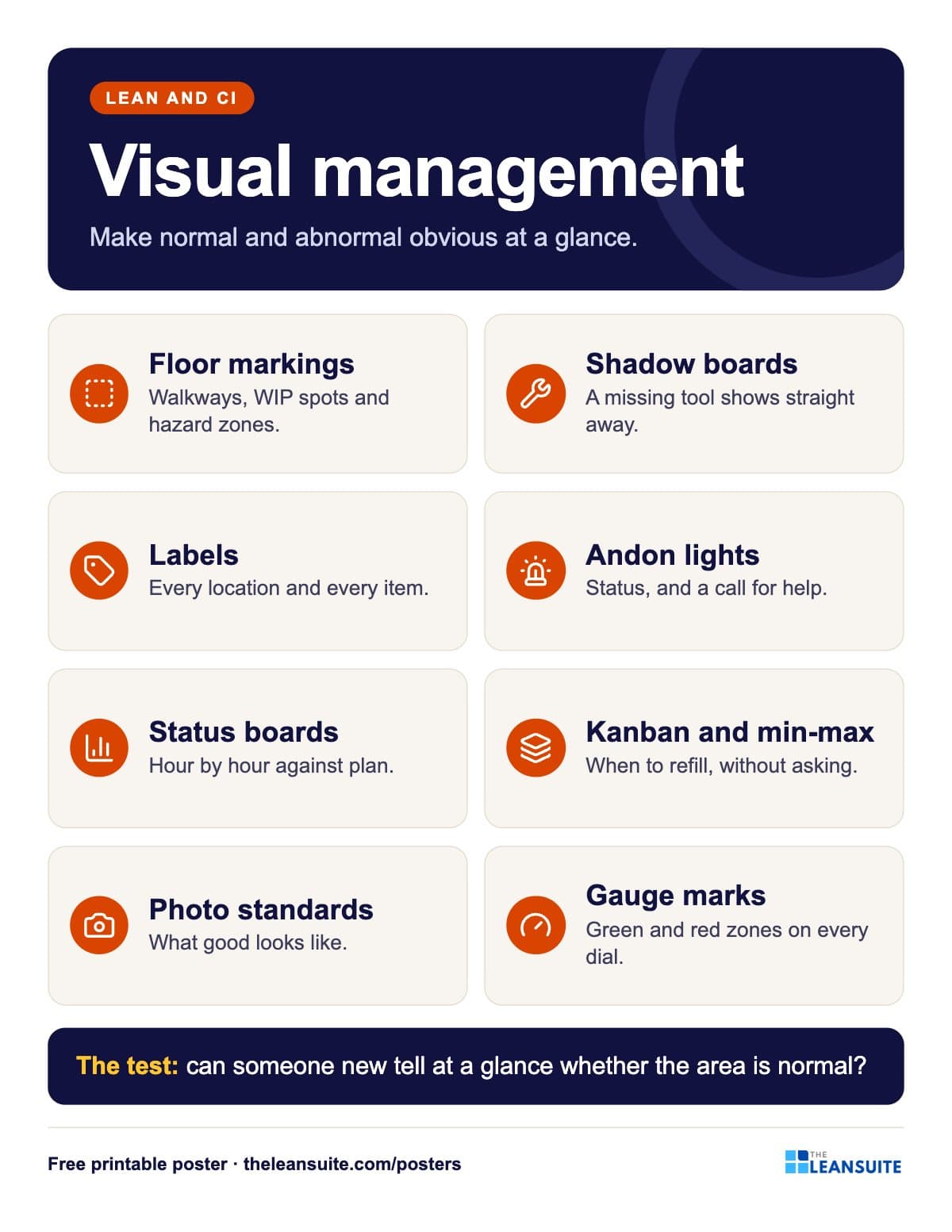 Lean and CIVisual management posterEight visual aids that show at a glance whether an area is normal.View and download
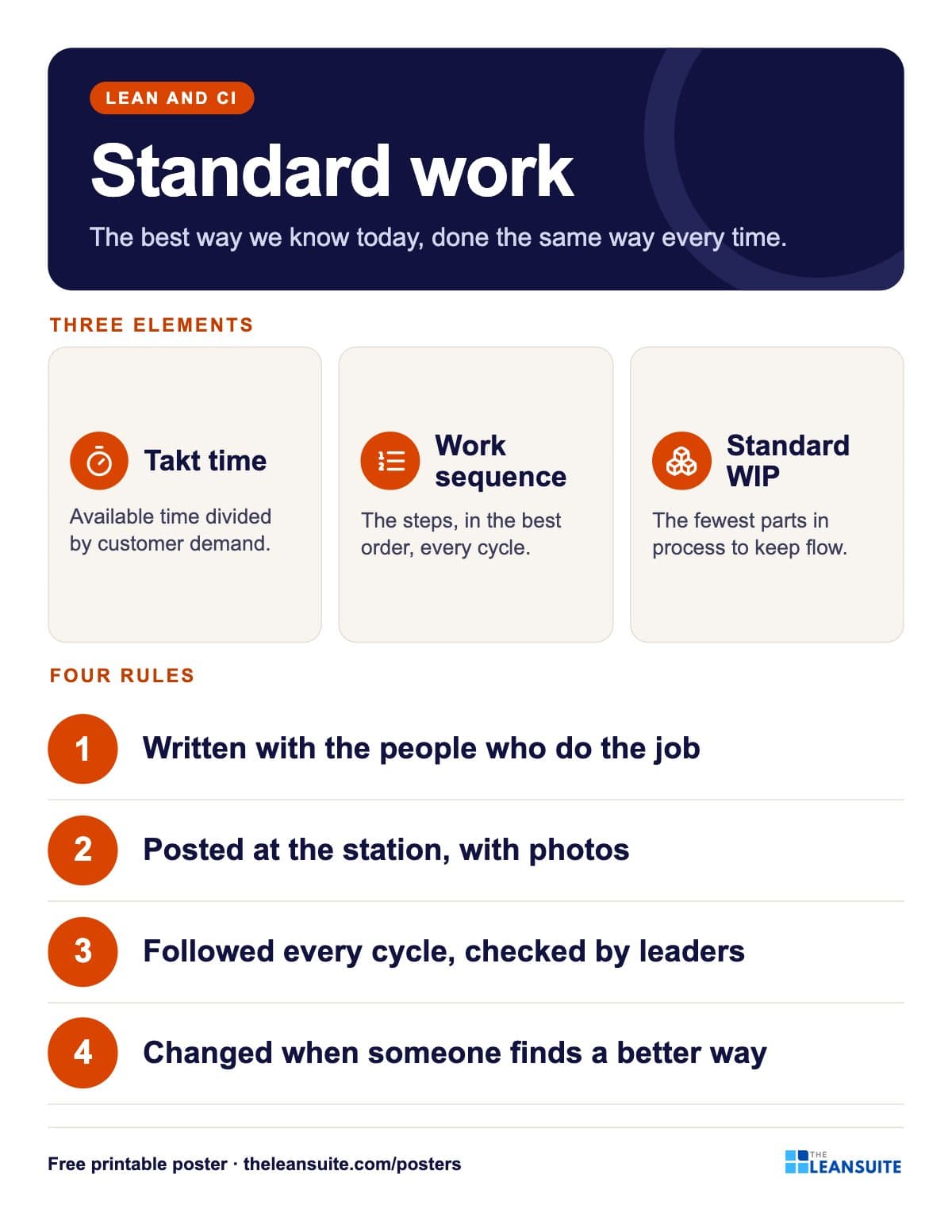 Lean and CIStandard work posterTakt time, work sequence and standard WIP, plus four rules for keeping a standard alive.View and download
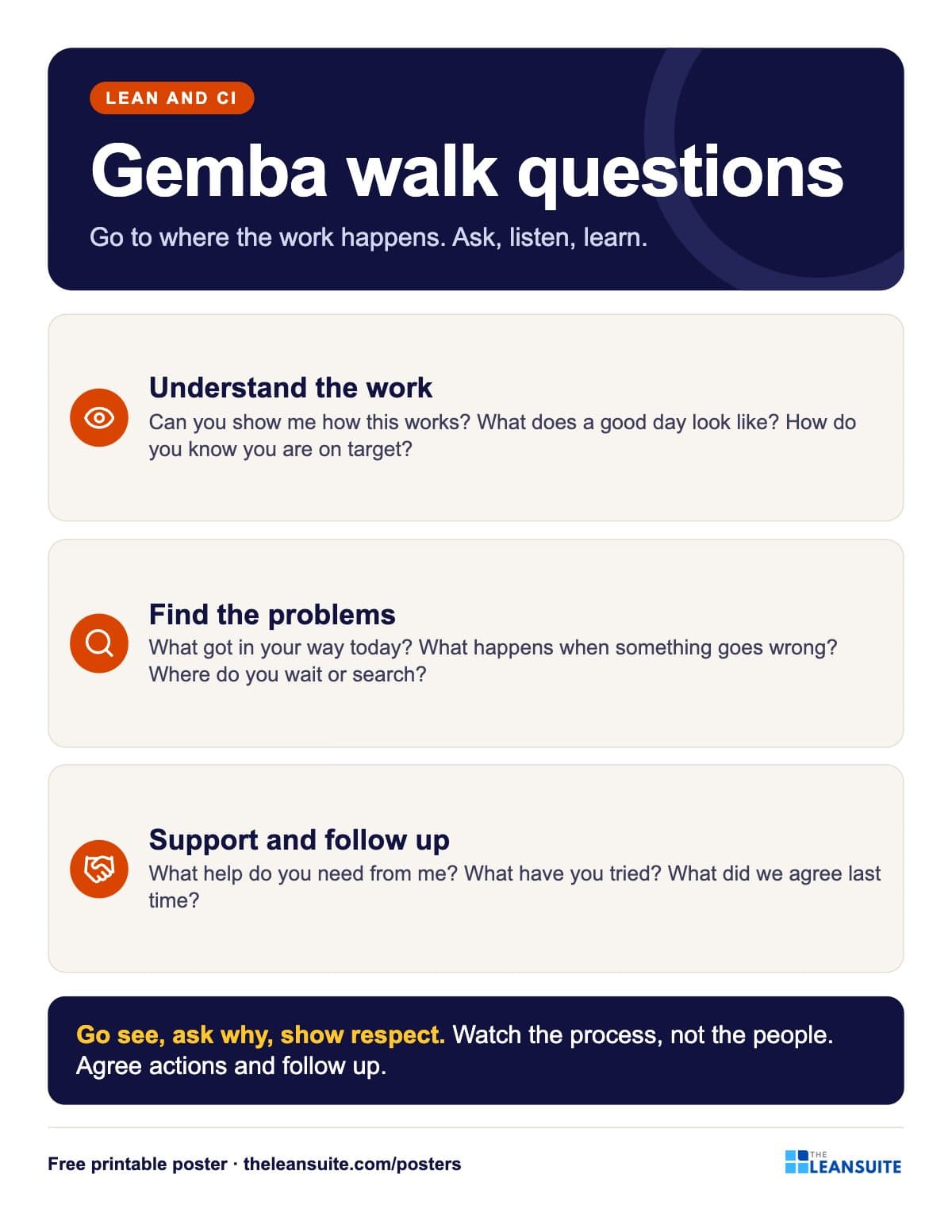 Lean and CIGemba walk questions posterNine questions to ask on a gemba walk, in three groups, and the rules of a good walk.View and download
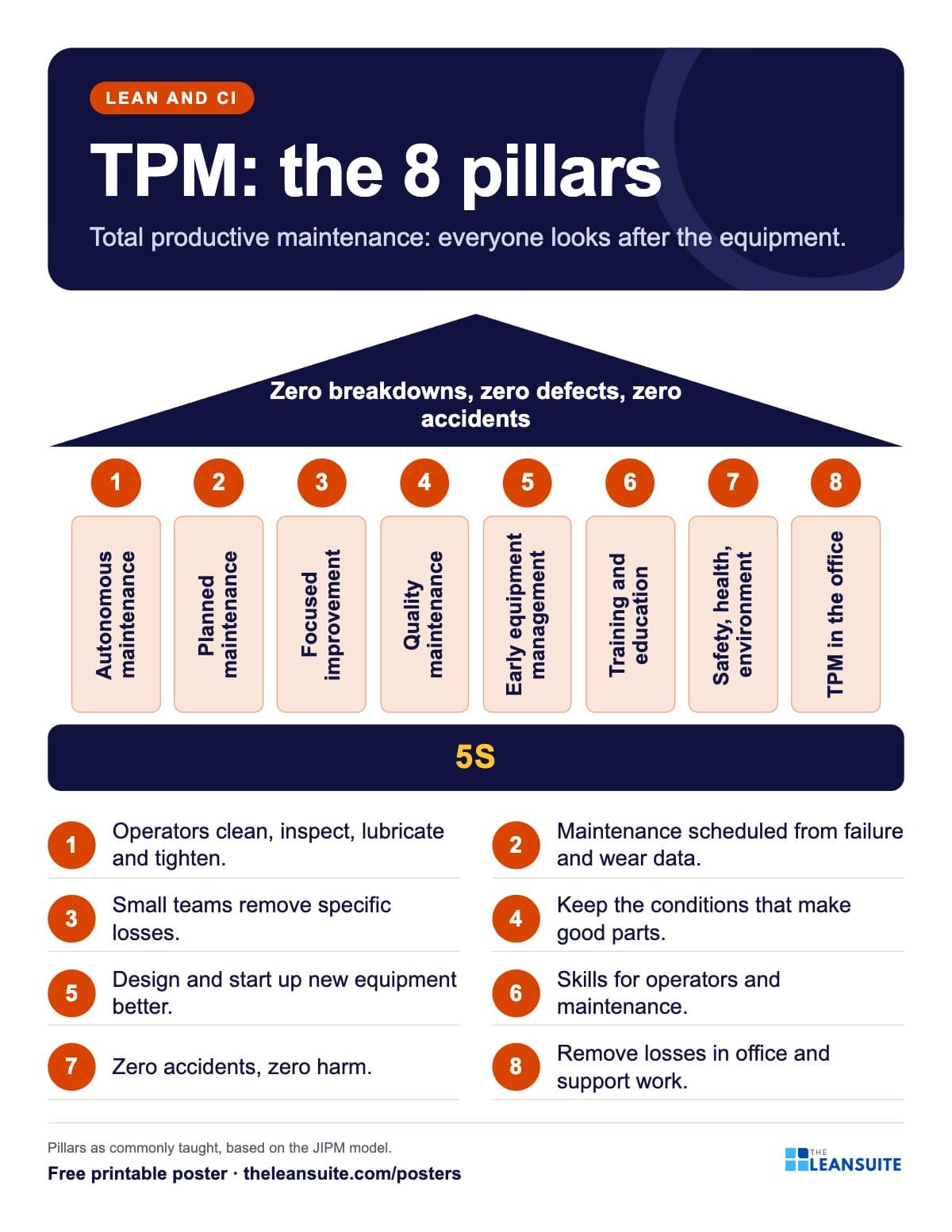 Lean and CITPM 8 pillars posterThe TPM house on a 5S foundation, with a line on each of the eight pillars.View and download
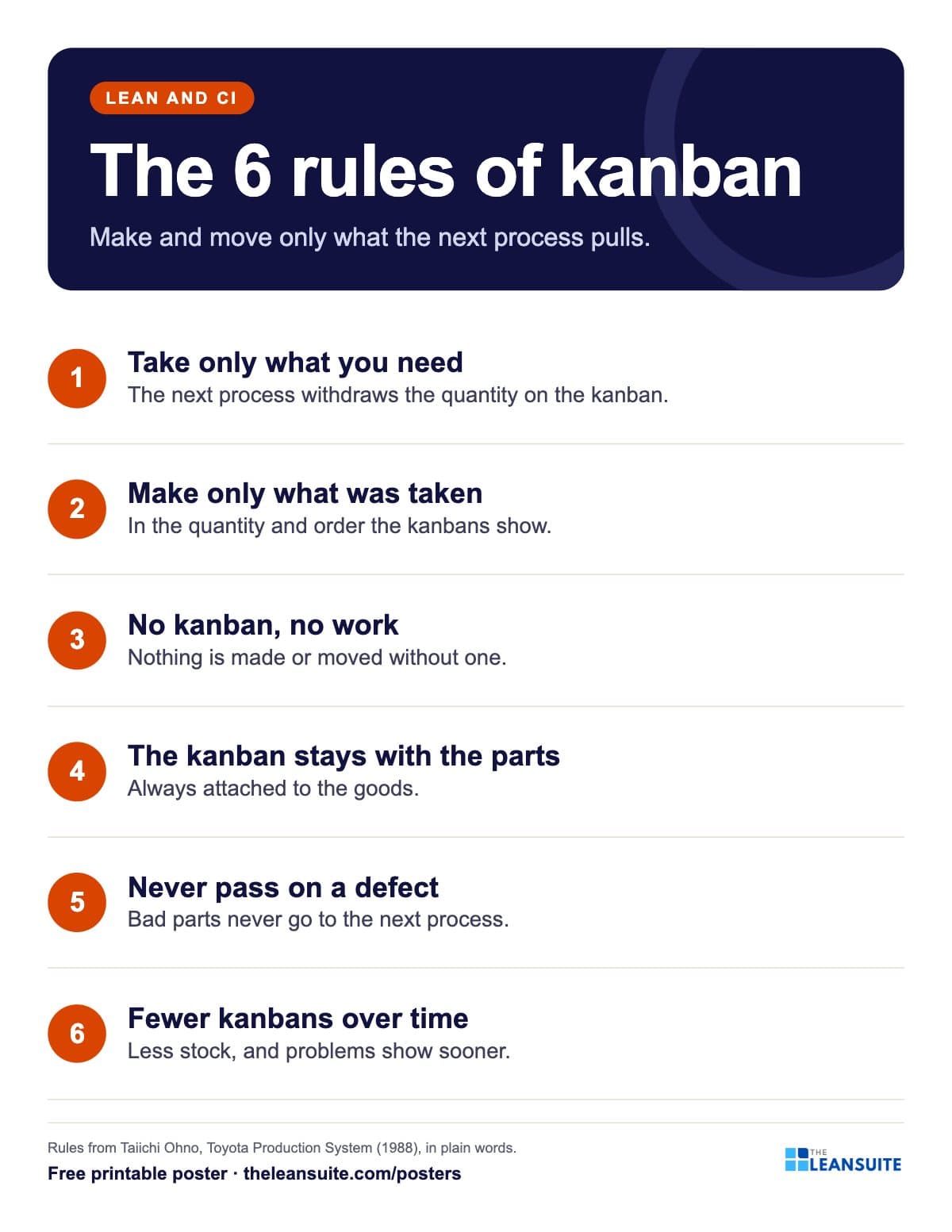 Lean and CIKanban rules posterTaiichi Ohno's six rules of kanban in plain words, for pull systems on the floor.View and download
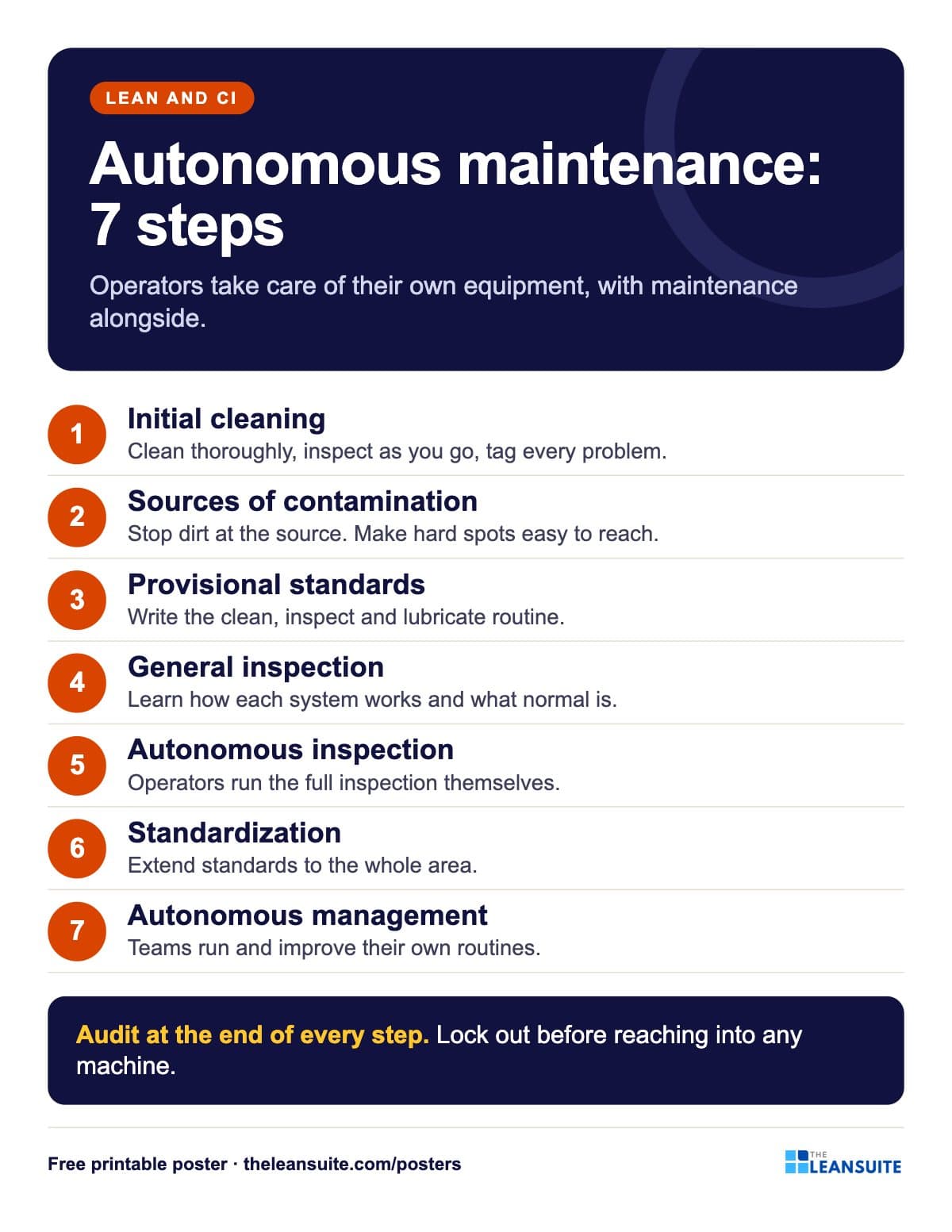 Lean and CIAutonomous maintenance 7 steps posterThe seven steps of jishu hozen, from initial cleaning to autonomous management.View and download
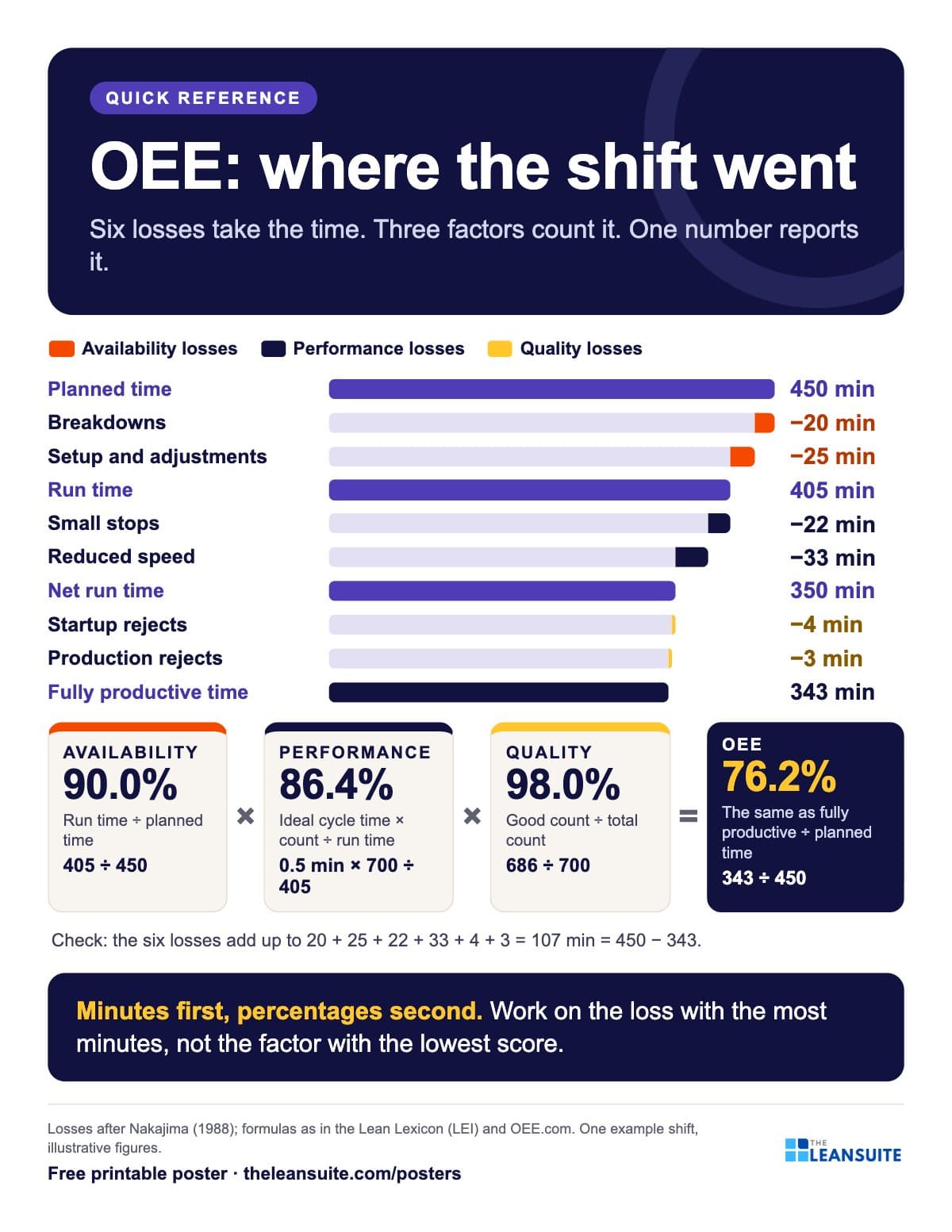 Quick referenceOEE and the six big losses posterOne shift's planned time cut down by six named losses to fully productive time, with availability, performance, quality and OEE worked out.View and download
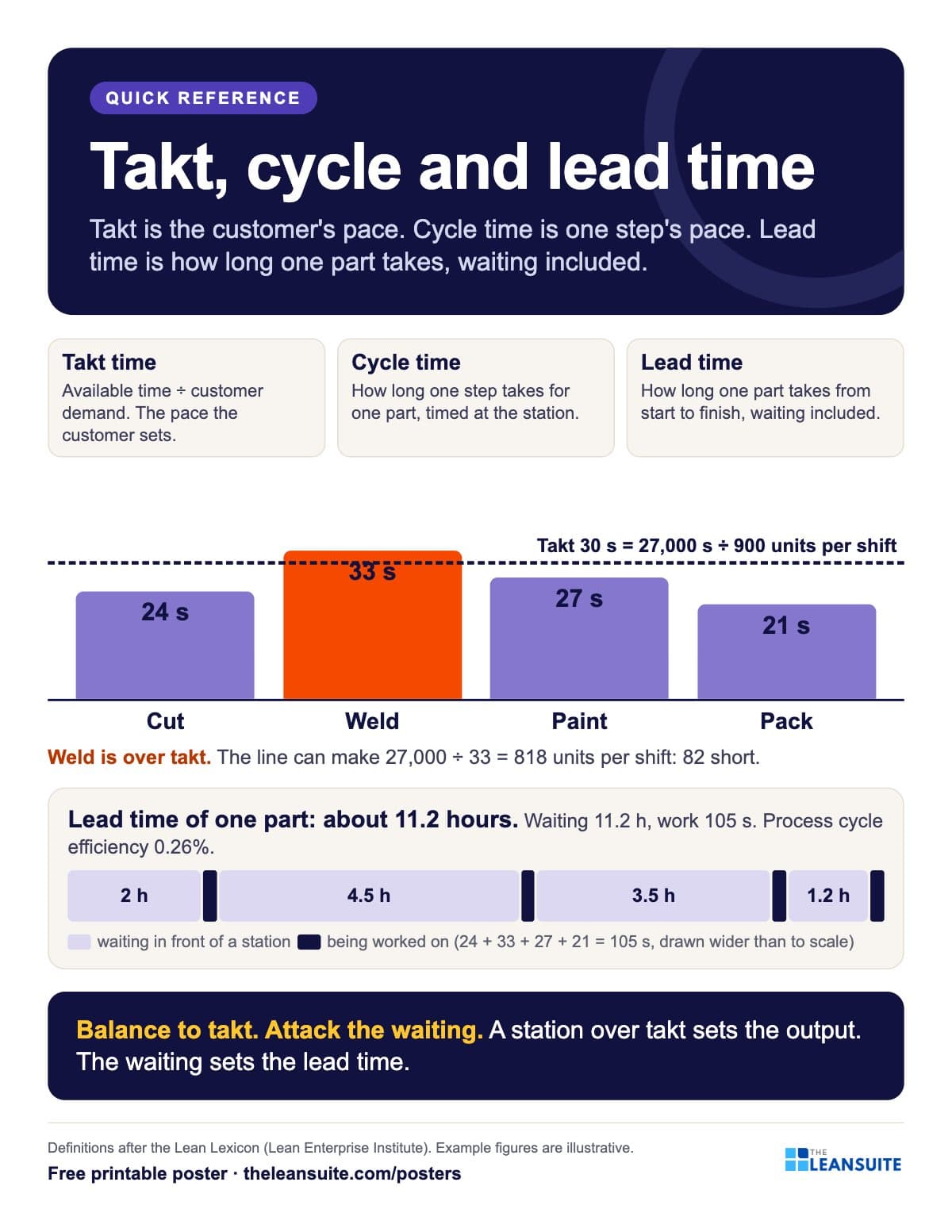 Quick referenceTakt time, cycle time and lead time posterThe three clocks on one line: takt from demand, each station's cycle time against it, and the lead time of one part, waiting included.View and download
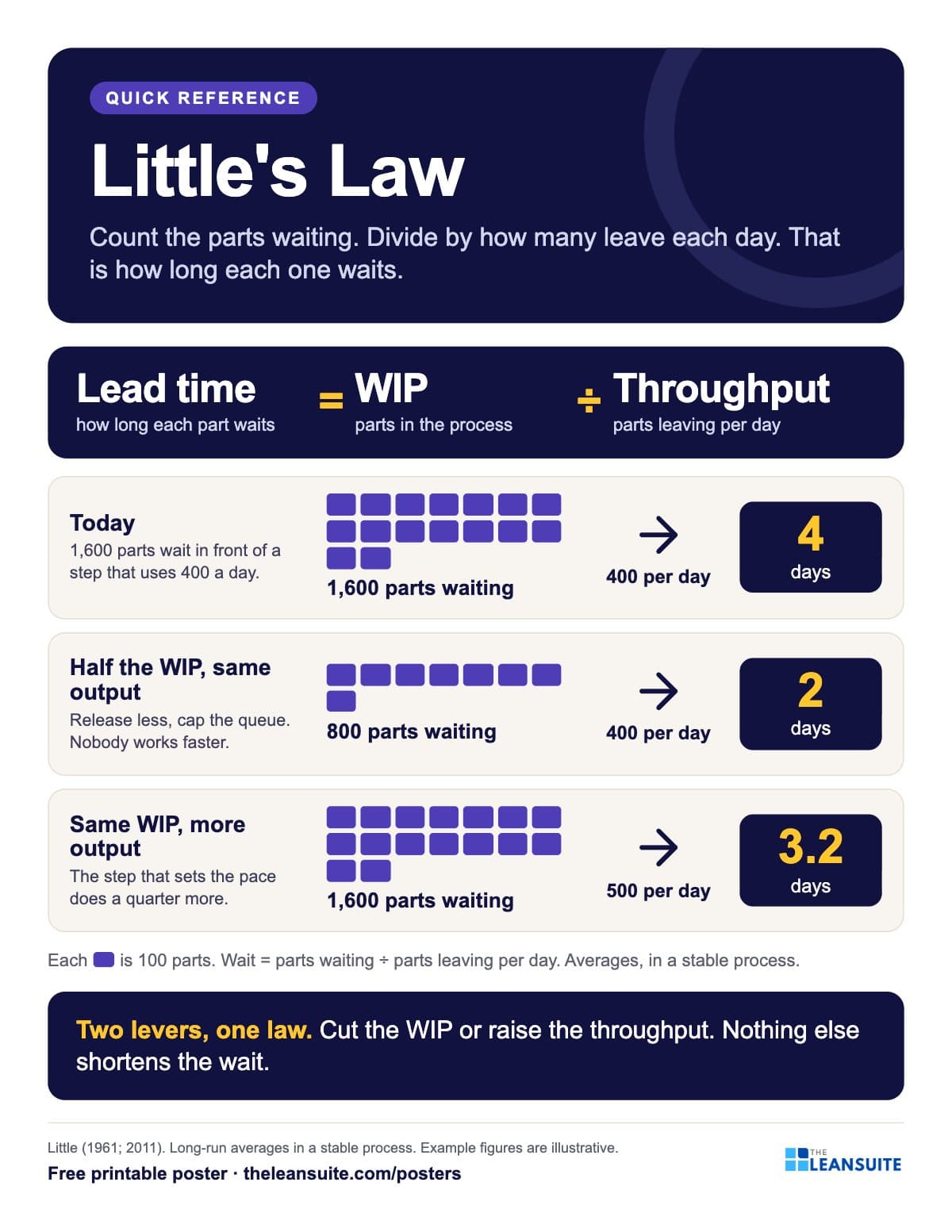 Quick referenceLittle's Law poster: WIP, throughput and lead timeLead time = WIP ÷ throughput, drawn as a queue of parts, with three worked cases: today, half the WIP, and a faster bottleneck.View and download
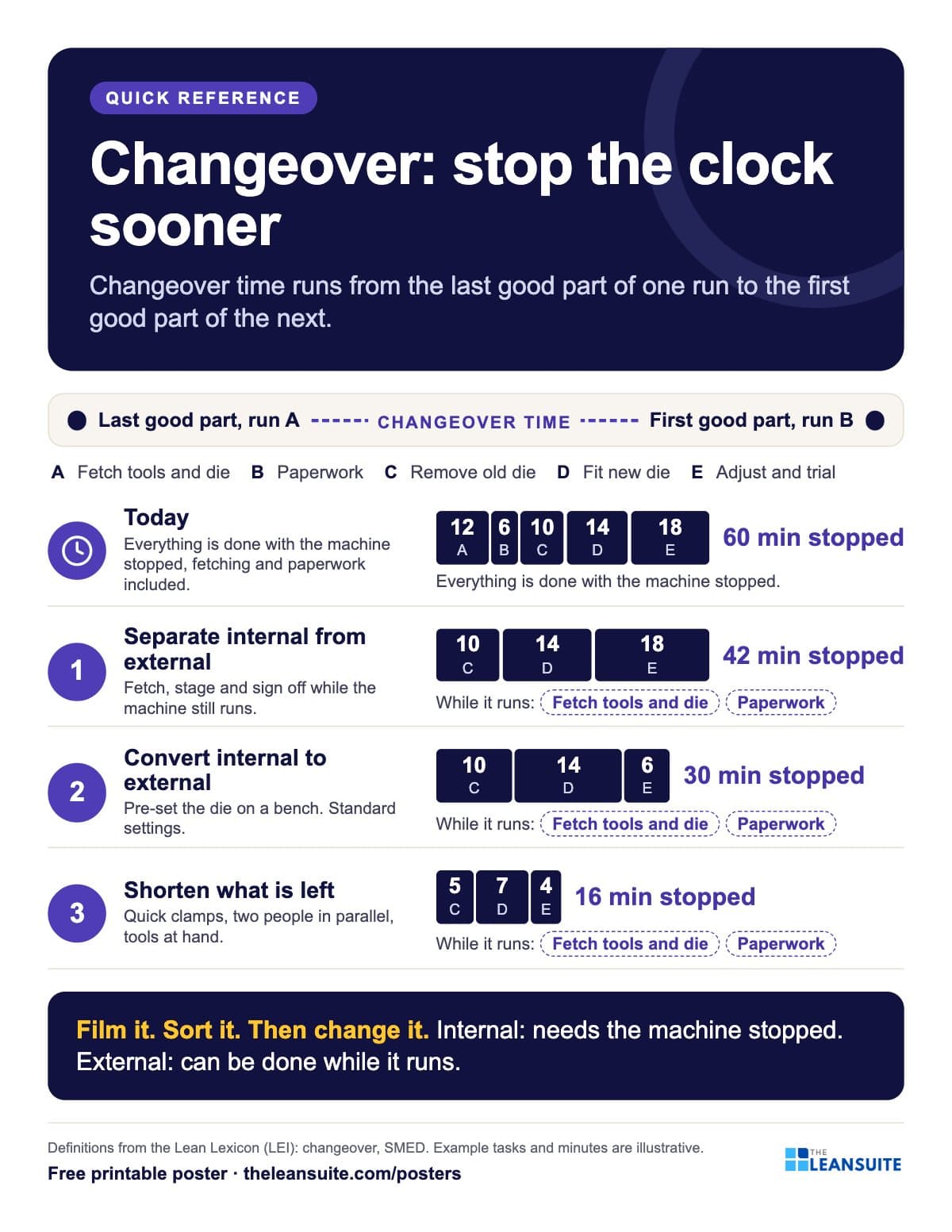 Quick referenceSMED changeover poster: internal and external workChangeover measured last good part to first good part, and the three moves that shrink the stopped time, worked from 60 minutes to 16.View and download
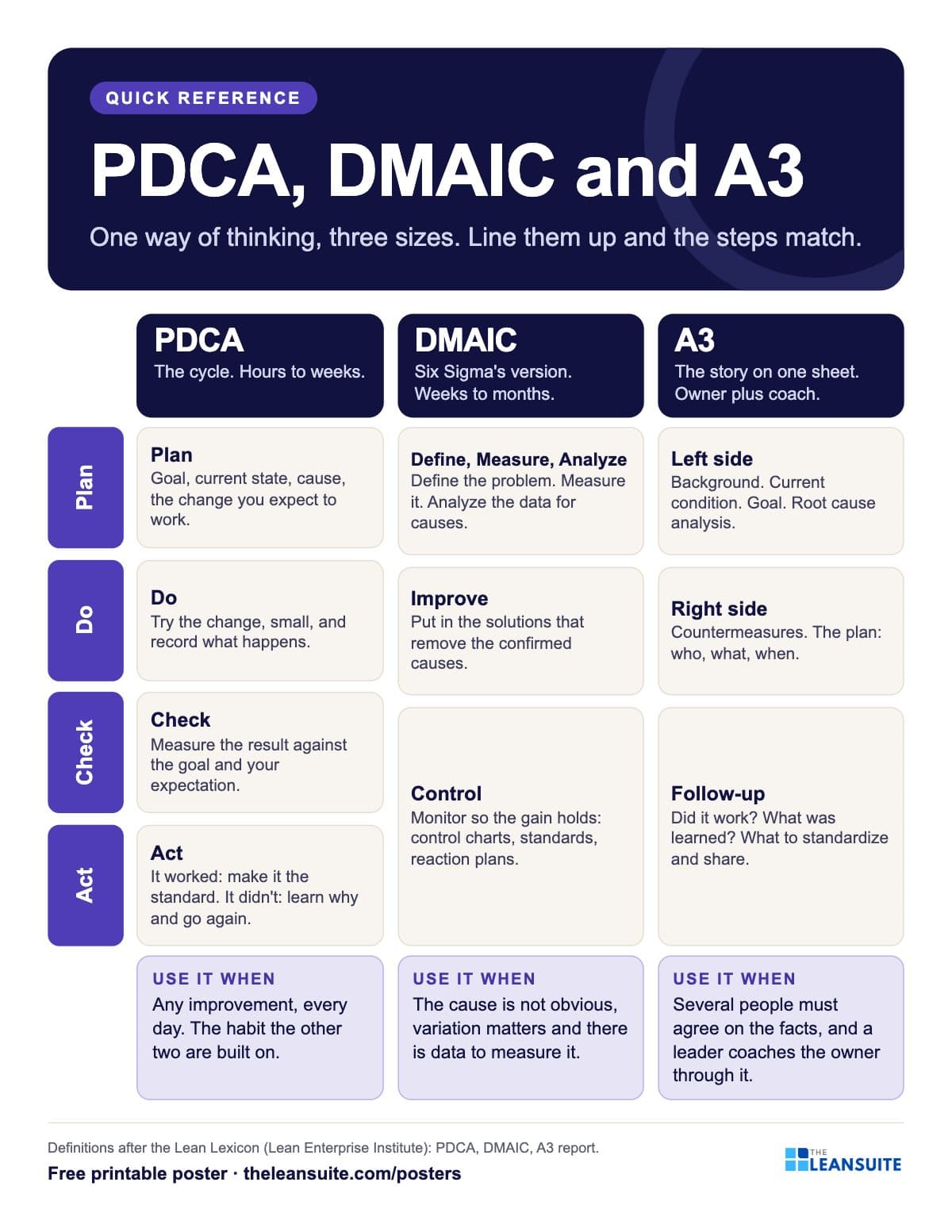 Quick referencePDCA, DMAIC and A3 side by side posterThe three methods lined up step by step, with when each fits: PDCA for every day, DMAIC for data and variation, A3 for agreement and coaching.View and download
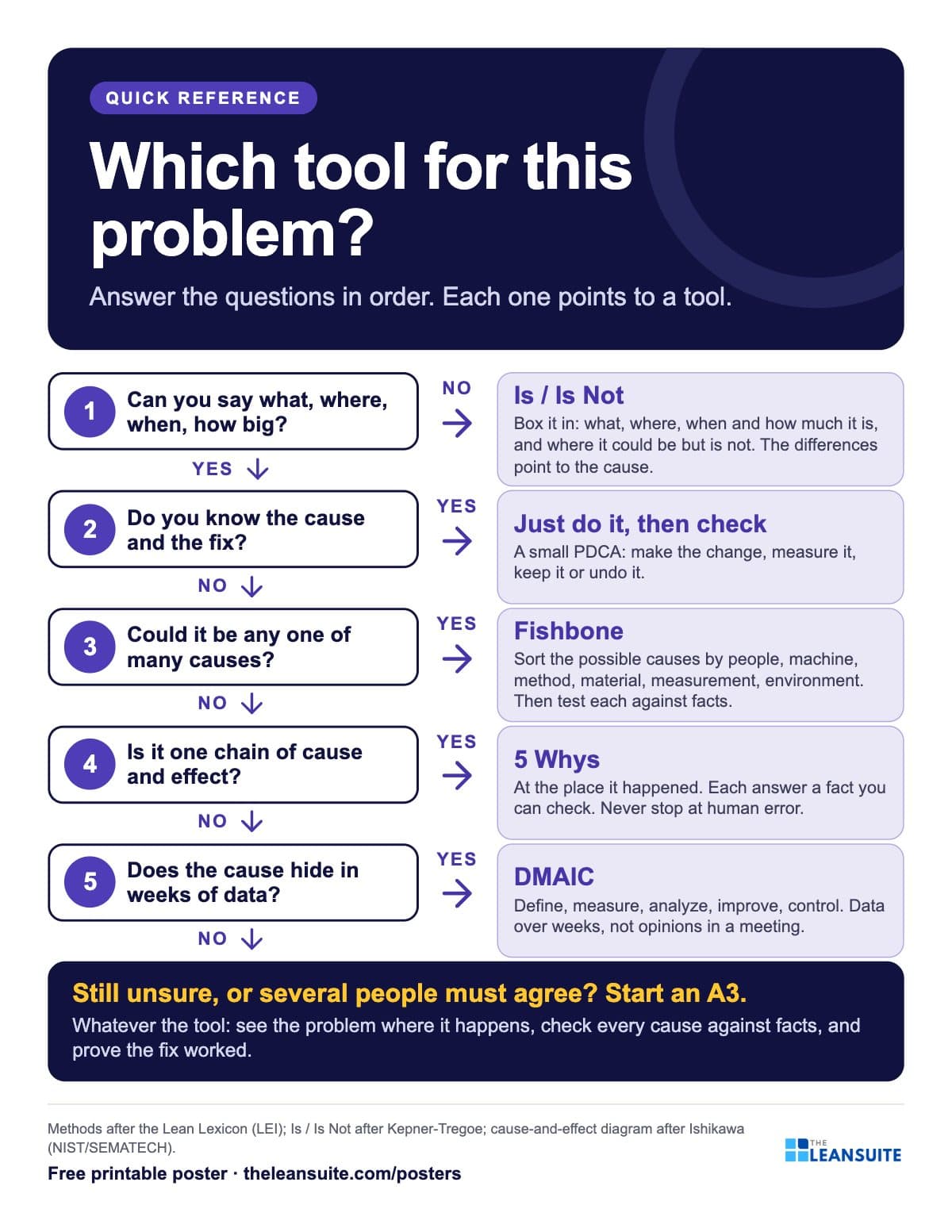 Quick referenceWhich problem-solving tool posterFive questions down the page lead to the tool that fits: Is/Is Not, just do it, fishbone, 5 Whys, DMAIC or an A3.View and download
Print-ready at six sizes
Vector PDFs at 24 x 36 in, 18 x 24 in, A2, A3, Letter, A4. Text and shapes stay sharp at any size, and nothing runs to the edge, so office printers and print shops both work.
Free PNG to share
Every poster is also a 300 dpi PNG you can download straight away, with no form: for Teams, the intranet, a TV screen or a LinkedIn post.
Plain words, your details
Large type that reads from across an aisle, no jargon and no sales pitch. Where your site's details matter, the poster leaves a blank to fill in.
The posters are free to print and share, under the same terms as the free templates. Teaching the method behind a poster? The free training decks cover 5S, kaizen, autonomous maintenance and the 8 wastes.
Next step
Want to track this every week?
See how LeanSuite runs lean routines like these in one place, on a 45-minute call with Q&A.
FAQs
About the posters
Yes. The 300 dpi PNG of every poster downloads straight away with no form. The print-ready PDFs (24 x 36 in, 18 x 24 in, A2, A3, Letter and A4) download after you enter your name and work email once; there is no account and nothing to pay.
24 x 36 in or A2 for a main wall or a team board people read from a few metres away; 18 x 24 in or A3 for a station or a notice board; Letter or A4 for a clipboard, a binder or a handout. The A3 file also prints on 11 x 17 in paper with fit to page.
You can print, share and pin them up as often as you like, and fill in the blanks by hand. The posters are general guidance: check them against your own site rules and procedures, especially the safety posters, before you put them up.
No. They are reminders of good general practice. Your site's risk assessments, written procedures (for example each machine's lockout procedure) and local regulations always come first.