

Quick reference poster
Updated · Free to print and share
PDCA, DMAIC and A3 side by side poster
PDCA, DMAIC and the A3 report are the same way of thinking at three sizes. PDCA is the four-step improvement cycle: plan a change, do it, check the result, act on what you learned. DMAIC is Six Sigma's five-phase version for problems that hide in data and variation. The A3 report puts the whole story of one problem on one sheet so that several people can agree on the facts and a leader can coach the owner. This poster lines the three up step by step and gives a plain rule for when each fits, so a team stops running a six-month project on a one-hour fix.
Download the poster
The PNG is free to download now. The print-ready vector PDFs open after a short form, once.
Free to print and share with your team. Enter your name and work email once to download.
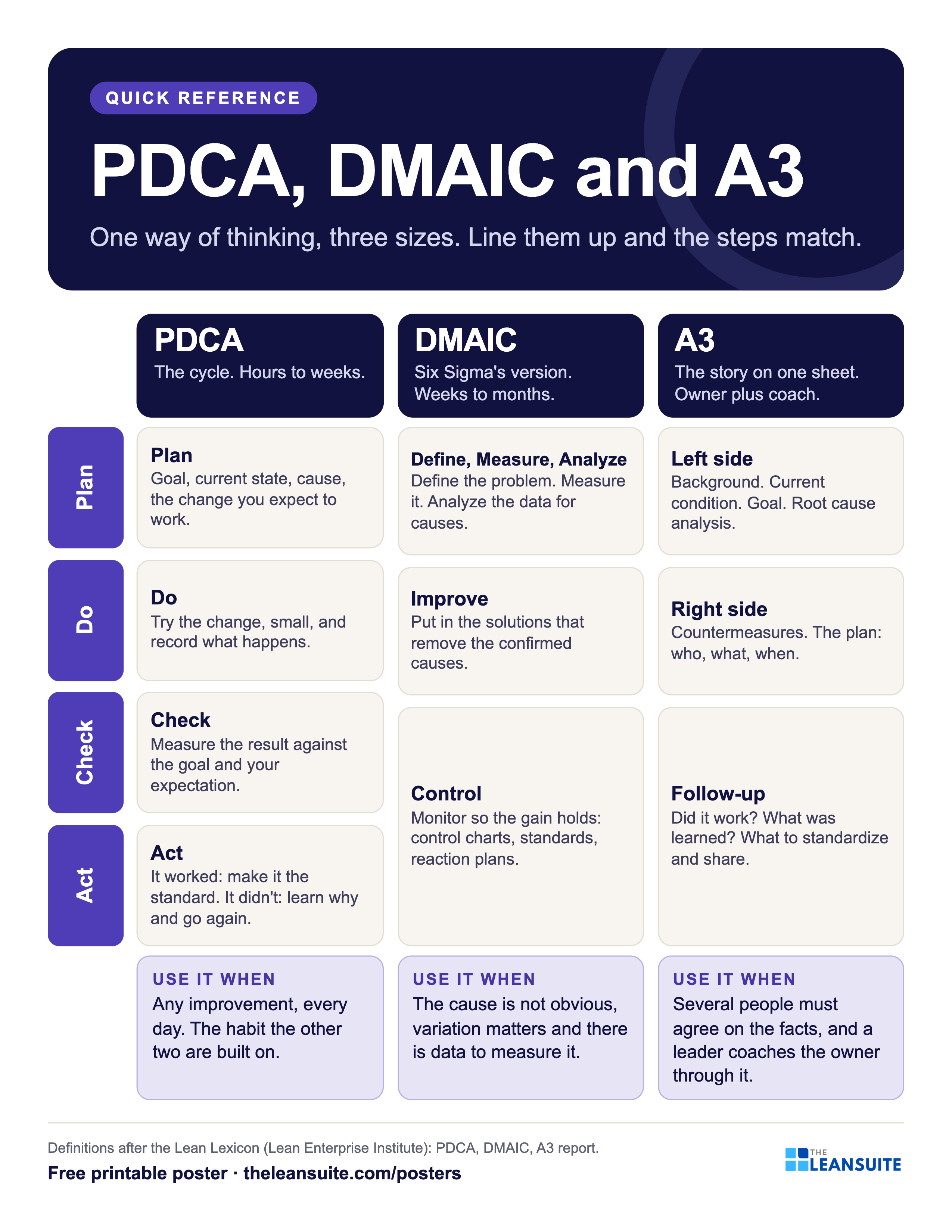
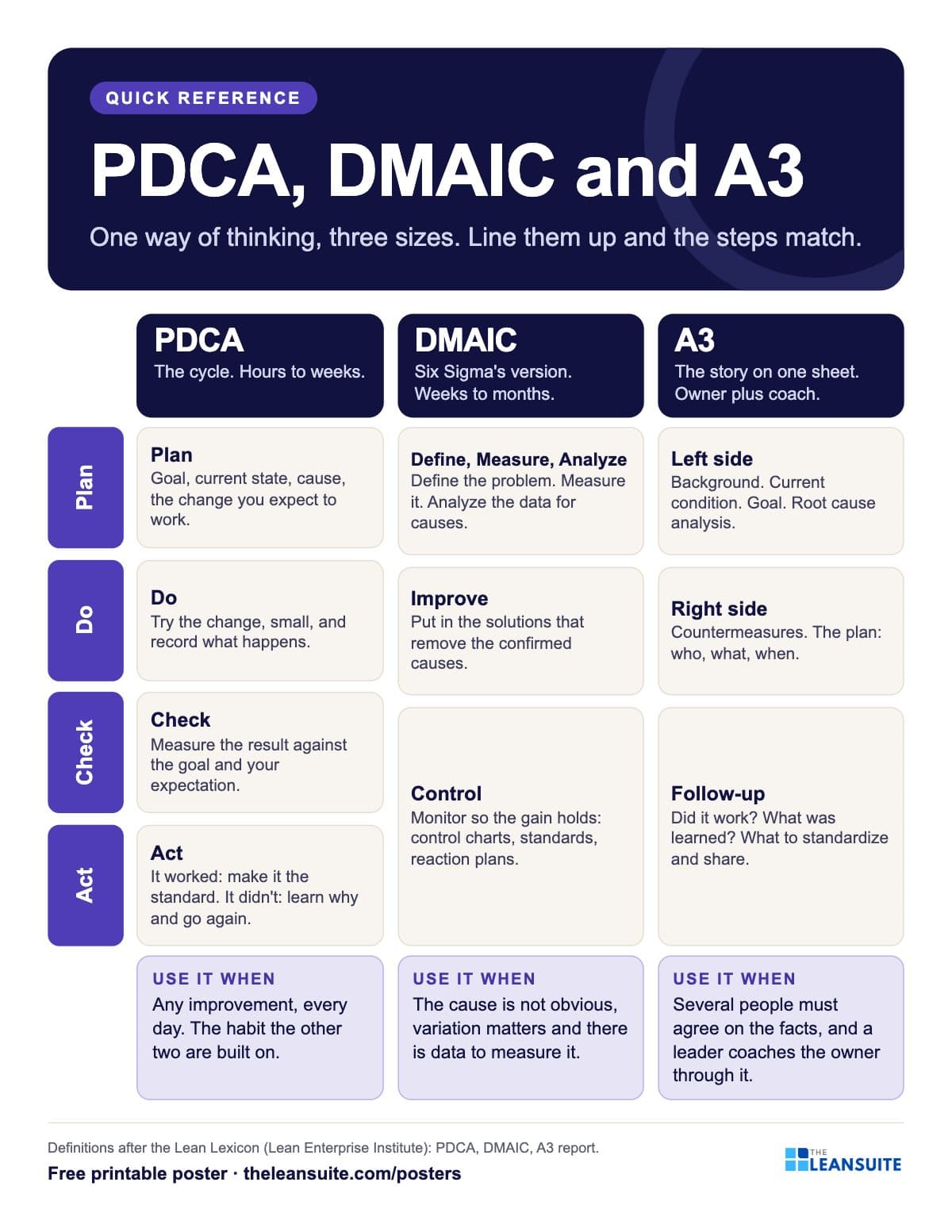 Three columns lined up against the four PDCA steps, with a bottom row saying when to use each.
The words on the poster
PDCA, DMAIC and A3
One way of thinking, three sizes. Line them up and the steps match.
PDCA: The cycle. Hours to weeks.
- Plan Goal, current state, cause, the change you expect to work.
- Do Try the change, small, and record what happens.
- Check Measure the result against the goal and your expectation.
- Act It worked: make it the standard. It didn't: learn why and go again.
- Use it when Any improvement, every day. The habit the other two are built on.
DMAIC: Six Sigma's version. Weeks to months.
- Define, Measure, Analyze Define the problem. Measure it. Analyze the data for causes.
- Improve Put in the solutions that remove the confirmed causes.
- Control Monitor so the gain holds: control charts, standards, reaction plans.
- Use it when The cause is not obvious, variation matters and there is data to measure it.
A3: The story on one sheet. Owner plus coach.
- Left side Background. Current condition. Goal. Root cause analysis.
- Right side Countermeasures. The plan: who, what, when.
- Follow-up Did it work? What was learned? What to standardize and share.
- Use it when Several people must agree on the facts, and a leader coaches the owner through it.
Definitions after the Lean Lexicon (Lean Enterprise Institute): PDCA, DMAIC, A3 report.
On the floor
How to use it
- 1
Pin it in the improvement room, next to the board where open problems are listed.
- 2
Before a new problem starts, ask: do we know the cause, do we have data, and who has to agree? The answers pick the column.
- 3
Use the rows to show a Six Sigma team and a kaizen team that they are running the same cycle.
- 4
Pair it with the free PDCA template, DMAIC project charter and A3 template.
Which size to print
- 24 x 36 in or A2: a main wall or team board, read from a few metres away.
- 18 x 24 in or A3: a station or notice board. The A3 file also fits 11 x 17 in paper.
- Letter or A4: a clipboard, binder or handout, on any office printer.
Every PDF is vector, so it stays sharp at full size. Nothing runs to the edge of the page, so no bleed is needed.
Templates, decks and guides to go with it
- DMAIC training presentationFree training deck: Define, measure, analyze, improve and control, with the main tools of each phase, in 16 slides.
- Kaizen training presentationFree training deck: What kaizen is, its principles, PDCA and four steps to a first improvement in 17 slides, with an activity and a quiz.
- PDCA templateOne improvement cycle on one page: plan, do, check against the goal, then standardize or adjust. PDF and Excel.
- DMAIC project charter templateThe Define-phase charter on one page: problem and goal, metrics, scope, team and phase dates, with savings and a tollgate checklist.
- A3 problem solving templateThe standard seven-box A3 from background to follow-up, with a filled-in worked example. PDF and Excel.
- Topic: Kaizen and continuous improvementEvery guide we have on the subject, sorted.
- Topic: Root cause analysis and problem solvingEvery guide we have on the subject, sorted.
Terms on this poster
A poster reminds. A routine makes it stick.
See how plants run their audits, improvements and follow-ups in LeanSuite, on a call built around your own problem.
Book a 45-minute demo