
Free training deck
Updated · About 30 minutes
World class manufacturing (WCM) training presentation
World class manufacturing (WCM) is a structured system for removing losses across a plant, built on TPM, total quality, lean and safety methods. The term goes back to Richard Schonberger's 1986 book; today it usually means the WCM system developed by Professor Hajime Yamashina with Fiat from the mid-2000s. This free deck introduces it in about 30 minutes. Its 17 editable slides cover the 10 technical and 10 managerial pillars, cost deployment, causal and resultant losses, the 7-step approach, model areas, audits, how WCM relates to lean, an illustrative example, the common mistakes, a loss-ranking activity and four check questions with answers, all with speaker notes. The PDF copy works as a handout.
Free to use: print it, copy it and edit it for your team. Enter your name and work email once to download.
A look inside
What is in the 17 slides
For plant managers, pillar leaders, CI and TPM coordinators and team leaders. Widescreen, in plain language, with speaker notes on every slide.
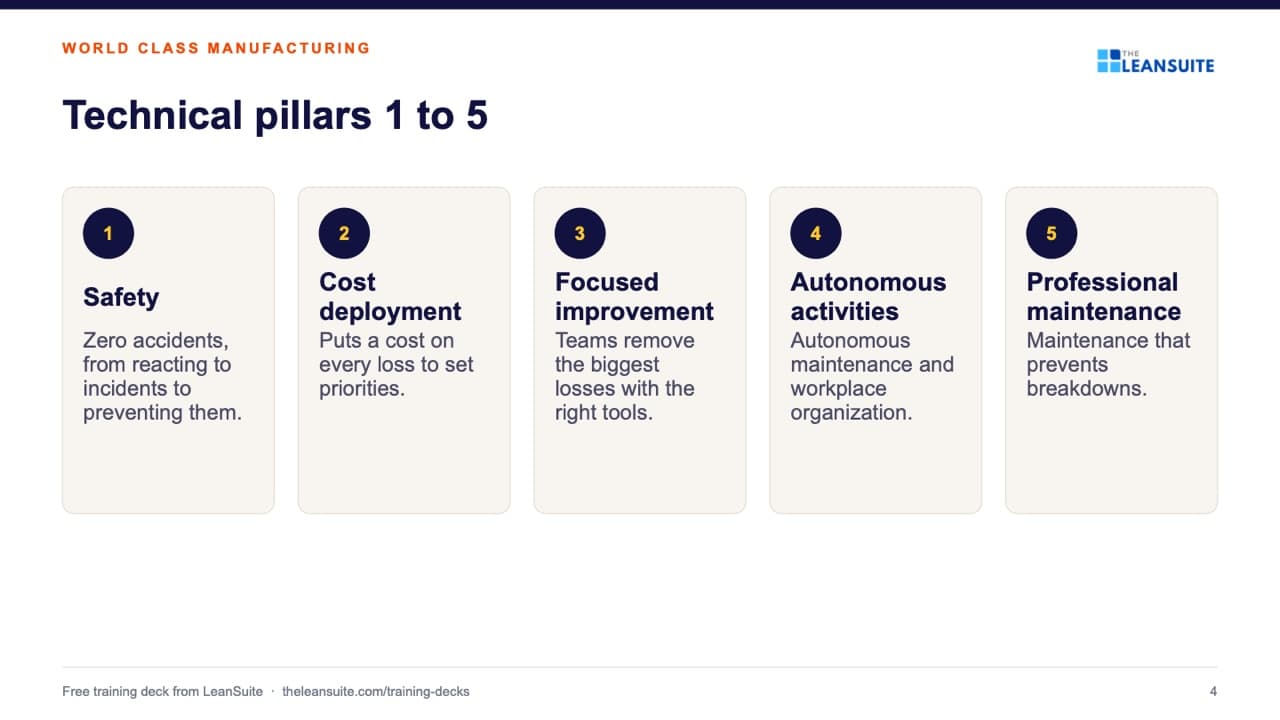
Slide 4: Technical pillars 1 to 5 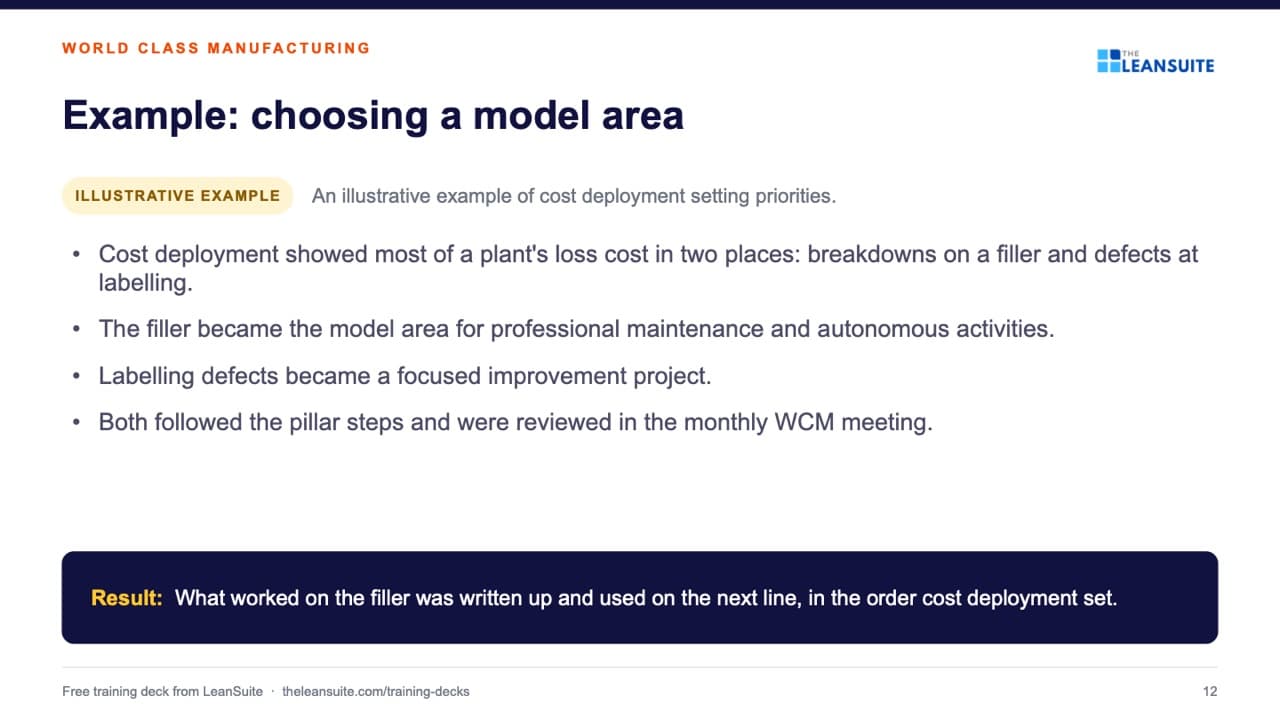
Slide 12: Example: choosing a model area 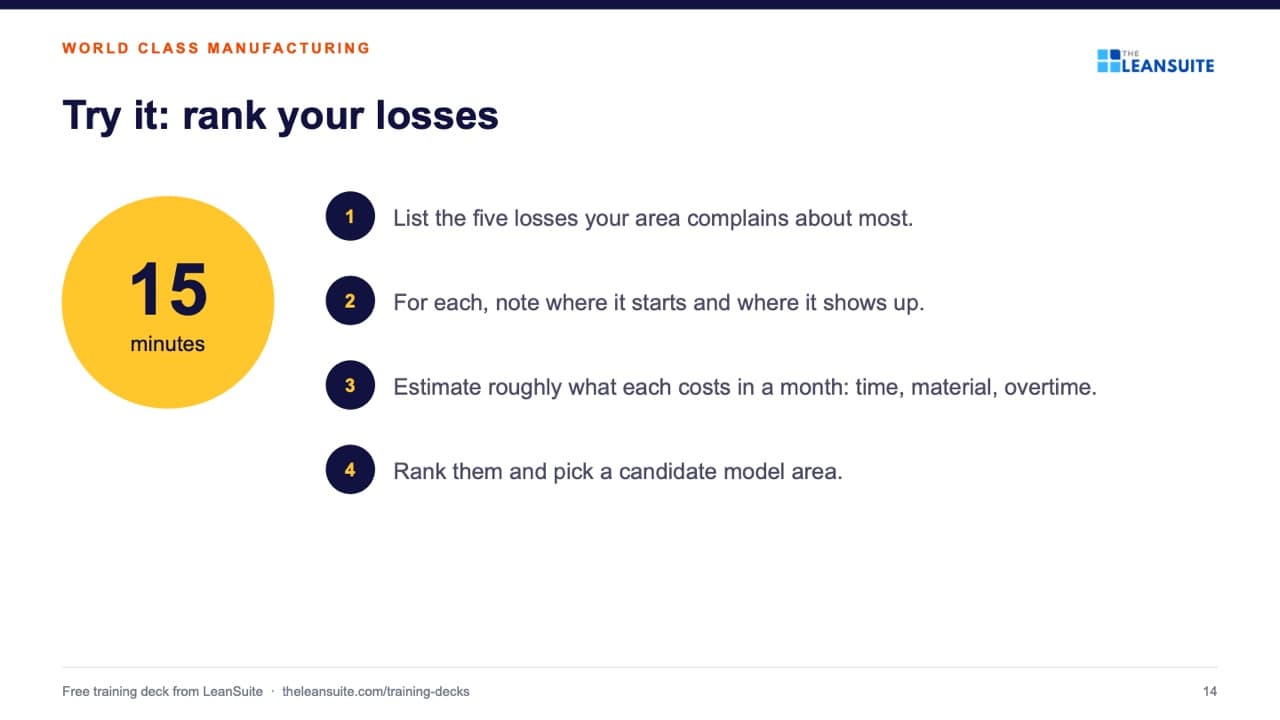
Slide 14: Try it: rank your losses
- 1World class manufacturing (WCM)Cover
- 2AgendaWhat world class manufacturing means · The 10 technical and 10 managerial pillars · Cost deployment and the 7-step approach · Model areas, audits and how WCM relates to lean · Example, activity and check questions
- 3What world class manufacturing meansWCM is a structured system for finding and removing losses across a whole plant.
- 4Technical pillars 1 to 5Safety, Cost deployment, Focused improvement, Autonomous activities, Professional maintenance
- 5Technical pillars 6 to 10Quality control, Logistics, Early management, People development, Environment and energy
- 6The 10 managerial pillarsThe managerial pillars measure how well leadership supports the technical work.
- 7Cost deploymentCost deployment links losses to money, so the plant works on the losses that cost most.
- 8The 7-step approachEach technical pillar is developed in seven steps, grouped into three phases.
- 9Model areas and expansionStart in a model area chosen by cost deployment: where the biggest losses are.
- 10WCM auditsPlants are audited on all 20 pillars, each scored from 0 to 5, for a total out of 100.
- 11WCM and leanShared with lean and TPM and what wcm adds
- 12Example: choosing a model areaAn illustrative example of cost deployment setting priorities.
- 13Common mistakesLaunching every pillar in every area at once.
- 14Try it: rank your lossesA 15-minute team activity
- 15Check your understanding4 check questions
- 16AnswersThe answers, to discuss
- 17Key points and next stepsNext: check our loss ranking with real data.
How to run it
Running the session
- 1
Prepare
Read the speaker notes once and swap the illustrative example for one from your own area if you have it. Print the PDF if people like a handout.
- 2
Present
The slides take about 15 minutes. Every slide has notes, so you can talk from them rather than read the slide.
- 3
Do the activity
List the five losses your area complains about most. The activity slide takes the team through it step by step; allow 15 minutes.
- 4
Check and follow up
Ask the check questions before showing the answers, then agree one next step with an owner and a date before people leave.
The check questions
- 1. How many pillars does WCM have?
- Twenty: 10 technical and 10 managerial.
- 2. What is cost deployment for?
- Putting a cost on losses, so the plant attacks the most expensive first.
- 3. What is the difference between a causal and a resultant loss?
- A causal loss is where the problem starts; a resultant loss is its effect elsewhere.
- 4. How is a WCM audit scored?
- Each of the 20 pillars from 0 to 5, for a total out of 100.
Templates and guides to go with it
- Cost deployment matrixWCM cost deployment on paper and in Excel: loss quantities by process, causal and resultant losses, the cost of each loss, a Pareto and the projects that recover them.
- QA matrix templateDefect modes against stations in flow order: where each is made and first caught, a weight × occurrence × detection score, an AA to C class and the escapes flagged.
- Six big losses worksheetWhere a machine's planned time goes: the six big losses in minutes, ranked, with A, P, Q and OEE worked out.
- Equipment criticality analysisAssets scored 1 to 5 on six criteria with your own weights, ranked and sorted into classes A, B and C with a safety override and a suggested maintenance strategy.
- Operational excellence assessment templateThe ten principles of operational excellence as 30 behaviors and practices you can see, scored 1 to 5 by several people, with the spread, the three lowest principles and an action plan.
- Topic: Lean manufacturing fundamentalsEvery guide we have on the subject, sorted.
- Topic: TPM and maintenanceEvery guide we have on the subject, sorted.
FAQ
World class manufacturing (WCM) training presentation: common questions
More free training decks
- 5S training presentationSort, set in order, shine, standardize and sustain in 16 slides, with a 15-minute sort activity and a quiz.View deck
- Kaizen training presentationWhat kaizen is, its principles, PDCA and four steps to a first improvement in 17 slides, with an activity and a quiz.View deck
- Autonomous maintenance training presentation: the 7 stepsThe 7 steps of jishu hozen, who does what and how step audits work, in 19 slides with notes and a quiz.View deck
- 8 wastes of lean training presentationValue vs waste, the 8 wastes (TIMWOODS) with examples, muda, mura and muri and a waste walk, in 17 slides.View deck
- Gemba walk training presentationGo see, ask why, show respect: how to plan, run and follow up a gemba walk, in 16 slides with a practice walk.View deck
- Root cause analysis training presentation: 5 whys and fishboneDefine, contain, the 5 whys, the fishbone diagram and verifying the cause, in 18 slides with a team activity.View deck
- TPM training presentation: the 8 pillarsWhat TPM is, the six big losses, OEE and the 8 pillars, in 19 slides with a loss-spotting activity.View deck
- Obeya room training presentationWhat an obeya is, what goes on its walls and how to run the meetings, in 15 slides with a design activity.View deck
- DMAIC training presentationDefine, measure, analyze, improve and control, with the main tools of each phase, in 16 slides.View deck
Training is the start. Keeping it going is the hard part.
See how plants run their audits, improvements and follow-ups in LeanSuite, on a call built around your own problem.
Schedule Demo