
Free training deck
Updated · About 30 minutes
TPM training presentation: the 8 pillars
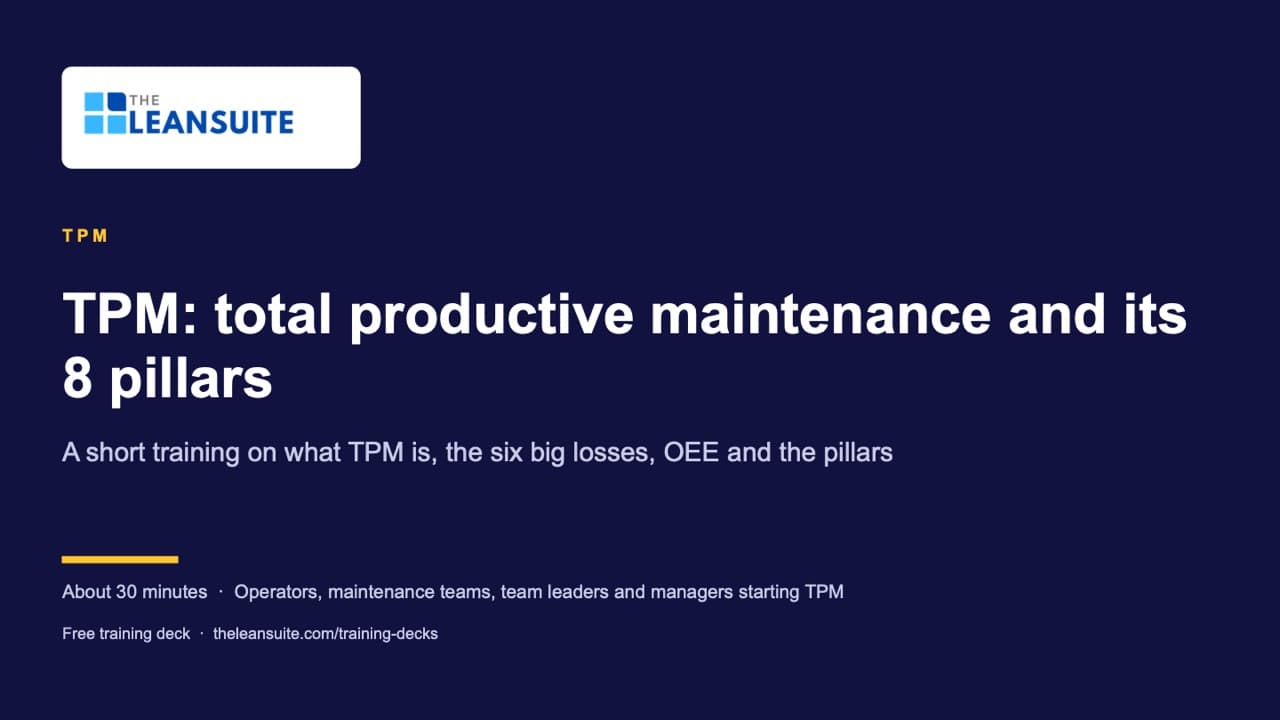
Total productive maintenance (TPM) is a plant-wide way of looking after equipment in which operators, maintenance, engineering and managers all play a part, with the aim of zero breakdowns, zero defects and zero accidents. This free deck introduces it in about 30 minutes. Its 19 editable slides cover what TPM is and why it matters, the six big losses, OEE, the 8 pillars and the 5S foundation, how plants usually start, an illustrative example, the common mistakes, an activity to find the six big losses on one machine and four check questions with answers. Every slide has speaker notes.
Free to use: print it, copy it and edit it for your team. Enter your name and work email once to download.
A look inside
What is in the 19 slides
For operators, maintenance teams, team leaders and managers starting TPM. Widescreen, in plain language, with speaker notes on every slide.
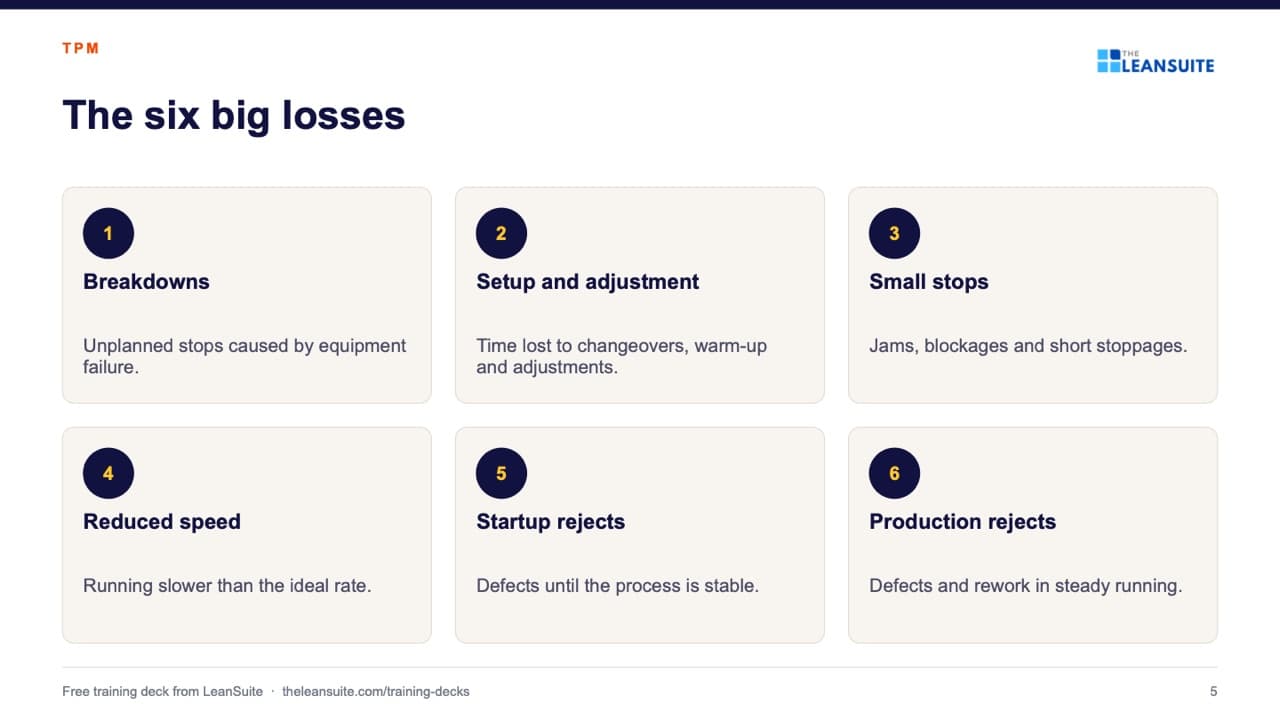
Slide 5: The six big losses 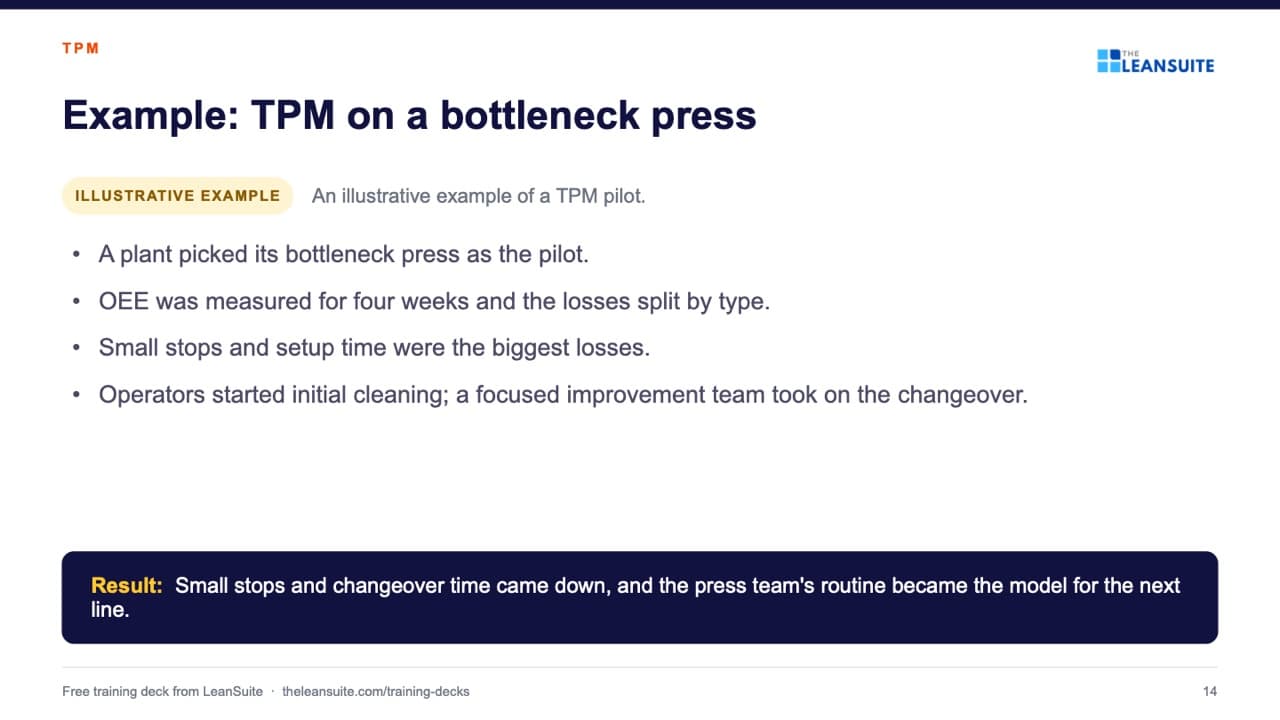
Slide 14: Example: TPM on a bottleneck press 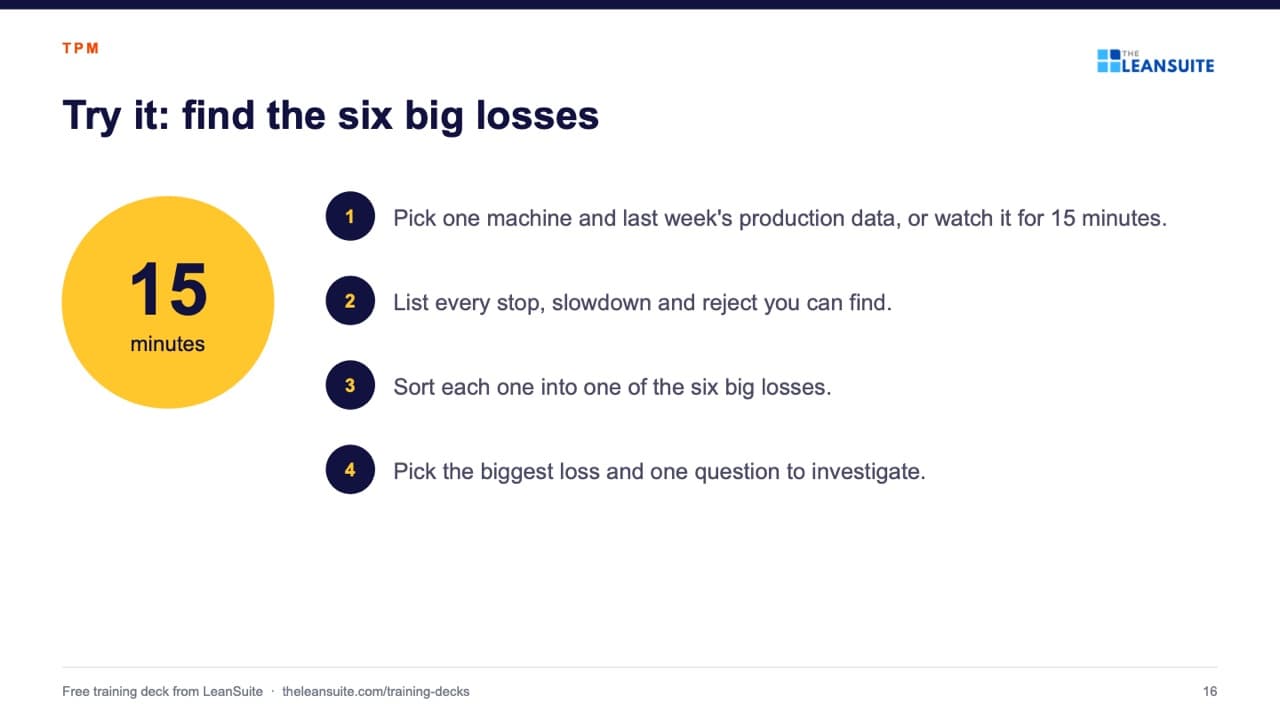
Slide 16: Try it: find the six big losses
- 1TPM: total productive maintenance and its 8 pillarsCover
- 2AgendaWhat TPM is and why it matters · The six big losses and OEE · The 8 pillars and the 5S foundation · How plants start, an example and common mistakes · Activity and check questions
- 3What TPM isTotal productive maintenance is a way of running a plant where everyone, not only maintenance, takes care of the equipment.
- 4Why it mattersUnplanned stops, slow running and defects take capacity you have already paid for.
- 5The six big lossesBreakdowns, Setup and adjustment, Small stops, Reduced speed, Startup rejects, Production rejects
- 6OEE: one measure for all six lossesOverall equipment effectiveness (OEE) = availability x performance x quality.
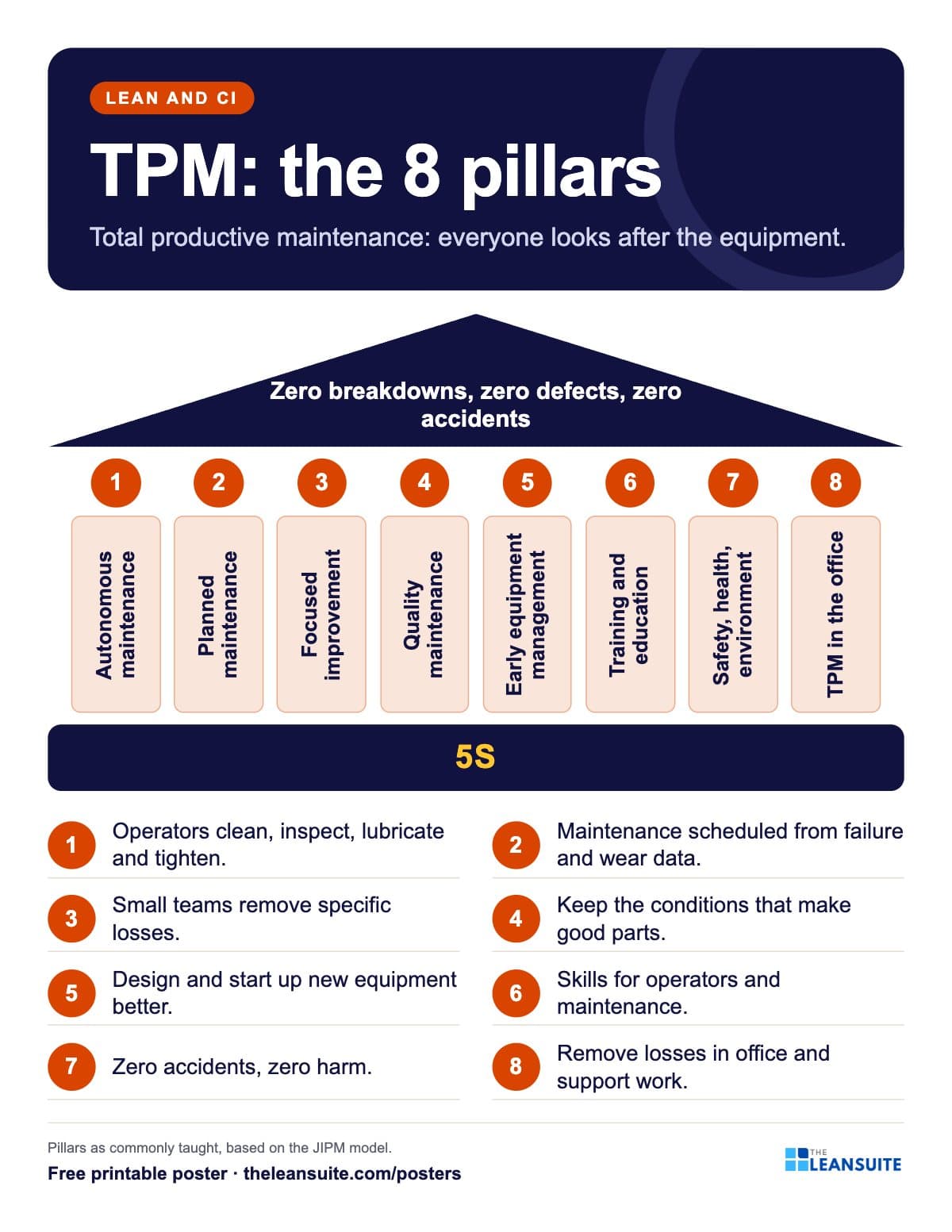
- 7The 8 pillarsAutonomous maintenance, Planned maintenance, Focused improvement, Quality maintenance, Early equipment management, Training and education, Safety, health, environment, TPM in the office
- 8Autonomous and planned maintenanceAutonomous maintenance and planned maintenance
- 9Focused improvement and quality maintenanceFocused improvement and quality maintenance
- 10Early equipment management and trainingEarly equipment management and training and education
- 11Safety, health, environment and the officeSafety, health and environment and tpm in the office
- 12The foundation: 5STPM needs a clean, organized workplace before anything else.
- 13How plants usually startManagement commitment and a small TPM steering group.
- 14Example: TPM on a bottleneck pressAn illustrative example of a TPM pilot.
- 15Common mistakesTreating TPM as a maintenance department project.
- 16Try it: find the six big lossesA 15-minute team activity
- 17Check your understanding4 check questions
- 18AnswersThe answers, to discuss
- 19Key points and next stepsNext: look into the biggest loss we found on our machine.
How to run it
Running the session
- 1
Prepare
Read the speaker notes once and swap the illustrative example for one from your own area if you have it. Print the PDF if people like a handout.
- 2
Present
The slides take about 15 minutes. Every slide has notes, so you can talk from them rather than read the slide.
- 3
Do the activity
Pick one machine and last week's production data, or watch it for 15 minutes. The activity slide takes the team through it step by step; allow 15 minutes.
- 4
Check and follow up
Ask the check questions before showing the answers, then agree one next step with an owner and a date before people leave.
The check questions
- 1. What are the three zeros TPM aims for?
- Zero breakdowns, zero defects and zero accidents.
- 2. What are the three factors of OEE?
- Availability, performance and quality.
- 3. Which pillar has operators clean, inspect, lubricate and tighten?
- Autonomous maintenance.
- 4. Why is 5S the foundation of TPM?
- Dirt and clutter hide abnormal conditions; a clean, organized area makes them visible.
Templates and guides to go with it
- OEE tracking sheetOne row per shift for a week. The Excel version works out availability, performance, quality and OEE and charts the week.
- Six big losses worksheetWhere a machine's planned time goes: the six big losses in minutes, ranked, with A, P, Q and OEE worked out.
- TPM tag logEvery abnormality tag with type, who fixes it, priority and dates, with days open and counts by type and week.
- Autonomous maintenance (CILR) checklist20 clean, inspect, lubricate and retighten checks with a box per day, an abnormality log and sign-off.
- Preventive maintenance checklist templateA PM checklist per machine with readings and sign-off, and a PM schedule that works out the next due date.
- Autonomous maintenance step auditCriteria for each of the seven autonomous maintenance steps, scored 0 to 2, with the step result and the decision to move on.
- Topic: TPM and maintenanceEvery guide we have on the subject, sorted.
Read more
After the session
Put it on the wall
Free printable poster on the same subject, so the team sees it every day: a PNG to download now, and print-ready PDFs from Letter to 24 x 36 in.
FAQ
TPM training presentation: common questions
More free training decks
- 5S training presentationSort, set in order, shine, standardize and sustain in 16 slides, with a 15-minute sort activity and a quiz.View deck
- Kaizen training presentationWhat kaizen is, its principles, PDCA and four steps to a first improvement in 17 slides, with an activity and a quiz.View deck
- Autonomous maintenance training presentation: the 7 stepsThe 7 steps of jishu hozen, who does what and how step audits work, in 19 slides with notes and a quiz.View deck
- 8 wastes of lean training presentationValue vs waste, the 8 wastes (TIMWOODS) with examples, muda, mura and muri and a waste walk, in 17 slides.View deck
- Gemba walk training presentationGo see, ask why, show respect: how to plan, run and follow up a gemba walk, in 16 slides with a practice walk.View deck
- Root cause analysis training presentation: 5 whys and fishboneDefine, contain, the 5 whys, the fishbone diagram and verifying the cause, in 18 slides with a team activity.View deck
- World class manufacturing (WCM) training presentationThe WCM pillars, cost deployment, the 7-step approach, model areas and audits, in 17 slides.View deck
- Obeya room training presentationWhat an obeya is, what goes on its walls and how to run the meetings, in 15 slides with a design activity.View deck
- DMAIC training presentationDefine, measure, analyze, improve and control, with the main tools of each phase, in 16 slides.View deck
Training is the start. Keeping it going is the hard part.
See how plants run their audits, improvements and follow-ups in LeanSuite, on a call built around your own problem.
Schedule Demo