
Free training deck
Updated · About 30 minutes
DMAIC training presentation
DMAIC (define, measure, analyze, improve, control) is the five-phase problem-solving cycle used in Six Sigma for problems whose cause is not known and has to be found with data. This free deck introduces it in about 30 minutes. Its 16 editable slides cover what DMAIC is, each phase and its main tools (project charter, SIPOC, gauge R&R, Pareto, FMEA, control plan, control charts), DMAIC versus PDCA, an illustrative example, the common mistakes, a project charter activity and four check questions with answers. Every slide has speaker notes.
Free to use: print it, copy it and edit it for your team. Enter your name and work email once to download.
A look inside
What is in the 16 slides
For engineers, quality staff, team leaders and new Six Sigma project members. Widescreen, in plain language, with speaker notes on every slide.
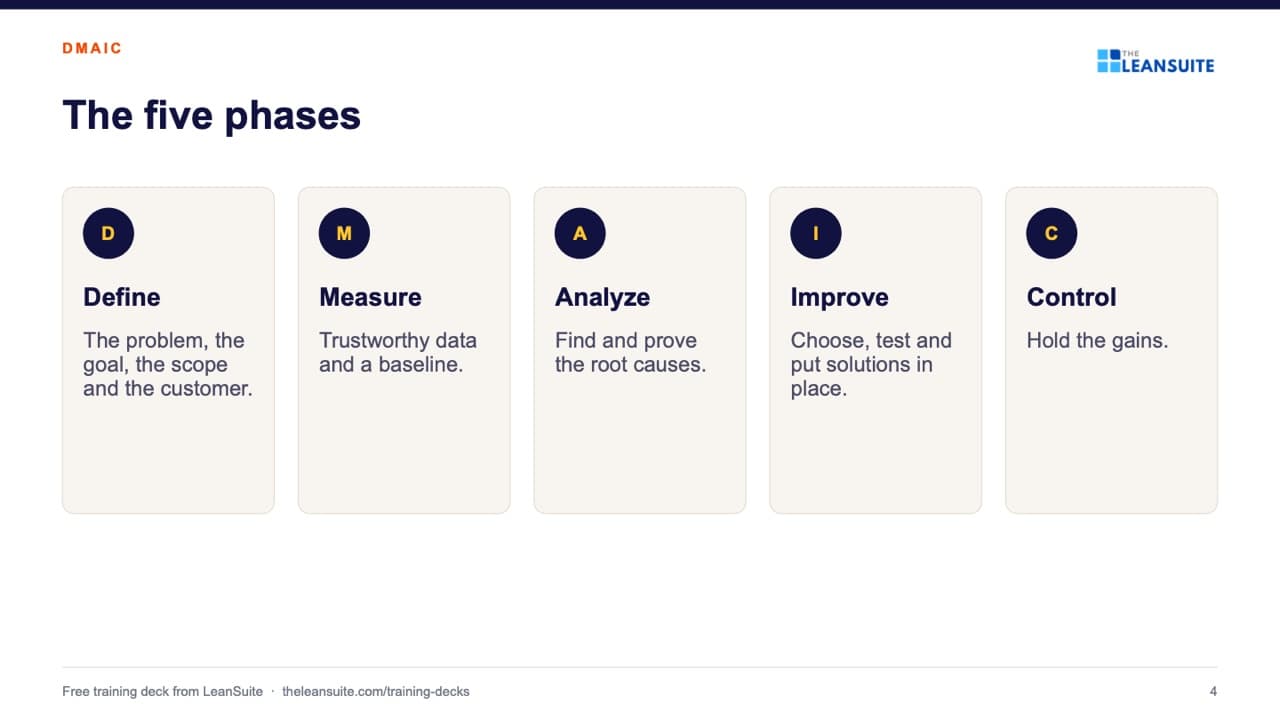
Slide 4: The five phases 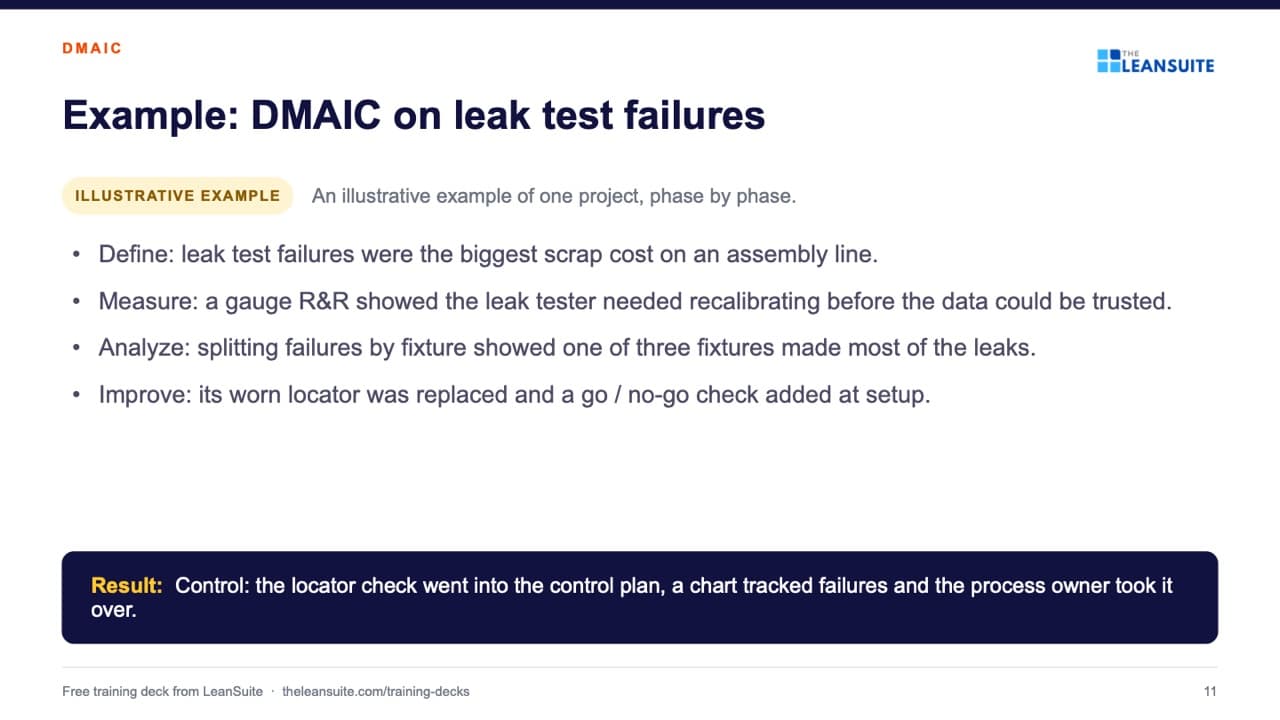
Slide 11: Example: DMAIC on leak test failures 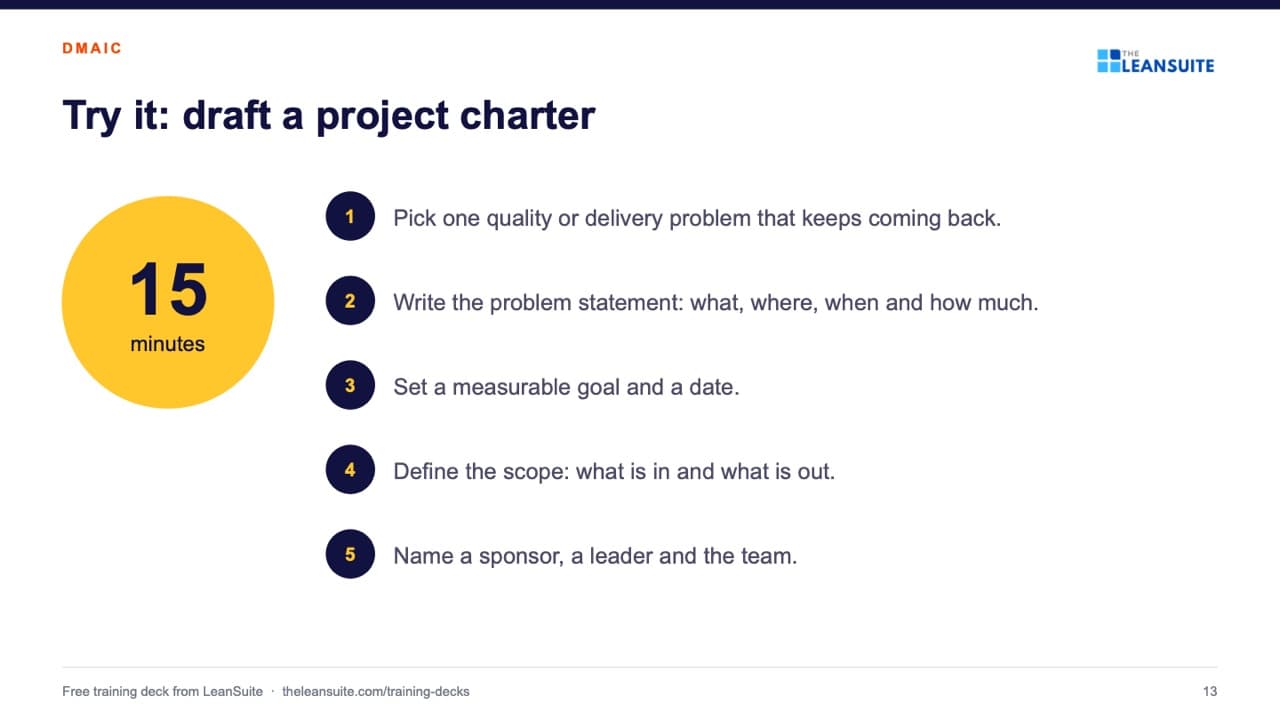
Slide 13: Try it: draft a project charter
- 1DMAIC: define, measure, analyze, improve, controlCover
- 2AgendaWhat DMAIC is · Define and measure · Analyze · Improve and control · Example, mistakes, activity and check questions
- 3What DMAIC isDMAIC is the five-phase problem-solving cycle used in Six Sigma: define, measure, analyze, improve and control.
- 4The five phasesDefine, Measure, Analyze, Improve, Control
- 5DefineA project charter: problem, goal, scope, team and sponsor.
- 6MeasureMap the process as it really runs.
- 7AnalyzeList the possible causes: fishbone, 5 whys, process map.
- 8ImproveGenerate solutions that remove the proven causes.
- 9ControlUpdate the standard work and train everyone.
- 10DMAIC and PDCADMAIC and pdca
- 11Example: DMAIC on leak test failuresAn illustrative example of one project, phase by phase.
- 12Common mistakesA scope so big the project never ends.
- 13Try it: draft a project charterA 15-minute team activity
- 14Check your understanding4 check questions
- 15AnswersThe answers, to discuss
- 16Key points and next stepsNext: take the charter we drafted to a sponsor.
How to run it
Running the session
- 1
Prepare
Read the speaker notes once and swap the illustrative example for one from your own area if you have it. Print the PDF if people like a handout.
- 2
Present
The slides take about 15 minutes. Every slide has notes, so you can talk from them rather than read the slide.
- 3
Do the activity
Pick one quality or delivery problem that keeps coming back. The activity slide takes the team through it step by step; allow 15 minutes.
- 4
Check and follow up
Ask the check questions before showing the answers, then agree one next step with an owner and a date before people leave.
The check questions
- 1. What do the letters DMAIC stand for?
- Define, measure, analyze, improve and control.
- 2. Why check the measurement system before analyzing?
- If the gauge is unreliable, the data and every conclusion from it are too.
- 3. What is a control plan?
- A list of what is checked, how and how often, and what to do if it goes wrong.
- 4. When is DMAIC a better choice than PDCA?
- For complex, repeat problems whose cause is unknown and must be found with data.
Templates and guides to go with it
- DMAIC project charter templateThe Define-phase charter on one page: problem and goal, metrics, scope, team and phase dates, with savings and a tollgate checklist.
- Control plan templateWhat is checked at each step, against which limits, how, how often, and what to do when a result is out.
- Gage R&R study sheet10 parts, 2 or 3 appraisers, 2 or 3 trials: EV, AV, GRR, PV, %GRR and ndc by the average and range method.
- Pareto chart templateA tally sheet, the categories sorted largest first with cumulative %, and the chart. Excel does the sorting and drawing.
- Process capability (Cpk) study sheet25 subgroups of readings with Cp, Cpk, Pp and Ppk worked out, control limits to check stability, and a histogram.
- PFMEA template (process FMEA)Failure modes, effects and causes rated for severity, occurrence and detection, with RPN before and after action.
- Topic: Quality managementEvery guide we have on the subject, sorted.
- Topic: Root cause analysis and problem solvingEvery guide we have on the subject, sorted.
After the session
Put it on the wall
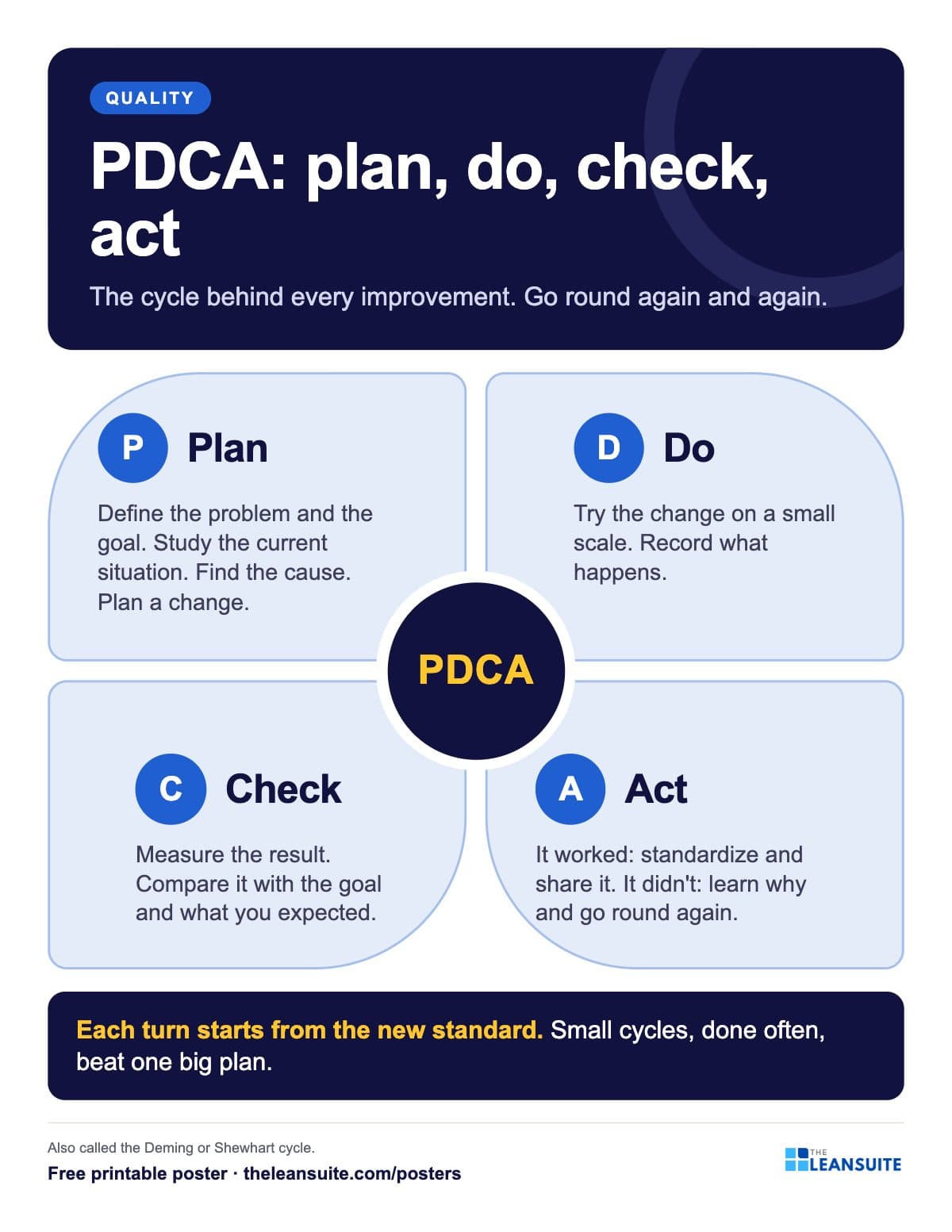
Free printable poster on the same subject, so the team sees it every day: a PNG to download now, and print-ready PDFs from Letter to 24 x 36 in.
FAQ
DMAIC training presentation: common questions
More free training decks
- 5S training presentationSort, set in order, shine, standardize and sustain in 16 slides, with a 15-minute sort activity and a quiz.View deck
- Kaizen training presentationWhat kaizen is, its principles, PDCA and four steps to a first improvement in 17 slides, with an activity and a quiz.View deck
- Autonomous maintenance training presentation: the 7 stepsThe 7 steps of jishu hozen, who does what and how step audits work, in 19 slides with notes and a quiz.View deck
- 8 wastes of lean training presentationValue vs waste, the 8 wastes (TIMWOODS) with examples, muda, mura and muri and a waste walk, in 17 slides.View deck
- Gemba walk training presentationGo see, ask why, show respect: how to plan, run and follow up a gemba walk, in 16 slides with a practice walk.View deck
- Root cause analysis training presentation: 5 whys and fishboneDefine, contain, the 5 whys, the fishbone diagram and verifying the cause, in 18 slides with a team activity.View deck
- TPM training presentation: the 8 pillarsWhat TPM is, the six big losses, OEE and the 8 pillars, in 19 slides with a loss-spotting activity.View deck
- World class manufacturing (WCM) training presentationThe WCM pillars, cost deployment, the 7-step approach, model areas and audits, in 17 slides.View deck
- Obeya room training presentationWhat an obeya is, what goes on its walls and how to run the meetings, in 15 slides with a design activity.View deck
Training is the start. Keeping it going is the hard part.
See how plants run their audits, improvements and follow-ups in LeanSuite, on a call built around your own problem.
Schedule Demo