
Free training deck
Updated · About 30 minutes
8 wastes of lean training presentation
The 8 wastes of lean are the eight kinds of activity that use time and resources without adding value for the customer: transport, inventory, motion, waiting, overproduction, overprocessing, defects and unused skills. This free deck teaches a team to see them in about 30 minutes. Its 17 editable slides cover value and waste, where the list comes from, each waste with examples and a question to ask, muda, mura and muri, how to run a waste walk, an illustrative example, the common mistakes, a spot-the-waste activity and four check questions with answers. Every slide has speaker notes.
Free to use: print it, copy it and edit it for your team. Enter your name and work email once to download.
A look inside
What is in the 17 slides
For operators, team leaders, office teams and anyone new to lean. Widescreen, in plain language, with speaker notes on every slide.
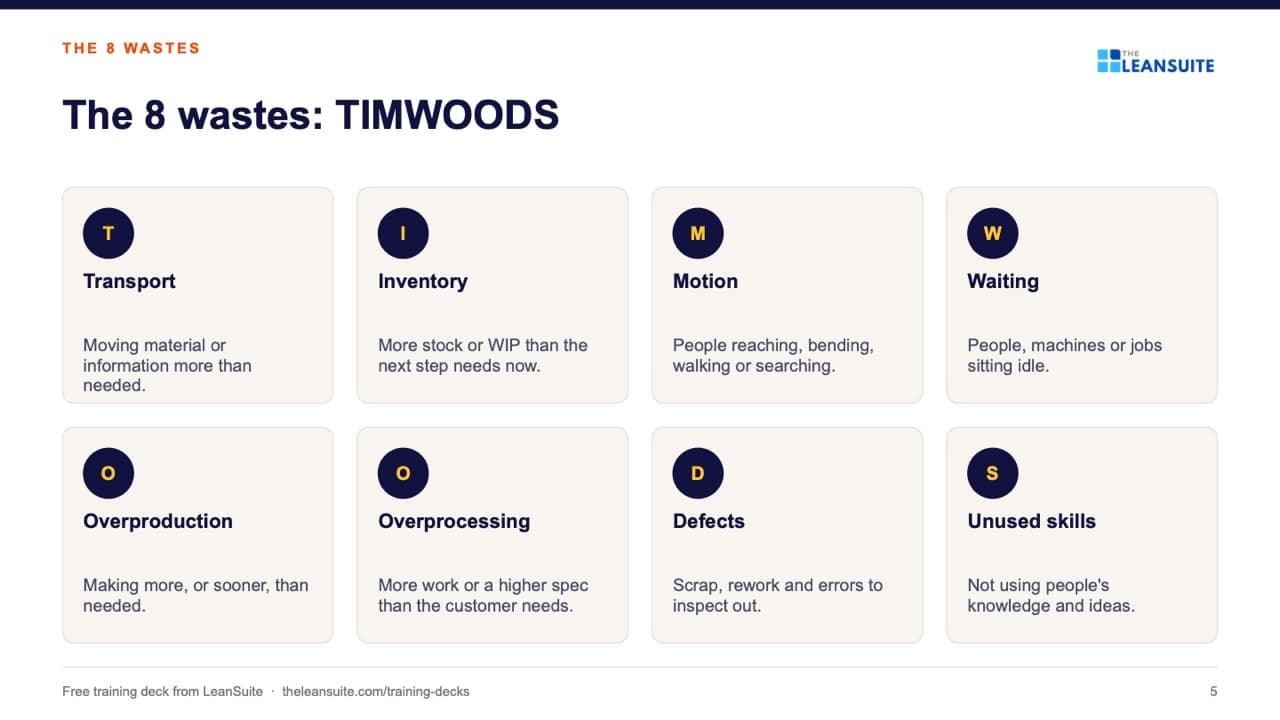
Slide 5: The 8 wastes: TIMWOODS 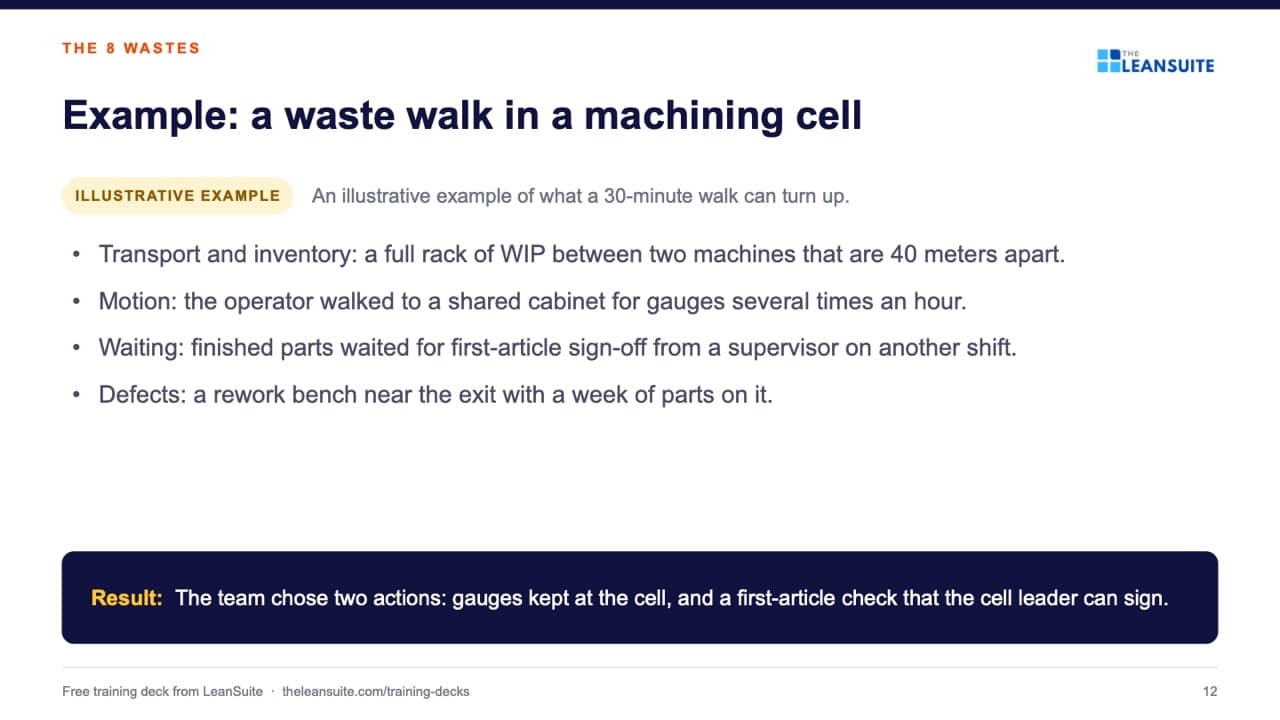
Slide 12: Example: a waste walk in a machining cell 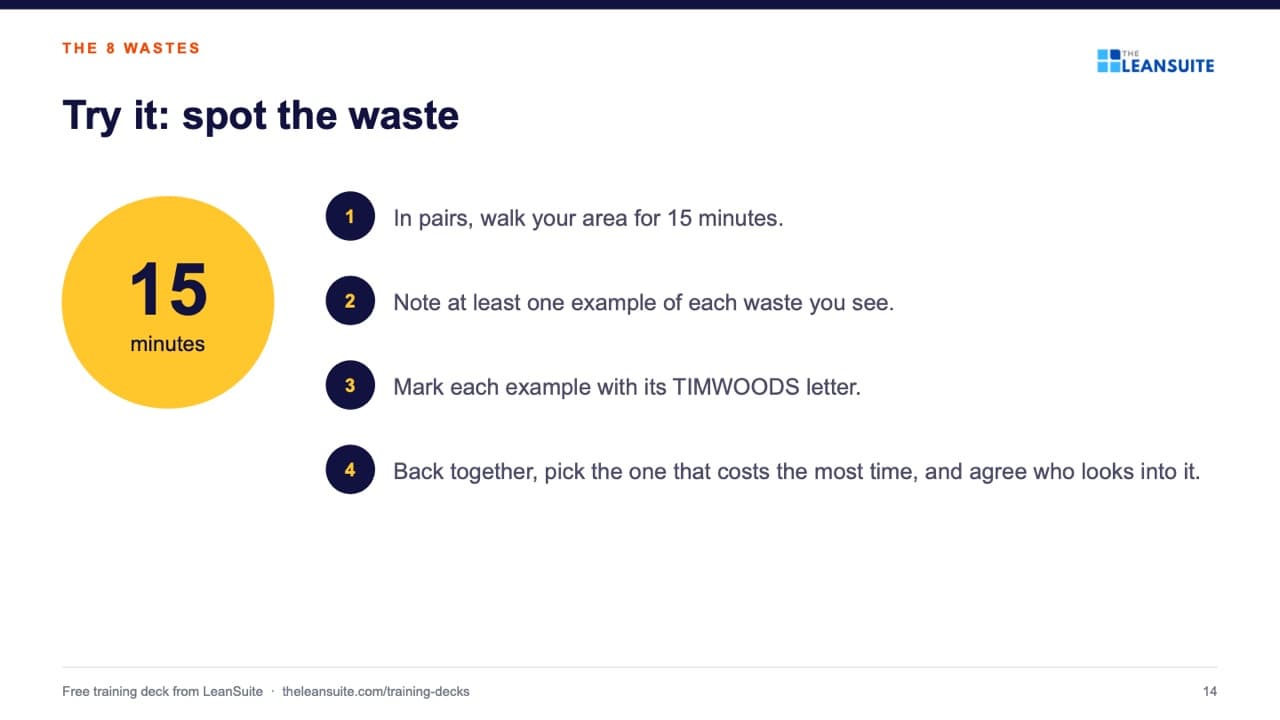
Slide 14: Try it: spot the waste
- 1The 8 wastes of leanCover
- 2AgendaValue and waste · The 8 wastes, with examples · Muda, mura and muri · How to run a waste walk · Activity and check questions
- 3Value and wasteIn lean, value is what the customer is willing to pay for. Anything else that uses time or resources is waste, muda in Japanese.
- 4Where the list comes fromTaiichi Ohno described seven wastes as part of the Toyota Production System.
- 5The 8 wastes: TIMWOODSTransport, Inventory, Motion, Waiting, Overproduction, Overprocessing, Defects, Unused skills
- 6Transport and inventoryTransport and inventory
- 7Motion and waitingMotion and waiting
- 8Overproduction and overprocessingOverproduction and overprocessing
- 9Defects and unused skillsDefects and unused skills
- 10Muda, mura and muriLean names three problems that work together. Waste is only one of them.
- 11How to see waste: a waste walkGo to the process and follow one product or one job from start to finish.
- 12Example: a waste walk in a machining cellAn illustrative example of what a 30-minute walk can turn up.
- 13Common mistakesBlaming people for waste the process creates.
- 14Try it: spot the wasteA 15-minute team activity
- 15Check your understanding4 check questions
- 16AnswersThe answers, to discuss
- 17Key points and next stepsNext: act on the waste we picked, and repeat the waste walk next month.
How to run it
Running the session
- 1
Prepare
Read the speaker notes once and swap the illustrative example for one from your own area if you have it. Print the PDF if people like a handout.
- 2
Present
The slides take about 15 minutes. Every slide has notes, so you can talk from them rather than read the slide.
- 3
Do the activity
In pairs, walk your area for 15 minutes. The activity slide takes the team through it step by step; allow 15 minutes.
- 4
Check and follow up
Ask the check questions before showing the answers, then agree one next step with an owner and a date before people leave.
The check questions
- 1. What does TIMWOODS stand for?
- Transport, inventory, motion, waiting, overproduction, overprocessing, defects and unused skills.
- 2. Why is overproduction called the worst waste?
- It creates other wastes, such as inventory, transport and waiting, and it hides problems until late.
- 3. What is the difference between mura and muri?
- Mura is unevenness in the workload. Muri is overburden on people or machines.
- 4. Is all non-value-added work waste to remove right away?
- No. Necessary non-value-added work, such as some inspections and required records, stays for now but should be reduced.
Templates and guides to go with it
- Waste walk checklist (TIMWOODS)32 things to look for across the eight wastes, with where and how much, and a findings log with dot votes, owners and dates.
- Spaghetti diagram templateSquared paper to trace every trip, a tally of trips and distance, and a before and after comparison.
- Lead time worksheetProduction lead time from the inventory waiting at each step, value-added time and process cycle efficiency, plus an order traced from order to delivery.
- Time study sheetTime each element over 10 cycles and work out the average, lowest repeatable and standard time. Excel does the sums.
- Topic: Lean manufacturing fundamentalsEvery guide we have on the subject, sorted.
- Topic: Value stream mapping and flowEvery guide we have on the subject, sorted.
Read more
After the session
Put it on the wall
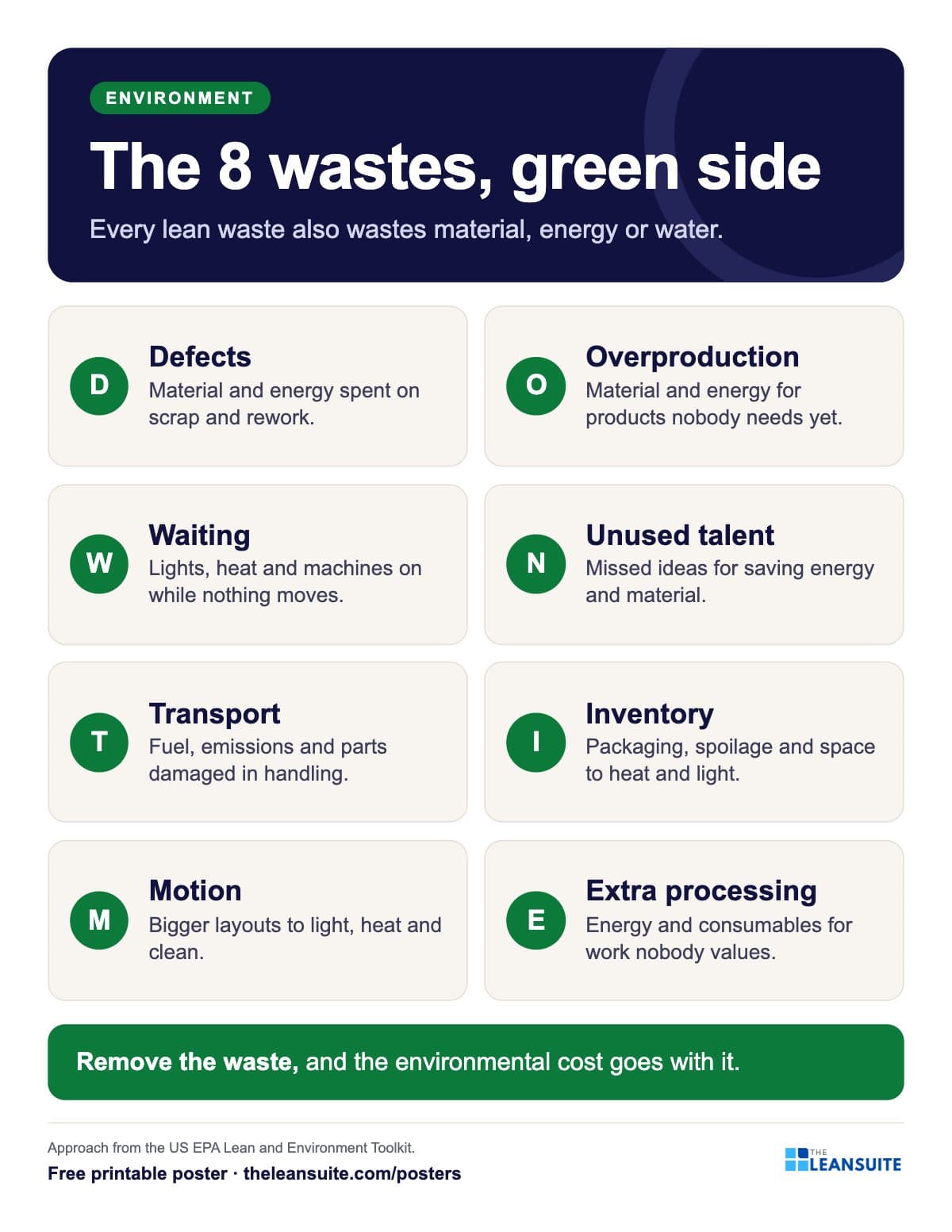
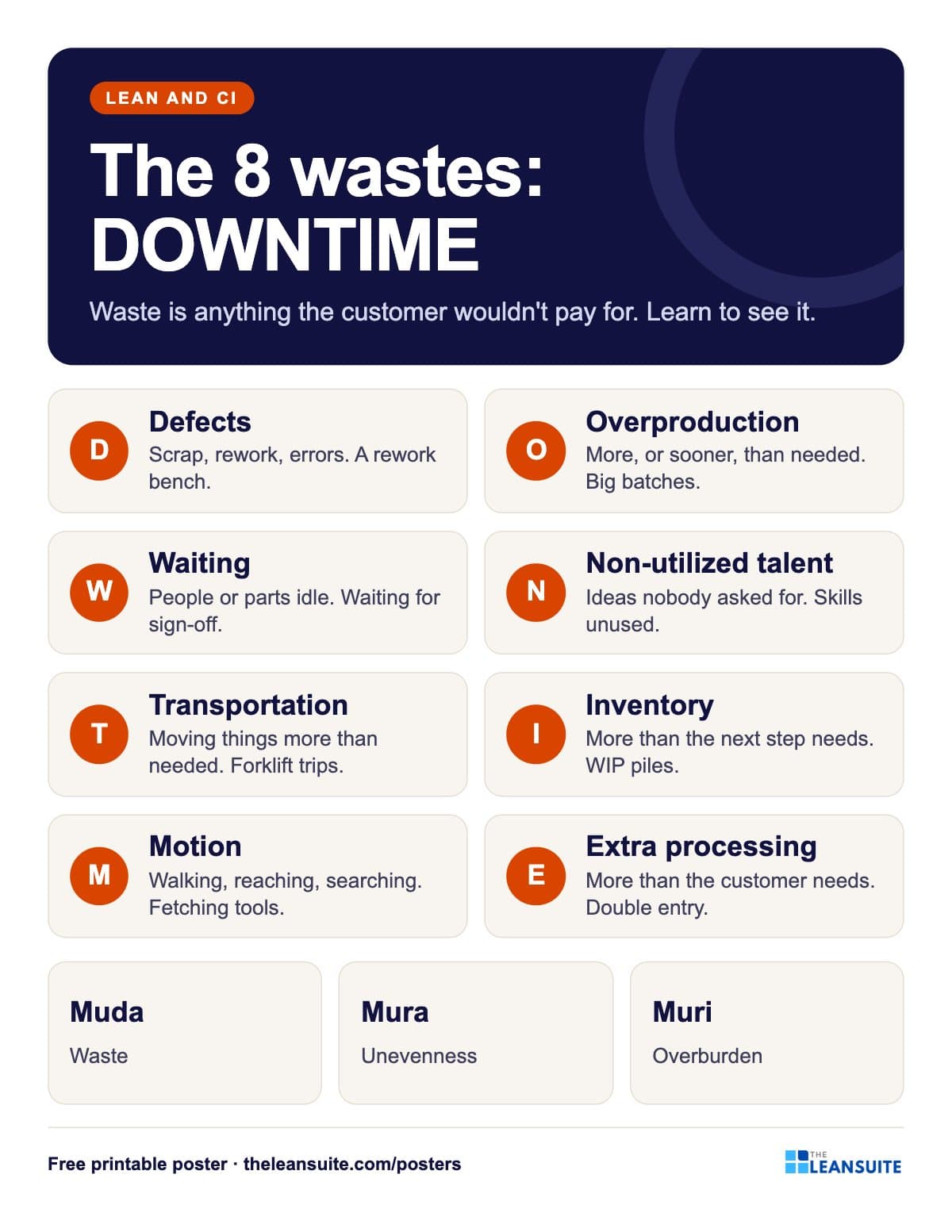
Free printable posters on the same subject, so the team sees it every day: a PNG to download now, and print-ready PDFs from Letter to 24 x 36 in.
FAQ
8 wastes of lean training presentation: common questions
More free training decks
- 5S training presentationSort, set in order, shine, standardize and sustain in 16 slides, with a 15-minute sort activity and a quiz.View deck
- Kaizen training presentationWhat kaizen is, its principles, PDCA and four steps to a first improvement in 17 slides, with an activity and a quiz.View deck
- Autonomous maintenance training presentation: the 7 stepsThe 7 steps of jishu hozen, who does what and how step audits work, in 19 slides with notes and a quiz.View deck
- Gemba walk training presentationGo see, ask why, show respect: how to plan, run and follow up a gemba walk, in 16 slides with a practice walk.View deck
- Root cause analysis training presentation: 5 whys and fishboneDefine, contain, the 5 whys, the fishbone diagram and verifying the cause, in 18 slides with a team activity.View deck
- TPM training presentation: the 8 pillarsWhat TPM is, the six big losses, OEE and the 8 pillars, in 19 slides with a loss-spotting activity.View deck
- World class manufacturing (WCM) training presentationThe WCM pillars, cost deployment, the 7-step approach, model areas and audits, in 17 slides.View deck
- Obeya room training presentationWhat an obeya is, what goes on its walls and how to run the meetings, in 15 slides with a design activity.View deck
- DMAIC training presentationDefine, measure, analyze, improve and control, with the main tools of each phase, in 16 slides.View deck
Training is the start. Keeping it going is the hard part.
See how plants run their audits, improvements and follow-ups in LeanSuite, on a call built around your own problem.
Schedule Demo