
Free training deck
Updated · About 25 minutes
5S training presentation
5S is a five-step method for organizing a work area and keeping it that way: sort, set in order, shine, standardize and sustain. This free deck teaches it to a team in about 25 minutes. It has 16 editable slides that explain each S in plain words, an illustrative example, the common mistakes, a 15-minute sort activity to run in your own area and four check questions with answers. Every slide has speaker notes, so a team leader can present it without preparing a script.
Free to use: print it, copy it and edit it for your team. Enter your name and work email once to download.
A look inside
What is in the 16 slides
For operators, team leaders and anyone new to 5S. Widescreen, in plain language, with speaker notes on every slide.
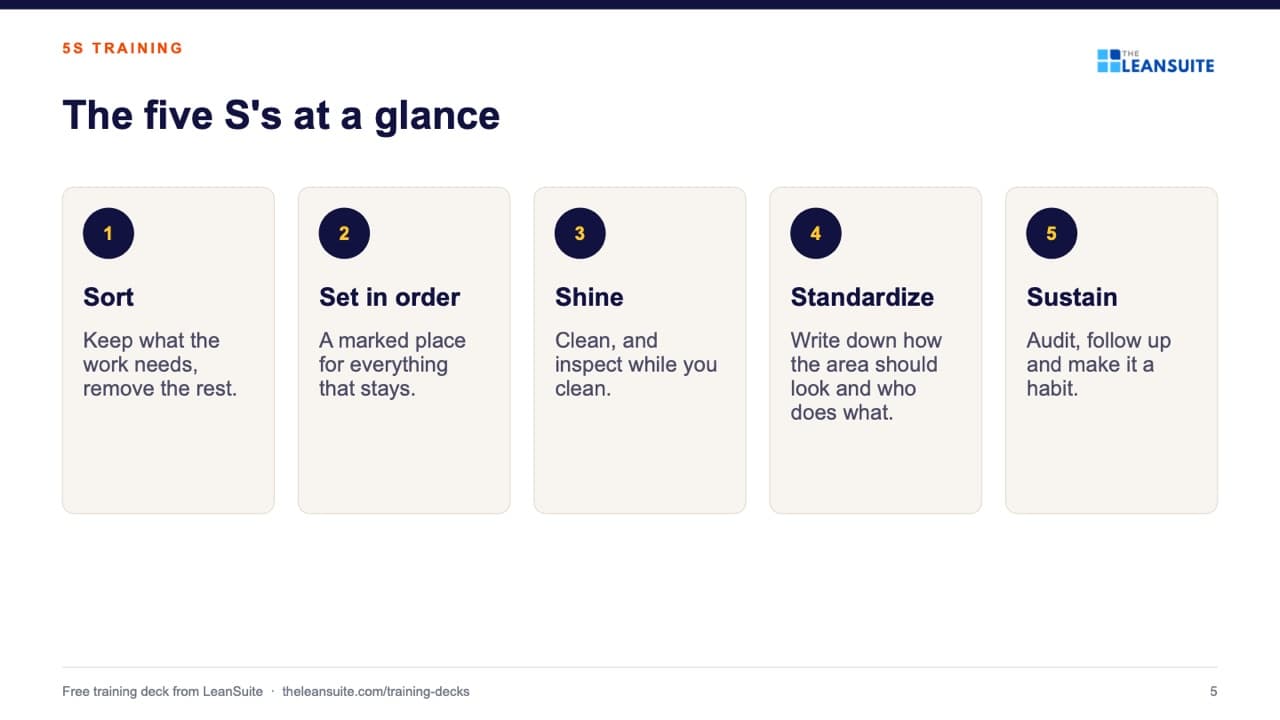
Slide 5: The five S's at a glance 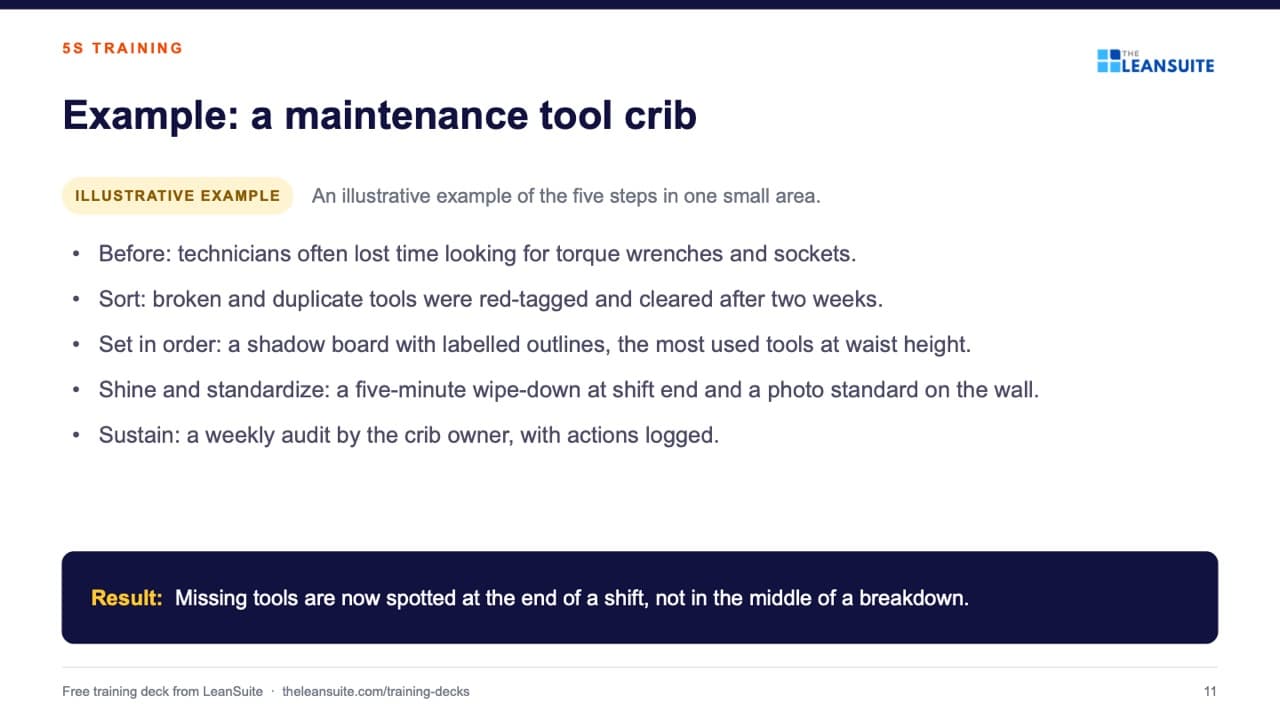
Slide 11: Example: a maintenance tool crib 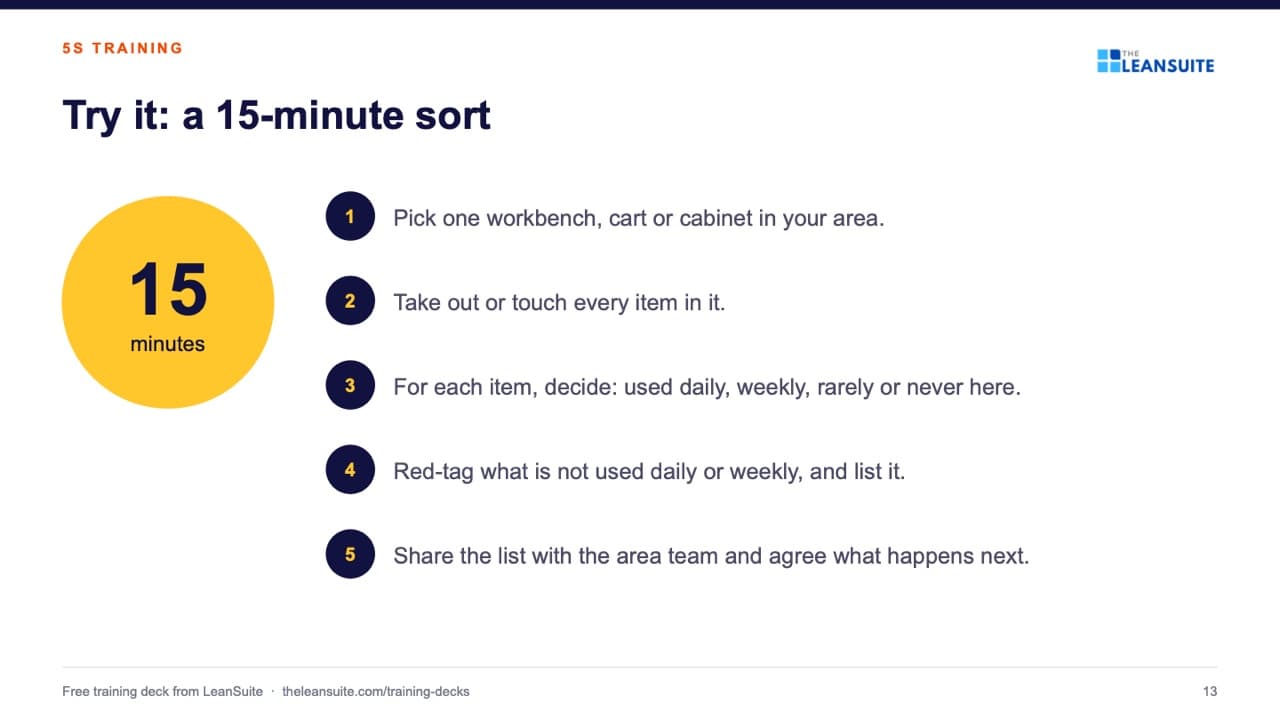
Slide 13: Try it: a 15-minute sort
- 15S: a workplace that shows its problemsCover
- 2AgendaWhy 5S matters · The five S's, one by one · An example and common mistakes · Activity: a 15-minute sort · Check questions and next steps
- 3Why we are doing this5S makes problems visible, so the team spends less time searching and more time on the work.
- 4What 5S isFive Japanese words, each starting with S, name five steps for organizing a work area and keeping it organized.
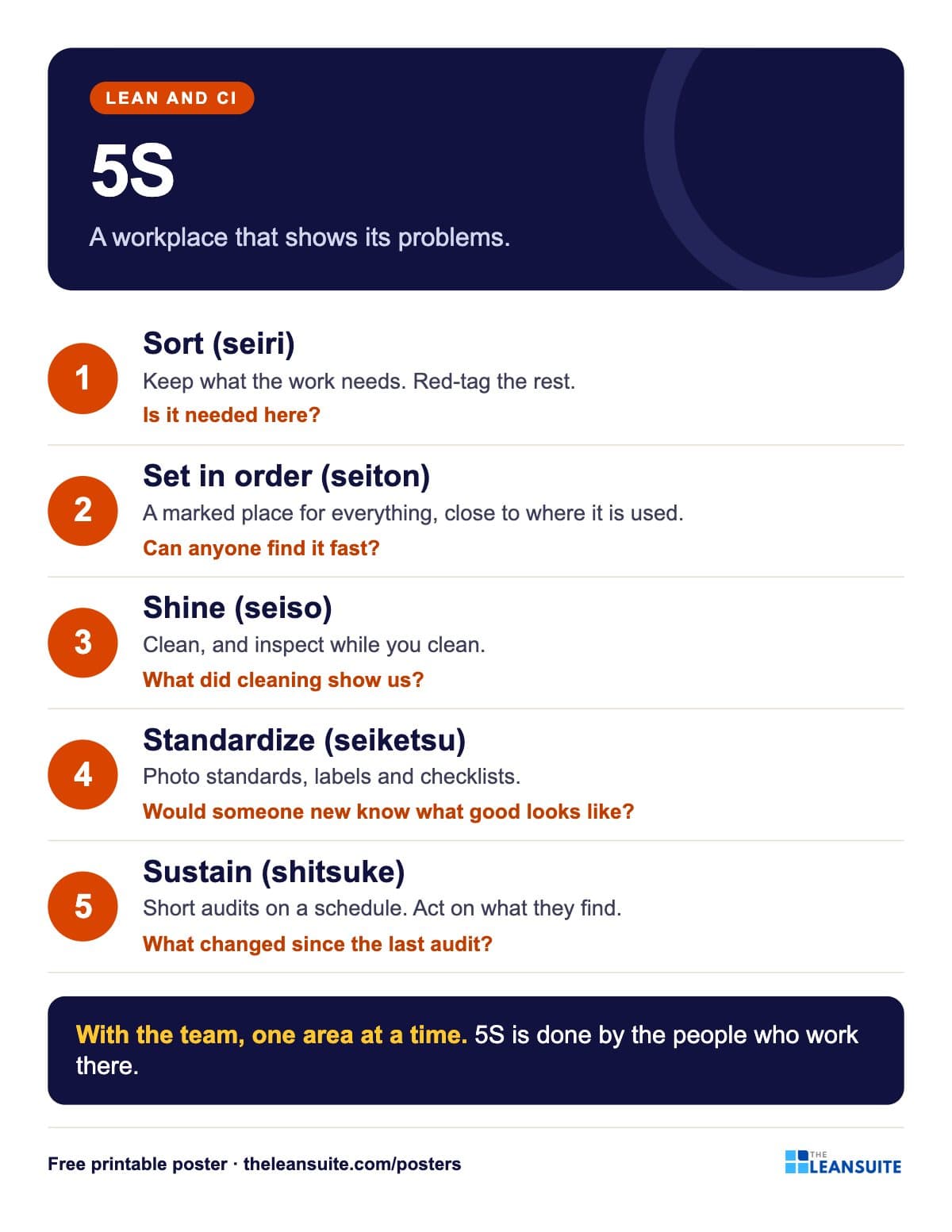
- 5The five S's at a glanceSort, Set in order, Shine, Standardize, Sustain
- 61. SortKeep what the area needs for its work and remove everything else.
- 72. Set in orderA place for everything, and everything in its place.
- 83. ShineClean the area and the equipment, and look for problems while you do it.
- 94. StandardizeWrite down how the first three S's are done, so everyone does them the same way.
- 105. SustainMake 5S a habit, not a one-time cleanup.
- 11Example: a maintenance tool cribAn illustrative example of the five steps in one small area.
- 12Common mistakesTreating 5S as a one-day cleanup event.
- 13Try it: a 15-minute sortA 15-minute team activity
- 14Check your understanding4 check questions
- 15AnswersThe answers, to discuss
- 16Key points and next stepsNext: finish the sort, then agree a place for everything that stays.
How to run it
Running the session
- 1
Prepare
Read the speaker notes once and swap the illustrative example for one from your own area if you have it. Print the PDF if people like a handout.
- 2
Present
The slides take about 10 minutes. Every slide has notes, so you can talk from them rather than read the slide.
- 3
Do the activity
Pick one workbench, cart or cabinet in your area. The activity slide takes the team through it step by step; allow 15 minutes.
- 4
Check and follow up
Ask the check questions before showing the answers, then agree one next step with an owner and a date before people leave.
The check questions
- 1. What is the difference between sort and set in order?
- Sort removes what the area does not need. Set in order arranges what is left so it is easy to find and put back.
- 2. Why do we say cleaning is inspection?
- While cleaning you see leaks, wear and loose parts early, before they cause a breakdown or a defect.
- 3. What does a red tag on an item mean?
- Its need is in question. It goes to a holding area until someone decides by an agreed date to keep, move, sell or scrap it.
- 4. Which S stops the others from slipping?
- Sustain: regular audits, leader walks and follow-up on findings turn 5S into a habit.
Templates and guides to go with it
- 5S audit checklist template25 checks, five per S, scored 1 to 5, with a score summary and a chart of the five S's.
- 5S red tag log and red tagsA log of every red-tagged item with its decision, and six printable red tags to cut out.
- Office 5S audit checklist25 checks written for offices and shared areas, five per S, scored 1 to 5, with a score summary and actions.
- Shadow board plannerPlan a shadow board: the tool list with how often each is used, a squared layout, labels, and a month of daily checks.
- Floor marking color guideA floor marking color standard with swatches, marks and line widths to fill in, and a floor marking check with a layout sketch.
- Topic: 5S and visual managementEvery guide we have on the subject, sorted.
After the session
Put it on the wall
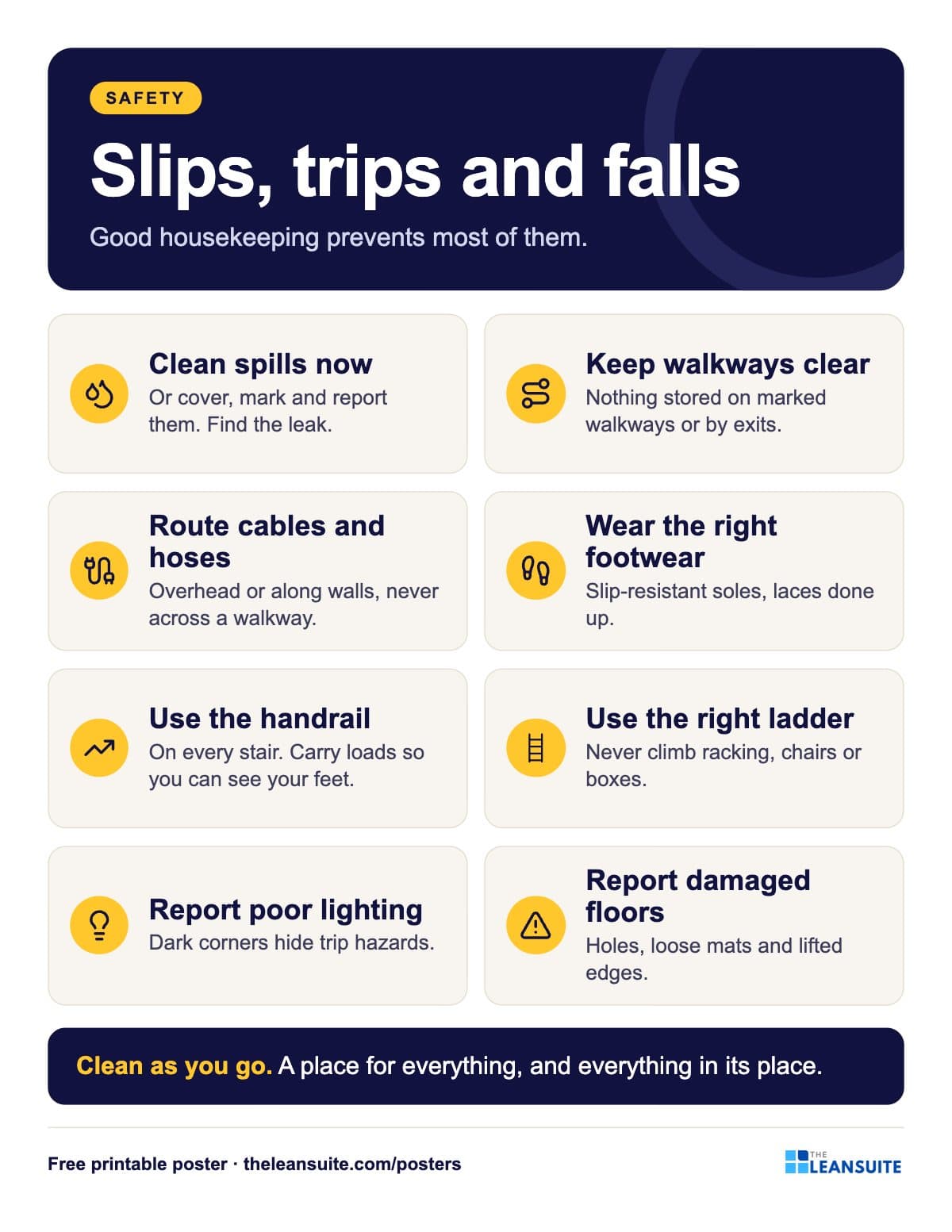
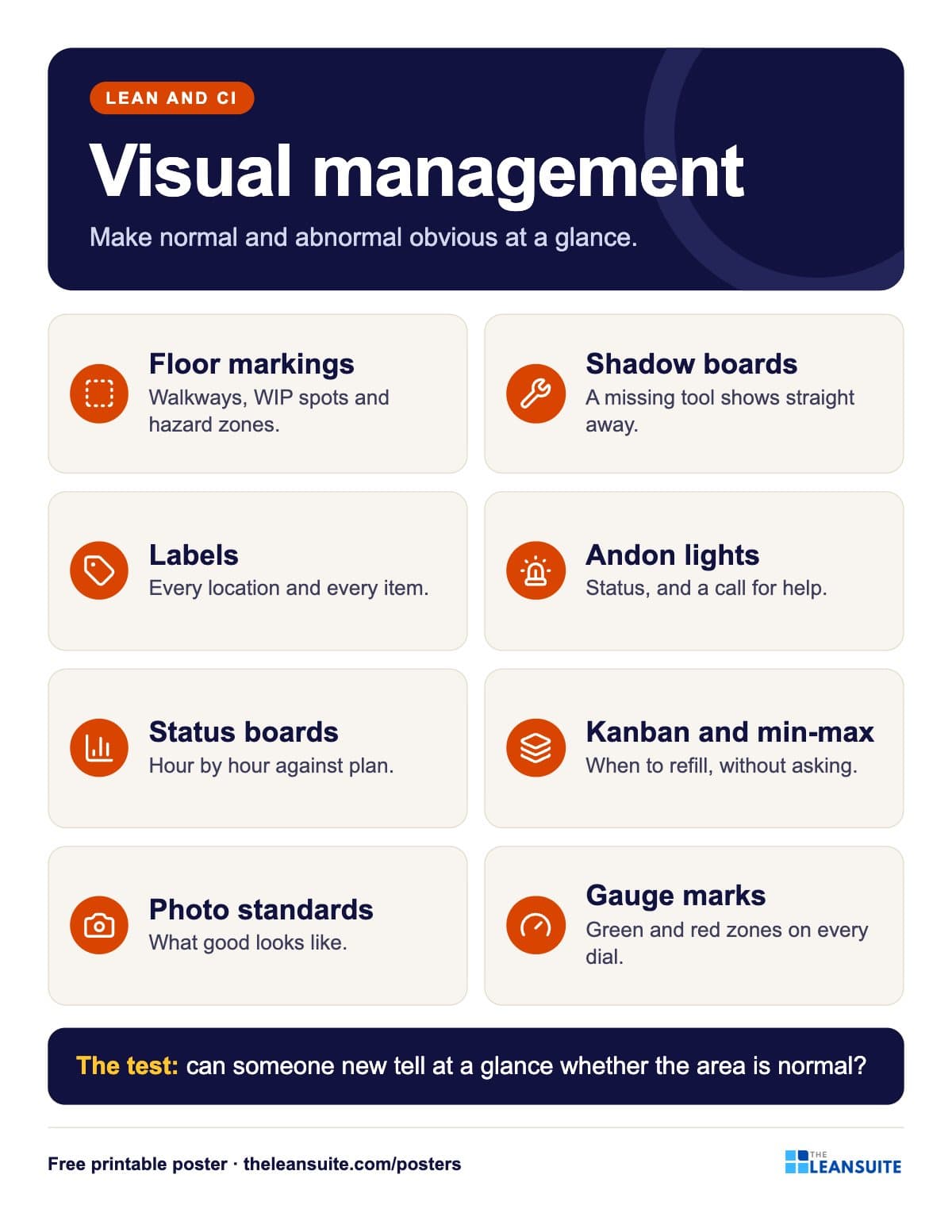
Free printable posters on the same subject, so the team sees it every day: a PNG to download now, and print-ready PDFs from Letter to 24 x 36 in.
FAQ
5S training presentation: common questions
More free training decks
- Kaizen training presentationWhat kaizen is, its principles, PDCA and four steps to a first improvement in 17 slides, with an activity and a quiz.View deck
- Autonomous maintenance training presentation: the 7 stepsThe 7 steps of jishu hozen, who does what and how step audits work, in 19 slides with notes and a quiz.View deck
- 8 wastes of lean training presentationValue vs waste, the 8 wastes (TIMWOODS) with examples, muda, mura and muri and a waste walk, in 17 slides.View deck
- Gemba walk training presentationGo see, ask why, show respect: how to plan, run and follow up a gemba walk, in 16 slides with a practice walk.View deck
- Root cause analysis training presentation: 5 whys and fishboneDefine, contain, the 5 whys, the fishbone diagram and verifying the cause, in 18 slides with a team activity.View deck
- TPM training presentation: the 8 pillarsWhat TPM is, the six big losses, OEE and the 8 pillars, in 19 slides with a loss-spotting activity.View deck
- World class manufacturing (WCM) training presentationThe WCM pillars, cost deployment, the 7-step approach, model areas and audits, in 17 slides.View deck
- Obeya room training presentationWhat an obeya is, what goes on its walls and how to run the meetings, in 15 slides with a design activity.View deck
- DMAIC training presentationDefine, measure, analyze, improve and control, with the main tools of each phase, in 16 slides.View deck
Training is the start. Keeping it going is the hard part.
See how plants run their audits, improvements and follow-ups in LeanSuite, on a call built around your own problem.
Schedule Demo