

Structured meetings: A meeting cadence for every tier, with the KPIs on the agenda
A structured meeting runs to a fixed cadence, a fixed agenda and a fixed set of KPIs, and ends with decisions on record. In a plant that means a short daily huddle on the line, a weekly area review and a monthly plant review, each one feeding the next. LeanSuite keeps every level's meeting as a series, with each item's KPIs filled in before anyone walks in and the open actions carried from week to week.
Structured meetings
Every meeting on a cadence, with its KPIs already on the agenda
The board shows the numbers. The meeting is where they get discussed and decided. Each level gets its own meeting series, and the KPIs, notes and actions stay with the meeting.
A meeting series for each level
Each level's meeting is a series with its own cadence, its purpose and what you want out of it, and an agenda that says who owns each item and how many minutes it gets. Every week runs the same way, whoever leads it.
The KPIs are already on the agenda
Each agenda item carries its own KPIs. They fill in by themselves for the meeting's week, met or missed against target, and the owner adds a comment where a number needs a reason before anyone walks in.
Prepared before, run item by item
Owners write one line each for highlights, lowlights, issues, priorities and the support they need. In the room you go item by item, turn a request for support into an action in one click, and move on with Done, next.
Nothing drops between meetings
Actions from earlier meetings come back until their owner ticks them off, and requests from one review go on the agenda of the next.
Tier 1
Shift huddle
- Cadence
- Daily
- Length
- 10 to 15 min
- KPIs
- Yesterday, and the month so far
Tier 2
Area review
- Cadence
- Weekly
- Length
- 30 min
- KPIs
- Last week, and the quarter so far
Tier 3
Plant review
- Cadence
- Monthly
- Length
- 60 min
- KPIs
- Last month, and the year so far
| Level | Meeting | Cadence | Length | What the KPIs show |
|---|---|---|---|---|
| Tier 1 | Shift huddle | Daily | 10 to 15 min | Yesterday, and the month so far |
| Tier 2 | Area review | Weekly | 30 min | Last week, and the quarter so far |
| Tier 3 | Plant review | Monthly | 60 min | Last month, and the year so far |
How a meeting runs
From the home screen to the last action, in one place
A weekly leadership review at a sample mine, step by step. The screens are LeanSuite with sample data.
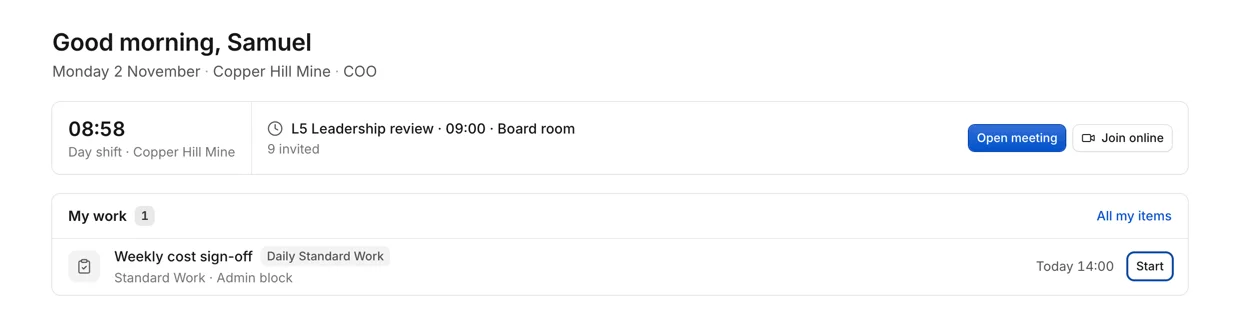
It's at the top of your day
On the morning of the meeting it sits at the top of your home screen: the time, the room and who's invited. Open it in the room, or join online.
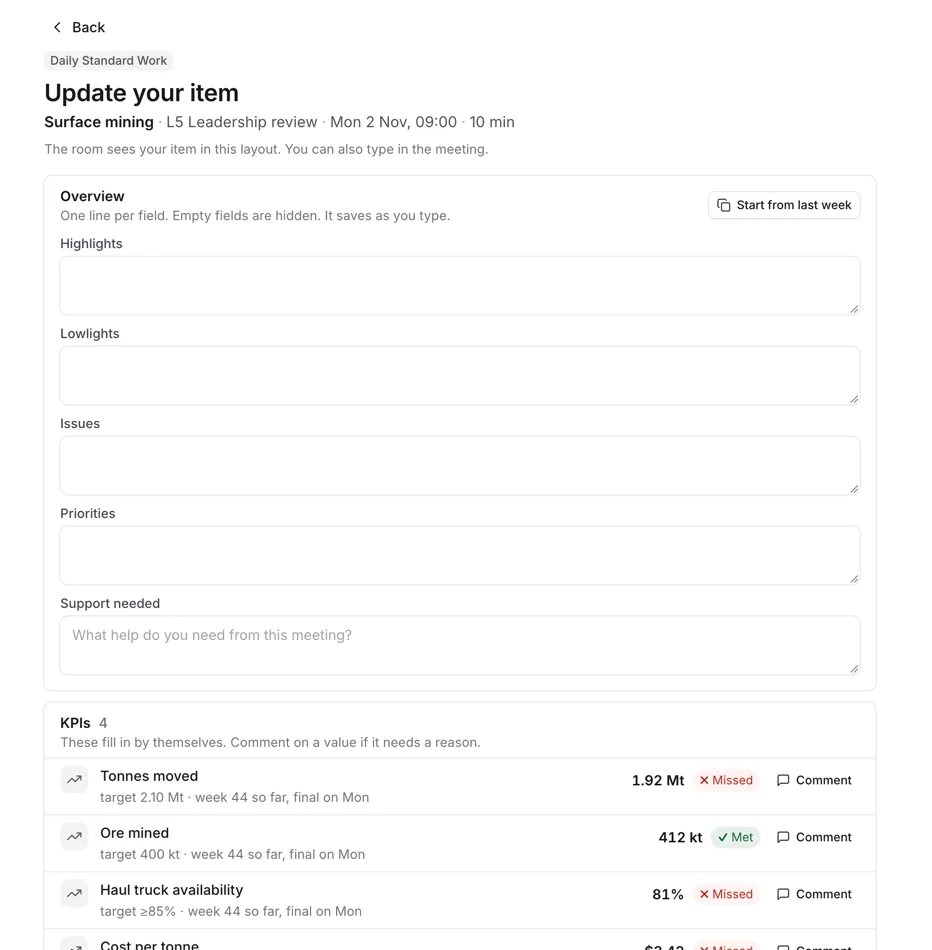
Each owner prepares their item before
Every agenda item has an owner. Before the meeting they write one line each for highlights, lowlights, issues, priorities and the support they need, or start from last week's. Their KPIs fill in by themselves, met or missed against target, and they add a comment where a number needs a reason.
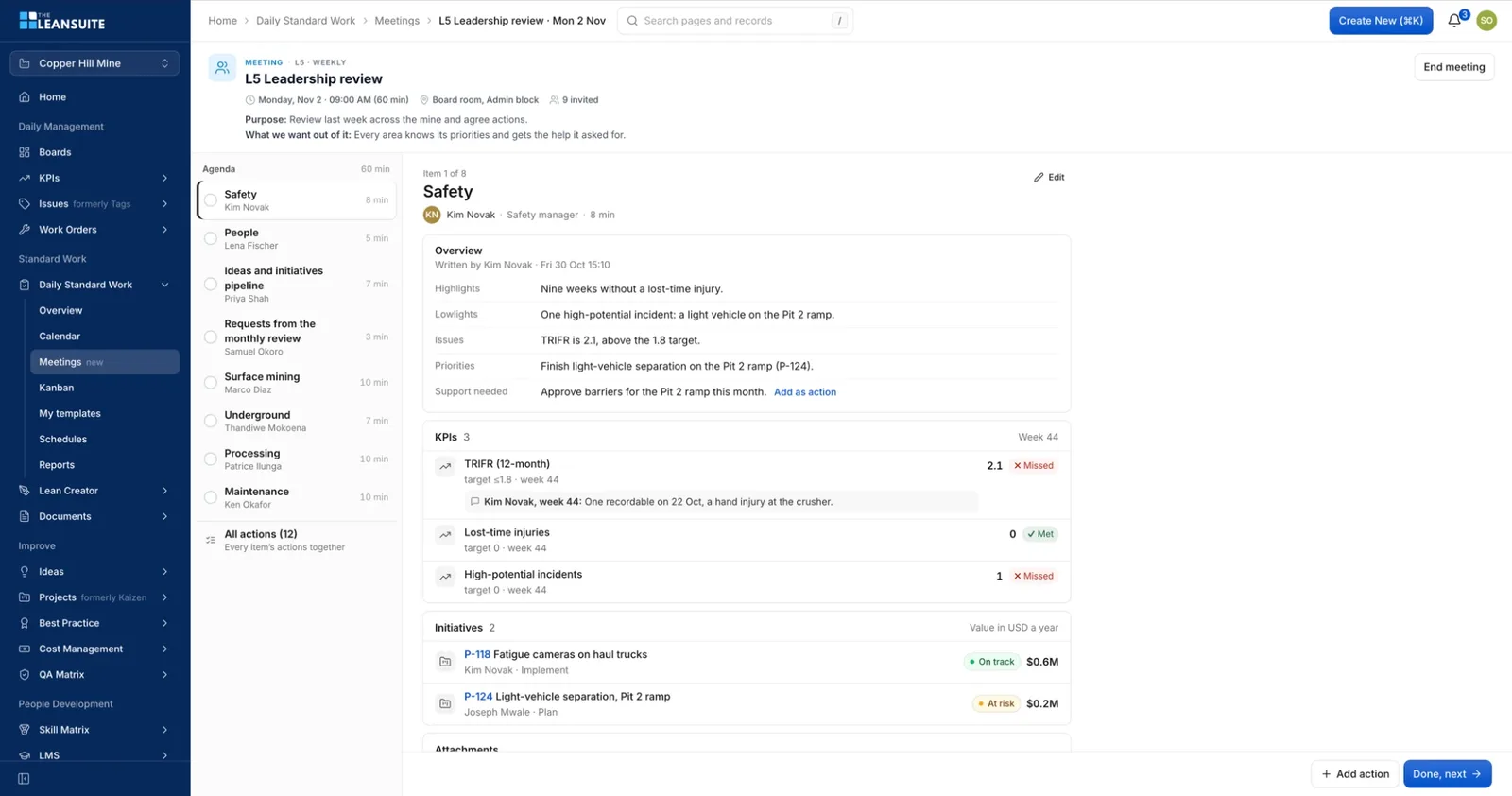
In the room, one item at a time
The agenda runs down the side with each owner and their minutes. Each item shows what the owner wrote, the KPIs against target with their comments, the initiatives with their status and value a year, and the attachments. A request for support becomes an action in one click, and Done, next moves the room on.
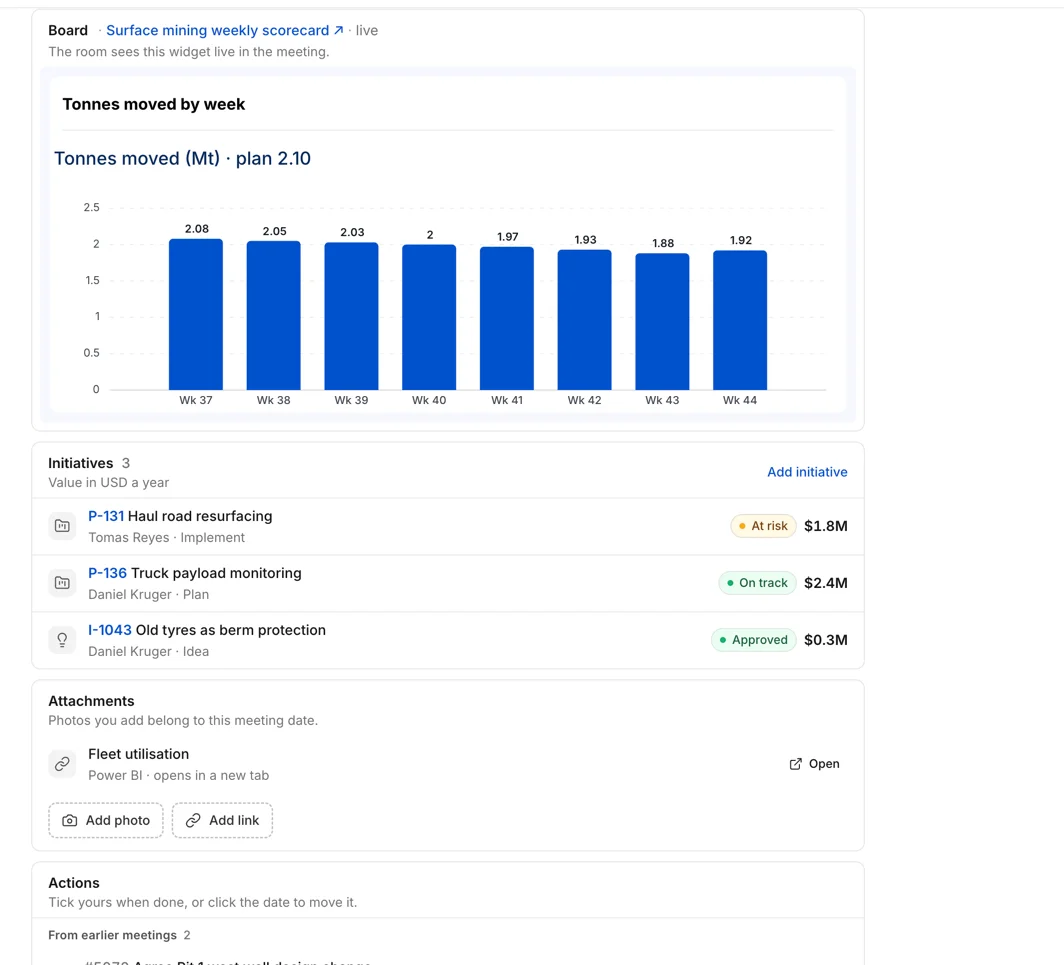
The board and the actions, in the same meeting
A board widget can sit inside an item and stays live, so the room sees the same chart as the floor. Photos and links such as a Power BI report are added to that meeting's date. Actions from earlier meetings come back until their owner ticks them off.
Tier by tier
What each tier meeting covers
Most plants run three or four levels. The names change from plant to plant; the job of each level does not.
Tier 1
Shift huddle
- Who
- Team leader and operators
- When
- Daily, start of shift, 10 to 15 minutes, standing at the board
- What it covers
- Safety, yesterday's KPIs against target, today's plan, problems the team can fix today
- What comes out
- Actions for today; what the team can't fix, escalated
Tier 2
Area review
- Who
- Supervisors, area manager, maintenance and quality
- When
- Daily or weekly, 20 to 30 minutes, after the tier 1 huddles
- What it covers
- The lines' boards read together, escalations from tier 1, cross-shift problems, the week's trend
- What comes out
- Blockers removed, owners for cross-line actions, repeat problems sent to tier 3
Tier 3
Plant review
- Who
- Plant manager and department heads
- When
- Weekly or monthly, 45 to 60 minutes
- What it covers
- Plant KPIs against plan, repeat problems, projects and resources, the month's pattern
- What comes out
- Decisions on priorities and resources, projects started, answers sent back down
Tier 4
Business or leadership review
- Who
- Site leaders and the executive team
- When
- Monthly
- What it covers
- Sites side by side, strategy KPIs, the year's goals
- What comes out
- Standard actions cascaded to every site, goals adjusted
How to
How to set a meeting cadence in five steps
Start from the decisions, not the calendar
List the decisions that have to be made every shift, every week and every month: who covers a missing operator, which order runs first, whether a line gets a capital fix. Each level of meeting exists to make one of those sets of decisions. A meeting with no decision to make is a report, and a report can be read.
Give each level one meeting, one owner and one time
Tier 1 on the line at the start of the shift, tier 2 for the area once a day or once a week, tier 3 for the plant once a week or once a month. Same time, same place, same owner. Stagger them so a problem raised at tier 1 at 7:00 can reach tier 2 by 9:00.
Fix the agenda and the KPIs for each meeting
Write the agenda once: safety first, then yesterday's KPIs against target, open actions, escalations, and decisions. Choose the few KPIs that level can act on. A shift huddle reads yesterday and the month so far; a plant review reads the month and the year.
Decide in the room and write it down
Every item ends in a decision, an action with a name and a date, or an escalation. If it is not written in the meeting it did not happen. The summary should be ready when the meeting ends, not typed up the next day.
Send up what the level can't settle, and send the answer back
An item the line can't fix goes on the next level's agenda with its history, and the answer comes back down to the meeting that asked. Review the cadence after a month: drop a meeting nobody decides anything in, and shorten one that always runs over.
What customers say
“Great user-friendly software! It's covering everything that WCM or similar Lean Programs are asking to do, in a very effective way.”
 Elena M.Global Head of Marelli Manufacturing System Automotive, Marelli
“Customer support has been exceptional. The team is always available to answer questions and consistently provides prompt responses. I have been working closely with them to set up KPIs and time studies for our company, and their level of support throughout the process has been outstanding”
 Luis R.CI Engineer, Tomball Controls
“The Project Tracking System generates significant savings while ensuring seamless delivery... The Global Kaizen Power Pitch completely transformed our ability to share best practices.”
 Ramsey AljahmiSr. Director of NAR Operations Excellence, Whirlpool Corporation
FAQs
Structured meetings and meeting cadence
A meeting that runs to a fixed cadence, a fixed agenda and a fixed set of measures, with a named owner, and that ends with decisions and actions on record. In manufacturing it is usually one level of a tiered meeting system: the shift huddle, the area review or the plant review.
The rhythm of a plant's recurring meetings: which meetings happen, how often, how long, who attends and in what order. A typical manufacturing cadence is a daily tier 1 huddle on each line, a daily or weekly tier 2 area review and a weekly or monthly tier 3 plant review, timed so a problem raised in the morning reaches the next level the same day.
The board shows the numbers; the meeting is where they are discussed and decided. In LeanSuite the tier board is a Lean Studio board fed by KPI Dashboards, and the meeting is a series in Daily Standard Work with its own agenda, each item's KPIs against target, the owner's notes, and the actions raised in the room.
Only the ones that level can act on. A shift huddle reads yesterday's safety, quality, delivery and cost results and the month so far. An area review reads the lines together for the week. A plant review reads the plant against plan for the month and the year. In LeanSuite each agenda item carries its own KPIs, filled in for the meeting's week, met or missed against target, with the owner's comment where a number needs a reason.
The set of routines a plant's leaders run every day, week and month to manage performance: the tiered meetings, the KPIs each one reviews, leader standard work, gemba walks and the way problems are escalated and closed. Structured meetings are its backbone, because they are where the numbers turn into decisions.
An item a level can't settle is escalated to the next level's meeting with its notes and history, and the reply goes back to the meeting that raised it. In LeanSuite requests from one review go on the agenda of the next, and actions from earlier meetings come back until their owner ticks them off, so nobody has to re-explain the problem from memory.
Not to start. A whiteboard, a printed agenda and an action log are enough for one line. Software earns its place when several levels and sites have to see the same numbers, when actions and escalations need to be tracked across meetings, and when someone is spending hours each month building the review pack by hand.
FREE RESOURCES
Free templates and posters
Not ready for software yet? Start with these free resources.
- Daily huddle agendaA 15-minute start-of-shift stand-up in six timed blocks, with yesterday's SQCDP results, today's plan, actions and escalations.
- Tier 2 meeting agenda and escalation sheetA 15-minute tier 2 agenda in ten timed blocks, fixed roles and rules, escalation triggers with time limits, and a log that ages every escalation and sends the answer back down.
- Monthly business review template (operations review agenda)A 90-minute operations review in nine timed blocks: who speaks when, the KPIs each block reviews with red or green, a prep checklist for every presenter and a log of decisions and actions.
- Escalation matrix templateWho is called for each type of issue and after how long, with severity rules, contacts and an escalation log.
- Shift handover templateSafety, production against plan, holds, downtime events, materials and people, and the open actions the next shift takes over.
- Leader standard work templateA team leader's daily, weekly and monthly routine with a box per day, follow-ups and a weekly review.
- Visual management posterEight visual aids that show at a glance whether an area is normal.
See your meeting cadence run in LeanSuite
Bring your current meeting calendar and the KPIs each meeting looks at. We set up one series with its agenda and KPIs and run a meeting through to its actions, in 45 minutes.