
Free template
Leader standard work template
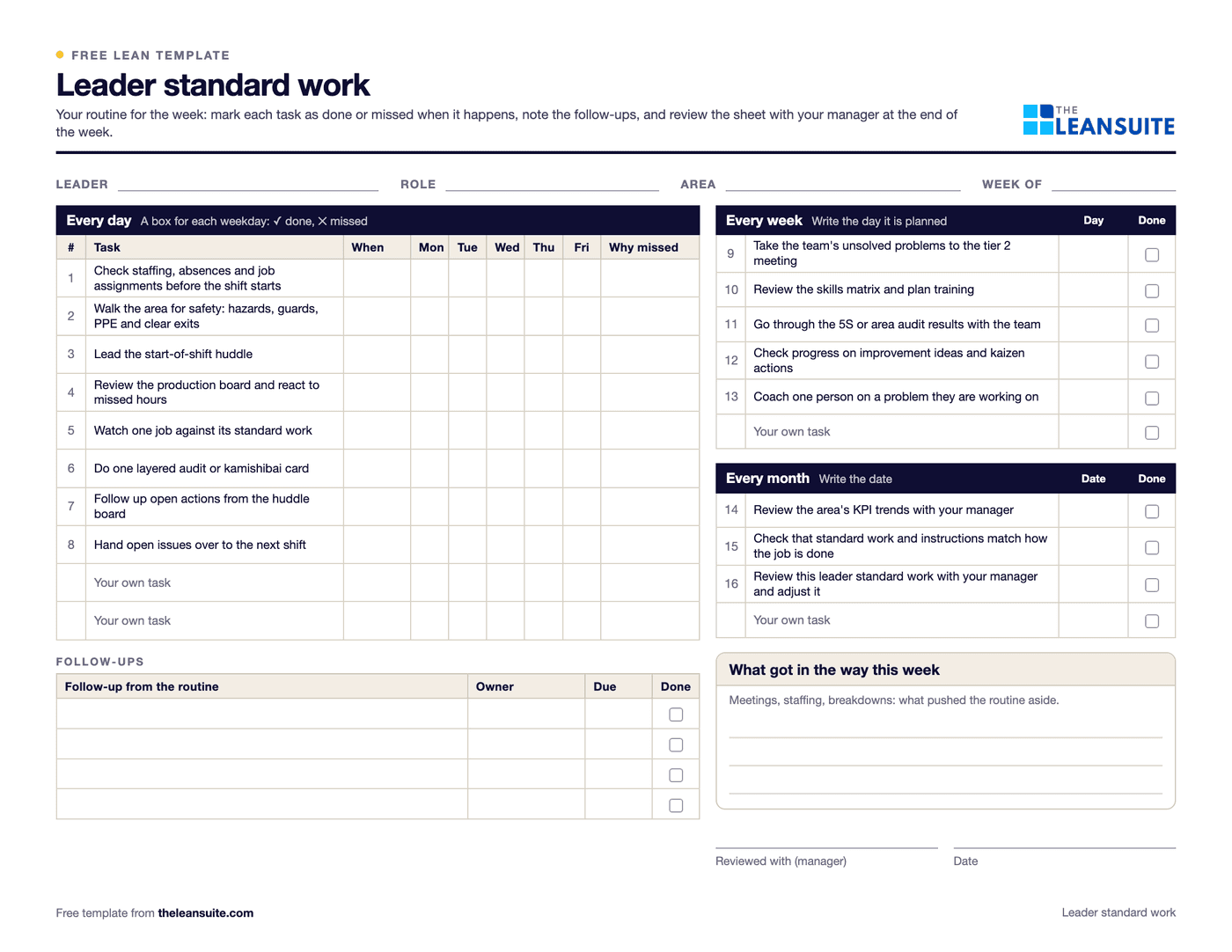
Leader standard work is a written routine of the daily, weekly and monthly tasks a leader does to keep the operating system running: huddles, gemba walks, audits, checking the boards and following up actions. Writing it down makes the leader's own work visible and protects time for coaching and problem solving. This template is filled in for a team leader or supervisor with 16 common tasks: eight daily ones with a box for each weekday, five weekly and three monthly, each with space for when it happens. Beside them are a table for the follow-ups the routine turns up and a box for what got in the way, for the weekly review with your manager. Change the tasks to fit your role.
Free to use: print it, copy it and edit it for your team. Enter your name and work email once to download.
When to use it
When to use a leader standard work template
- When tiered meetings, gemba walks or audits are set up, so each leader knows which of them are theirs and when they happen.
- For a new team leader or supervisor, to show what the job involves each day beyond firefighting.
- When routines slip under pressure, to see which tasks get dropped and why.
- For coaching: a leader and their manager review the sheet each week and adjust it.
- At every level, with different tasks: a team leader's sheet is mostly daily tasks, a plant manager's has more weekly and monthly ones.
How to fill it in
- 1
Fill in the header
Leader, role, area and the week. Use one sheet per leader per week.
- 2
Make the tasks yours
Start from the 16 tasks. Cross out what is not your job, add what is in the blank rows, and keep the list short enough to do on a normal day.
- 3
Put a time on each task
Write when each daily task happens, such as before the shift or after the huddle, the day for each weekly task and the date for each monthly one. Tasks without a time get pushed out.
- 4
Mark it as you go
A tick when a task is done and a cross when it is missed, with a word on why. Mark it during the day, not at the end of the week.
- 5
Write down the follow-ups
Anything the routine turns up that needs action goes in the follow-up table with an owner and a date.
- 6
Note what got in the way
At the end of the week, write what stopped the routine: meetings, staffing, breakdowns.
- 7
Review it with your manager
Go through the ticks, the crosses and the follow-ups together every week, deal with whatever keeps pushing the routine aside, and change the sheet when the job changes.
What's on the sheet
The 16 routine tasks on the leader standard work template
Written for a team leader or supervisor. On the sheet each task has space for when it happens and a box to mark done or missed; cross out what is not your job and add your own in the blank rows.
Every day
A box for each weekday
- 1Check staffing, absences and job assignments before the shift starts
- 2Walk the area for safety: hazards, guards, PPE and clear exits
- 3Lead the start-of-shift huddle
- 4Review the production board and react to missed hours
- 5Watch one job against its standard work
- 6Do one layered audit or kamishibai card
- 7Follow up open actions from the huddle board
- 8Hand open issues over to the next shift
Every week
Write the day it is planned
- 9Take the team's unsolved problems to the tier 2 meeting
- 10Review the skills matrix and plan training
- 11Go through the 5S or area audit results with the team
- 12Check progress on improvement ideas and kaizen actions
- 13Coach one person on a problem they are working on
Every month
Write the date
- 14Review the area's KPI trends with your manager
- 15Check that standard work and instructions match how the job is done
- 16Review this leader standard work with your manager and adjust it
A filled-in example
Illustrative, not a benchmarkOne week of leader standard work for a first-shift team leader in an assembly area.
- Daily: the huddle, the safety walk and the handover done all five days; the standard work observation missed on Tuesday and Thursday, both times because of a line stop.
- Layered audit: done four days out of five, with one finding, a torque check skipped at station 3.
- Weekly: two problems taken to the tier 2 meeting; an operator coached on the torque check.
- Follow-ups: correct the torque check sheet at station 3 (owner: the quality technician); ask maintenance about the repeat line stop (owner: the team leader).
- What got in the way: two long line stops pulled the team leader onto the line.
The weekly review with the area manager showed the standard work observation was the task that dropped whenever the line stopped, so they moved it to straight after the huddle. The line stop went to maintenance as a problem to solve rather than staying a reason to skip the routine.
Common mistakes
Writing a job description
Leader standard work covers specific tasks at specific times. Leave the rest of the job off the sheet.
Filling the whole day
The routine takes part of the day and leaves the rest for problems and people. A sheet that fills every minute will not survive the first breakdown.
Ticking without doing
A tick for a walk that did not happen hides the problem. Mark the misses and write why.
Nobody reviews it
Without a weekly review with the leader's manager, the sheet turns into paperwork and nothing protects the routine from being pushed aside.
Never changing it
When the area, the team or the targets change, change the tasks too.
Download the template
Free to use: print it, copy it and edit it for your team. Enter your name and work email once to download.
Run this template in LeanSuite
In LeanSuite you build a checklist or audit in Lean Creator and schedule it in Daily Standard Work to a person, a role or a machine with a repeat rule; each person sees their checks on a calendar or Kanban board, gets a reminder before one is due, and missed ones show in red.
In the lean glossary
Free tools
FAQ
Leader standard work template: common questions
More free templates
All templates- 5S audit checklist template25 checks, five per S, scored 1 to 5, with a score summary and a chart of the five S's.
- Gemba walk checklistA walk plan and route, 30 prompts in six groups and a findings table with owners and due dates.
- Autonomous maintenance (CILR) checklist20 clean, inspect, lubricate and retighten checks with a box per day, an abnormality log and sign-off.
- A3 problem solving templateThe standard seven-box A3 on one landscape sheet, from background to follow-up.
- PDCA templateOne improvement cycle on one landscape page: plan, do, check against the goal, then standardize or adjust.
- 5 Whys templateA problem statement, five why rows with evidence, the root cause and the countermeasure.
- 5W1H templateSix questions with prompts and evidence, turned into a problem statement before the root cause analysis.
- 8D report templateD0 to D8 on three pages: team, is/is not, containment, occurrence and escape causes, actions and closure.
- Poka-yoke worksheetEach step's possible errors, prevention or detection, the method, a device idea and a verified box.
- Skills matrix templatePeople by skills, a 0 to 4 scale, a training column and a coverage row that shows the gaps.
- Standard work sheet templateTakt time, each element's manual, machine and walk time on a time chart, key points and standard WIP.
- One point lesson (OPL) templateOne topic on one page: wrong way and right way pictures, key points, why it matters and a sign-off record.
- SMED changeover worksheetChangeover steps with times, internal or external, what can move, ideas and before/after totals.
- Kaizen event charter templateScope, team and roles, baseline and target metrics, a five-day schedule, risks and sign-off.
- RACI matrix template17 kaizen project tasks by 10 roles, with R, A, C, I drop-downs and a check for one accountable per task.