
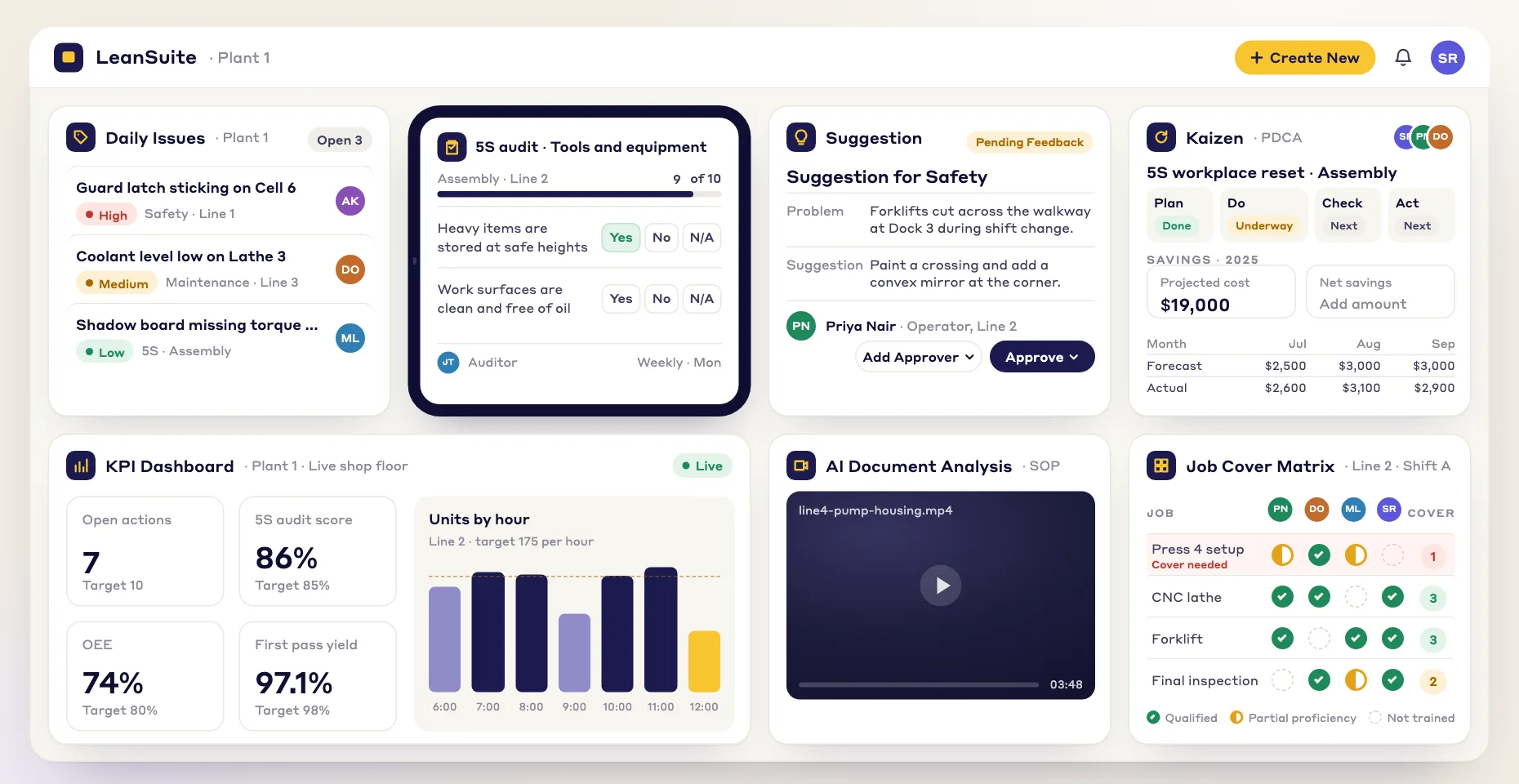
Lean Studio board · Improvement & ideas
Suggestion Board
In one sentence
A suggestion board is a visual board where every employee idea is a card that moves through submitted, under review, approved, in progress and done, so the person who raised the idea can see what happened to it.
A suggestion board shows every employee idea as a card and moves it through the stages a suggestion goes through: submitted, under review, approved (or declined with a reason), in progress and done. The point of putting it on a board is that the person who had the idea can see where it is, which is what keeps ideas coming.
When to use it
When to use the Suggestion Board
- When a suggestion scheme exists on paper but people have stopped using it because nothing visible happens.
- For a team or area that wants to run its own ideas without waiting for a plant-wide system.
- In a kaizen teian programme, to make the weekly review a five-minute walk along the board.
- To show the count of ideas raised and done per month on the tier board.
What is on the board
- 1
Submitted
New ideas, with who raised them and the problem they solve.
- 2
Under review
Being looked at by the team leader or the area, with a date to answer by.
- 3
Approved
Agreed, with an owner and a due date; declined ideas get a reason and go back to the person.
- 4
In progress
Being implemented.
- 5
Done
Implemented, with the result and a thank-you.
Running it
How to run a Suggestion Board session
- 1Put the board where the team works, and write the promise on it: every idea gets a first answer within a week.
- 2Anyone adds a card any time: the idea, the problem it solves, their name and the date. No form, no minimum.
- 3The team leader reviews new cards weekly, typically ten minutes at the end of a huddle, with the people who raised them present: approve, decline with a reason, or ask a question.
- 4Approved cards get an owner and a date before they move. Small ideas the area can do itself are done by the area; the rest go to the supervisor's weekly review.
- 5Move cards as work happens and write the result on the card when it reaches done. Leave done cards up for a month.
- 6Count ideas raised and done per month and put the two numbers on the tier board. If the gap grows, the review is too slow.
- 7Good output: a week or less from submitted to first answer, more cards in done than in review, and names on the board from every shift.
Worked example · sample data
Worked example
The sample board has seven ideas across five columns. Two are newly submitted: D. Ruiz wants the scrap bin nearer the saw, and A. Kaur wants the torque guns colour-coded by station. J. Lind's idea to hang the air hose from the ceiling is under review. M. Osei's second label printer is approved with T. Nguyen as owner, and R. Patel's shadow board for the die cart is in progress. Two are done: S. Alvarez's bigger font on the pick list and D. Ruiz's mirror at the blind corner. At the weekly review the team leader approved the scrap bin move on the spot, since the area could do it that shift, asked J. Lind for a cost on the air hose, and pointed out in front of the team that D. Ruiz had two cards on the board.
The board shown at the top of this page, read through. Invented data, not a customer.
Common mistakes
- Ideas that sit in review for a month. People learn within weeks whether the board is real.
- Declining without a reason, or declining quietly by never moving the card.
- Approving everything and implementing nothing. An approved card with no owner is a promise not kept.
- Only the team leader adds cards, because the operators were 'too busy'.
- Taking done cards down the same day. A month of visible wins recruits the next ideas.
How it works in Lean Studio
- 1Start from the Suggestion Board template: five columns from submitted to done.
- 2Add a card per idea with the person's name and drag it along as it is reviewed and implemented; colour cards by area or by type.
- 3Give each approved card an owner and a date, and keep the done column visible for a month so the wins are seen.
- 4Save the finished board to My templates so the next team starts from your version.
Lean Studio boards are drawn with stickies, text, shapes (rectangle, rounded rectangle, ellipse, diamond), arrows and charts, and any board can carry the 15 data widgets, from a scorecard to a kanban. See all widgets and boards.
Also in LeanSuite
Where it goes next in LeanSuite
LeanSuite's Idea Management turns frontline suggestions into reviewed, approved and tracked improvements.
Idea Management is the plant-wide version: operators submit from a phone or shared tablet with an employee ID, each idea goes to the right reviewer, who approves it, approves it with feedback or rejects it with a reason, and people can see what happened to theirs. Idea Management
An approved idea becomes a Kaizen project in one click, with the link to the original idea kept, so its savings are tracked against plant targets. Kaizen & Projects
Points, campaigns and a monthly leaderboard reward taking part, and built-in reports show the participation rate, ideas by department and ideas waiting for feedback by manager. Idea Management
Open this board in LeanSuite
Suggestion Board is one of the 30 ready-made boards in Lean Studio, LeanSuite's whiteboard. Try the interactive demo in your browser with sample data, or pilot LeanSuite on your own lines for 90 days, with the setup done by our team.
What Lean Studio isRelated boards and templates
In the lean glossary
FAQ
Suggestion Board: common questions
More improvement & ideas boards
All 30 Lean Studio boards- Impact / Effort MatrixPrioritize improvement ideas by impact and effort into Implement, Challenge, Possible, Kill.
- Affinity DiagramCluster brainstormed ideas into shared themes.
- Gap AnalysisCompare current vs future state and plan actions that close the gap.
- Kaizen Event ReportSummarize a kaizen event: before and after states, measured results, and the actions.
- Gemba Walk BoardPlan a gemba walk, capture observations at the workplace, and turn them into follow-ups.
- 8 Wastes WalkWalk the process and collect concrete examples of each of the eight wastes.
- 5S Audit BoardScore and track workplace organization across the five S disciplines.