

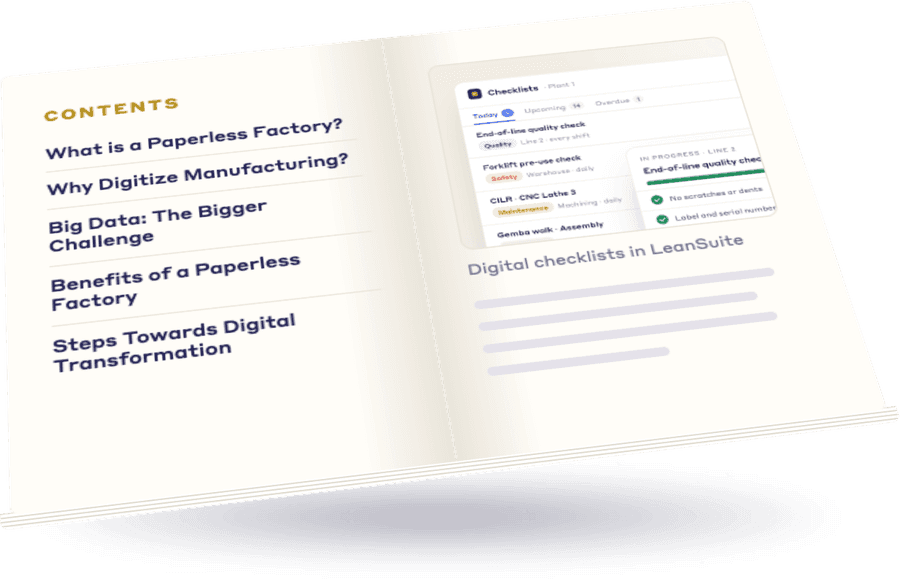

Summary
A summary of the e-book in its own words: what a paperless factory is, the problems with paper, the human side and the three steps to start. The pandemic-era statistics, the survey and market figures and the dated technology examples are left out.
What a paperless factory is
A paperless factory is a manufacturing environment where information and processes are digitized, removing the need for paper documents. It uses systems and software to streamline workflows, improve communication, and automate data management, so the plant relies less on physical documents.
Why move off paper
Disconnected systems, partial automation, silos of information, lack of collaboration, and difficult logistics affect quality, efficiency, and the bottom line. Paper-based systems add four problems of their own.
- Wasted time
- Manual data entry, sorting, and organizing paperwork take significant time, and mistakes such as wrong orders or inaccurate entries can affect customer satisfaction.
- Storage and printing
- Paper needs space to store, adds a fire hazard, and printing costs ink, electricity, and labor to distribute.
- Data security
- Paper documents can be accessed, stolen, or leaked without the access control a digital system gives.
- Data accuracy
- Carrying documents by hand around a plant leads to errors and delays that digital communication avoids.
Where a paper record loses time and accuracy
- 1
Written on paper
Forms, logs and clipboards on the floor. - 2
Carried and filed by hand
Errors and delays on the way. - 3
Keyed into a system later
Manual entry takes time and adds mistakes. - 4
Mistakes reach the customer
A wrong order or entry affects customer satisfaction.
Digital data also opens up uses paper cannot: dashboards of machine health and efficiency, quality checks that flag defects or deviations as they happen, and predictive maintenance that uses sensor data to anticipate failures before they occur.
The human side
Resistance to change is a natural human tendency. Moving to a digital-first plant asks people to change their skills and their mindset, and it can meet skepticism or pushback, including the fear that machines will take people's jobs.
Automation in manufacturing marks a shift to people and machines working together. Machines take on repetitive, tedious, or hazardous tasks; people bring creative problem-solving and the ability to adapt quickly, which keeps them at the heart of decisions and of handling the unexpected.
Three steps to start
Three steps toward a digital plant
- 1
Assess and plan
- 2
Empower leaders and employees
- 3
Establish a long-term plan
Step 1: Assess and plan
Evaluate existing processes, technologies, and skills, and pinpoint where digital tools can make a real difference. Write a roadmap with objectives, timelines, and measures of success, and choose tools that fit the company's needs, starting with those that bring early benefits and momentum.
Step 2: Empower leaders and employees
Leaders champion the change, provide the resources, and explain the vision and benefits across the organization. Build a culture that accepts change and experimentation, and make sure every employee is comfortable with the new tools through training, regular communication, feedback, and support.
Step 3: Establish a long-term plan
Set and track goals for continuous improvement. For lasting change, the organization needs to decide what its goals are and how automation will help reach them.