
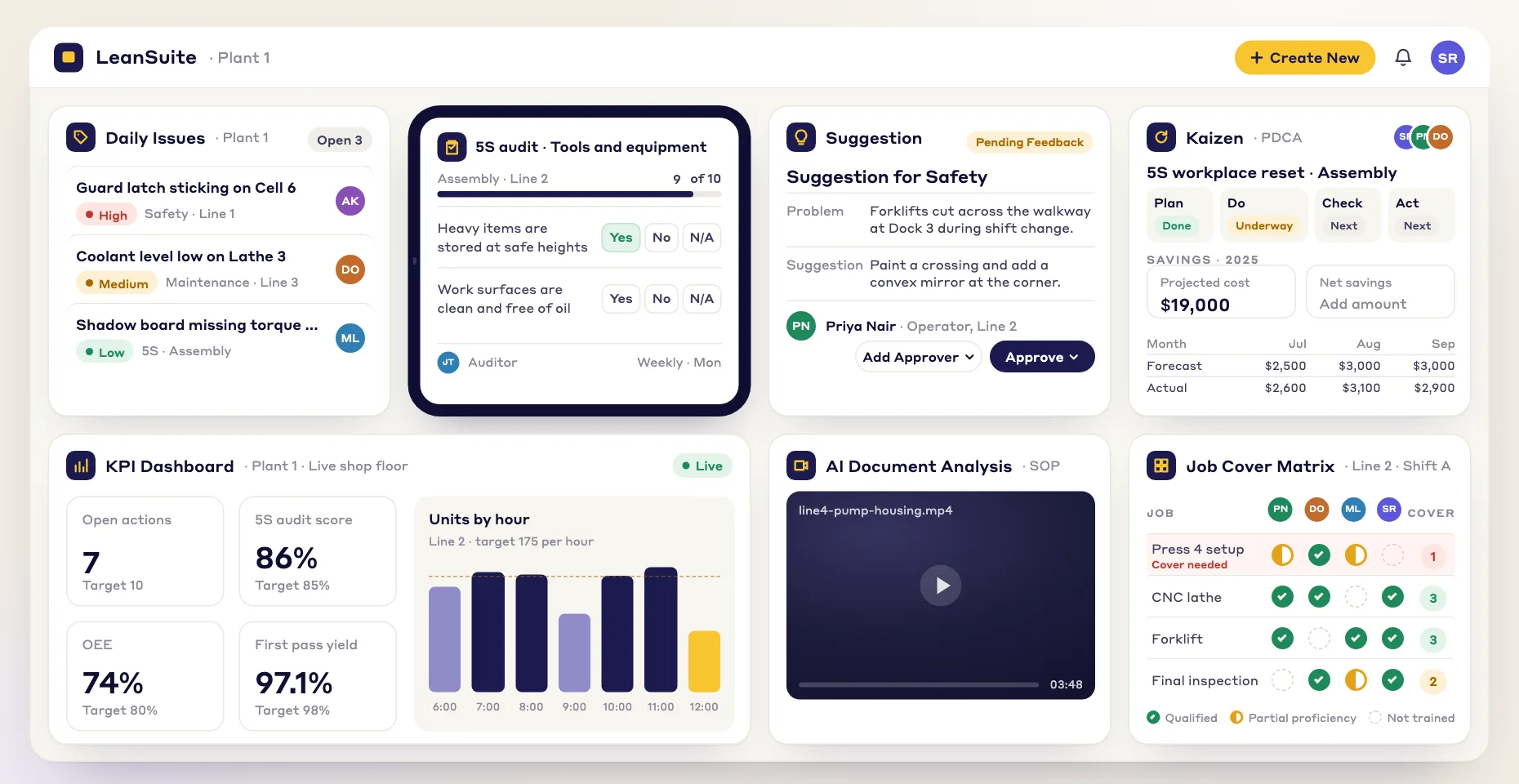
Lean coordinator: job description and interview questions
A lean coordinator keeps the basics of the lean system running day to day: 5S and visual management, audits, training, the idea program and support for team leaders. It is often the first dedicated lean role at a smaller site, or a support role inside a larger CI team.
- Also called
- Lean champion, Lean specialist, Lean facilitator, CI coordinator
- Usually reports to
- Continuous improvement manager or plant manager
Roles and responsibilities
- Run the 5S program: standards, audits, scores and follow-up in each area.
- Set up and maintain visual management: boards, floor markings, labels and shadow boards.
- Coordinate the idea or suggestion program: collect, route, track and recognise ideas.
- Train new starters and teams in lean basics.
- Support team leaders with daily huddles and boards.
- Help prepare and follow up kaizen events.
- Keep lean training records, audit results and program reports up to date.
- Share good practice between areas.
Skills
- 5S and visual management
- Audit methods, such as layered process audits
- Basic problem solving and PDCA
- Training and coaching on the floor
- Organisation and record keeping
- Spreadsheets and simple reports
- Getting on with people at every level
KPIs the role usually owns
- 5S audit scores by area (5S audit in the glossary)
- Audits completed on schedule (Layered process audit (LPA) in the glossary)
- Ideas submitted, implemented and response time (Kaizen teian in the glossary)
- People trained in lean basics
- Huddle and board use by area (Daily huddle in the glossary)
Free to copy and edit
Lean coordinator job description
A starting point to edit for your site. Add the location, shift pattern, pay range and how to apply, and cut anything that does not fit the job you are hiring for. No sign-up needed.
Job title: Lean coordinator
Reports to: Continuous improvement manager or plant manager

About the role
We are looking for a lean coordinator to keep our lean basics running every day. You will run 5S and visual management, coordinate audits and the idea program, train our teams and support team leaders.

What you will do
- Run 5S standards and audits in each area and follow up the findings.
- Set up and maintain visual management on the floor.
- Coordinate the idea program from submission to recognition.
- Train new starters and teams in lean basics.
- Support team leaders with daily huddles and boards.
- Help prepare and follow up kaizen events.
- Keep training, audit and program records up to date.

What you will bring
- Experience in a manufacturing or operations environment.
- Working knowledge of 5S, visual management and basic problem solving.
- Organised, with good follow-through.
- Comfortable training and talking to groups on the floor.
- Good spreadsheet skills.

Nice to have
- Lean or six sigma yellow or green belt training.
- Experience as a team leader or in a support role such as quality or training.

[Add: location, shift pattern, pay range, benefits and how to apply.]
12 lean coordinator interview questions
With what a good answer covers. Ask for a real example every time: the best candidates talk about what they did, with numbers, and are honest about what did not work.
- 1
How would you start a 5S program in an area that has never done it?
A good answer: Start small with the team that works there, explain why, sort and set in order one area first, make the standard visual, audit regularly and show the before and after.
- 2
Why do 5S programs fade, and how do you stop it?
A good answer: No owner, audits that stop, standards nobody agreed and leaders not looking; fix it with team ownership, short regular audits and leaders checking on their walks.
- 3
What makes a good visual board?
A good answer: It shows at a glance whether things are on target, is updated by the team, and leads to action rather than just displaying data.
- 4
How would you run an idea program so people keep using it?
A good answer: Easy to submit, a quick reply to every idea, people encouraged to implement their own, progress visible and recognition that is fair.
- 5
How do you teach lean basics to people who have seen programs come and go?
A good answer: Use their own area and problems, keep it short and practical, listen to the past experience and show a quick real change.
- 6
What would you do if a team leader is not doing their audits?
A good answer: Find out why (time, the audit's value, understanding), simplify it if needed, and raise it with their manager if it continues.
- 7
What is the difference between seiri and seiton?
A good answer: Seiri is sort: removing what is not needed. Seiton is set in order: a marked place for everything that remains.
- 8
How do you keep track of lots of small actions across areas?
A good answer: One simple tracker with owners and dates, reviewed at a fixed time each week, and visible to the people concerned.
- 9
Tell me about something you improved in a previous job.
A good answer: A specific change, why they made it, how they involved others, and what difference it made.
- 10
How do you support a team leader running a daily huddle for the first time?
A good answer: Help set up the board, join the first few huddles, give quiet feedback afterwards and step back as they gain confidence.
- 11
How do you share a good idea from one area with another?
A good answer: Take people to see it, explain what problem it solved, help them adapt it, and record it so others can find it.
- 12
What would make you say the lean program at a site is working?
A good answer: Standards kept without chasing, teams solving their own problems, ideas flowing and results on the boards improving.
Career path
Often comes from
- Team leader or operator
- Quality or training coordinator
- Graduate in a first role
Often leads to
- Kaizen facilitator
- Continuous improvement engineer or specialist
- Production supervisor
The role teaches the basics of lean thoroughly, which helps in any later CI or production job.
Pay: no public source tracks this title on its own, and no U.S. Bureau of Labor Statistics occupation is a close enough match to quote. Check local job postings for the range in your area.
Free templates for this role
Guides
Other continuous improvement roles
- Operational excellence managerRuns the improvement system for a site or a business: strategy deployment, the CI team, standards and the results they deliver.
- Kaizen facilitatorPlans and runs kaizen events, keeps teams to the method and makes sure the actions get finished after the event.
- Continuous improvement managerLeads the CI program at a site: the project pipeline, the CI team, training and the savings it reports.
- Production supervisor with CI dutiesRuns a shift or an area to plan, and leads the daily improvement there: huddles, problem solving and standard work.
- Continuous improvement engineerLeads improvement projects hands-on: analyses the process, finds the causes and puts in changes that cut waste and variation.
- Lean six sigma black beltLeads complex, data-heavy improvement projects with DMAIC and coaches green belts.
How mature is the system this role would run?
Score your site on 24 statements across eight dimensions and see where a new hire should start.
Take the maturity assessment