
Free template
Layered process audit (LPA) checklist
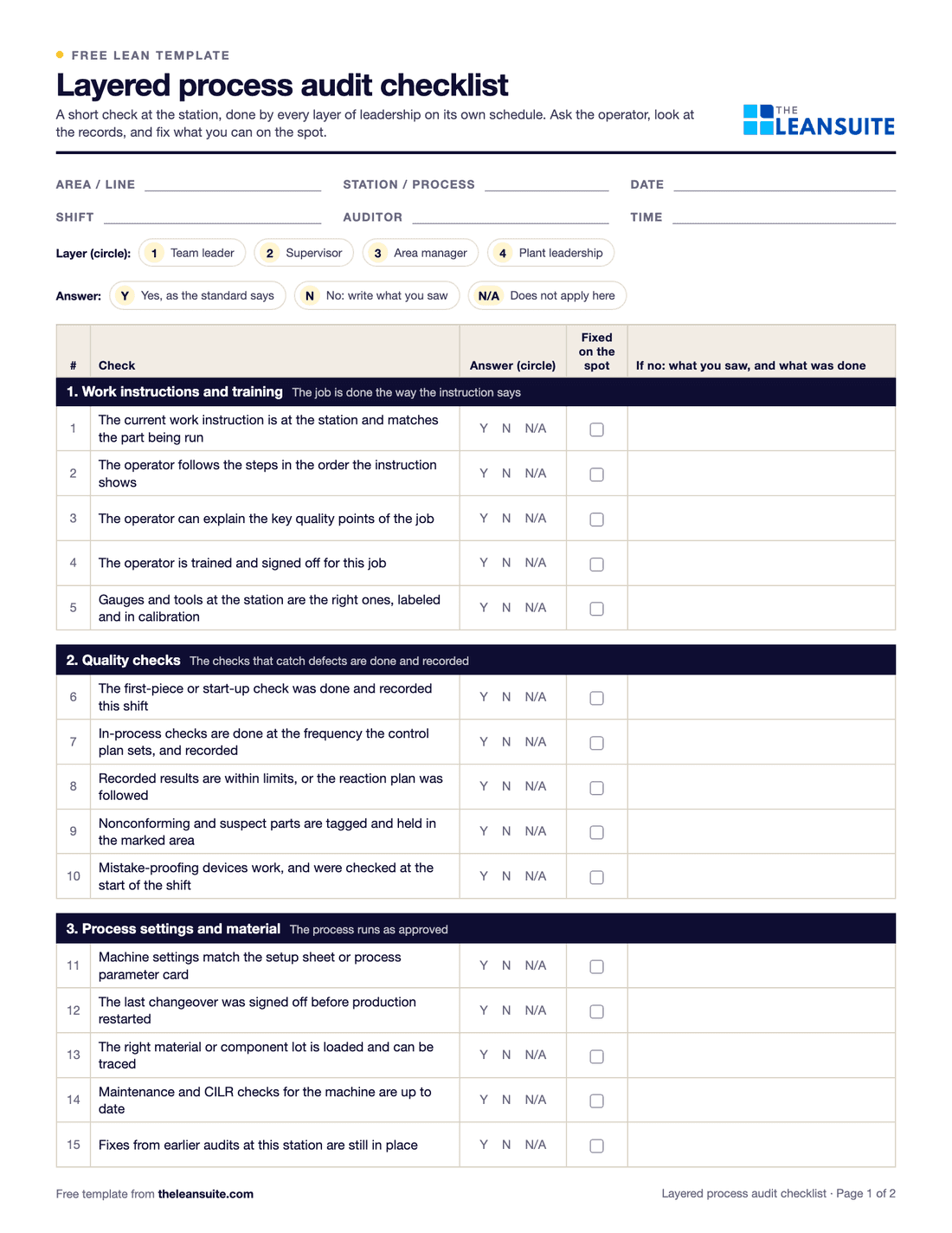
A layered process audit (LPA) is a short check at the station that the key steps and controls of a process are being followed, done by several layers of leadership, each on its own schedule. The team leader might audit every shift, the supervisor every week and the plant manager every month, all with the same short list. This checklist has 20 checks in four groups: work instructions and training, quality checks, process settings and material, and safety and workplace. Each is answered yes, no or N/A, with a box for a no that was fixed on the spot, a score by group, a table for the findings that need an owner and a note of who audits the area.
Free to use: print it, copy it and edit it for your team. Enter your name and work email once to download.
When to use it
When to use a layered process audit checklist
- On high-risk steps where a skipped check or a wrong setting reaches the customer, such as crimping, welding, torque or final inspection.
- When a customer asks for layered process audits, which is common in automotive supply.
- After a corrective action, to check at every layer that the new method is still being followed weeks later.
- To get leaders onto the floor on a fixed routine, as part of their leader standard work.
- Not in place of a full process audit or a 5S audit: an LPA is short on purpose and looks at a few things often.
How to fill it in
- 1
Set the layers and the schedule
Decide who audits at each layer and how often, and write it on page 2. Spread the audits across shifts so night shift is audited too.
- 2
Make the checks fit the station
Start from the 20 checks. Replace the ones that do not apply with checks for the station's own risks, taken from the process FMEA, the control plan and recent defects.
- 3
Audit at the station
Fill in the header and circle your layer. Ask the operator to show you, look at the records, and answer each check yes, no or N/A from what you see.
- 4
Fix what you can on the spot
For every no, write what you saw. If it can be put right during the audit, such as a missing record or a gauge out of place, do it and tick fixed on the spot.
- 5
Log the rest with an owner
Anything not fixed goes in the findings table with an action, an owner and a due date. The Excel version counts them and marks overdue ones.
- 6
Work out the score and pass it on
Score is yes ÷ (yes + no) for each group and for the whole audit. Note anything the next layer should look at again.
What's on the checklist
The 20 checks on the layered process audit checklist
Five checks in each of four groups. On the sheet each one is answered yes, no or N/A at the station, with a box for a no that was fixed on the spot and space for what you saw; replace the checks that do not fit with the station's own risks.
Work instructions and training
The job is done the way the instruction says
- 1The current work instruction is at the station and matches the part being run
- 2The operator follows the steps in the order the instruction shows
- 3The operator can explain the key quality points of the job
- 4The operator is trained and signed off for this job
- 5Gauges and tools at the station are the right ones, labeled and in calibration
Quality checks
The checks that catch defects are done and recorded
- 6The first-piece or start-up check was done and recorded this shift
- 7In-process checks are done at the frequency the control plan sets, and recorded
- 8Recorded results are within limits, or the reaction plan was followed
- 9Nonconforming and suspect parts are tagged and held in the marked area
- 10Mistake-proofing devices work, and were checked at the start of the shift
Process settings and material
The process runs as approved
- 11Machine settings match the setup sheet or process parameter card
- 12The last changeover was signed off before production restarted
- 13The right material or component lot is loaded and can be traced
- 14Maintenance and CILR checks for the machine are up to date
- 15Fixes from earlier audits at this station are still in place
Safety and workplace
The area is safe and organized
- 16Required PPE is worn
- 17Guards, interlocks and emergency stops are in place and work
- 18The area meets its 5S standard, with nothing that does not belong
- 19Material is at its marked location, between the minimum and maximum
- 20Open findings from the last audit at this station are closed or have an owner and a date
A filled-in example
Illustrative, not a benchmarkAn example: a team leader's layer 1 audit at a hose crimping station on day shift.
- Work instructions and training: all five checks yes.
- Quality checks: check 7 no, the 10:00 crimp diameter check was not recorded. The operator had done it and wrote it in during the audit, so it was fixed on the spot.
- Process settings and material: check 13 no, the hose lot on the rack did not match the lot on the traveler. The rack was held and the finding went in the table with an owner.
- Safety and workplace: check 19 no, eight boxes of fittings stacked above the marked maximum.
- Check 9, suspect parts held in the marked area, was N/A: there were none that shift.
16 yes, 3 no and 1 N/A, a score of 84%. Two findings go in the table with owners and dates, and the supervisor's layer 2 audit that week starts with checks 13 and 19.
Common mistakes
Auditing from the office
An LPA done from the records alone misses what the operator is really doing. Go to the station every time.
Only the first layer shows up
If managers skip their audits, the team hears that the checks do not matter. Track audits done against planned for every layer.
Writing no and walking away
Every no needs what you saw and either a fix on the spot or an owner and a date. A score with no actions changes nothing.
Treating it as an audit of the operator
A no usually means the process makes the right way hard: no gauge at hand, an unclear instruction, a record nobody reads. Fix the process.
Never changing the checks
A check that has been yes at every layer for months tells you little. Swap it for a newer risk, but keep most of the list stable so the scores can be compared.
Download the template
Free to use: print it, copy it and edit it for your team. Enter your name and work email once to download.
Run this template in LeanSuite
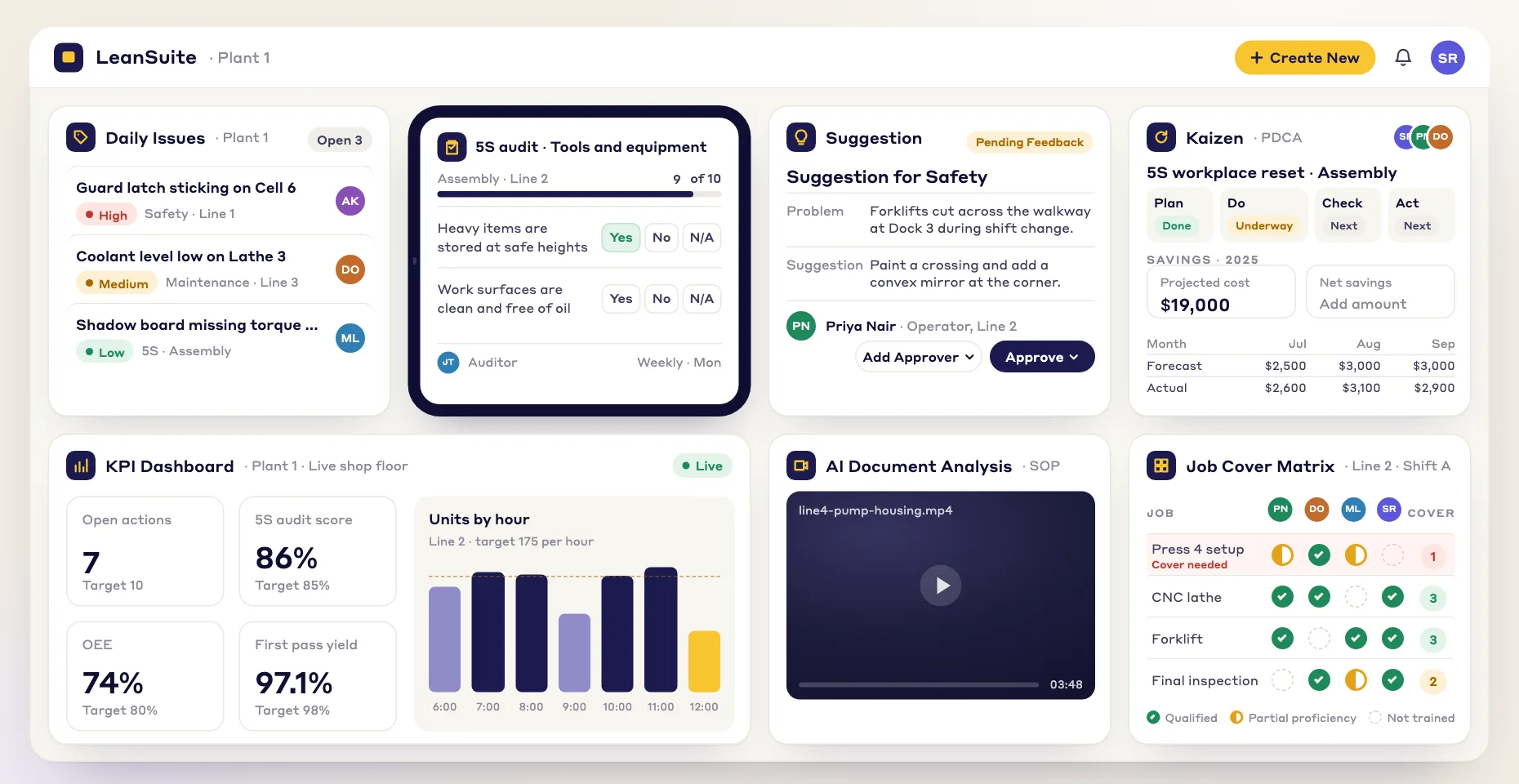
In LeanSuite you schedule the same LPA checklist for each layer, auditors complete their checks on a phone or tablet with photo evidence where required, and every finding becomes a tracked action.
In the lean glossary
Free tools
FAQ
Layered process audit (LPA) checklist: common questions
More free templates
All templates- 5S audit checklist template25 checks, five per S, scored 1 to 5, with a score summary and a chart of the five S's.
- Gemba walk checklistA walk plan and route, 30 prompts in six groups and a findings table with owners and due dates.
- Leader standard work templateA team leader's daily, weekly and monthly routine with a box per day, follow-ups and a weekly review.
- Autonomous maintenance (CILR) checklist20 clean, inspect, lubricate and retighten checks with a box per day, an abnormality log and sign-off.
- A3 problem solving templateThe standard seven-box A3 on one landscape sheet, from background to follow-up.
- PDCA templateOne improvement cycle on one landscape page: plan, do, check against the goal, then standardize or adjust.
- 5 Whys templateA problem statement, five why rows with evidence, the root cause and the countermeasure.
- 5W1H templateSix questions with prompts and evidence, turned into a problem statement before the root cause analysis.
- 8D report templateD0 to D8 on three pages: team, is/is not, containment, occurrence and escape causes, actions and closure.
- Poka-yoke worksheetEach step's possible errors, prevention or detection, the method, a device idea and a verified box.
- Skills matrix templatePeople by skills, a 0 to 4 scale, a training column and a coverage row that shows the gaps.
- Standard work sheet templateTakt time, each element's manual, machine and walk time on a time chart, key points and standard WIP.
- One point lesson (OPL) templateOne topic on one page: wrong way and right way pictures, key points, why it matters and a sign-off record.
- SMED changeover worksheetChangeover steps with times, internal or external, what can move, ideas and before/after totals.
- Kaizen event charter templateScope, team and roles, baseline and target metrics, a five-day schedule, risks and sign-off.
- RACI matrix template17 kaizen project tasks by 10 roles, with R, A, C, I drop-downs and a check for one accountable per task.
- PFMEA template (process FMEA)Failure modes, effects and causes rated for severity, occurrence and detection, with RPN before and after action.
- 5S red tag log and red tagsA log of every red-tagged item with its decision, and six printable red tags to cut out.
- Shift handover templateProduction against plan, safety, quality, equipment, materials and people, and the open issues the next shift takes over.
- Kanban card templateSix production and six withdrawal kanban cards to print and cut out, with loop sizing and a card register.
- Pareto chart templateA tally sheet, the categories sorted largest first with cumulative %, and the chart. Excel does the sorting and drawing.
- Control plan templateWhat is checked at each step, against which limits, how, how often, and what to do when a result is out.
- Corrective action request (CAPA) formProblem, containment, root cause, corrective and preventive action, and proof the fix worked, on two pages.
Can't find the template you need?
Tell us what you're looking for. We'll make it and send it to your inbox, free.
A shift handover sheet, a red tag log, a changeover checklist for one machine: if your team uses it on the floor, ask.