


Summary
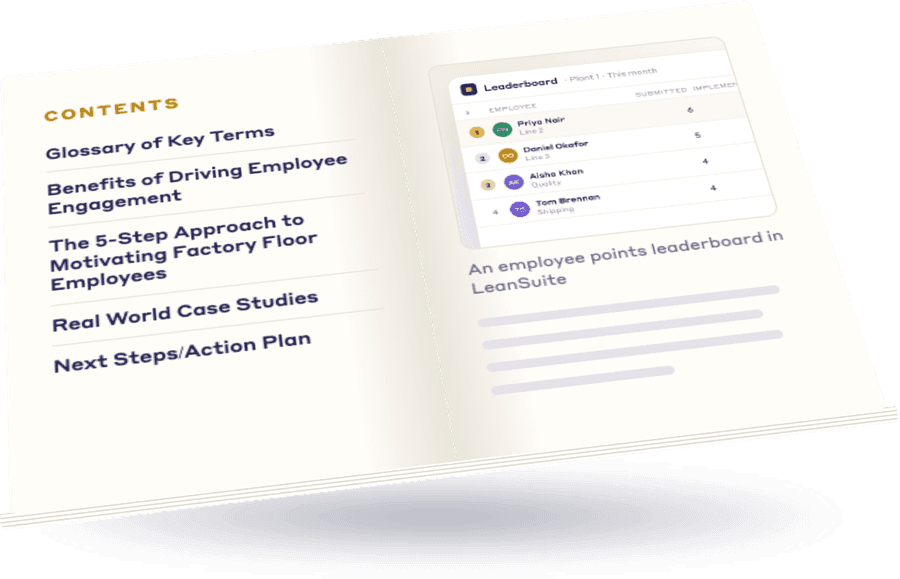
A summary of the e-book in its own words: why engagement matters, the five steps and the answers to common questions. The two company case studies are left out because their figures have no public source.
Why engagement matters on the floor
Engaging employees on the factory floor is vital for operational excellence, improving productivity, and fostering a positive workplace culture. Motivated employees work more efficiently, have better awareness of quality, and actively contribute to continuous improvement.
Maintaining motivation on busy, repetitive factory floors is challenging. Managers need effective ways to inspire enthusiasm, accountability, and ownership across their workforce. The e-book sets out a five-step framework to improve engagement systematically, with what each step involves and how to apply it.
Productivity
Motivated employees work more efficiently, with fewer delays and fewer errors.
Quality
Engaged workers pay close attention to detail, which helps them detect and prevent defects and cuts rework.
Safety
A safety culture grows when workers feel responsible for their own well-being and that of their teammates.
Improvement
Engaged employees take part in problem solving and process improvement, which speeds up continuous improvement.
The five steps
Five steps to an engaged floor
- 1
Understand employee motivations
- 2
Set clear, achievable goals
- 3
Implement meaningful recognition
- 4
Foster ownership through involvement
- 5
Provide support and development
Step 1: Understand employee motivations
Each employee is motivated by different factors such as recognition, skill growth, teamwork, or purpose. Hold informal conversations or surveys to learn what matters most to your workers, and use what you learn to personalize rewards, responsibilities, and support.
Step 2: Set clear, achievable goals
Clear, realistic goals give workers focus and a sense of accomplishment. Define specific goals, like defect reduction or improvement suggestions, for each shift. Communicate them during briefings, track them on shop floor boards, and celebrate successes.
Step 3: Implement meaningful recognition
Recognition raises morale and reinforces good behaviors. Set up programs such as a Worker of the Week nominated by peers and managers, offer rewards that employees value, and encourage colleagues to recognize each other's efforts.
Step 4: Foster ownership through involvement
Create improvement teams that meet regularly to discuss bottlenecks and propose solutions. Share the teams' outcomes with higher management to validate employee contributions and encourage continued involvement.
Step 5: Provide support and development
Ongoing training and career development sustain motivation by showing investment in employees' futures. Offer cross-training, shadowing, and regular feedback sessions, and help employees build growth plans that link their aspirations with company goals.
Questions managers ask
What if some workers resist motivational efforts?
Resistance often comes from mistrust or past failures. Leaders can overcome it by listening openly, addressing concerns with empathy, involving skeptics in designing the program, and showing consistent commitment over time.
How often should recognition be given?
Recognition should be continuous. Frequent informal praise lifts everyday morale, while formal awards mark major achievements. Together they build a culture of appreciation.
Do these strategies apply to every manufacturing sector?
Yes, but they need tailoring to the specific context, workforce culture, and operational realities of each plant.
How can motivation be maintained long term?
It takes ongoing engagement, realistic goal-setting, career development, trusted leadership, and timely recognition, plus ongoing feedback and adjusting the approach based on results.
When workers resist
- 1
Listen openly
Hear the concern before answering it. - 2
Address concerns with empathy
- 3
Involve skeptics in designing the program
- 4
Show consistent commitment over time