

Free kit: 5 files
Updated
Kaizen event in a box
Kaizen event in a box is the complete kit for running a five-day kaizen event. The 24-page facilitator guide covers picking the right problem, the charter, the team, the pre-work from three weeks out, each day minute by minute from Monday's current state to Friday's report-out, the ten conversations that derail events, and the 30-60-90 day sustain plan. Two editable PowerPoint decks run the Monday kick-off and the Friday report-out. The Excel workbook holds the charter, roster, daily board, idea matrix with live scoring, action tracker and before-and-after metrics. The A3 event board fits on one sheet. The method follows the Lean Enterprise Institute's Lean Lexicon and the US Environmental Protection Agency's Lean in Government Starter Kit, and the kit links to this site's single-form templates (charter, preparation checklist, tracker) instead of repeating them.
Free to use: print it, copy it and edit it for your team. Enter your name and work email once to download.
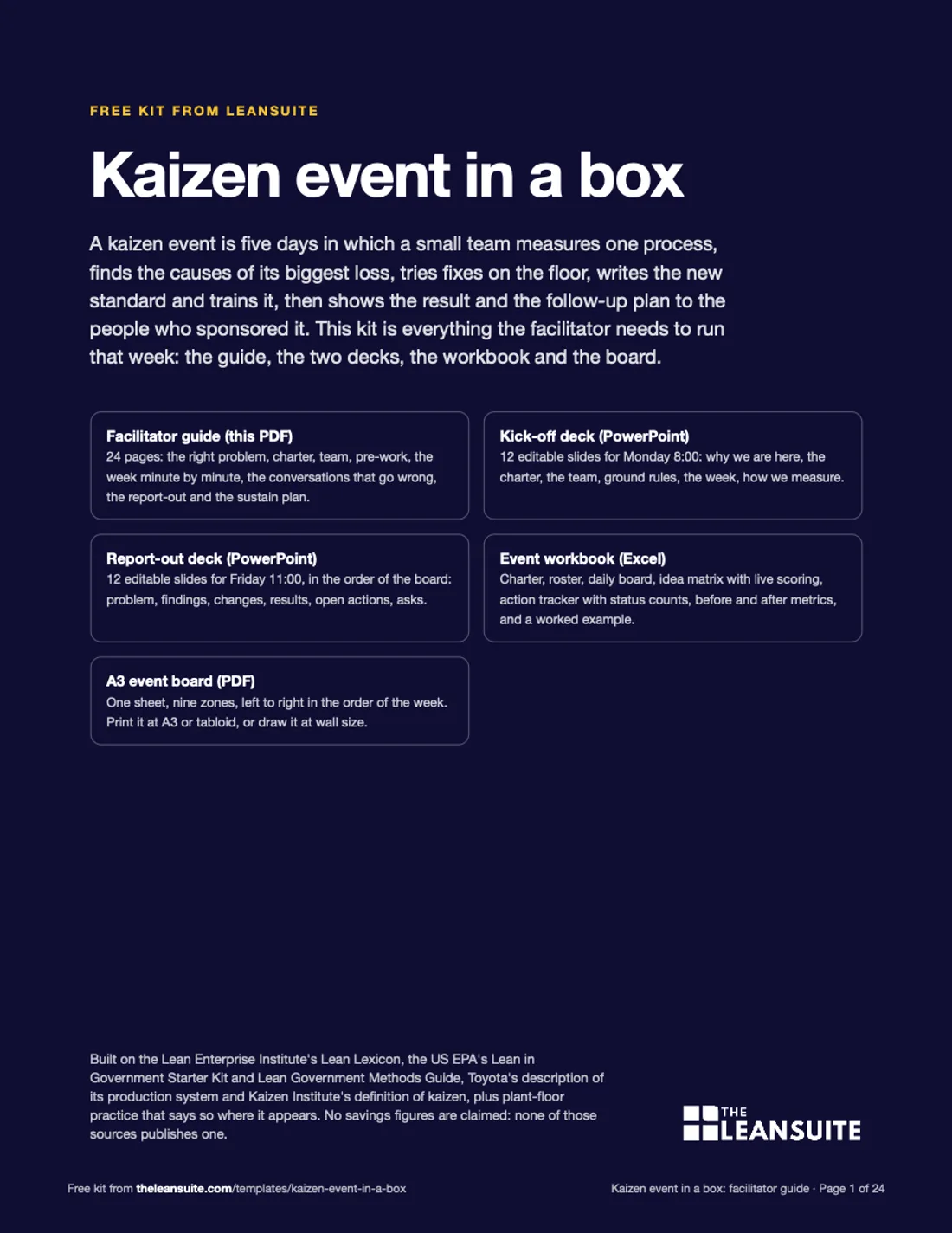 A navy page titled Kaizen event in a box, one paragraph on what a kaizen event is, and five cards naming the guide, the kick-off deck, the report-out deck, the workbook and the A3 board.
What is in the box
Five files that run the week end to end
The guide is for the facilitator. The decks are for the team and the sponsor. The workbook is the scribe's one open laptop. The board is on the wall. Each picture below is a page or slide of the actual file.
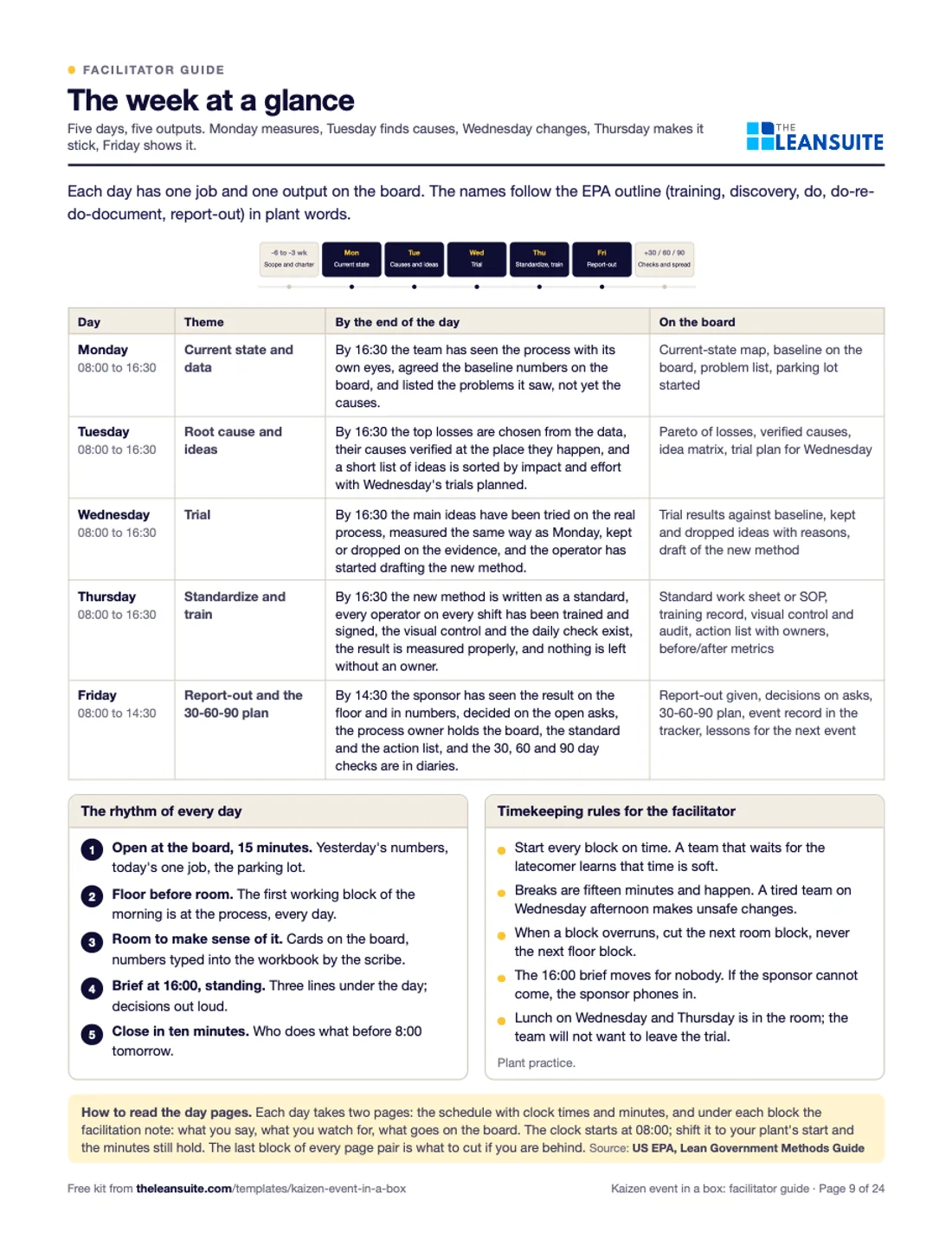
Facilitator guide (PDF)
24 pages, Letter (prints on A4): problem choice, charter, team, pre-work, five days minute by minute, conversations that go wrong, report-out, sustain plan, sources.
923 KB · 24 pages
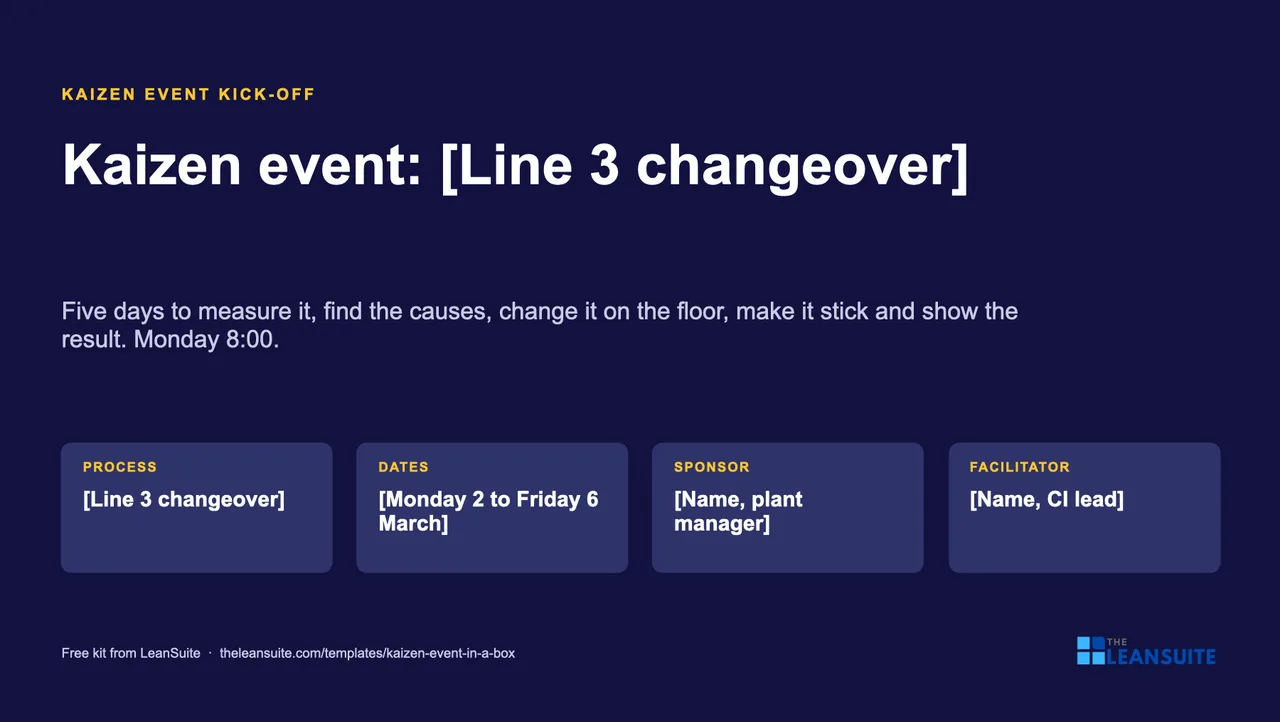
Kick-off deck (PowerPoint)
12 editable slides for Monday 8:00 with speaker notes: why we are here, charter, metrics, boundaries, team, ground rules, the week, today, the board, Friday, logistics.
721 KB · 12 slides
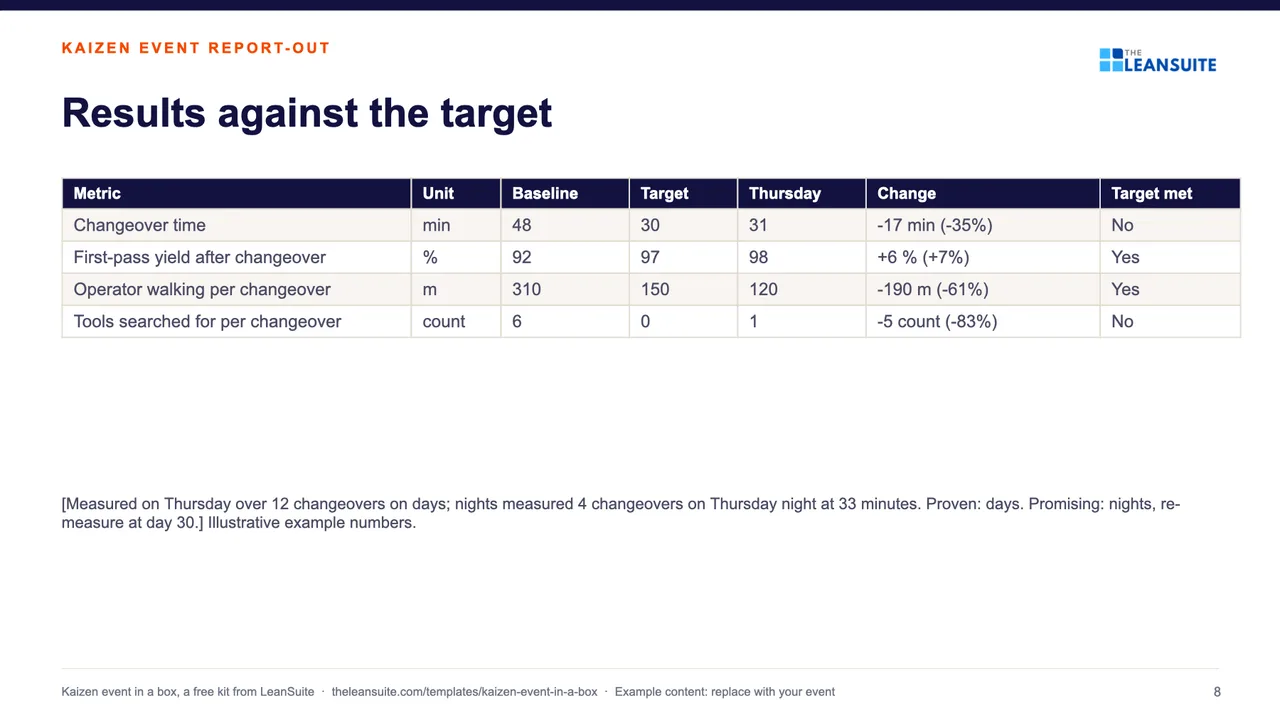
Report-out deck (PowerPoint)
12 editable slides for Friday 11:00 in the order of the board: problem, team, findings, causes, trials, changes, results, standard, open actions, 30-60-90, asks.
730 KB · 12 slides
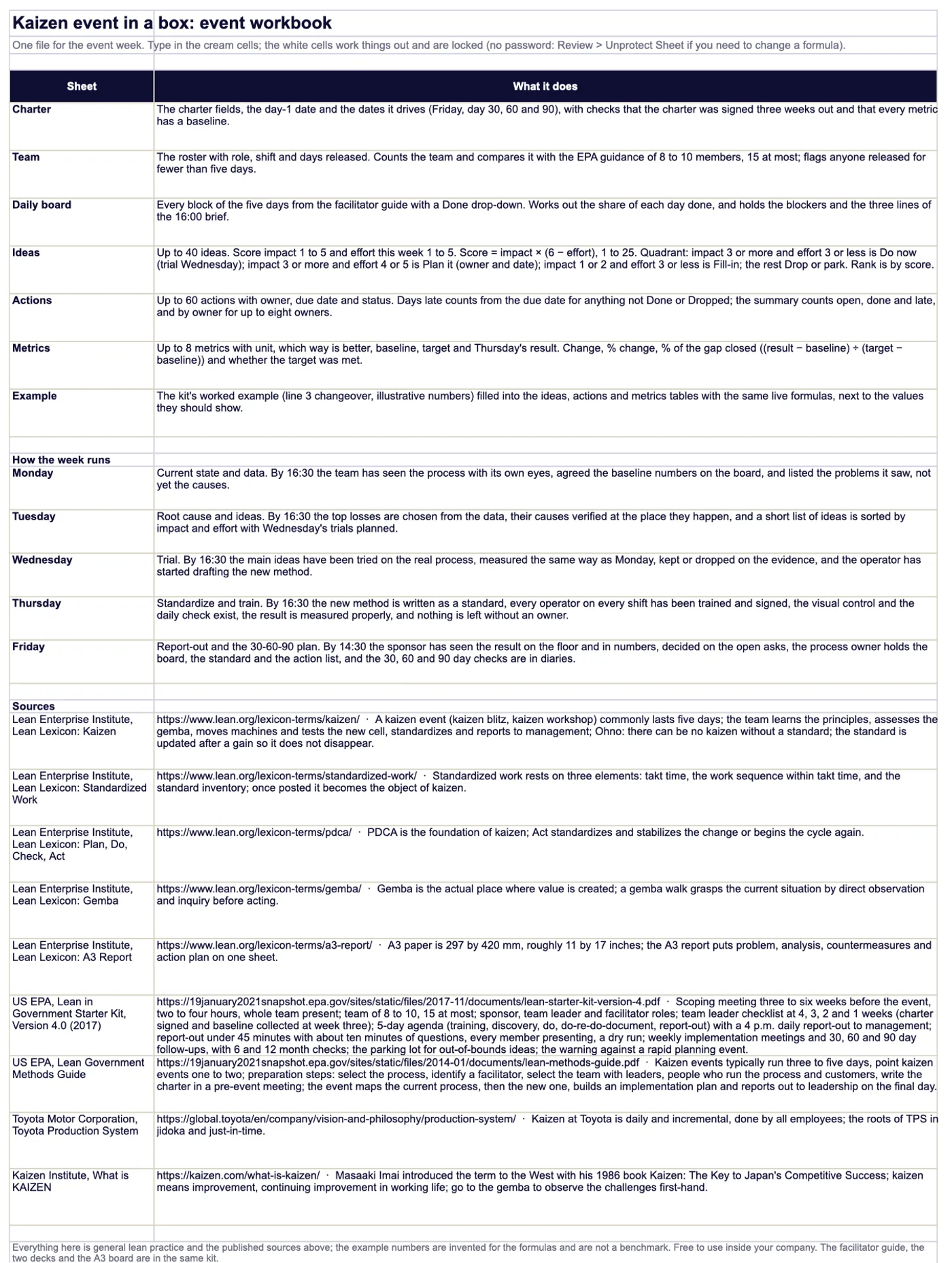
Event workbook (Excel)
Charter with date checks, roster with size check, daily board, 40-idea impact-effort matrix with score, quadrant and rank, 60-action tracker with late flags, before/after metrics with % change and gap closed, worked example.
38 KB
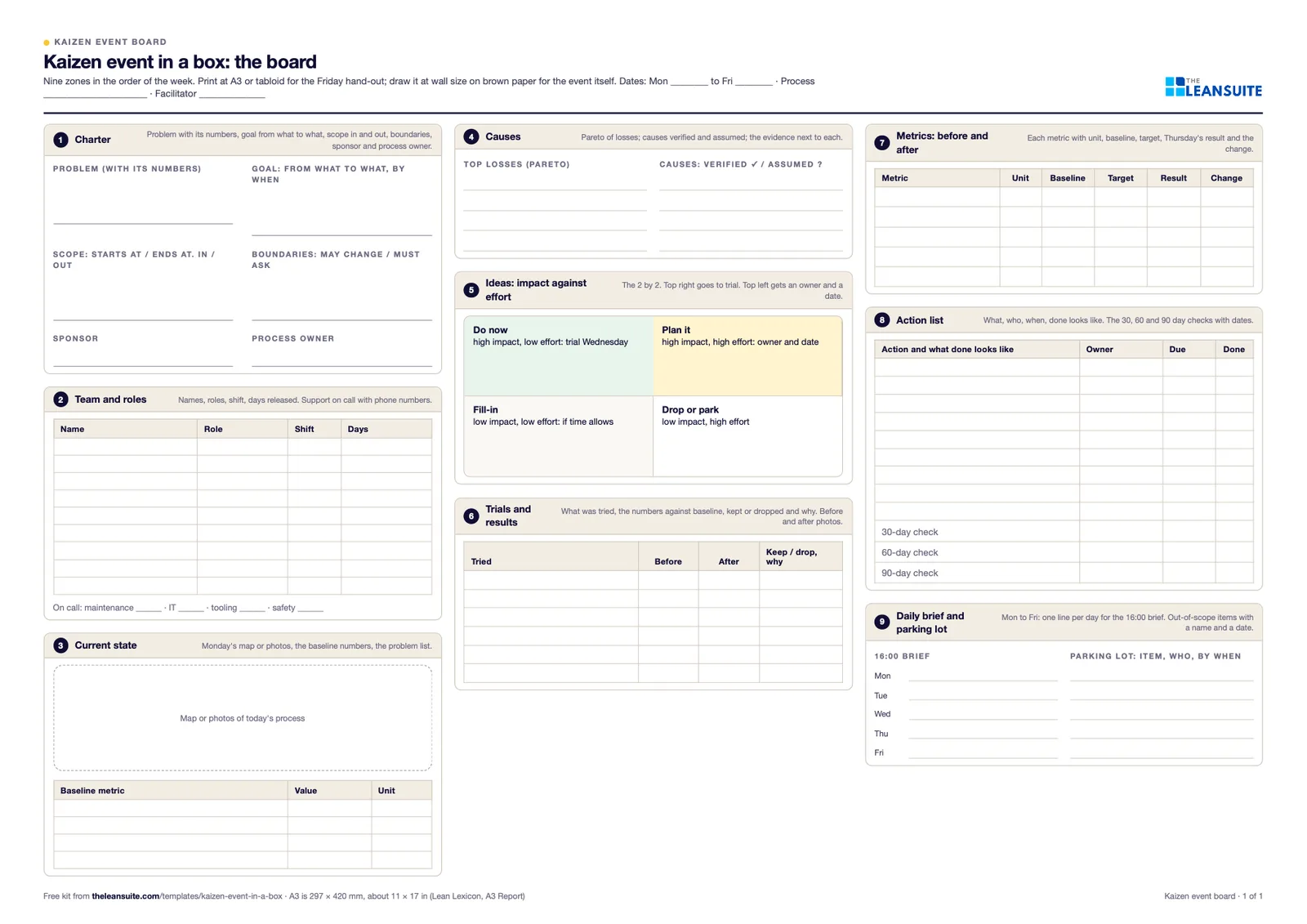
A3 event board (PDF)
One sheet, A3 landscape (prints at tabloid, or Letter and A4 with fit to page): nine zones in the order of the week.
148 KB · 1 pages
The week, day by day
Monday measures, Tuesday finds causes, Wednesday changes, Thursday makes it stick, Friday shows it
Each day has one job and one output on the board. The guide gives every block with its clock time and a facilitation note; here are the longest blocks of each day. The clock starts at 08:00 and shifts with your plant's start.
- 6 to 3 weeks out
Scope and charter
Scoping meeting, charter signed at week three, baseline measured, team released, support booked.
- 108:00 to 16:30
Monday
Current state and data
- 08:30Charter walk-through
- 10:15Gemba walk one: observe in pairs
- 12:30Build the current state on the board
- 14:15Gemba walk two: verify the map
On the board: Current-state map, baseline on the board, problem list, parking lot started
- 208:00 to 16:30
Tuesday
Root cause and ideas
- 08:15Choose the losses to attack
- 09:15Root cause at the gemba
- 10:45Causes confirmed and assumptions listed
- 12:30Idea generation
On the board: Pareto of losses, verified causes, idea matrix, trial plan for Wednesday
- 308:00 to 16:30
Wednesday
Trial
- 08:15Try it on the floor
- 11:00Measure and compare
- 12:30Second round
- 14:45Draft the new method with the operator
On the board: Trial results against baseline, kept and dropped ideas with reasons, draft of the new method
- 408:00 to 16:30
Thursday
Standardize and train
- 08:15Write the standard properly
- 10:00Train every operator on every shift
- 12:30Visual control and the daily check
- 13:30The action list
On the board: Standard work sheet or SOP, training record, visual control and audit, action list with owners, before/after metrics
- 508:00 to 14:30
Friday
Report-out and the 30-60-90 plan
- 08:30Build the report-out from the board
- 09:45Dry run
- 11:00Report-out
- 12:00Lunch with the team
On the board: Report-out given, decisions on asks, 30-60-90 plan, event record in the tracker, lessons for the next event
- Days 30, 60 and 90
Checks and spread
Weekly follow-up meeting, metric re-measured the same way, standard audited, actions closed, event closed in the tracker.
Day names follow the EPA Lean in Government Starter Kit's five-day outline (training, discovery, do, do-re-do-document, report-out) in plant words. The Lean Lexicon's kaizen event commonly lasts five days.
Before you book the room
Six questions that decide whether this problem fits a week
Most events fail in the choice of problem, weeks before day one. Score the candidate against these six questions. Five or six yes answers: run it. Three or fewer: fix the scope or pick another problem.
Is it one process with a clear start and end?
A team can map and change one process in a week. "Packing, from last inspection to pallet wrapped" works. "Our delivery performance" does not.
Can you measure it before and after inside the week?
The metric has to move in days, not months: minutes per changeover, metres walked, defects per shift, cases waiting. A monthly KPI cannot show a Wednesday trial worked.
Does the process run often enough to try changes on Wednesday?
A line that runs every shift can be tested ten times before Friday. A process that happens twice a month cannot be trialled, only planned.
Is most of the fix within the team's reach?
Moving a rack, re-sequencing steps, adding a visual, rewriting the standard: yes. A new machine, a software change, a change of rules: those sit outside the event's boundaries and go to the parking lot, as the EPA kit suggests for changes that need rulemaking.
Does it hurt the operators as well as the sponsor?
If the people doing the work feel the pain every shift, they will bring the ideas. If only the P&L feels it, you will be pulling teeth all week.
Can the right people be released for the full five days?
The EPA kit puts the sponsor's job as getting team members 2 to 5 days away from their regular duties. Half-day attendance is the most common reason a Wednesday trial never happens.
Who does what
The EPA kit puts a Lean event team at 8 to 10 members, with 15 as the largest size it recommends; beyond that the facilitator cannot manage the room. Most of the team should be people who do the work every day. Add one or two people from outside the area for fresh questions, and keep observers to a few at a time.
- Sponsor
- The manager who owns the result and the budget: usually the plant manager or value stream manager. Helps write the charter, approves the time and money, opens Monday, comes to the 16:00 brief every day or sits in the event, decides on the asks at the Friday report-out, and holds the team to the 30, 60 and 90 day checks. The EPA kit lists each of these as the sponsor's job.
- Process owner
- The supervisor or area leader who has to run the new method on Monday week. On the team all week. Owns the standard, the training record and the action list after Friday. Chairs the weekly follow-up meeting.
- Team leader
- A respected person from the area, or a CI lead. Logistics before and during the week: room, releases, data pack, supplies, meals, the daily brief, the report-out invitations. Becomes the implementation team leader afterwards (EPA's term) and runs the action list to closure.
- Facilitator
- Someone trained in the method and neutral about the answer. Can be in-house CI or from outside the plant. Runs the agenda and the tools, keeps the team at the gemba, protects the quiet voices, keeps scope inside the charter, calls the sponsor when a boundary is reached, and never owns an idea.
- Team members
- Operators and technicians from every shift that runs the process, plus the support people the problem needs: maintenance, quality, planning, engineering, finance for the numbers. Released for the whole week. Observe, measure, propose, try, write the standard, present on Friday. Everyone presents.
- Support on call
- Maintenance, IT, tooling, purchasing, safety. Named before the event with a phone number and a two-hour response promise for Wednesday and Thursday. The EPA kit has these people on call where they are not full members.
Team size and the sponsor, team leader and facilitator roles follow the EPA Starter Kit; the process owner and the on-call promise are plant practice.
Already have the single forms?
The kit links to these templates instead of repeating them
The workbook holds the event-week versions of the charter, matrix, actions and metrics in one file. When you want the form on its own, with its own PDF and Excel, these are the ones the guide points to.
- Kaizen event charter templateFor the charter as a single form, with its own Excel checks and a Little's Law check.
- Kaizen event preparation checklistFor the team leader's full list: 44 dated items from six weeks out and five go or no-go gates.
- Kaizen event trackerFor every event in the plant on one sheet with its 30, 60 and 90 day checks.
- Impact-effort matrixFor the 2 by 2 on its own, for a session outside an event.
- Kaizen action trackerFor the action list on its own.
- 5 whys templateFor Tuesday's root cause work at the gemba.
- Standard work sheetFor Thursday's standard: sequence, times and key points.
- Training sign-off sheetFor Thursday's training record for every operator on every shift.
Where the method comes from
Every method statement in the guide traces to one of these; where the guide gives plant practice instead, it says so on the page. Read on October 18, 2026.
- Lean Enterprise Institute, Lean Lexicon: Kaizen (opens in a new tab)A kaizen event (kaizen blitz, kaizen workshop) commonly lasts five days; the team learns the principles, assesses the gemba, moves machines and tests the new cell, standardizes and reports to management; Ohno: there can be no kaizen without a standard; the standard is updated after a gain so it does not disappear.
- Lean Enterprise Institute, Lean Lexicon: Standardized Work (opens in a new tab)Standardized work rests on three elements: takt time, the work sequence within takt time, and the standard inventory; once posted it becomes the object of kaizen.
- Lean Enterprise Institute, Lean Lexicon: Plan, Do, Check, Act (opens in a new tab)PDCA is the foundation of kaizen; Act standardizes and stabilizes the change or begins the cycle again.
- Lean Enterprise Institute, Lean Lexicon: Gemba (opens in a new tab)Gemba is the actual place where value is created; a gemba walk grasps the current situation by direct observation and inquiry before acting.
- Lean Enterprise Institute, Lean Lexicon: A3 Report (opens in a new tab)A3 paper is 297 by 420 mm, roughly 11 by 17 inches; the A3 report puts problem, analysis, countermeasures and action plan on one sheet.
- US EPA, Lean in Government Starter Kit, Version 4.0 (2017) (opens in a new tab)Scoping meeting three to six weeks before the event, two to four hours, whole team present; team of 8 to 10, 15 at most; sponsor, team leader and facilitator roles; team leader checklist at 4, 3, 2 and 1 weeks (charter signed and baseline collected at week three); 5-day agenda (training, discovery, do, do-re-do-document, report-out) with a 4 p.m. daily report-out to management; report-out under 45 minutes with about ten minutes of questions, every member presenting, a dry run; weekly implementation meetings and 30, 60 and 90 day follow-ups, with 6 and 12 month checks; the parking lot for out-of-bounds ideas; the warning against a rapid planning event.
- US EPA, Lean Government Methods Guide (opens in a new tab)Kaizen events typically run three to five days, point kaizen events one to two; preparation steps: select the process, identify a facilitator, select the team with leaders, people who run the process and customers, write the charter in a pre-event meeting; the event maps the current process, then the new one, builds an implementation plan and reports out to leadership on the final day.
- Toyota Motor Corporation, Toyota Production System (opens in a new tab)Kaizen at Toyota is daily and incremental, done by all employees; the roots of TPS in jidoka and just-in-time.
- Kaizen Institute, What is KAIZEN (opens in a new tab)Masaaki Imai introduced the term to the West with his 1986 book Kaizen: The Key to Japan's Competitive Success; kaizen means improvement, continuing improvement in working life; go to the gemba to observe the challenges first-hand.
What this kit does not claim
- Typical savings, payback or percentage improvement figures for kaizen events. None of the primary sources read for this kit publishes a general number, so the kit gives none.
- A claim that five days is the only right length. The EPA guides give three to five days for a kaizen event and one to two for a point kaizen; this kit is built for five and says where to cut.
- Named customers, plants or events. The worked example is invented and labelled as such.
A kaizen event is five days in which a small team measures one process, finds the causes of its biggest loss, tries fixes on the floor, writes the new standard and trains it, then shows the result and the follow-up plan to the people who sponsored it. This kit is everything the facilitator needs to run that week: the guide, the two decks, the workbook and the board.
Download the kit
Free to use: print it, copy it and edit it for your team. Enter your name and work email once to download.
Run the event in LeanSuite
LeanSuite manages every improvement project, from a small Kaizen event to a full DMAIC project, in one visual hub and tracks each one through to results.
See it in a 45-minute demoIn the lean glossary
Free tools
Guides
Train the team and put it on the wall
FAQ
Kaizen event in a box: common questions
The Lean Lexicon says a kaizen event commonly lasts five days, and the EPA's Lean Government Methods Guide gives three to five days, with one to two days for a point kaizen on a very narrow problem. This kit is built for five. For a three-day event the guide says what to cut: run Monday morning, Tuesday, Wednesday and the Friday report-out, and move the standard writing and training into Wednesday afternoon.
The EPA Lean in Government Starter Kit puts a Lean event team at 8 to 10 members, with 15 as the largest size it recommends. Most should be people who do the work every day, from every shift that runs the process, plus the support functions the problem needs. The workbook's roster sheet counts the team against that guidance.
No, but you need a facilitator who is neutral about the answer and is not also the sponsor or the process owner. The EPA kit notes an outsider can help a team get past entrenched views; an in-house CI lead from another area does the same job. The guide's role page says what the facilitator does and does not do.
The process owner takes the board, the standard, the training record and the action list, and runs a weekly follow-up meeting. The sponsor, process owner and facilitator re-measure the metric and audit the standard at days 30, 60 and 90, as the EPA kit expects. The kit's workbook dates those checks from the Monday you enter, and the kaizen event tracker template keeps every event's checks in one place.
Yes. The EPA material the kit draws on was written for government permitting and administrative processes, and the week has the same shape: measure the current state, find causes, try changes, standardize, report out. Swap the plant words (line, changeover, die cart) for yours; the clock times and the roles hold.
Can't find the template you need?
Tell us what you're looking for. We'll make it and send it to your inbox, free.
A shift handover sheet, a red tag log, a changeover checklist for one machine: if your team uses it on the floor, ask.