

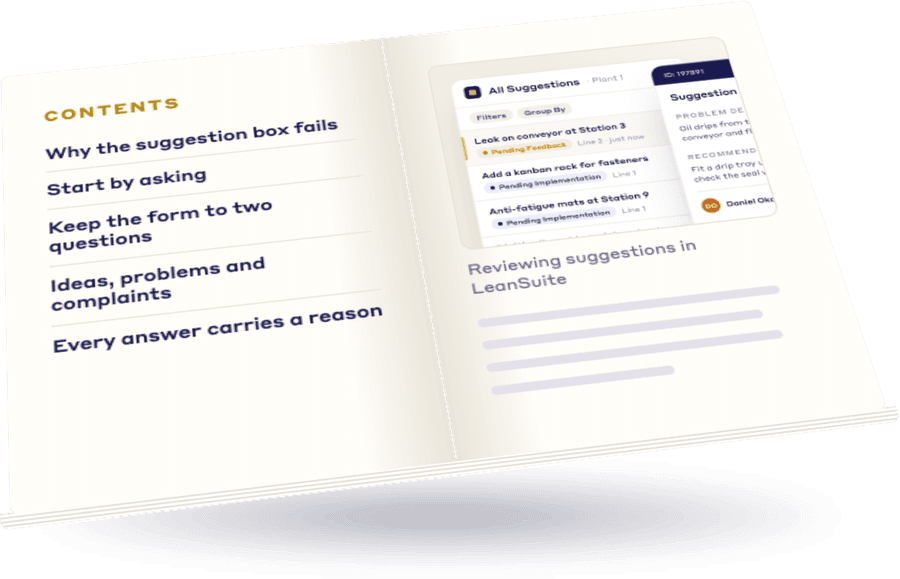

Read it online
The full text of the e-book. The PDF has the same content, laid out to print.
Chapter 1
Why the suggestion box fails
Even with suggestion boxes, what we've seen in the past is they get collected maybe once or twice a week. So by the time it gets to the actual person, the person who's suggesting something, they lose their motivation.
If somebody writes something on paper and puts it in a box, it's such a waste of time. First they're writing it on paper, somebody else is picking it up, taking it to someone else after reading it: oh, this is for you.
Somebody would put in the suggestion in the suggestion box. Then who knows when that suggestion box gets opened up. You've lost that voice. That person would never come to you and be like, hey, I have an idea, let's fix this. Imagine if that person has an avenue where they could just put in their idea and it goes directly to their manager. The manager directly replies, right there.
Traditionally, if you do that on paper, there's so much time lost within it just to get back to those people. And then the essence of the suggestion system, it's lost.
You run some sort of campaign. You educate everybody. They put in the suggestion. But now who takes care of it, quickly enough, so you don't lose their interest? The moment it's over 24 hours, you lose them again.
You probably do gemba walks every day, and you go around and talk to people. But touching base with 250 people every single day is not possible.
Chapter 2
Start by asking
Where usually people start is, you start with asking them, what are the different things that we can do? That is the most basic thing that you would start with in any operational excellence program. But you would want to keep that in a continuous mode, because things are ever changing.
Main knowledge lies at the frontline operators.
A lot of the companies that apply lean, that is one of the first things that they do: to increase collaboration, to get people to suggest ideas, also to collect what is really happening on the shop floor.
If there's a larger shop floor, in a day, as a manager or as an owner, yes, you do walk the floor. But then there are so many different things that go unseen. So for that you could implement something like a suggestion program. Or you could coach people on: every time you see something, you need to report that in a certain way.
Give everybody an opportunity to voice out their opinions, voice out where they see things are wrong, voice out where the things can be improved.
If you're building that culture, the suggestion system is one good entry point. People get comfortable with it, and they realize the value of it, and then you move on to other things.
Chapter 3
Keep the form to two questions
Collect the suggestions from the shop floor, which is as easy as just simply what the problem is and what is my solution.
You customize this, saying: we are starting fresh on our journey. I don't care about anything else. All I care about is what is your problem and what is your recommended solution. But as we move further and as we get more and more mature, factories that are actually mature in their journey, they can now start collecting maybe what is it going to cost, and what is the benefit from it.
For the operators you could actually make it even simpler by taking out even some of these extra fields, and potentially add them over time as you get more and more mature: now we also need to understand, you're suggesting this, but what do you think would be the cost of it, and what do you think would be the benefit of it?
It would be ideal to collect all the suggestions right away, when it comes to their mind. Just have them put in a problem description and a suggestion, because those are the mandatory ones that you have to have, and put in an attachment, and that's it.
Chapter 4
Ideas, problems and complaints
Yes, it can be an idea, but it's very broad. That can directly go into kaizen. It doesn't need to be a suggestion. A suggestion would be more very focused. Oh, I'm having trouble with... I have to go pick up this part 100 times in a shift. Why don't you put that part close to me? That's very specific. That is something that we could encourage them to put an idea around, so that you can work on it right away and close it and get benefit of it.
Suggestions is ideas that can turn into kaizens, which would bring you savings. Tagging is more like identifying problems that will bring you back to basic condition. If there's a leak on the floor, if there's spill on the floor, if there's hard to access areas, if there's sources of contamination, you want to identify all that.
Suggestion, tag or kaizen?
- Decision
Is it a broad idea?
- Yes:
- It can go directly into kaizen. It doesn't need to be a suggestion.
- No:
- Ask the next question.
- Decision
Does it bring something back to basic condition?
A leak, a spill, a hard-to-access area, a source of contamination.- Yes:
- It's a tag.
- No:
- It's a suggestion.
A focused suggestion
“I have to go pick up this part 100 times in a shift. Why don't you put that part close to me?” Work on it right away, close it and get the benefit.
There are certain scenarios where something comes in and it doesn't necessarily fall in an idea category, and it's more like a complaint. Or it could also be something where they're talking about bringing the machine back to basic condition. So again, it's not necessarily an improvement idea. Sometimes people just complain.
That requires some cadence and some training with the operators to build that ownership. But after you've built that ownership, you want people to be coming up with: oh, this machine is leaking, we don't need to shut it down right now, but someone needs to address it later on. Or there's a safety hazard somewhere, so someone can trip and fall, so we better fix this.
They see an unsafe condition, they should report it. They see a hard to access area, they should report it. So that over time everybody becomes part of that continuous improvement journey. And everybody's eyes, they also start realizing: oh, we can improve here, we can improve there.
Chapter 5
Every answer carries a reason
It's always the closure of that loop. A lot of people on the shop floor, they can just find excuses: I don't want to submit, because somebody else can see it.
Your system will break if you don't get back to your people. They will give you a suggestion for one week, and then if you don't get back to them, it's not going to work.
As you're getting those improvement ideas, you want to actually get back to your people in time, and also provide them with what, as a management, you're thinking. Even if it's like, this is a great idea, but we're not going to do this right now, we're going to park it on the side and come back to it later. Even that thing goes a long way, and it doesn't shut down the person. It actually motivates them.
You would want to capture pretty much everything. If this is something that I would want to do later on, I can just put a label for hold and come back to this. But you still would want to capture all the ideas.
If I'm rejecting it, I'm actually putting in a reason why I'm rejecting it: hey, it's a great suggestion, but we don't think we can do this right now. Or, it's a great suggestion, but I'm not the one who can actually approve it.
You can't just reject something without giving the actual feedback. It keeps that feedback loop alive all the time. The answer you get to people, even though you're saying no to them, it's going to keep improving over time.
Or you could simply be like, this is actually not a suggestion, it's a tag. Why don't you put a tag in? Because it's back to basic condition what you're talking about. It's not really an improvement idea that you suggested.
If they've filled out a form, then it's gone from their end, and they're not able to see what is happening in the background with that idea that they submitted. The whole idea around suggestion is you need to keep those people always in the loop, with the feedback. At any given time you can look at what is really happening: if there's any comment on it, if there's something waiting on financing or parts or whatever that might be.
Chapter 6
Send it to the person who can act on it
Suggestion is mostly driven by operators on the shop floor, but then managed by operations, because you want to make sure that you're getting back to people.
Once they put in what the problem is, put in what the suggestion is, it goes into pending feedback mode. From there the clock starts. If it's safety related, it could go to a certain individual. If it's quality related, you can really manage the entire workload, and not everything needs to come to you. You can have those already go to the right people that are going to be working on those projects.
Depending on what kind of problem it is, you can actually route the suggestion to the right people. If it's coming from safety, it can go to specific people. If it's coming for workplace organization or AM or PM, it can go to the right person. So there's no middleman.
You could take a picture and send it right to the owner of that process.
A suggestion's route, with no middleman
- 1
The problem and the suggestion
The two mandatory fields, plus an attachment. Cost and benefit can come later, as the plant matures. - 2
Pending feedback: the clock starts
Keep the person who suggested it in the loop. - 3
Routed by the kind of problem
Safety to specific people; workplace organization, AM or PM to the right person. - 4
An answer with a reason
Do it, put it on hold, reject it with a reason, or point it to a tag.
Chapter 7
Measure the gap
How many are coming in, how many are getting evaluated. If the gap is getting bigger, that means the problem is growing. If the gap is getting smaller, that means you're getting back to your people fast enough.
If you want to really split it into the different areas and give responsibility to those area owners to implement stuff, you can actually track it by manager as well: okay, how many are pending implementation from this manager, from this manager, and see who's got the most.
Let's say you've got all those supervisors evaluating those suggestions. You could sort them by who's got the most pending ones. So you could pretty much have a talk with them: okay, your department has the most pending. You would want the gap to be smaller as you're going. This gap over time should decrease.
A suggestion system can be another way where it gives opportunity from both a bottom up and a top down approach. Bottom up, you can start seeing what are the surface level problems or suggestions that are coming in. And top down, it really starts filtering out. If there's five or six different managers for different areas, who are the ones that are getting back to their people right on time? Who are the ones that are not getting back to their people on time? Because that's how you build a culture of continuous improvement.
For people that are not communicating, you could actually go to them and be like, what is going on?
We could even track things like how many ideas were coming before versus how many ideas are coming now, meaning how many more people are engaged. That could be another way to measure success.
Chapter 8
Points, prizes and focused campaigns
You can actually incentivize people by creating a prize catalog. It allows you to give out points to people that are submitting suggestions and people that are implementing it. The more points they collect, they can redeem those points for any of the prize catalog items that you can make available for them. You can have a company bag, company mug and so on.
If it gets rejected, maybe just for keeping them motivated, you might want to give them five points.
Build the leaderboard so that people are motivated at all times. Let's say I am number three. It could be that if I put in three more ideas, then I could be number one.
Usually there's a fight that only project leads get the benefit or the savings. But you can also divide up the savings into team members as well.
Focused campaigns
If you're looking for focused ideas on a certain problem at a given time, you could run a campaign saying, how do we reduce scrap on line one? It's more like when you have kaizen events. You could have focused ones, and you can award people two times, three times more points. Add a description, so they're clear about it.
Let's say waste is a big problem: okay, this next one week, we're going to focus on this main area, and we're going to start collecting suggestions just around this topic.
One consultant runs his idea campaigns like this.
He actually went on the shop floor, kind of like a kaizen event, and ran a campaign: okay, we're going to first find all the improvement ideas that we can work on. And then he categorized them under level one, level two, level three: which ones are easy to do, which ones require at least two people to do, and then a bigger team to do. Out of the level ones, he categorized them into high priority and low priority, and basically converted those into projects.
Chapter 9
Make it easy to submit from the floor
A lot of the systems that are out there, they require a company email, which then doesn't necessarily go down to the shop floor level, because the people that are on the shop floor, they don't have access to company email.
We highly encourage that they have their own login accounts. Otherwise, if it's a generic form, there's two problems. One is they won't be able to collect points, and second, they won't be able to see the feedback that's received from the managers.
Some customers have a QR code right on the machine, just to submit ideas. They actually printed these QR codes and placed them on the shop floor.
Usually what our customers have done in the past is deployed two or three tablets on the shop floor per one or two lines. For two lines, three lines, they have one tablet. For another two or three lines, they have another tablet, like that. So they can go pick up the tablet, or go to the kiosk, and just submit their suggestion right there. If anyone at any given time wants to add a suggestion, they have access to some sort of tablet on the shop floor. That would work the best.
So that over time everybody becomes part of that continuous improvement journey.