

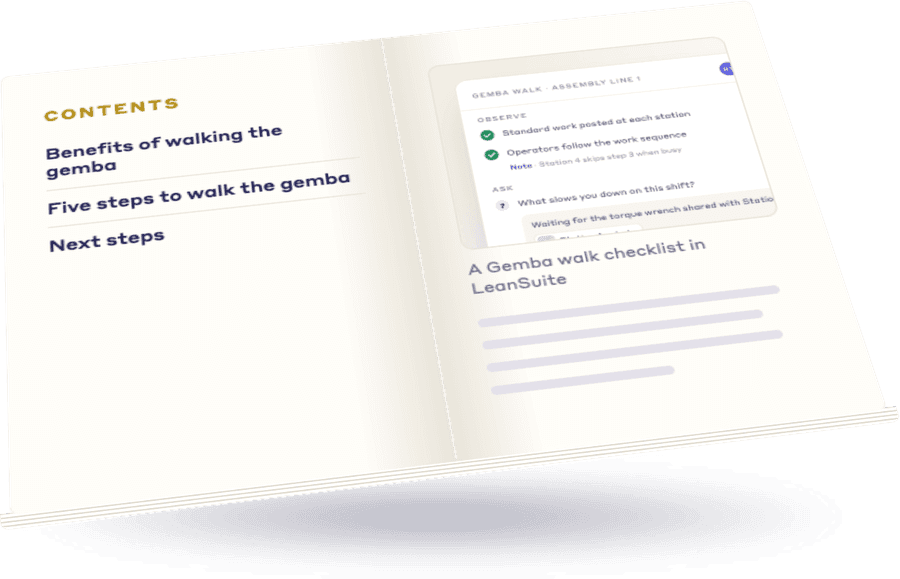

Read it online
The full text of the e-book. The PDF has the same content, laid out to print.
Introduction
Walking the gemba, the actual place where work is done, is a basic practice for leaders in operations. It lets leaders understand processes firsthand, see problems where they happen and talk with frontline employees. This guide gives leaders at every level a practical way to walk the gemba without disrupting the work.
Leaders who walk the gemba regularly build trust and base their decisions on what is really happening. This guide breaks down the key techniques and sets out practical steps for making gemba walks part of a leader's routine.
Many leaders struggle to bridge the gap between management decisions and what happens on the floor. The gemba walk closes that gap by putting the leader in the workplace. It is a purposeful activity: observing processes, asking questions and working with the people who do the job.
Glossary of key terms
- Gemba
- A Japanese term meaning “the real place”: where value is created, usually the factory floor or work area.
- Gemba walk
- A leadership practice of visiting the place where work happens to observe, learn and talk with employees.
- Continuous improvement (kaizen)
- Ongoing, incremental improvement of processes by the people closest to the work.
- Lean leadership
- Leadership principles built on respect for people, removing waste and continuous improvement.
- Root cause analysis
- A problem-solving method that looks for the underlying causes of an issue rather than its symptoms.
Benefits of walking the gemba
Firsthand understanding
Leaders see processes and issues for themselves instead of relying on filtered reports or secondhand accounts. This shows them details and opportunities that reports often miss.
Better problem solving
By seeing the actual flow of work and talking directly with operators, leaders can find the root causes of problems sooner. This shortens the time from spotting a problem to putting a countermeasure in place.
Employee engagement
Gemba walks show that leaders care about frontline employees' work and well-being. Talking face to face builds trust and encourages people to share what they know.
A culture of continuous improvement
When leaders are visibly involved in daily operations, teams keep looking for improvements, because they know management sees their ideas and their problems.
Better decisions
What leaders learn on the floor gives them a solid basis for decisions that take operating reality into account, which helps avoid unintended consequences.
Less waste
Watching the real workflow helps leaders spot non-value-adding activities, redundant steps and bottlenecks, and decide which waste to remove first.
Five steps to walk the gemba
One gemba walk, in five steps
- 1
Prepare with clear intent
- 2
Go to the real place
- 3
Observe with intent and ask why
- 4
Engage employees and listen
- 5
Reflect, follow up and take action
Step 1: Prepare with clear intent
A gemba walk needs a clear objective, or it turns into aimless observation. Decide on the focus, such as safety, quality, delivery or employee engagement, before you step onto the floor. Prepare by reviewing recent performance data, known issues and concerns raised by others, and shape the walk and your questions around them.
Knowing what you want to learn helps you focus, ask relevant questions and pick out meaningful observations instead of getting lost in detail. Reading the shift reports before you go is a simple way to prepare.
Step 2: Go to the real place
The point of a gemba walk is to visit the place where value is created, such as the production line, workstation or service point, and watch the actual work. Do not run these visits from meeting rooms or offices. Much of the important context is in the environment itself: sounds, movement, interactions and small inefficiencies.
On the floor, respect the rhythm of the work. Pay close attention without getting in the way. Go while production is running, look at the layout and watch the handoffs between people and stations.
Step 3: Observe with intent and ask why
Observation is not passive. Watch how the process flows, how information moves and how problems surface, then ask why each step is done the way it is. Asking “why” several times helps you reach root causes instead of surface symptoms.
Keep an open mind and do not jump to conclusions. Collect facts, patterns and behaviors for later analysis. Ask operators why a step is needed or why it differs from the documented procedure. The answer can reveal a workaround for an equipment problem or an unclear instruction.
Step 4: Engage employees and listen
A gemba walk is a chance to talk with frontline employees. Make people feel heard: ask open-ended questions, acknowledge the problems they raise and listen more than you speak. This brings out insights that would otherwise stay hidden.
Listening also builds trust and makes the walk a problem-solving partnership rather than an inspection. Thank people for their openness, and ask gently for more detail when an explanation is vague.
Step 5: Reflect, follow up and take action
Reflect after the walk. Pull your observations together, choose the key issues and build action plans with the team. Following up on what you committed to shows that you are serious and accountable.
Share feedback with both frontline workers and management to close the loop. Assign quick fixes, such as safety issues, right away, and schedule larger problems as kaizen projects.
After the walk: where each finding goes
- 1
Pull your observations together
Choose the key issues and build action plans with the team. - 2Decision
Is it a quick fix, such as a safety issue?
- Yes:
- Assign it right away.
- No:
- Schedule it as a kaizen project.
- 3
Share feedback to close the loop
With both frontline workers and management.
Frequently asked questions
How long should a gemba walk last?
Usually 30 minutes to one hour. That leaves time to observe and talk without disrupting operations.
How often should leaders walk the gemba?
A common pattern is daily walks for frontline supervisors and weekly walks for middle and senior managers. Regular walks build continuity, trust and an up-to-date picture of operations.
Should leaders try to solve problems on the spot?
Focus first on learning and listening. Problem-solving usually follows, together with the team, so the fix is planned and lasts instead of being rushed.
How do you encourage reluctant employees to speak openly?
Show up consistently, be respectful and listen. Trust builds over time. Recognizing contributions and keeping confidences also encourage honesty.
Can gemba walks be used outside manufacturing?
Yes. Any place where value is created, including services, healthcare and offices, can use them.
How should leaders record what they find?
Capture the key observations and agreed actions briefly, ideally in a shared tool the team can see. That keeps owners accountable and makes progress easy to track.
Next steps
- Set a clear focus for each walk. Before each visit, pick a specific objective tied to current problems or improvement priorities.
- Block regular, protected time. Put gemba walks in your calendar at set times so they become a habit. Keeping that time free shows frontline teams they have your attention.
- Practice observing and asking why. Watch the workflow closely and ask “why” in a respectful, curious way to find the underlying issues.
- Engage teams respectfully. Approach people with humility and thanks, and make it safe for them to speak candidly.
- Follow up. Record findings, give each action a clear owner and report progress openly. Closing the loop shows accountability and keeps improvement going.
Conclusion
A gemba walk works when it has a clear purpose, takes place where the work happens and ends with follow-up. Prepare a focus, observe and ask why, listen to the people doing the work, then assign owners and report back on what changed.
References
- Liker, J. K. (2004). The Toyota Way: 14 Management Principles from the World's Greatest Manufacturer. McGraw-Hill.
- Liker, J. K., & Meier, D. (2006). The Toyota Way Fieldbook. McGraw-Hill.
- Mann, D. (2010). Creating a Lean Culture: Tools to Sustain Lean Conversions (2nd ed.). Productivity Press.
- Ohno, T. (1988). Toyota Production System: Beyond Large-Scale Production. Productivity Press.
- Rother, M., & Shook, J. (2003). Learning to See: Value Stream Mapping to Add Value and Eliminate Muda. Lean Enterprise Institute.
- Spear, S. J. (2009). The High-Velocity Edge: How Market Leaders Leverage Operational Excellence to Beat the Competition. McGraw-Hill.
- Womack, J. P., & Jones, D. T. (1996). Lean Thinking: Banish Waste and Create Wealth in Your Corporation. Simon & Schuster.
- Lean Enterprise Institute. (n.d.). Lean resources. https://www.lean.org
Free templates for this guide
- Gemba walk checklistPlan the purpose and route, use the prompts on the floor and log findings with owners and due dates.
- Leader standard work templatePut regular gemba walks into a leader's daily, weekly and monthly routine.
- Waste walk checklistWalk one process looking for the eight wastes and record what you find.
- 5 Whys templateFollow up a problem seen on the walk from its symptom to the root cause.
- Quick kaizen templateRecord a small fix from the walk on one page: before, after, cause and countermeasure.