


Summary
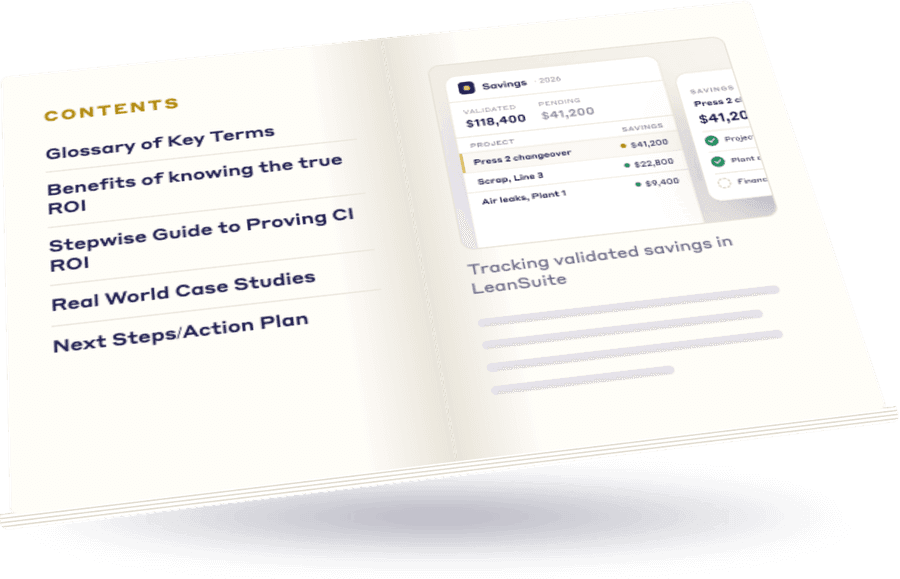
A summary of the e-book in its own words: the terms, the four steps to prove the return, and a plan to start. Every figure in the PDF is left out: the returns, the worked example and the company case studies have no public source.
Why prove the return
Continuous improvement programs promise transformative results, yet many fail to secure sustained investment because their return is unproven to executives who want hard numbers. Proving the true return means counting the financial gains and the strategic ones, such as engagement, and showing them with data.
Proving the value of CI comes down to three things: a baseline set before the work starts, tracking on several measures at once, and telling the story with real data. Done well, it keeps a program funded through a downturn.
- ROI
- Return on investment: net benefits divided by costs, expressed as a percentage, that is (gains minus costs) divided by costs.
- Balanced scorecard
- A tool that measures CI across four perspectives: financial, customer, process, and learning.
- Baseline metrics
- Performance data from before the CI work, for an accurate before and after comparison.
- Intangible benefits
- Non-financial gains, like morale or agility, counted through proxies such as lower turnover.
Four steps to prove it
Proving the return in four steps
- 1
Establish baselines and define success metrics
- 2
Implement CI projects with rigorous tracking
- 3
Calculate true ROI with conservative assumptions
- 4
Communicate, sustain, and scale with storytelling
Step 1: Establish baselines and define success metrics
Choose KPIs across financial (cost savings), operational (OEE), customer (NPS), and people (engagement) categories with a balanced scorecard. Capture the baseline with surveys, value stream mapping sessions, and simple dashboards before the projects start.
Step 2: Implement CI projects with rigorous tracking
Launch DMAIC projects and tag each saving to a specific initiative through control plans and before and after audits. Cross-functional audits then check that the gains last and have not faded back.
Step 3: Calculate true ROI with conservative assumptions
Take the annualized benefits, hard and soft, minus the costs, divided by the investment. Then cut the benefits back with a conservative haircut before you present the result.
Step 4: Communicate, sustain, and scale with storytelling
Present the results through executive dashboards and a story arc: the problem and baseline, the action and results, the vision for what comes next. Test scenarios with a sensitivity analysis, refresh the metrics in quarterly reviews, and celebrate wins to keep momentum.
A plan to start
- Week 1, baseline audit. Choose the KPIs and collect the before data with value stream mapping workshops, time studies, and engagement surveys.
- Week 2, project pipeline. Pick the highest-impact opportunities with a Pareto analysis of the baseline and write DMAIC charters with targets, timelines, and owners.
- Week 3, one visible pilot. Run a kaizen event on the quickest win, put the changes in at once, and measure before and after with photos and testimonials.
- Every month, balanced scorecards. Track every KPI with red, amber, and green status, audit that the gains hold, and review wins and variances in a short meeting.
- Every quarter, the executive story. Present the problem, baseline, action, results, and next steps with conservative numbers, to secure the next quarter's funding.
From baseline to the first executive story
- Week 1Baseline auditChoose the KPIs and collect the before data.
- Week 2Project pipelinePareto the baseline, write the DMAIC charters.
- Week 3One visible pilotA kaizen event on the quickest win, measured.
- Every monthBalanced scorecardsRed, amber and green status, and audits that gains hold.
- Every quarterThe executive storyConservative numbers, next quarter's funding.
How do I set a baseline without historical data?
Run short, intensive audits with value stream mapping for the processes and employee surveys for engagement, and sample current operations statistically.
What if leadership wants proof right away?
Run a short pilot aimed at a visible quick win, such as setup time reduction or defect elimination, and present the before and after data with photos and testimonials before scaling up.
How do you sustain the gains?
Daily audits, leader standard work with Gemba walks, automated dashboards, and recognition programs, with baselines refreshed every year to catch fade.