

Free printable · US Letter and A4
Office scavenger hunt: the 8 wastes hunt for teams
Most office scavenger hunts send people looking for a stapler or a plant. This one sends teams to photograph real waste: a request stuck waiting for sign-off, a pile of work between two steps, the same data typed twice. It gets people moving and laughing, and every photo is something the team could fix.
- Teams of 3 or 4
- Play: 30 to 45 min
- Set up: about 10 min
- Office, plant or warehouse, in areas that are safe to walk
Get the printable, free
Pick your industry and the examples on the sheets use things your team sees every day.
Helps us send you examples that fit. It is not printed on the sheets.
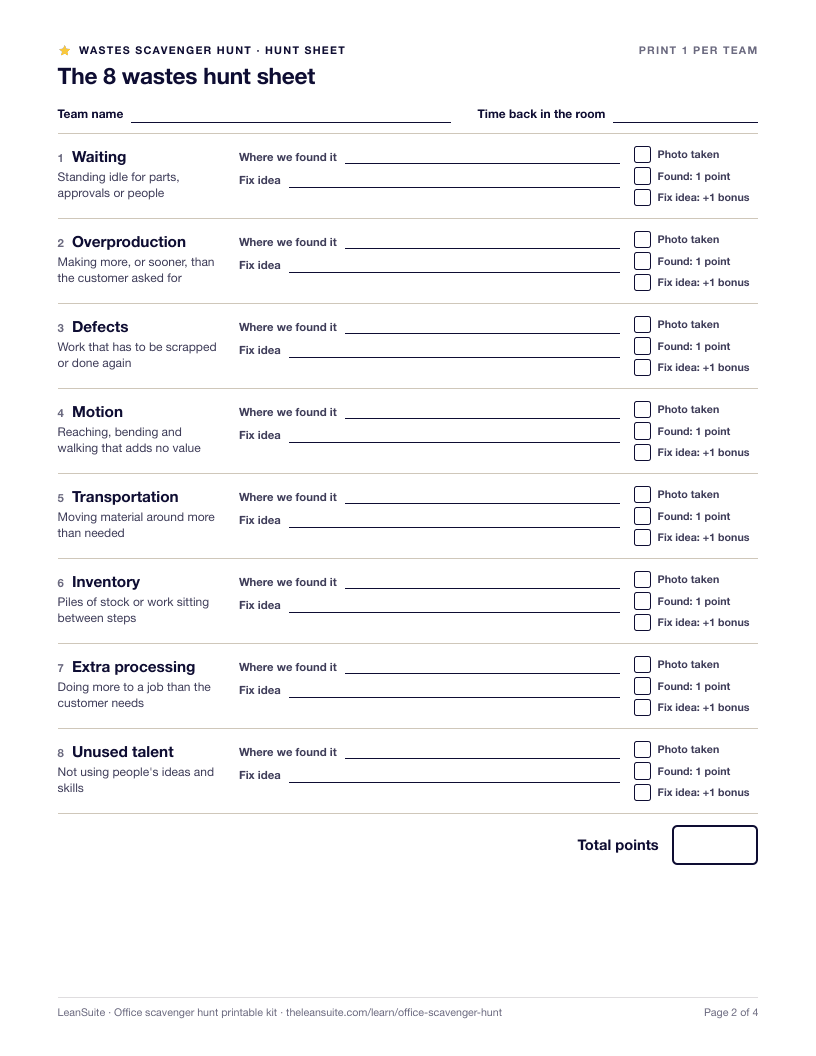
8 wastes hunt · Team: ____________
- WaitingStanding idle for parts, approvals or people1 + 1
- OverproductionMaking more, or sooner, than the customer asked for1 + 1
- DefectsWork that has to be scrapped or done again1 + 1
- MotionReaching, bending and walking that adds no value1 + 1
- TransportationMoving material around more than needed1 + 1
- InventoryPiles of stock or work sitting between steps1 + 1
- Extra processingDoing more to a job than the customer needs1 + 1
- Unused talentNot using people's ideas and skills1 + 1
The game in five steps
Step 1: Split into teams of 3 or 4
Step 2: Agree the safe areas to visit
Step 3: 20 minutes to photograph each waste
Step 4: Teams show their best photos
Step 5: Score, and crown the winning team
What teams hunt for
The 8 wastes, the hint on the hunt sheet, and one office and one plant example of each.
- Waste 1
Waiting
Standing idle for parts, approvals or people
- Office
- A request sitting in an inbox for sign-off
- Plant
- A machine standing idle for material or a changeover
- Waste 2
Overproduction
Making more, or sooner, than the customer asked for
- Office
- A report printed or sent that nobody reads
- Plant
- Parts made before the next step needs them
- Waste 3
Defects
Work that has to be scrapped or done again
- Office
- A form sent back because a field was missing
- Plant
- A reject bin or a rework rack
- Waste 4
Motion
Reaching, bending and walking that adds no value
- Office
- A shared printer far from the people who use it
- Plant
- Tools kept out of reach of the job
- Waste 5
Transportation
Moving material around more than needed
- Office
- Paperwork carried to another building for a signature
- Plant
- Parts moved twice between storage spots
- Waste 6
Inventory
Piles of stock or work sitting between steps
- Office
- A cupboard of old brochures or supplies
- Plant
- A pile of work waiting for the next step
- Waste 7
Extra processing
Doing more to a job than the customer needs
- Office
- The same data typed into two systems
- Plant
- A surface polished that the customer never sees
- Waste 8
Unused talent
Not using people's ideas and skills
- Office
- An idea board with no replies
- Plant
- An operator's fix that nobody asked about
How to play
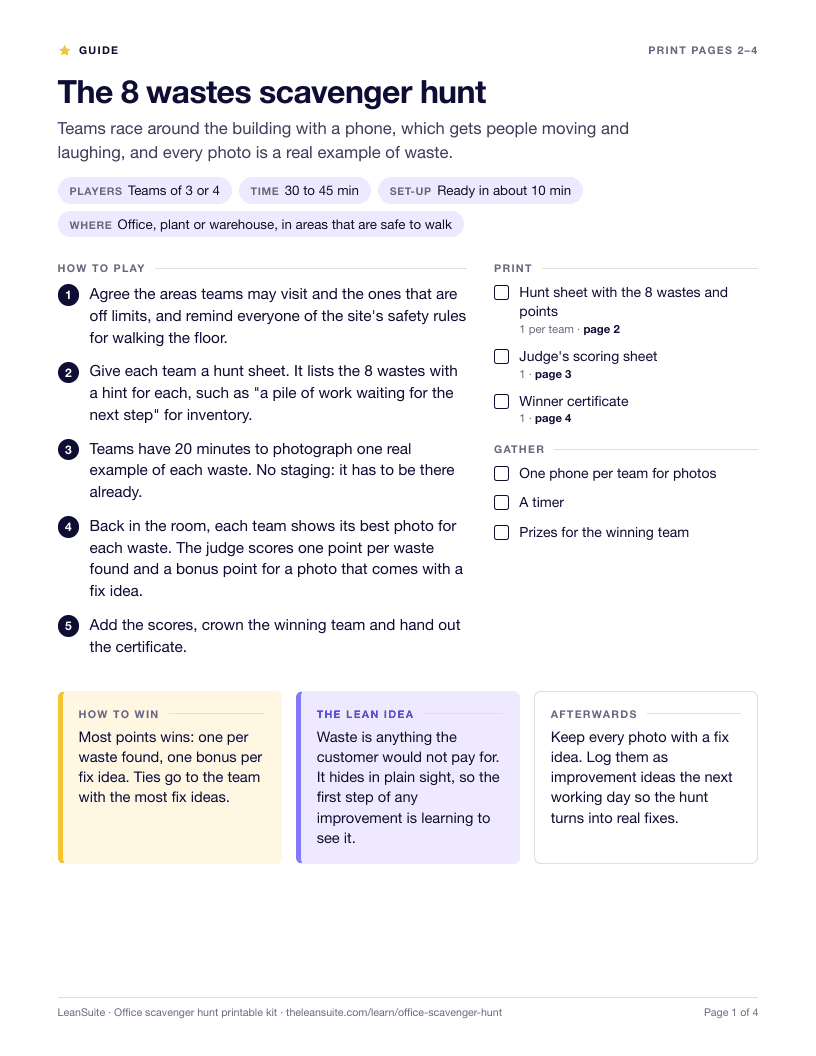
- Agree the areas teams may visit and the ones that are off limits, and remind everyone of the site's safety rules for walking the floor.
- Give each team a hunt sheet. It lists the 8 wastes with a hint for each, such as "a pile of work waiting for the next step" for inventory.
- Teams have 20 minutes to photograph one real example of each waste. No staging: it has to be there already.
- Back in the room, each team shows its best photo for each waste. The judge scores one point per waste found and a bonus point for a photo that comes with a fix idea.
- Add the scores, crown the winning team and hand out the certificate.
- Hunt sheet with the 8 wastes and points · 1 per team
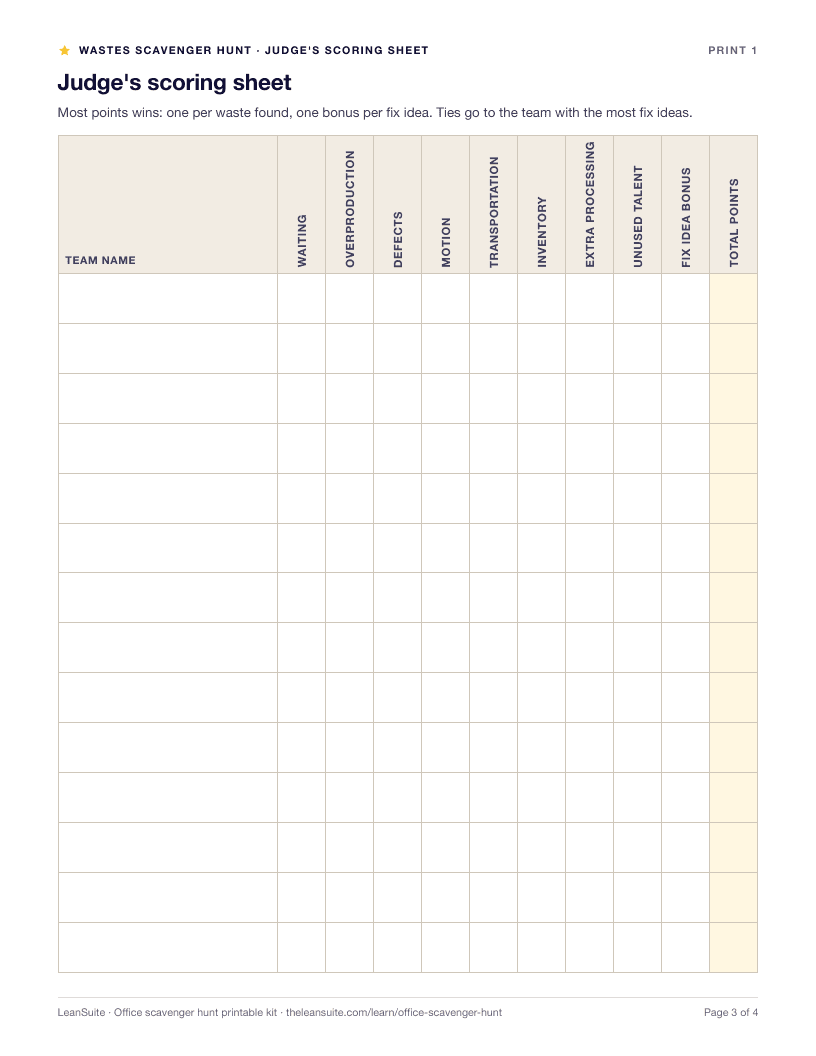
- Judge's scoring sheet · 1
- Winner certificate · 1
Gather
- One phone per team for photos
- A timer
- Prizes for the winning team
How to win
Most points wins: one per waste found, one bonus per fix idea. Ties go to the team with the most fix ideas.
Why it works
Waste is anything the customer would not pay for. It hides in plain sight, so the first step of any improvement is learning to see it.
Afterwards
Keep every photo with a fix idea. Log them as improvement ideas the next working day so the hunt turns into real fixes.
Four ways to use it
Team building
Run it as a 45-minute team event. It works in mixed teams of office and floor staff.
New starters
A hunt in the first week shows people the building and how the team thinks about waste.
Holiday party
Play it at the party, then log the photos with fix ideas the next working day.
Lean training
Teach the 8 wastes in the morning and hunt for them after lunch.
Print it, cut it, play
- A hunt sheet with the 8 wastes, a hint for each and the points
- A judge's scoring sheet for up to 14 teams
- A winner certificate and a one-page guide
Make it fit your plant
Pick your industry and the examples on the sheets use things your team sees every day.
Helps us send you examples that fit. It is not printed on the sheets.
Don't let the photos sit in a phone
Every photo with a fix idea is a real improvement idea. LeanSuite gives each one an owner and a status, so the hunt turns into fixes. Book a 45-minute demo and we will set up your first ideas with you.
FAQ
About office scavenger hunt
Teams of three or four get a hunt sheet listing the 8 wastes with a hint for each. They have 20 minutes to photograph one real example of each waste, then show their best photos. One point per waste found and a bonus point for each photo with a fix idea.
Yes. Every waste has office examples: a request waiting in an inbox, a report nobody reads, a form sent back for a missing field. The table on this page lists one office and one plant example for each.
30 to 45 minutes: a few minutes to brief, 20 minutes to hunt, and the rest to show photos and score.
Agree the areas teams may visit and the ones that are off limits before you start, and remind everyone of the site's rules for walking the floor. Nothing may be staged for a photo.