


Read it online
The full text of the e-book. The PDF has the same content, laid out to print.
A note from the LeanSuite team
If you are reading this, you are probably the person others look to when it is time to close the year, fix what is not working and set a direction for the next quarter. While you wrap up Q4, you are already thinking about how Q1 should begin.
This guide has three aims:
- Help you close Q4 in a structured way.
- Help you set a realistic, focused plan for Q1.
- Give you practical tools instead of abstract concepts.
Each section gives a short explanation followed by something you can use: a template, a checklist or a worksheet. Use it as a guided reset for your continuous improvement work as you move from one year into the next.
The LeanSuite team
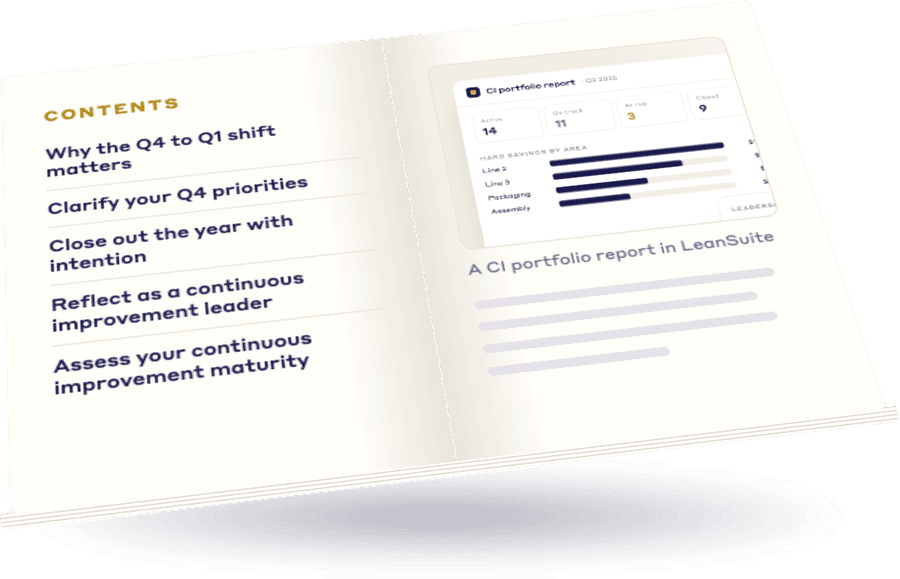
Why the Q4 to Q1 shift matters
Q4 is a demanding period. Reporting, year-end targets, limited resources and open issues all arrive at once. At the same time, planning for next year cannot wait.
This creates a common pattern:
- Q4 becomes a rush to finish.
- Q1 begins without a clear, shared plan.
- The team spends the first weeks reacting instead of executing.
A better approach is to use Q4 as a bridge into Q1:
- Close out key issues instead of carrying them forward.
- Capture what you learned this year.
- Choose a small number of priorities and make them visible.
The steps that follow help you do that, with a tool to use at each stage.
Q4 as a bridge into Q1, stage by stage
- 1
Clarify your Q4 priorities
- 2
Close out the year with intention
- 3
Reflect as a continuous improvement leader
- 4
Assess your continuous improvement maturity
- 5
Build your 30/60/90 day plan
- 6
Equip yourself with quick-win tools
- 7
Start Q1 with a clear roadmap
Step 1
Clarify your Q4 priorities
First, decide where your limited time and attention should go in Q4. Not everything is equally important, and not everything must happen now.
A few questions help:
- Which initiatives will have the most impact if completed before year-end?
- Which activities could safely move into Q1?
- Where is the team currently spread too thin?
| Initiative | Impact (1 low, 5 high) | Effort (1 low, 5 high) | Decision |
|---|
The PDF prints this table with 8 blank rows to fill in.
How to work with it
- List your current key initiatives and tasks.
- Rate impact and effort honestly, not optimistically.
- Mark high-impact, lower-effort items as Q4 priorities.
- Defer or redesign low-impact, high-effort items.
This gives you a rational basis for saying “yes” and “not now.”
Step 2
Close out the year with intention
Once priorities are clear, close the year deliberately rather than simply running out of time.
A good close-out:
- Reduces the number of unresolved issues going into Q1.
- Makes results visible to leadership and teams.
- Clarifies what still needs attention in the next cycle.
Close-out checklist
- Major recurring issues from this year have clear owners and closure plans.
- The top three continuous improvement priorities for Q1 are defined.
- Training or coaching needs for the next quarter are identified.
- Critical standard operating procedures (SOPs) are current and in use.
- Chronic downtime and repeat issues have been reviewed and understood.
- A simple summary of benefits and savings is ready for stakeholders.
- Daily or tier meetings are running consistently and adding value.
- The suggestion or kaizen process is ready to run from early Q1.
- Continuous improvement tools, trackers and boards are cleaned up and relevant.
- A draft 30/60/90 day plan exists, even in simple form.
Use this list in a short review session with your team, or in a one-to-one session as you prepare for year-end.
Step 3
Reflect as a continuous improvement leader
Planning is stronger when it is grounded in reflection. This is where you turn a busy year into clear insights.
Good reflection looks for patterns as well as events:
- Where did continuous improvement create real value this year?
- Where did good intentions stall?
- What does the team need from you in the next cycle?
| Question | Your notes |
|---|---|
| What worked particularly well in continuous improvement this year? | |
| Where did we invest effort without seeing the results we expected? | |
| Which processes still feel fragile or dependent on a few individuals? | |
| Where did we see strong engagement from people? | |
| Where did we face resistance or fatigue? | |
| What is one practice from this year that is worth repeating and strengthening? | |
| What is one practice that should be redesigned or stopped next year? |
Use the worksheet for your own thinking or for a team discussion. Capture themes rather than only specific incidents. These themes become inputs to your Q1 focus areas.
Step 4
Assess your continuous improvement maturity
With your reflection done, step back and assess the overall maturity of your continuous improvement system. The aim is not to label the organization but to choose the right next steps for where it is now.
| Area | Focus | Score (1 to 5) |
|---|---|---|
| Leadership and vision | How clearly leaders support and communicate continuous improvement. | |
| Process discipline | How consistently processes are defined, followed and reviewed. | |
| Capability | How well people are trained and coached in continuous improvement methods. | |
| Engagement | How actively people contribute ideas and join improvement efforts. | |
| Results and measurement | How clearly results are tracked, reported and used. |
Once rated:
- Note which areas are strong enough for now.
- Pick one or two weaker areas that would make the biggest difference if improved.
Choosing one or two focus areas for Q1 works better than trying to improve everything at once.
Step 5
Build your 30/60/90 day plan
Next, turn your insights into a focused plan for the first 90 days of the new year. It does not need to be complex. It does need to be clear.
| Time frame | Focus | Key actions | Evidence of success |
|---|---|---|---|
| First 30 days | Stabilize and align | ||
| Days 31 to 60 | Execute one key improvement | ||
| Days 61 to 90 | Standardize and embed |
A typical pattern looks like this:
- First 30 days: close the most important open issues and align the team around the plan.
- Days 31 to 60: deliver one meaningful improvement in a priority area.
- Days 61 to 90: standardize, document and build the successful changes into daily work.
The first 90 days of the new year
- First 30 daysStabilize and alignClose the most important open issues and align the team around the plan.
- Days 31 to 60Execute one key improvementDeliver one meaningful improvement in a priority area.
- Days 61 to 90Standardize and embedStandardize, document and build the successful changes into daily work.
Review this plan regularly, and change it only when there is a clear reason, not on impulse.
Step 6
Equip yourself with quick-win tools
A small, consistent set of tools makes it much easier to run continuous improvement without reinventing the wheel every time. The essentials are a way to track results, a simple way to review standards and a clear path for ideas to move from suggestion to implementation.
| Tool | Purpose | Template fields |
|---|---|---|
| Continuous improvement savings tracker | Record the financial and non-financial impact of initiatives. | Project name, owner, start and end dates, problem statement, solution, savings type, estimated vs. actual savings, comments. |
| SOP audit checklist | Keep key procedures accurate and in use. | SOP title, process owner, last review date, version, compliance check, gaps identified, actions, due dates. |
| Suggestion / idea tracker | Follow ideas from submission to implementation. | Idea ID, submitter, area, description, status (new, under review, approved, implemented, declined), decision notes, benefits. |
| Leadership reflection guide | Help leaders review how they support continuous improvement. | Leader name, period covered, key wins, challenges, actions to support continuous improvement next period, support needed, follow-up date. |
The four templates follow in the next chapter.
Step 6 templates
The four templates
Continuous improvement savings tracker
Purpose: track the impact of each initiative in a structured way.
| Field | Description |
|---|---|
| Project ID | Unique reference for the initiative |
| Project name | Short, clear name |
| Area / department | Where the project is taking place |
| Project owner | Person responsible for delivery |
| Start date | When work began |
| End date | When work finished (or is expected to finish) |
| Problem statement | Brief description of the issue being addressed |
| Solution summary | Short description of the solution implemented |
| Savings type | e.g. cost reduction, cost avoidance, quality, lead time, safety |
| Estimated annual savings | Expected benefit per year (numeric) |
| Actual annual savings | Verified benefit per year (after implementation) |
| Currency | Currency of savings (e.g. USD, EUR) |
| Key metric improved | Main measure affected (e.g. defects per million, hours, units) |
| Baseline value | Metric value before the change |
| Current value | Metric value after the change |
| Validation method | How the savings were confirmed (data source, method) |
| Status | e.g. idea, in progress, implemented, verified, closed |
| Notes | Any additional comments |
SOP audit checklist
Purpose: keep important procedures accurate, current and actually used.
| Field | Description |
|---|---|
| SOP ID | Unique identifier or code |
| SOP title | Name of the procedure |
| Process area | Area, line or department |
| Process owner | Responsible person or role |
| Last review date | Date of the last formal review |
| Next review date | Planned date for the next review |
| Version | Current version number or date |
| Is the SOP easy to find? | Yes / No |
| Is the SOP up to date with current practice? | Yes / No / Partly |
| Are users trained on this SOP? | Yes / No / Partly |
| Evidence of use | Short note, e.g. “Observed in use” or “Audit sample checked” |
| Gaps identified | Issues, mismatches or missing steps |
| Actions required | What needs to be updated or fixed |
| Action owner | Who will make the change |
| Action due date | When the action should be completed |
| Follow-up date | When to confirm the changes are done |
| Final status | e.g. OK, update in progress, needs redesign |
Suggestion / idea tracker
Purpose: follow ideas from submission to implementation so people see progress.
| Field | Description |
|---|---|
| Idea ID | Unique number or code |
| Submission date | When the idea was submitted |
| Submitted by | Name of the person (or team) |
| Area / location | Where the idea applies |
| Idea title | Short, clear name |
| Idea description | Brief description of the suggestion |
| Category | e.g. safety, quality, cost, delivery, morale |
| Initial impact estimate | High / medium / low, or a short comment |
| Reviewer / approver | Person or role who reviews the idea |
| Review date | When the idea was reviewed |
| Decision | e.g. approved, on hold, declined, needs more information |
| Reason for decision | Short explanation, especially if declined |
| Implementation owner | Who will implement it if approved |
| Target completion date | When implementation should be done |
| Actual completion date | When it was completed |
| Benefits observed | Short note on impact (can link to the savings tracker) |
| Recognition given | e.g. thank-you, mention in a meeting, reward |
| Current status | e.g. new, under review, in progress, implemented, closed |
Leadership reflection guide
Purpose: help team leaders and managers reflect on how they support continuous improvement.
| Section | Prompt | Your notes |
|---|---|---|
| Context | Leader name | |
| Context | Role / area | |
| Context | Period covered (e.g. quarter, month) | |
| Reflection | In this period, what went well for continuous improvement in my area? | |
| Reflection | Where did I see projects or ideas stall? Why? | |
| Reflection | How often did I talk about improvement in my regular meetings? | |
| Reflection | How did I recognize people who contributed to improvements? | |
| Reflection | Where did my own behavior or priorities send mixed messages about continuous improvement? | |
| Next steps | What will I keep doing next period? | |
| Next steps | What will I start doing, or do more deliberately? | |
| Next steps | What support or resources do I need to lead continuous improvement better? | |
| Follow-up | Date for the next reflection / review |
Step 7
Start Q1 with a clear roadmap
How you start Q1 has a strong influence on how the rest of the year goes. A structured kickoff shows people that continuous improvement is part of how the organization works.
A good kickoff:
- Connects past achievements with future plans.
- Makes expectations visible.
- Invites participation rather than announcing decisions from a distance.
Kickoff agenda template
Adapt this structure for your first continuous improvement session of 2027:
- Highlight a few key continuous improvement wins from the past year.
- Share the high-level maturity assessment and what it tells you.
- Present the 30/60/90 day plan and explain why these priorities were chosen.
- Explain how people can contribute ideas and get involved in improvements.
- Show the core measures you will be watching and why they matter.
- Close with a clear theme or focus phrase for the quarter.
Examples of a focus phrase:
- “Q1 is about stability and reducing recurring issues.”
- “Q1 is about improving flow on our most important product line.”
A clear theme tells people where to put their effort.
Free templates for this guide
- Cost savings trackerA savings log with hard and soft savings and a sign-off column for Finance.
- Standard work audit checklistCheck a job against its written standard and sort each gap by cause.
- Idea suggestion formA one-page idea form and an idea log that tracks how long each answer takes.
- Leader standard work templateTurn your Q1 plan into a leader's daily, weekly and monthly routine.
- Hoshin kanri X-matrixLink the year's objectives to improvement priorities and metrics on one page.
- Daily huddle agendaA short start-of-shift stand-up to keep daily meetings running consistently.