

Free printable · US Letter and A4
Lean bingo: free printable cards and caller sheet
Lean bingo is bingo where every square is a lean term and the caller reads a clue instead of a number. Players have to work out the term, so the 8 wastes, 5S and the rest of the lean vocabulary stick without a lecture. It starts in seconds, works for any number of players and needs nothing but the cards and a pen.
- Any number
- Play: 15 to 30 min
- Set up: about 10 min
- Party, office, shift meeting
Get the printable, free
Pick your industry and the examples on the sheets use things your team sees every day.
Helps us send you examples that fit. It is not printed on the sheets.
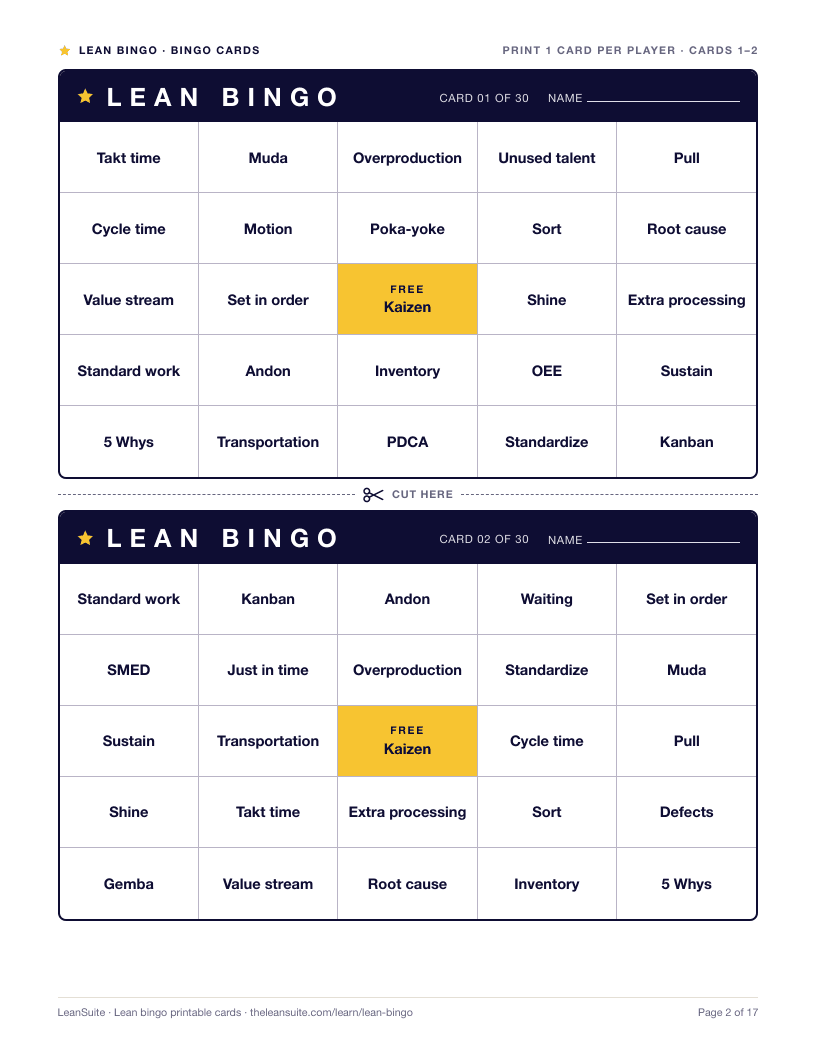
LEAN BINGO
- Transportation
- Poka-yoke
- Set in order
- Root cause
- Waiting
- PDCA
- OEE
- Extra processing
- Cycle time
- Defects
- Pull
- Standardize
- FREE: Kaizen
- Kanban
- Just in time
- Unused talent
- 5 Whys
- Overproduction
- Standard work
- Shine
- Value stream
- Inventory
- Andon
- Muda
- Motion
The caller reads
“Standing idle for parts, approvals or people”
Players mark: Waiting
The game in five steps
Step 1: Hand out a different card to each player
Step 2: The caller reads a clue
Step 3: Players mark the term it describes
Step 4: A full line shouts "Kaizen!"
Step 5: The caller checks the line
All 30 terms and their clues
The caller sheet in the printable has every clue. The eight in yellow are the 8 wastes.
- WaitingOne of the 8 wastesStanding idle for parts, approvals or people
- OverproductionOne of the 8 wastesMaking more, or sooner, than the customer asked for
- DefectsOne of the 8 wastesWork that has to be scrapped or done again
- MotionOne of the 8 wastesReaching, bending and walking that adds no value
- TransportationOne of the 8 wastesMoving material around more than needed
- InventoryOne of the 8 wastesPiles of stock or work sitting between steps
- Extra processingOne of the 8 wastesDoing more to a job than the customer needs
- Unused talentOne of the 8 wastesNot using people's ideas and skills
- SortThe first S: remove what you do not need
- Set in orderThe second S: a place for everything
- ShineThe third S: clean and inspect
- StandardizeThe fourth S: the same way, every time, everywhere
- SustainThe fifth S: keep it up
- KaizenSmall, steady improvements by everyone
- GembaThe real place where the work happens
- KanbanA card or signal that says make or move one more
- AndonA light or signal to call for help at once
- Poka-yokeA mistake-proofing device or step
- Takt timeThe pace of customer demand
- Cycle timeHow long one unit takes at a step
- 5 WhysAsking why again and again to reach the root cause
- PDCAPlan, do, check, act
- Root causeThe real reason a problem happens
- Value streamEvery step from order to delivery
- Just in timeThe right part, in the right amount, when it is needed
- SMEDCutting changeover time, ideally to single-digit minutes
- OEEAvailability times performance times quality
- MudaThe Japanese word for waste
- PullMake only when the next step asks for it
- Standard workThe current best way to do a job, written down
How to play
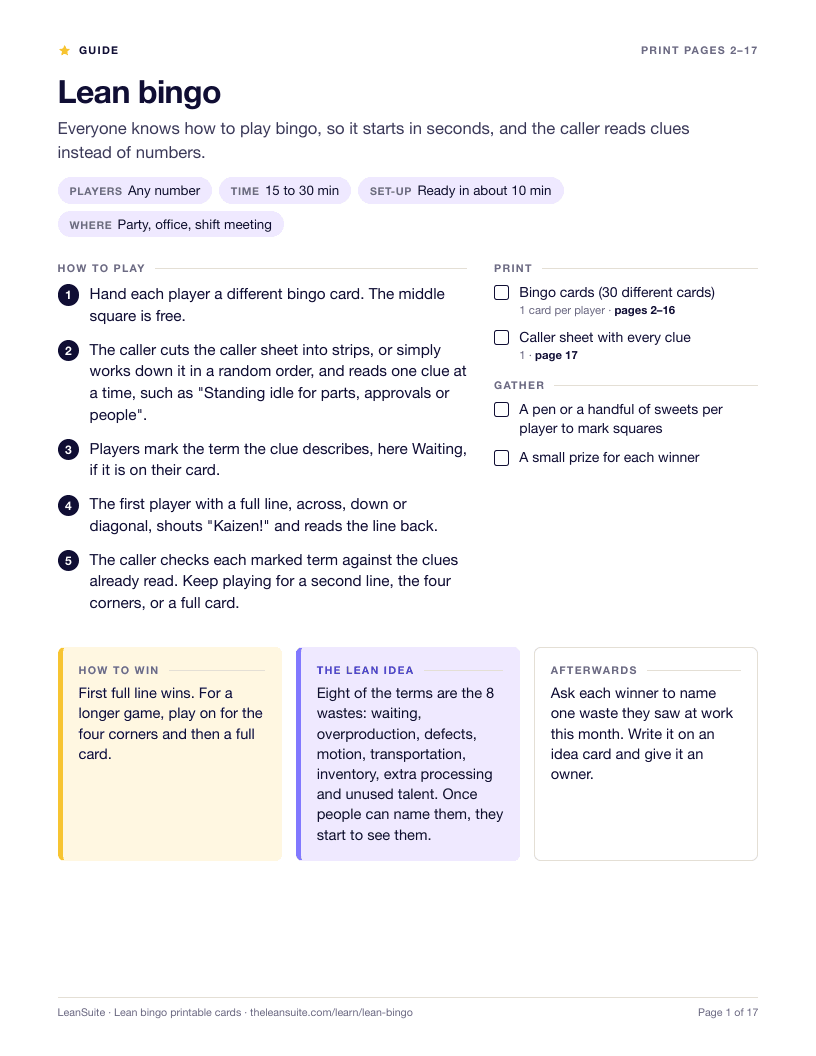
- Hand each player a different bingo card. The middle square is free.
- The caller cuts the caller sheet into strips, or simply works down it in a random order, and reads one clue at a time, such as "Standing idle for parts, approvals or people".
- Players mark the term the clue describes, here Waiting, if it is on their card.
- The first player with a full line, across, down or diagonal, shouts "Kaizen!" and reads the line back.
- The caller checks each marked term against the clues already read. Keep playing for a second line, the four corners, or a full card.
- Bingo cards (30 different cards) · 1 card per player
- Caller sheet with every clue · 1
Gather
- A pen or a handful of sweets per player to mark squares
- A small prize for each winner
How to win
First full line wins. For a longer game, play on for the four corners and then a full card.
Why it works
Eight of the terms are the 8 wastes: waiting, overproduction, defects, motion, transportation, inventory, extra processing and unused talent. Once people can name them, they start to see them.
Afterwards
Ask each winner to name one waste they saw at work this month. Write it on an idea card and give it an owner.
Four ways to use it
Shift meeting
Play to one line. It takes about ten minutes, and the clues teach the terms as you go.
Training class
Play straight after teaching the 8 wastes and 5S, as a check that the words stuck.
Holiday party
The same cards work at the party. The holiday page has six more games to go with it.
On a video call
Send everyone the PDF. Players mark their card on paper or on screen while the caller reads the clues aloud.
Print it, cut it, play
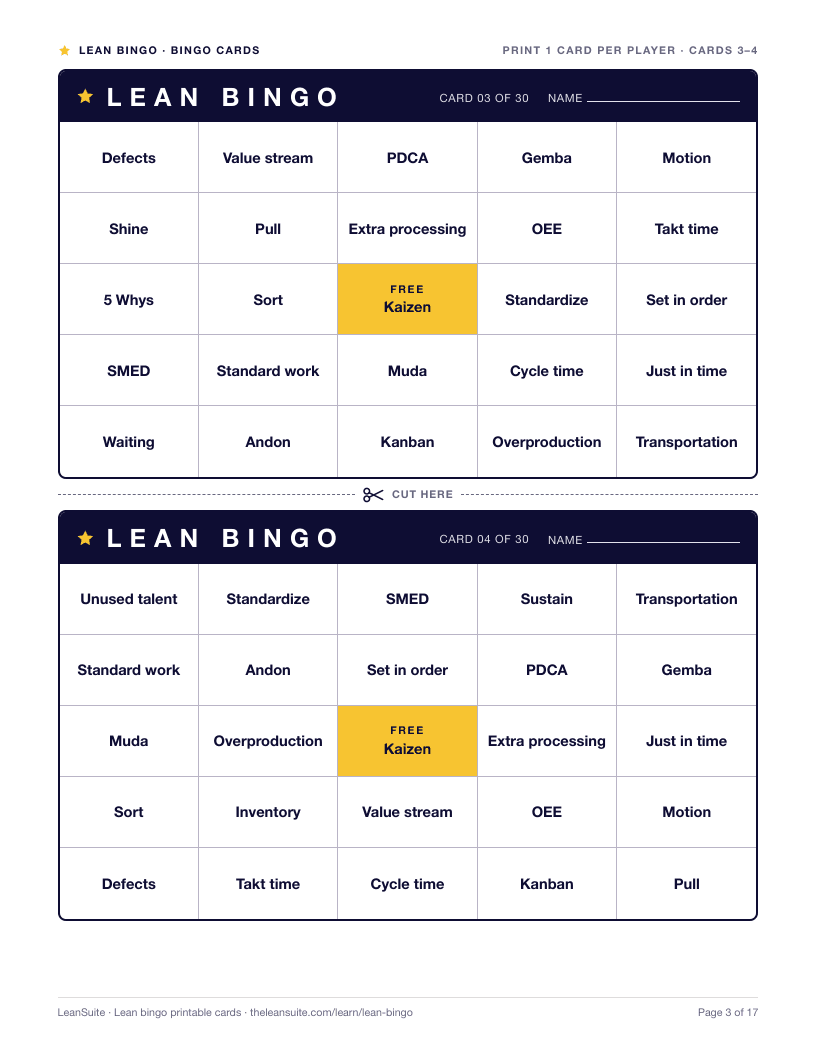
- 30 different bingo cards, two to a page
- A caller sheet with all 30 clues to read or cut into strips
- A one-page guide
Make it fit your plant
Pick your industry and the examples on the sheets use things your team sees every day.
Helps us send you examples that fit. It is not printed on the sheets.
Turn the wastes people name into fixes
When players start spotting waiting, motion and defects at work, LeanSuite gives each idea an owner and a status so it gets fixed. Book a 45-minute demo and we will set up your first ideas with you.
FAQ
About lean bingo
A bingo game for lean training. The squares are lean terms such as Waiting, Kanban or Poka-yoke, and the caller reads a clue for each one. Players mark the term the clue describes, and the first full line wins.
30 different bingo cards, two to a page, a caller sheet with every clue and a one-page guide, in US Letter and A4. The middle square of every card is a free Kaizen square.
About 15 minutes to the first full line. Play on for the four corners and a full card if you have 30 minutes.
No. The clue explains each term, so beginners learn as they play. People who know lean simply finish faster.