




Kanban is a visual method for managing work, with tasks on cards that move across a board from to do to done. Its four principles (start with what you do now, change incrementally, respect current roles, encourage leadership at all levels) let a team adopt it without tearing up how it already works.
What is Kanban?
Kanban is a visual project management framework designed to optimize workflows and enhance efficiency. This is done by providing real-time tracking and fostering collaboration among team members.
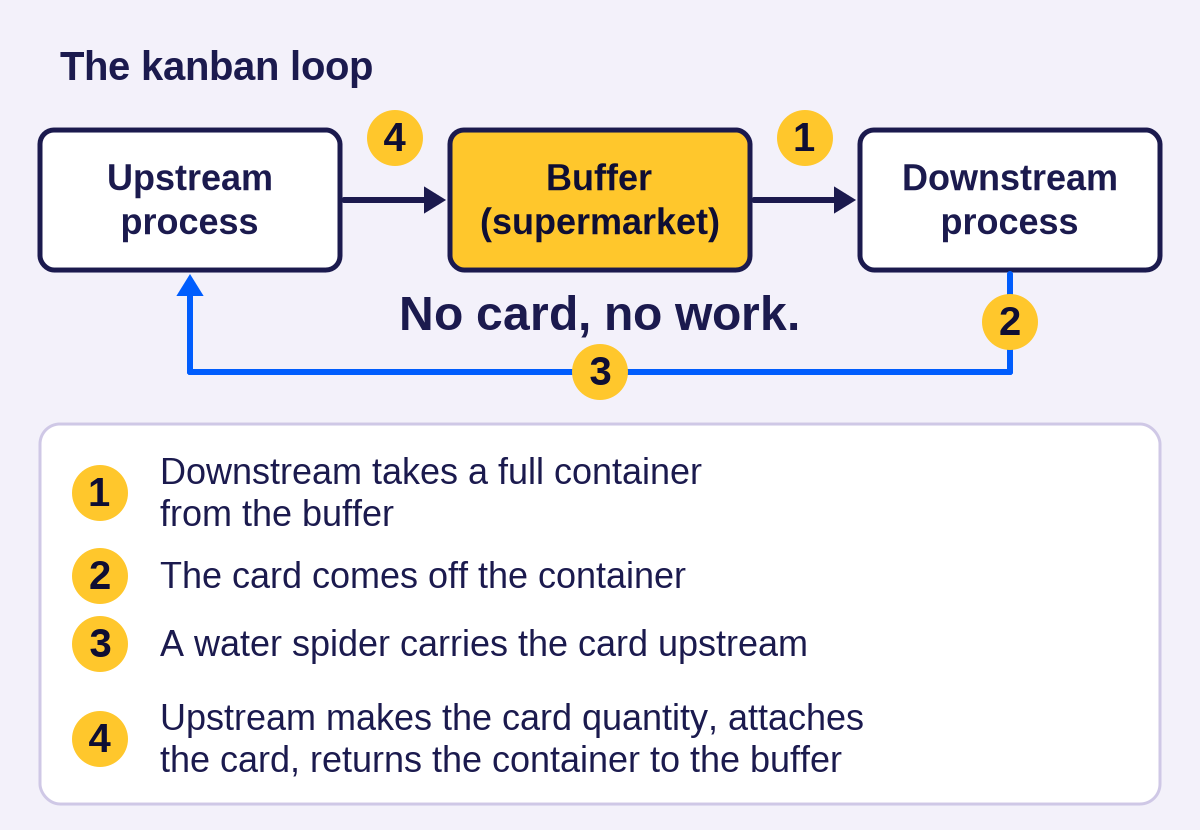
Text version of this figure
Three boxes in a row: Upstream process, Buffer (supermarket) in gold, and Downstream process. Step 1: an arrow from the buffer to the downstream process, a full container taken from the buffer. Step 2: at the downstream process the card comes off the container. Step 3: a blue arrow runs back under the boxes to the upstream process, where a water spider carries the card upstream. Step 4: an arrow from the upstream process to the buffer, upstream makes the card quantity, attaches the card and returns the container to the buffer. Centre text: No card, no work. A numbered list under the diagram gives the steps in words: 1 Downstream takes a full container from the buffer. 2 The card comes off the container. 3 A water spider carries the card upstream. 4 Upstream makes the card quantity, attaches the card, returns the container to the buffer. Heading: The kanban loop.
Originating from the Toyota Production System, Kanban uses boards and cards to represent tasks and their progression through various workflow stages. This allows teams to clearly visualize the status of their projects. What’s more, this visualization promotes transparency and enables project teams to identify bottlenecks, streamline processes, and make informed decisions.
The Kanban method isn’t like other methodologies that require overhauling existing systems. Instead, it is a flexible agile project management approach that can be seamlessly integrated into an organization’s current processes. By doing so, it respects established workflows while encouraging continuous improvement and adaptability. This, in turn, leads to more effective project management and increased productivity.
What are Kanban boards?
Kanban boards serve as the most common means of visualizing a Kanban system. They provide a clear and accessible way for teams to manage their workflow efficiently. Essentially, these boards represent work items of various types and sizes. They range from simple tasks to complex requirements and are typically displayed on individual notes or cards.
The visual representation allows team members to see at a glance what needs to be done, what is currently in progress, and what has been completed. Each work item progresses through a series of activities known as the workflow, which is modelled directly on the Kanban board. This visual workflow helps the project manager and teams identify bottlenecks, streamline processes, and facilitate better communication and collaboration.
By offering a real-time overview of tasks, Kanban boards empower teams to make informed decisions, enhance productivity, and foster a culture of continuous improvement.
- 1
To Do
Work items sit on cards, from simple tasks to complex requirements - 2
In Progress
A WIP limit caps how many tasks run at once, so current work is finished before new work starts - 3
Done
Completed work, visible to everyone at a glance
The stage names are the post's examples; each team models its own workflow on its board.
What are the four core principles of Kanban?
The Kanban methodology is built on four core principles that provide a structured yet flexible framework for enhancing workflow efficiency. The four core principles of Kanban are:

1. Start with what you do now
Kanban begins by valuing the existing processes and practices within an organization. In essence, this principle emphasizes that there is no need for a complete overhaul of current workflows. Instead, the Kanban framework encourages teams to visualize their current work and identify areas for potential improvement.
By starting with what you do now, Kanban respects the established systems and helps teams build upon their successes. As a result, this approach makes it easier for teams to adapt Kanban systems without the resistance that often comes with drastic changes.
2. Agree to pursue incremental, evolutionary change
Continuous improvement is a fundamental aspect of the Kanban methodology.
Instead of implementing drastic changes, Kanban advocates for incremental, evolutionary change. So, this involves making small, manageable improvements over time. This allows teams to gradually optimize their processes without disrupting their current operations.
By pursuing change incrementally, teams can experiment, learn from their experiences, and adapt accordingly. Consequently, fostering a culture of continuous improvement that drives sustained success.
3. Respect the current process, roles, responsibilities, titles
Kanban is designed to respect the existing processes, roles, and responsibilities within an organization. In other words, it acknowledges that these elements have been established for a reason and that sudden changes can be counterproductive.
By maintaining respect for current structures, Kanban reassures team members that their roles and expertise in existing process are valued. This respect helps to mitigate fears of disruption. Thereby, ensuring a smoother transition and fostering a positive environment for gradual and meaningful improvements.
4. Encourage acts of leadership at all levels
Kanban emphasizes the importance of collaboration and encourages acts of leadership at all organizational levels. In essence, this principle empowers individuals, regardless of their position or title, to take ownership of issues and contribute to process improvements.
By fostering an environment where everyone can lead, Kanban promotes a collaborative culture that values diverse perspectives and innovative solutions. This inclusive approach helps to drive continuous improvement and enhances team dynamics. Ultimately, leading to more effective problem-solving and process optimization.
What are the six core practices of Kanban?
Implementing Kanban effectively requires more than just understanding its principles; it involves embracing the six core practices that form the backbone of this methodology. The six core practices of Kanban are:

1. Visualize the workflow
Visualizing the workflow is a fundamental practice in Kanban that significantly enhances the visibility of tasks across the entire process.
By using a Kanban board, teams can see all the tasks in progress at a glance, including their current status and any bottlenecks that may exist. This transparency allows for a more accurate assessment of the workflow, helping teams identify areas needing improvement and enabling better decision-making.
When team members have a clear picture of the workflow, they can focus on optimizing processes and addressing obstacles promptly.
2. Limit work in progress (WIP)
Limiting work in progress is the second Kanban practice and it aims to enhance project efficiency by reducing wasted time and resources.
By setting a cap on the number of tasks that can be in progress simultaneously, teams can ensure that they are not overwhelmed and can maintain focus on completing current tasks before starting new ones. This approach prevents task overload and minimizes the risk of errors or delays. As a result, this leads to faster completion times and higher-quality outcomes.
By cutting down on multitasking and encouraging task completion, the WIP limits help teams streamline their processes and maintain a steady workflow.
3. Manage flow
A goal of the Kanban methodology is to ensure that work moves smoothly from one stage to the next. That’s why this third principle, manage flow, is important. The Kanban board acts as a visual tool that allows teams to observe and manage how tasks progress through various stages, such as “To Do,” “In Progress,” and “Done.”
By managing flow, teams can quickly identify any bottlenecks or disruptions in the process and take corrective actions to resolve them. This practice helps maintain a continuous and predictable workflow. Thus, enabling teams to deliver consistent results and improve overall performance.
4. Make process policies explicit
Making process policies explicit is a key practice in Kanban that involves defining, publishing, and sharing the rules and guidelines that govern the workflow.
By clearly outlining these policies, teams create a shared understanding of how tasks should be managed and what is expected at each stage of the process. This clarity helps reduce confusion and miscommunication. Therefore, ensuring that everyone on the team is aligned and working towards common goals.
Explicit process policies also provide a framework for evaluating and improving workflows. This allows teams to make informed adjustments and drive continuous improvement.
5. Implement feedback loops
The Kanban method emphasizes small, continuous, incremental, and evolutionary changes. So, it’s no surprise that the fifth Kanban practice is to implement feedback loops.
Regular feedback sessions, such as daily stand-ups, enable teams to reflect on their performance, identify areas for improvement, and discuss potential solutions. These feedback loops facilitate open communication and collaboration. Thus, allowing teams to adapt quickly to changing circumstances and refine their processes.
By fostering an environment of ongoing feedback and learning, Kanban encourages teams to make gradual improvements that enhance efficiency and effectiveness over time.
6. Improve collaboratively
The sixth practice of Kanban, improve collaboratively, emphasizes the power of teamwork in driving continuous improvement and innovation within an organization. By fostering a culture where diverse perspectives are valued, teams are encouraged to work together to identify inefficiencies and develop creative solutions.
This collaborative approach not only leverages the collective expertise of team members, but also promotes ownership and accountability in the improvement process. Essentially, the Kanban system encourages teams to experiment with new ideas and strategies, learning from both successes and setbacks. This iterative process of collaborative improvement ensures that organizations remain agile, adaptable, and well positioned for sustainable success.
Implementing the Kanban method
Successful Kanban implementations require a deep understanding of the Kanban principles and practices. This foundational knowledge will guide you in visualizing work and managing workflow efficiently.
Start by setting up a simple Kanban board, which acts as a visual tool for representing user stories or tasks with cards. This board will help you visualize the status of each task as it moves through various stages of your workflow.
Remember, implementing Kanban is not a one-time task, but a continuous journey of improvement. As your team becomes familiar with the Kanban system, encourage regular reflections and assessments to identify areas for improvement. This iterative process will help your organization adapt to changing demands and maintain a steady focus on streamlining processes, optimizing flow, and fostering a culture of continuous improvement.
Frequently Asked Questions
What is the difference between Kanban principles and Kanban practices?
The four principles are the attitude you adopt: start with what you do now, change in small steps, respect existing roles and titles, and let anyone lead improvement. The six practices are what you do day to day: visualize the workflow, limit work in progress, manage flow, make policies explicit, run feedback loops and improve together.
What is a WIP limit in Kanban?
A cap on how many tasks can be in progress at the same time. It stops the team being overloaded, cuts multitasking and pushes people to finish current work before pulling new work. The result is fewer errors and delays, faster completion and a steadier flow across the board.
Do you have to change your current process to start Kanban?
No. The first principle is start with what you do now. You map the work you already do onto a board, keep existing roles and responsibilities, and look for small improvements from there. That is what separates Kanban from methods that demand an overhaul, and it is why it meets less resistance.
Where does Kanban come from?
From the Toyota Production System. Kanban uses boards and cards to show each task and the stage it has reached, so the team can see status, spot bottlenecks and decide what to do next. It has since become a flexible agile project management approach that fits into an organization's existing processes instead of replacing them.
What columns does a Kanban board have?
At its simplest, To Do, In Progress and Done. Each column is a stage in the workflow, and each card is a work item, from a small task to a complex requirement. The columns mirror your own workflow, so they should match the stages your work really passes through.
How do you start implementing Kanban?
Learn the four principles and six practices first, then set up a simple board with a card for each task or user story and move cards as work progresses. Review the board regularly, use feedback sessions such as daily stand-ups to spot problems, and improve in small steps. It is an ongoing practice, not a one-off set-up.
Conclusion
In conclusion, embracing the four core principles of Kanban provides a robust framework for effectively managing your workflow. Kanban is not only a powerful tool for project managers seeking to enhance their project management practices, but also a methodology that fosters successful project management by improving team efficiency and productivity
Free for this topic: Standard work sheet template, SMED changeover worksheet, Takt time calculator
Want our lean manufacturing guides first in Google? Add us as a preferred source.
Add LeanSuite as a preferred source on Google (opens in a new tab)


