
Free template
One point lesson (OPL) template
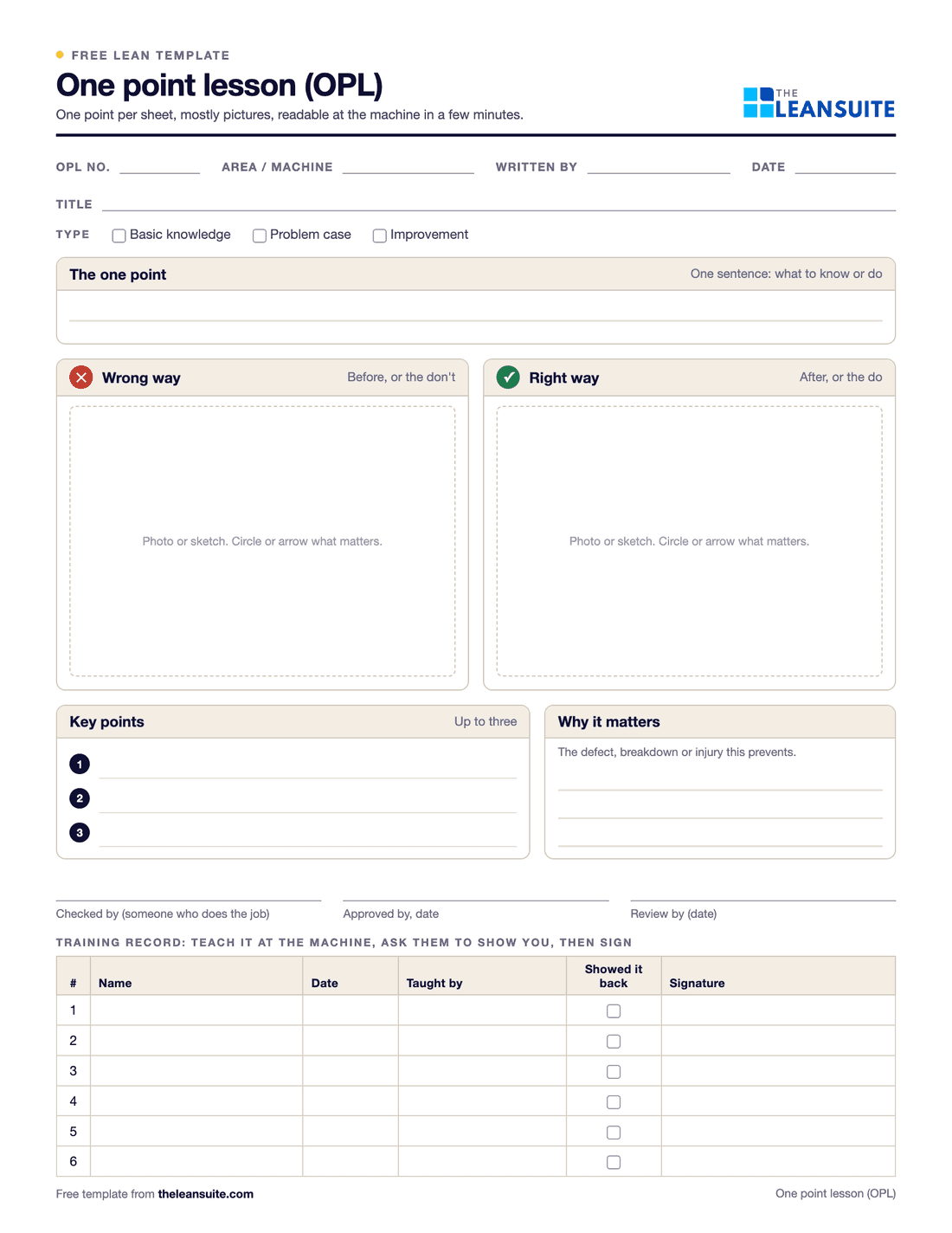
A one point lesson (OPL) is a single-page visual sheet that teaches one thing, such as how to read a gauge or spot a worn belt. It is mostly pictures and takes a few minutes to read at the machine. The operator or technician who knows the job best often writes it. This template has a header with the OPL number and type (basic knowledge, a problem case or an improvement), a box for the one point in a sentence, two picture boxes for the wrong way and the right way, three key points, a line on why it matters, and a training record where each person taught the lesson signs that they understood it.
Free to use: print it, copy it and edit it for your team. Enter your name and work email once to download.
When to use it
When to use a one point lesson
- To share something learned on the floor, such as the fix for a recurring problem, with every shift before it is forgotten.
- In autonomous maintenance, to teach operators one check, such as reading a sight glass or which lubricant goes on which point.
- After a defect, a near miss or a breakdown, to show the wrong way and the right way so it does not happen again.
- For one detail of a longer procedure that people keep getting wrong: the OPL shows that step without rewriting the SOP.
- Not for a whole job. A task with many steps needs standard work or a work instruction.
How to fill it in
- 1
Pick one point
One piece of knowledge or one skill per sheet. If the title needs the word "and", write two lessons.
- 2
Fill in the header
OPL number, title, area or machine, who wrote it and the date, and tick the type: basic knowledge, a problem case or an improvement.
- 3
Write the point in one sentence
What the reader must know or do, in plain words, such as: check the oil level with the machine stopped and level.
- 4
Show the wrong way and the right way
A photo or a simple sketch in each box, with an arrow or a circle on what matters. The pictures should teach the lesson even without the text.
- 5
Add the key points and why
Up to three short key points, and one line on why it matters: the defect, breakdown or injury it prevents.
- 6
Test it and approve it
Ask someone who does the job to read it at the machine. If they have questions, change the sheet. Then the team leader or engineer signs it off.
- 7
Teach it and record it
Go through it with each person at the machine, ask them to show you, and have them sign the training record. Post the sheet where the work is done.
A filled-in example
Illustrative, not a benchmarkAn OPL written by a maintenance technician after a conveyor chain failed early because it had been set too tight.
- Type: problem case. Title: setting chain tension on conveyor 2.
- The point: set the chain so it lifts between the two marks at its midpoint, and no tighter.
- Wrong way: a photo of the chain pulled tight with no slack, next to the worn sprocket that followed.
- Right way: a photo of a ruler against the chain at the midpoint, with the lift between the marks.
- Key points: lock out the conveyor first; measure at the midpoint; check again after a new chain has run in.
- Why it matters: an over-tight chain wears out sprockets and bearings early.
The page holds one point, two photos and three key points, and an operator can read it in a couple of minutes. Each person who sets the chain is shown the check at the conveyor and signs the record, and the OPL is posted next to the tensioner.
Common mistakes
Teaching more than one point
A sheet with five topics is a procedure. Keep to one point, and write another OPL for the next.
Too many words
If it needs paragraphs, nobody will read it at the machine. Let the pictures carry the lesson and keep the text to a few lines.
Pictures that do not show the difference
A photo of the whole machine teaches nothing. Get close to the point and mark it, so the wrong way and the right way are clearly different.
Posting it without teaching it
Nobody learns a method from a sheet on the wall. Go through it with each person and check they can do it.
Never reviewing it
When the machine, the part or the method changes, update the OPL or take it down, or it will keep teaching the old way.
Download the template
Free to use: print it, copy it and edit it for your team. Enter your name and work email once to download.
Run this template in LeanSuite
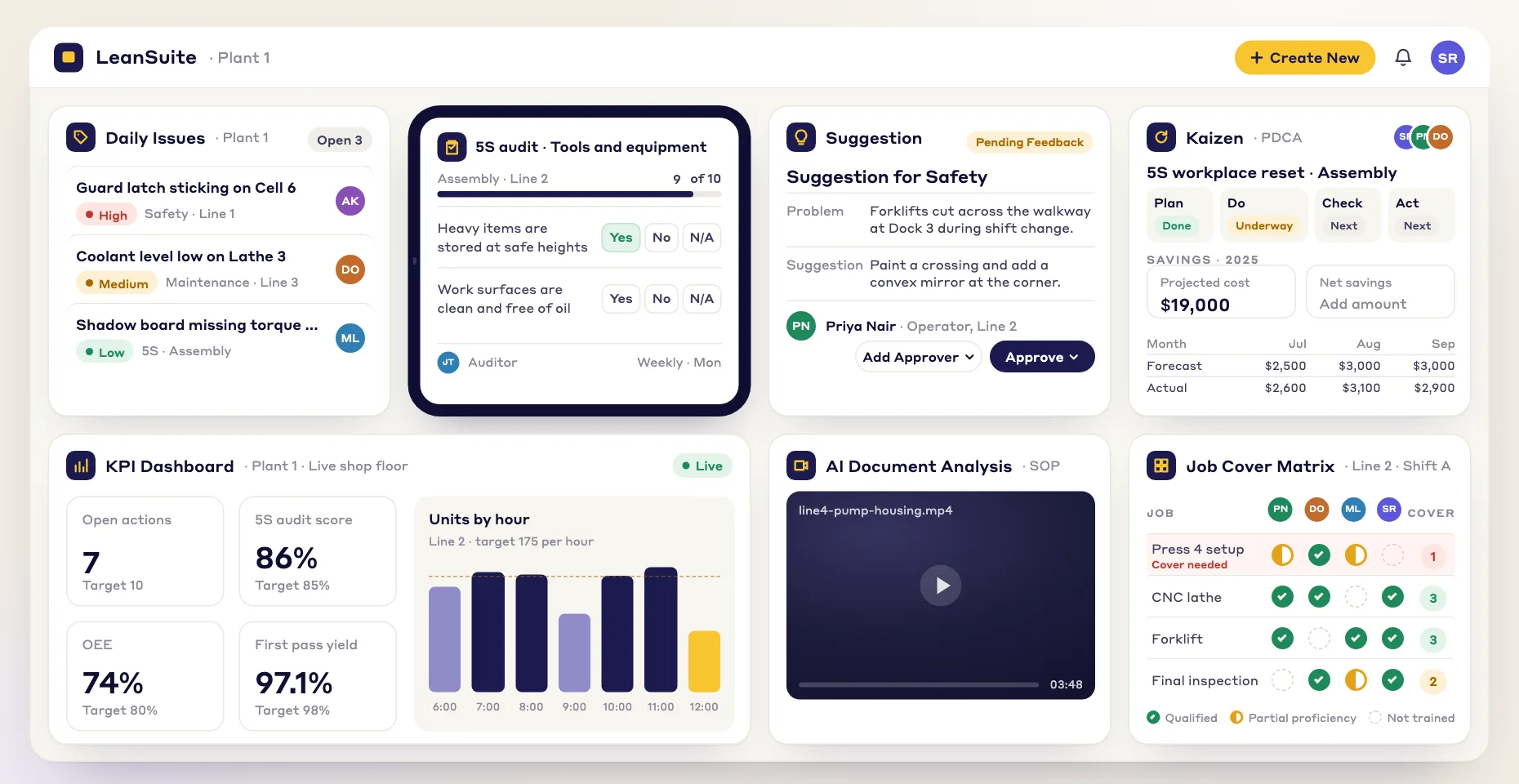
In LeanSuite you attach a before-and-after photo pair and the AI writes the one point lesson, with its title, key points and acknowledgement questions, ready to assign to the operators who need it, who can scan a QR code at the line to read and sign off.
In the lean glossary
Free tools
FAQ
One point lesson (OPL) template: common questions
More free templates
All templates- 5S audit checklist template25 checks, five per S, scored 1 to 5, with a score summary and a chart of the five S's.
- Gemba walk checklistA walk plan and route, 30 prompts in six groups and a findings table with owners and due dates.
- Leader standard work templateA team leader's daily, weekly and monthly routine with a box per day, follow-ups and a weekly review.
- Autonomous maintenance (CILR) checklist20 clean, inspect, lubricate and retighten checks with a box per day, an abnormality log and sign-off.
- A3 problem solving templateThe standard seven-box A3 on one landscape sheet, from background to follow-up.
- PDCA templateOne improvement cycle on one landscape page: plan, do, check against the goal, then standardize or adjust.
- 5 Whys templateA problem statement, five why rows with evidence, the root cause and the countermeasure.
- 5W1H templateSix questions with prompts and evidence, turned into a problem statement before the root cause analysis.
- 8D report templateD0 to D8 on three pages: team, is/is not, containment, occurrence and escape causes, actions and closure.
- Poka-yoke worksheetEach step's possible errors, prevention or detection, the method, a device idea and a verified box.
- Skills matrix templatePeople by skills, a 0 to 4 scale, a training column and a coverage row that shows the gaps.
- Standard work sheet templateTakt time, each element's manual, machine and walk time on a time chart, key points and standard WIP.
- SMED changeover worksheetChangeover steps with times, internal or external, what can move, ideas and before/after totals.
- Kaizen event charter templateScope, team and roles, baseline and target metrics, a five-day schedule, risks and sign-off.
- RACI matrix template17 kaizen project tasks by 10 roles, with R, A, C, I drop-downs and a check for one accountable per task.