
Free template
5W1H template
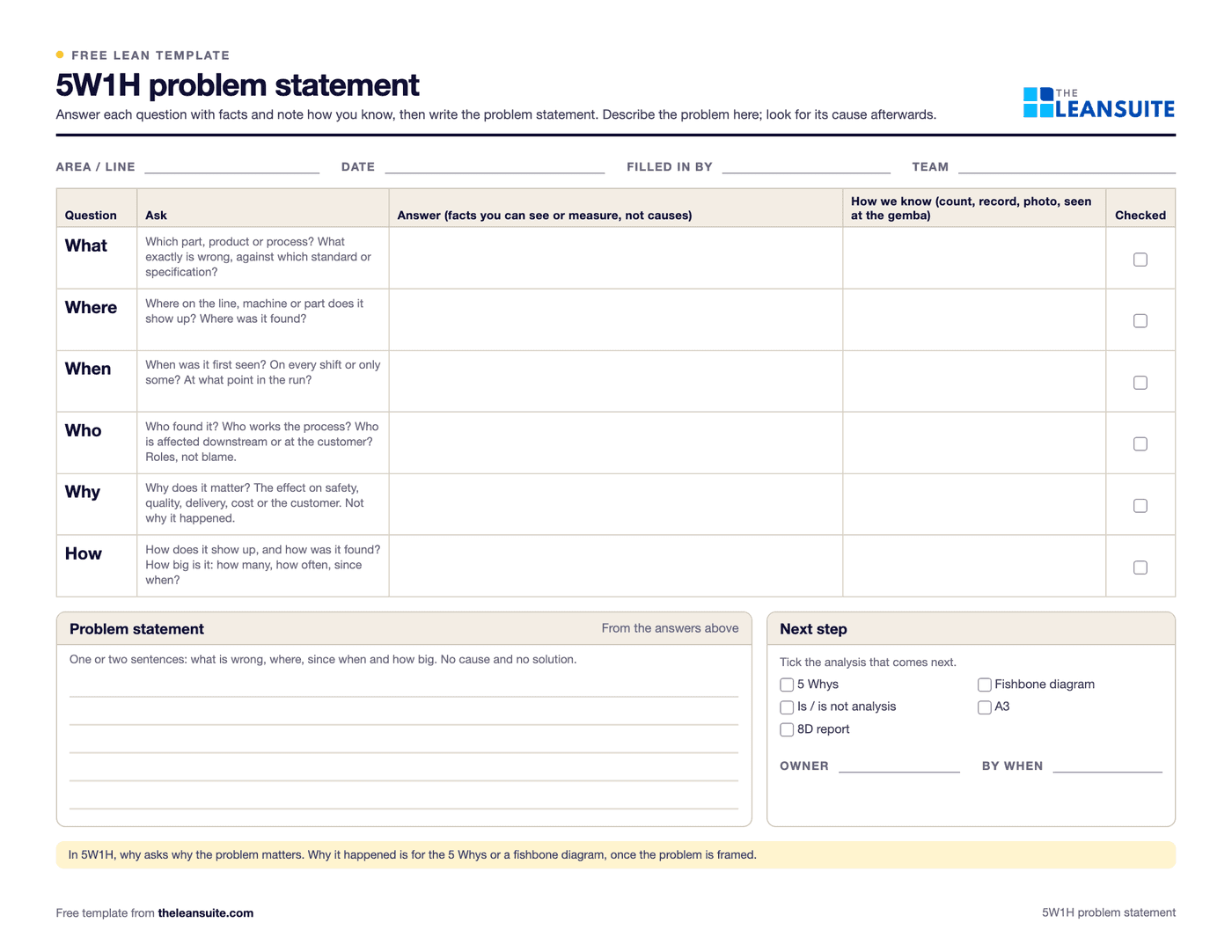
5W1H is a set of six questions (who, what, when, where, why and how) that a team answers with facts to describe a problem before it looks for the cause. On the shop floor it turns a report like “we have quality problems on line 2” into a problem statement someone can investigate. This worksheet has one row per question, with prompts for what to ask, space for the answer and a column for how you know it. Under the rows are a box for the problem statement you write from the answers and a place to note which analysis comes next. In 5W1H, why asks why the problem matters. The cause comes later, from the 5 Whys or a fishbone diagram.
Free to use: print it, copy it and edit it for your team. Enter your name and work email once to download.
When to use it
When to use 5W1H
- At the start of a root cause analysis, before a 5 Whys, a fishbone diagram or an 8D, so everyone works from the same facts.
- When a problem is reported in vague words, such as “the new parts are bad” or “the machine keeps stopping”, and nobody can say how big it is.
- To fill the current condition box of an A3 or the problem description (D2) of an 8D.
- When a problem has to be handed to someone who was not there, such as the next shift or a support team.
- Not for finding the cause itself. 5W1H frames the problem, and the analysis comes after it.
How to fill it in
- 1
Fill in the header
Area or line, date, who is filling it in and who took part. Do it with the people who saw the problem, at the gemba if you can.
- 2
Answer what first
Which part, product or process, and what exactly is wrong with it compared with the standard or specification. Write what you can see or measure and leave causes out.
- 3
Answer where and when
Where on the line, machine or part the problem shows up, and where it was found. When it was first seen, whether it happens on every shift or only on some, and at what point in the run.
- 4
Answer who
Who found it, who works the process and who is affected downstream or at the customer. Write roles, so the team knows who to talk to, and keep blame out of it.
- 5
Answer why it matters and how
Why: the effect on safety, quality, delivery, cost or the customer. How: how the problem shows up, how it was detected and how big it is, in parts, stops or hours and since when.
- 6
Write how you know
For each answer, note the evidence: a count, a record, a photo, something seen at the gemba. Tick the checked box once it is confirmed, and go and check any answer that is still a guess.
- 7
Write the problem statement
Put the answers together in one or two sentences with no cause and no solution in them. Tick the analysis that comes next and give the sheet to whoever runs it.
A filled-in example
Illustrative, not a benchmarkA 5W1H on leaks found at final test on a pump assembly line.
- What: model B pumps leaking at the outlet fitting on the final pressure test, where the standard is no leaks.
- Where: assembly line 3, found at the final test station. The leak is always at the outlet fitting, which is fitted and torqued at station 5.
- When: first seen on Tuesday's night shift, and on every shift since.
- Who: found by the final test operators; the station 5 operators on all three shifts fit the part; the rework cell repairs the leaking pumps.
- Why it matters: every leaking pump is reworked, and a leak missed at test would reach the customer.
- How: a pressure drop on the test rig, 14 leaking pumps out of 310 built since Tuesday, counted from the test records.
Problem statement: since Tuesday's night shift, 14 of the 310 model B pumps built on line 3 have leaked at the outlet fitting on final test. The statement names no cause. The team takes it to a fishbone with the station 5 operators, then runs a 5 Whys on the likeliest branch.
Common mistakes
Writing a cause into the answers
“Leaks because the torque gun is out” is a guess about the cause. Write what is seen and leave the cause to the analysis.
Answering from memory in a meeting room
Answers nobody has checked send the analysis the wrong way. Go to where the problem is and get the facts.
Using who to find someone to blame
The who row finds the people who know the process and the people affected. Once it turns into blame, people stop reporting problems.
Reading why as the root cause
In 5W1H, why asks why the problem matters. Asking why it happened belongs to the 5 Whys, after the problem is framed.
Leaving out how big
Write a count or a rate instead of “some leaks”. Without one you cannot tell later whether a countermeasure worked.
Download the template
Free to use: print it, copy it and edit it for your team. Enter your name and work email once to download.
Run this template in LeanSuite
In LeanSuite's continuous improvement software you add 5W1H, 5 Whys, 4M1D and fishbone sections to any phase of a project, and the RCA Agent drafts them from the problem description and attached manuals or SOPs for you to edit and push into the action plan.
In the lean glossary
FAQ
5W1H template: common questions
More free templates
All templates- 5S audit checklist template25 checks, five per S, scored 1 to 5, with a score summary and a chart of the five S's.
- Gemba walk checklistA walk plan and route, 30 prompts in six groups and a findings table with owners and due dates.
- Leader standard work templateA team leader's daily, weekly and monthly routine with a box per day, follow-ups and a weekly review.
- Autonomous maintenance (CILR) checklist20 clean, inspect, lubricate and retighten checks with a box per day, an abnormality log and sign-off.
- A3 problem solving templateThe standard seven-box A3 on one landscape sheet, from background to follow-up.
- PDCA templateOne improvement cycle on one landscape page: plan, do, check against the goal, then standardize or adjust.
- 5 Whys templateA problem statement, five why rows with evidence, the root cause and the countermeasure.
- 8D report templateD0 to D8 on three pages: team, is/is not, containment, occurrence and escape causes, actions and closure.
- Poka-yoke worksheetEach step's possible errors, prevention or detection, the method, a device idea and a verified box.
- Skills matrix templatePeople by skills, a 0 to 4 scale, a training column and a coverage row that shows the gaps.
- Standard work sheet templateTakt time, each element's manual, machine and walk time on a time chart, key points and standard WIP.
- One point lesson (OPL) templateOne topic on one page: wrong way and right way pictures, key points, why it matters and a sign-off record.
- SMED changeover worksheetChangeover steps with times, internal or external, what can move, ideas and before/after totals.
- Kaizen event charter templateScope, team and roles, baseline and target metrics, a five-day schedule, risks and sign-off.
- RACI matrix template17 kaizen project tasks by 10 roles, with R, A, C, I drop-downs and a check for one accountable per task.