
Free template
Autonomous maintenance (CILR) checklist
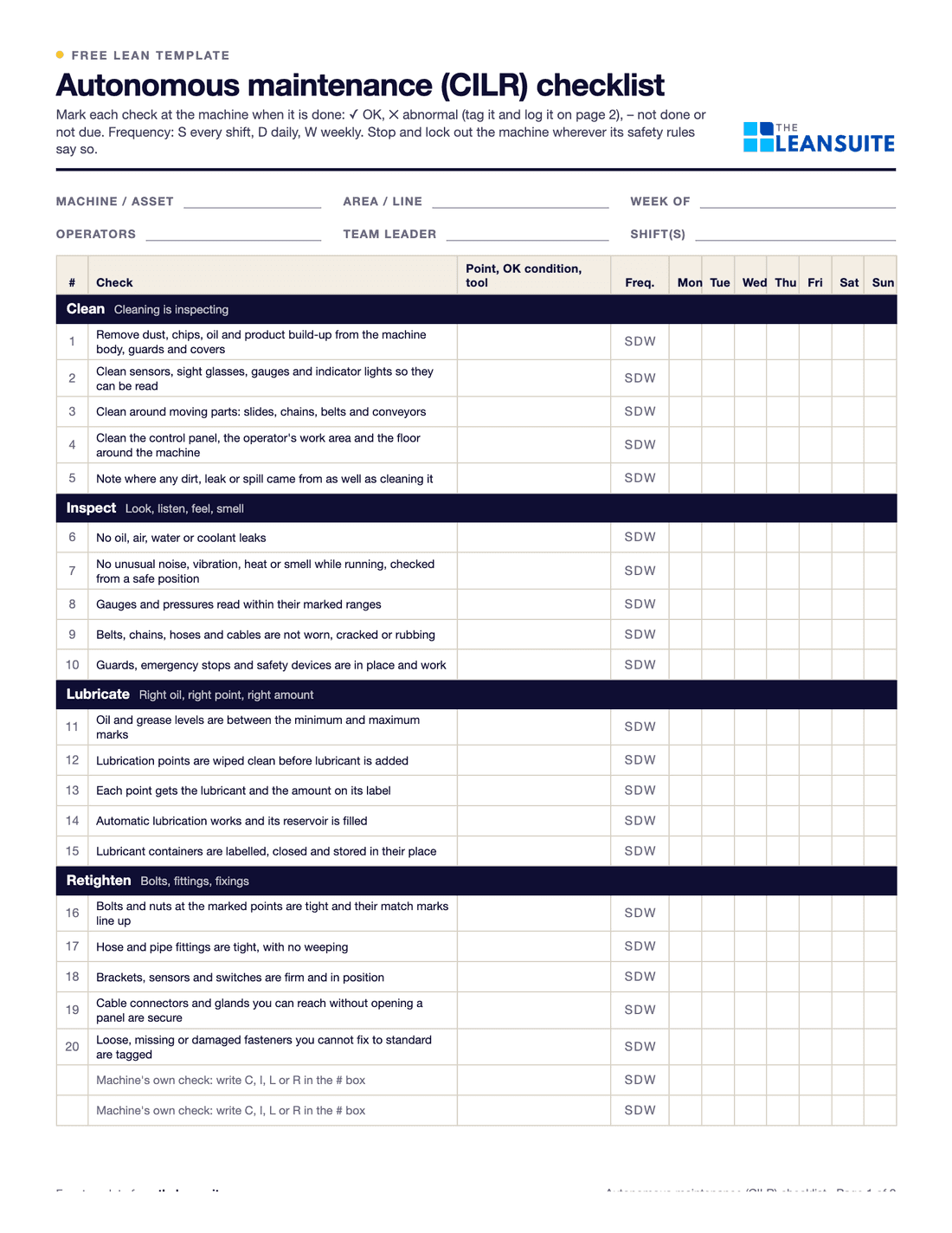
Autonomous maintenance is the TPM pillar in which operators take on the basic care of their own machines, and CILR (clean, inspect, lubricate, retighten) is the routine they carry out every shift, day or week. This checklist has 20 common CILR checks, five for each task, with a column for the machine's own point, standard and tool, a frequency to circle and a box for each day of the week. Anything abnormal goes in the log on page 2 with its tag number, next to the sources of dirt and the hard-to-reach places the team finds, which are what step 2 of autonomous maintenance works on. Cross out checks that do not apply and add the machine's own, so the sheet matches the machine.
Free to use: print it, copy it and edit it for your team. Enter your name and work email once to download.
When to use it
When to use an autonomous maintenance checklist
- After the initial clean of a machine, step 1 of autonomous maintenance, to turn what the team found into a routine the operators repeat.
- To draft a machine's first CILR standard: start from these checks, cross out what does not apply and add the machine's own points.
- On a machine with repeat minor stops, leaks or loose parts, so the operator finds small problems before they cause a breakdown.
- When routine care moves from maintenance to operators, so both sides agree what the operator checks and what goes to maintenance.
How to fill it in
- 1
Fill in the header
Machine or asset, area, the week, the operators who run it and the team leader. Use one sheet per machine per week.
- 2
Make the checks fit the machine
Go through the 20 checks with maintenance. Cross out any that do not apply, add the machine's own in the blank rows, and write the point, the OK condition and the tool for each, such as: gearbox sight glass, oil between the marks.
- 3
Set the frequency
Circle S for every shift, D for daily or W for weekly. Operators and maintenance agree it from how quickly the machine gets dirty, wears or works loose.
- 4
Do the checks safely
Follow the machine's lockout and safety rules: some checks need the machine stopped and isolated. Operators check and tighten only what the standard says they can.
- 5
Mark each box
A tick for OK, a cross for abnormal and a dash if the check was not done or not due. Every cross gets a tag and a line in the abnormality log.
- 6
Log what you find
On page 2, write each abnormality, its tag number and whether the operator fixed it or it went to maintenance. Note where dirt and leaks come from and which points are hard to reach.
- 7
Review it every week
The team leader and maintenance go through the crosses, the open tags and the sources of dirt, fix causes instead of cleaning the same leak every day, and update the standard when a check changes.
What's on the checklist
The 20 CILR checks on the autonomous maintenance checklist
Five checks for each of clean, inspect, lubricate and retighten. On the sheet each one has a column for the machine's own point, standard and tool, a frequency and a box per day; cross out the ones that do not apply and add the machine's own.
Clean
Cleaning is inspecting
- 1Remove dust, chips, oil and product build-up from the machine body, guards and covers
- 2Clean sensors, sight glasses, gauges and indicator lights so they can be read
- 3Clean around moving parts: slides, chains, belts and conveyors
- 4Clean the control panel, the operator's work area and the floor around the machine
- 5Note where any dirt, leak or spill came from as well as cleaning it
Inspect
Look, listen, feel, smell
- 6No oil, air, water or coolant leaks
- 7No unusual noise, vibration, heat or smell while running, checked from a safe position
- 8Gauges and pressures read within their marked ranges
- 9Belts, chains, hoses and cables are not worn, cracked or rubbing
- 10Guards, emergency stops and safety devices are in place and work
Lubricate
Right oil, right point, right amount
- 11Oil and grease levels are between the minimum and maximum marks
- 12Lubrication points are wiped clean before lubricant is added
- 13Each point gets the lubricant and the amount on its label
- 14Automatic lubrication works and its reservoir is filled
- 15Lubricant containers are labelled, closed and stored in their place
Retighten
Bolts, fittings, fixings
- 16Bolts and nuts at the marked points are tight and their match marks line up
- 17Hose and pipe fittings are tight, with no weeping
- 18Brackets, sensors and switches are firm and in position
- 19Cable connectors and glands you can reach without opening a panel are secure
- 20Loose, missing or damaged fasteners you cannot fix to standard are tagged
A filled-in example
Illustrative, not a benchmarkOne week of CILR on a case erector in a packing area, run on two shifts.
- Clean: glue build-up on the nozzle guard every day. Source noted: the glue pot overfills at start-up.
- Inspect: the vacuum gauge read below its green band on Wednesday. Tagged; maintenance found a split vacuum hose.
- Lubricate: the chain drive's point had no label, so it got grease one day and oil the next. The team added a label with the right lubricant and amount.
- Retighten: the match mark on a sensor bracket had moved twice. The operator retightened it and tagged the bracket for a better fixing.
- Hard to reach: the rear chain guard has to come off to see the chain, so the team asked for an inspection window.
In one week the operators found four abnormalities, one source of dirt and one hard-to-reach point. The weekly review turns the glue overflow, the missing label and the bracket into fixes, so the same crosses do not come back next week.
Common mistakes
Cleaning without looking
Cleaning is how operators find problems. Wiping away the same leak every day without tagging it hides the problem.
Using a generic list as the standard
These checks are a starting point. Each machine needs its own points, OK conditions and tools, agreed with maintenance.
Ticking at the end of the shift
Ticks written from memory at the end of the shift can't be trusted. Mark each box at the machine, when the check is done.
Crosses nobody follows up
If abnormal marks never get an answer, operators stop making them. Review the open tags every week and close each one.
Asking operators to go beyond their training
Operators do the checks they are trained and allowed to do. Anything that needs a panel opened or a guard removed stays with maintenance unless the standard says otherwise.
Download the template
Free to use: print it, copy it and edit it for your team. Enter your name and work email once to download.
Run this template in LeanSuite
LeanSuite puts each machine's clean, inspect, lubricate and retighten routine on the operator's Daily Standard Work, assigned to the machine so whoever runs it sees the checks, with a photo or QR scan as proof and a maintenance tag raised from any check that finds a problem.
In the lean glossary
FAQ
Autonomous maintenance (CILR) checklist: common questions
More free templates
All templates- 5S audit checklist template25 checks, five per S, scored 1 to 5, with a score summary and a chart of the five S's.
- Gemba walk checklistA walk plan and route, 30 prompts in six groups and a findings table with owners and due dates.
- Leader standard work templateA team leader's daily, weekly and monthly routine with a box per day, follow-ups and a weekly review.
- A3 problem solving templateThe standard seven-box A3 on one landscape sheet, from background to follow-up.
- PDCA templateOne improvement cycle on one landscape page: plan, do, check against the goal, then standardize or adjust.
- 5 Whys templateA problem statement, five why rows with evidence, the root cause and the countermeasure.
- 5W1H templateSix questions with prompts and evidence, turned into a problem statement before the root cause analysis.
- 8D report templateD0 to D8 on three pages: team, is/is not, containment, occurrence and escape causes, actions and closure.
- Poka-yoke worksheetEach step's possible errors, prevention or detection, the method, a device idea and a verified box.
- Skills matrix templatePeople by skills, a 0 to 4 scale, a training column and a coverage row that shows the gaps.
- Standard work sheet templateTakt time, each element's manual, machine and walk time on a time chart, key points and standard WIP.
- One point lesson (OPL) templateOne topic on one page: wrong way and right way pictures, key points, why it matters and a sign-off record.
- SMED changeover worksheetChangeover steps with times, internal or external, what can move, ideas and before/after totals.
- Kaizen event charter templateScope, team and roles, baseline and target metrics, a five-day schedule, risks and sign-off.
- RACI matrix template17 kaizen project tasks by 10 roles, with R, A, C, I drop-downs and a check for one accountable per task.