
Skip to content
LeanSuite - Lean Manufacturing Software

Guide and free templates

Leader standard work: definition, examples and free templates

Short answer

Leader standard work is a written routine of the daily, weekly and monthly tasks each leader does to keep the lean system running, such as tier meetings, gemba walks, audits and checks of the boards. It is standard work for leaders: it makes the leader's own work visible, so a missed check shows up and gets talked about instead of quietly dropping off the day.

Why it matters

Why leader standard work matters

Lean tools only keep working if someone checks them. A tier board that nobody looks at stops being updated, and a standard that nobody watches drifts away from how the job is really done. Leader standard work puts those checks in each leader's week at fixed times, so they still happen on a busy day.

It also changes what leaders see. A team leader who watches one job against its standard every day finds the gap between the written method and the real one. A manager who goes through a supervisor's sheet each week sees which tasks get dropped and why, and that is usually where the system needs help: a meeting that overruns, a missing person, a machine that keeps stopping.

Once it is written down, the routine can be taught to a new leader, covered when someone is away and improved like any other standard. The glossary entry has the short definition, and our guide to what manufacturing leaders should do daily goes into the team leader's day in more depth.

The leader standard work pyramid

Leader standard work by role

Every level has a routine, but its size changes. A team leader's day is mostly fixed tasks tied to the shift. Higher up, the routine gets shorter, moves from daily to weekly and monthly, and is more about checking that the routines below are working.

Share of the day that is standard work
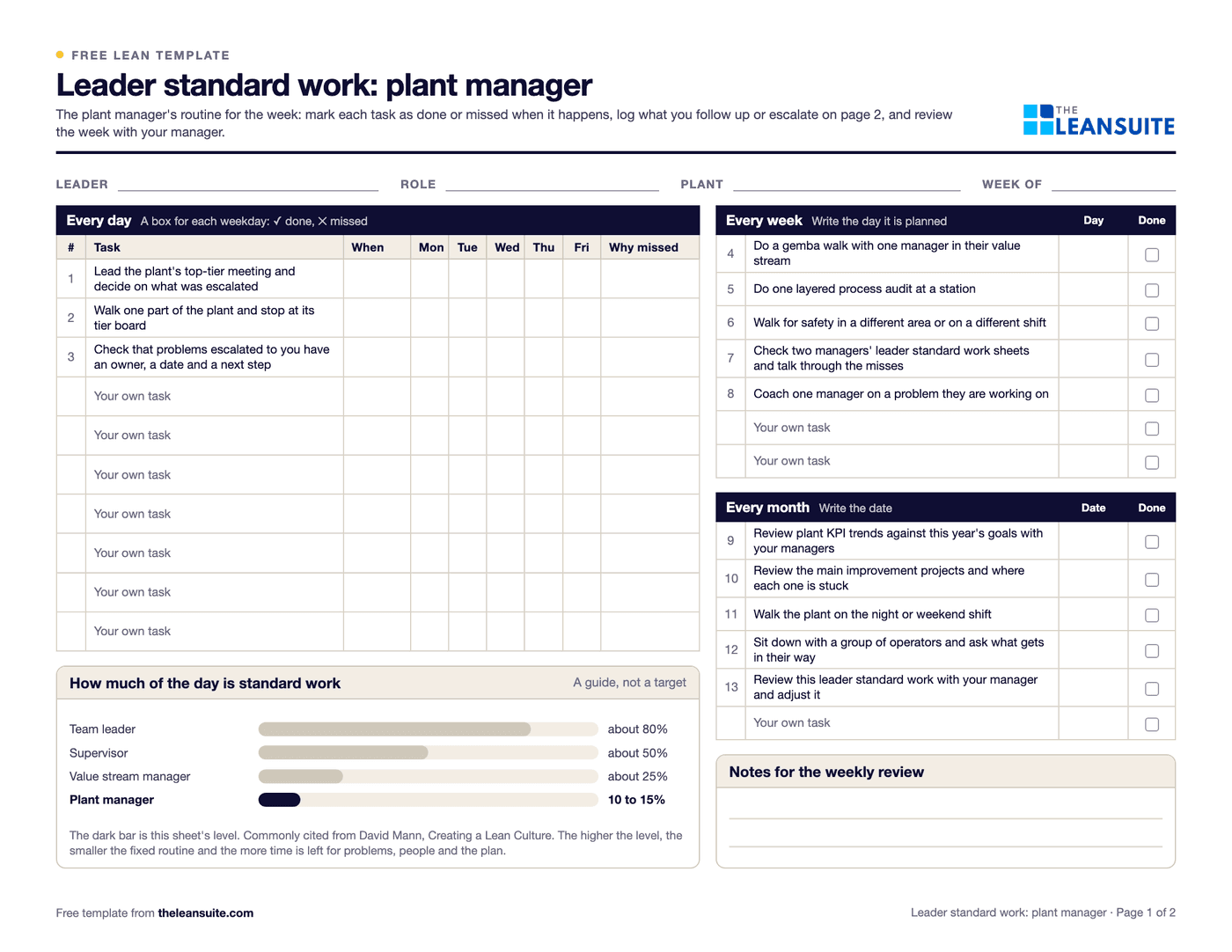
  1. Plant manager10 to 15%
  2. Production or value stream managerabout 25%
  3. Supervisor or area leaderabout 50%
  4. Team leaderabout 80%

The share of the day is David Mann's guidance in his book Creating a Lean Culture, the source most often quoted for it. It is a guide, not LeanSuite data and not a target. Tier numbers vary from plant to plant; this is a common four-level setup.

  • Plant manager

    The plant's top-tier meeting

    The whole plant: a daily walk, gemba walks with managers, checks of the managers' own routines, KPIs against the year's goals and time on the night or weekend shift.

    Plant manager leader standard work template
  • Production or value stream manager

    Tier 3, for the value stream or department

    Several areas: walks and audits with the supervisors, checks of the supervisors' routines, decisions on what is escalated and a monthly KPI review.

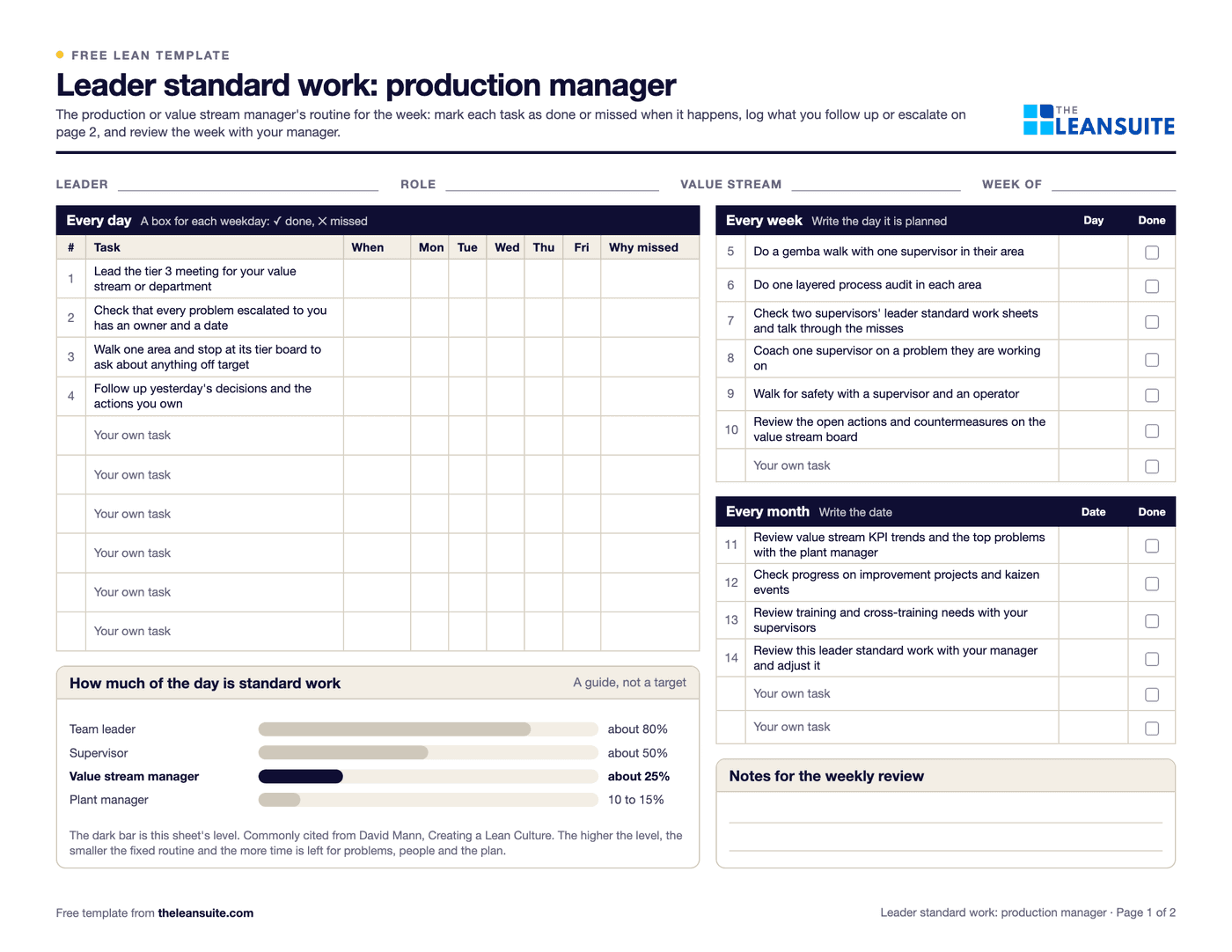
    Production manager leader standard work template
  • Supervisor or area leader

    Tier 2, for the area

    One area and its teams: checks that each team's board and routine work, a layered audit, coaching team leaders and escalating what the area cannot solve.

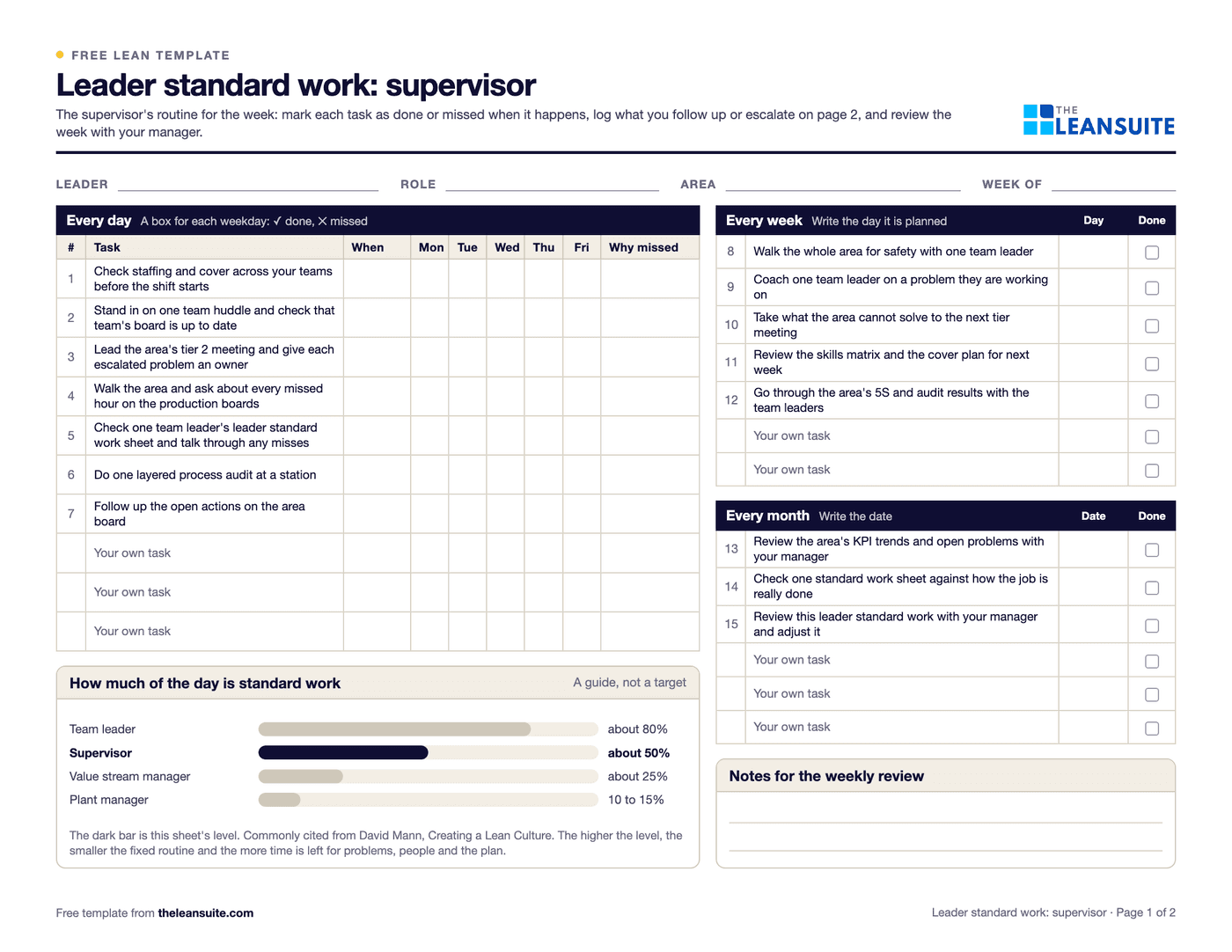
    Supervisor leader standard work template
  • Team leader

    Tier 1, the team huddle

    The shift and the team's own process: staffing, the huddle, the production board, watching jobs against their standard and the handover.

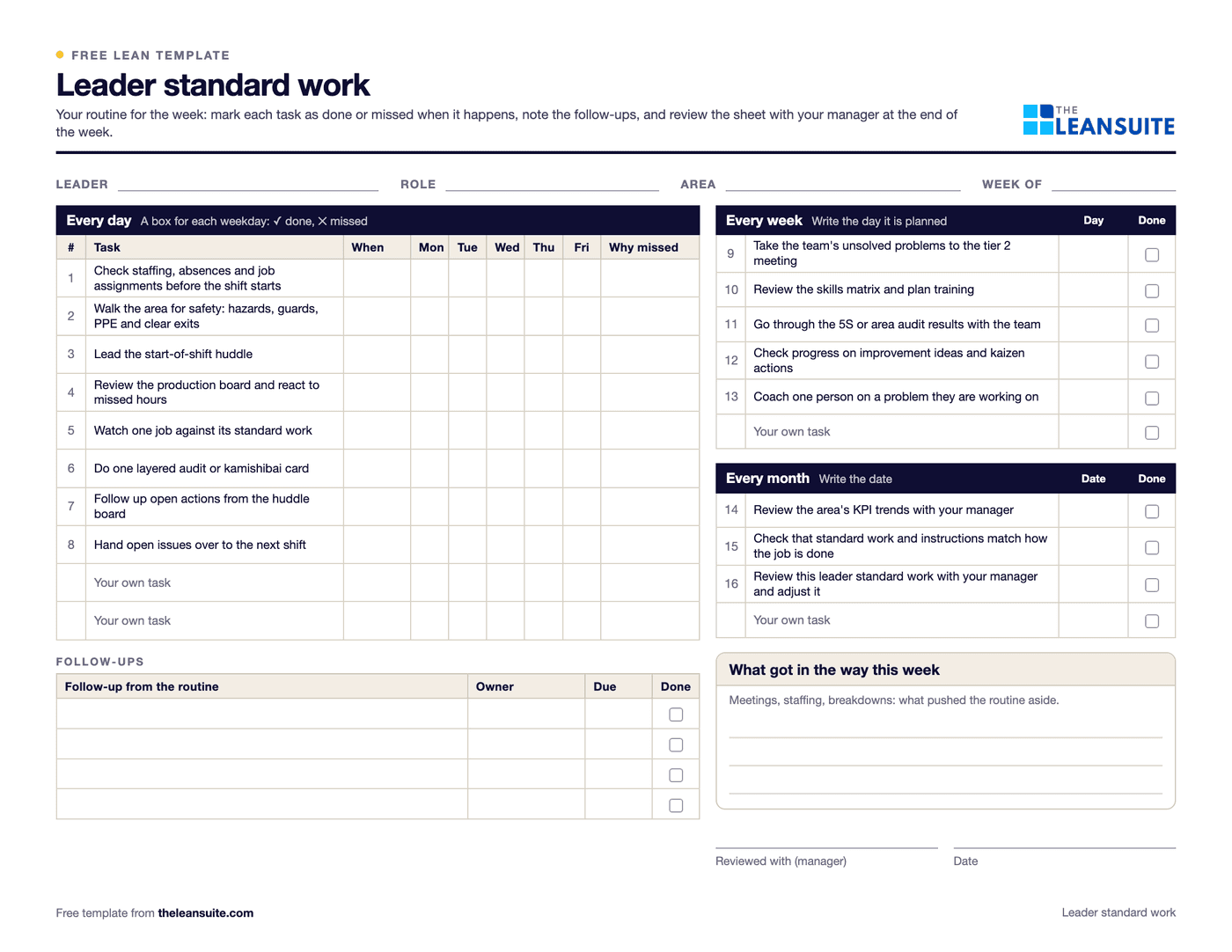
    Leader standard work template

How to

How to build leader standard work in 5 steps

  1. 1

    List what the routine has to keep running

    Write down the tier meetings, boards, audits and walks your plant already has, and who should keep each one going. Leader standard work supports that system. It does not replace it.

  2. 2

    Write each level's tasks by day, week and month

    Start from the [template](#templates) for the level and cut it down. Each task should be something you can see done or not done, such as doing one layered audit at a station, rather than something like supporting safety.

  3. 3

    Give every task a time, and leave room

    Put a time on each daily task, a day on each weekly one and a date on each monthly one. Leave the rest of the day for problems and people. The higher the level, the smaller the fixed routine.

  4. 4

    Mark it as you go and keep it visible

    Tick or cross each task when it happens and write why when one is missed. Keep the sheet where your manager and your team can see it, on the board or on a clipboard.

  5. 5

    Review it every week with the next leader up

    Go through the misses, the follow-ups and what got in the way. Fix the cause of misses that keep coming back, and change the routine when the job changes.

Examples

Leader standard work examples by role

One example routine for each level, the same tasks the free templates start from. They are examples, not a standard: a plant with three tiers, or supervisors who also run a line, will need different ones.

Team leader

about 80% of the day (Mann)

Every day

  • Check staffing, absences and job assignments before the shift starts
  • Walk the area for safety: hazards, guards, PPE and clear exits
  • Lead the start-of-shift huddle
  • Review the production board and react to missed hours
  • Watch one job against its standard work
  • Do one layered audit or kamishibai card
  • Follow up open actions from the huddle board
  • Hand open issues over to the next shift

Every week

  • Take the team's unsolved problems to the tier 2 meeting
  • Review the skills matrix and plan training
  • Go through the 5S or area audit results with the team
  • Check progress on improvement ideas and kaizen actions
  • Coach one person on a problem they are working on

Every month

  • Review the area's KPI trends with your manager
  • Check that standard work and instructions match how the job is done
  • Review this leader standard work with your manager and adjust it
Download this routine as a template

Supervisor or area leader

about 50% of the day (Mann)

Every day

  • Check staffing and cover across your teams before the shift starts
  • Stand in on one team huddle and check that team's board is up to date
  • Lead the area's tier 2 meeting and give each escalated problem an owner
  • Walk the area and ask about every missed hour on the production boards
  • Check one team leader's leader standard work sheet and talk through any misses
  • Do one layered process audit at a station
  • Follow up the open actions on the area board

Every week

  • Walk the whole area for safety with one team leader
  • Coach one team leader on a problem they are working on
  • Take what the area cannot solve to the next tier meeting
  • Review the skills matrix and the cover plan for next week
  • Go through the area's 5S and audit results with the team leaders

Every month

  • Review the area's KPI trends and open problems with your manager
  • Check one standard work sheet against how the job is really done
  • Review this leader standard work with your manager and adjust it
Download this routine as a template

Production or value stream manager

about 25% of the day (Mann)

Every day

  • Lead the tier 3 meeting for your value stream or department
  • Check that every problem escalated to you has an owner and a date
  • Walk one area and stop at its tier board to ask about anything off target
  • Follow up yesterday's decisions and the actions you own

Every week

  • Do a gemba walk with one supervisor in their area
  • Do one layered process audit in each area
  • Check two supervisors' leader standard work sheets and talk through the misses
  • Coach one supervisor on a problem they are working on
  • Walk for safety with a supervisor and an operator
  • Review the open actions and countermeasures on the value stream board

Every month

  • Review value stream KPI trends and the top problems with the plant manager
  • Check progress on improvement projects and kaizen events
  • Review training and cross-training needs with your supervisors
  • Review this leader standard work with your manager and adjust it
Download this routine as a template

Plant manager

10 to 15% of the day (Mann)

Every day

  • Lead the plant's top-tier meeting and decide on what was escalated
  • Walk one part of the plant and stop at its tier board
  • Check that problems escalated to you have an owner, a date and a next step

Every week

  • Do a gemba walk with one manager in their value stream
  • Do one layered process audit at a station
  • Walk for safety in a different area or on a different shift
  • Check two managers' leader standard work sheets and talk through the misses
  • Coach one manager on a problem they are working on

Every month

  • Review plant KPI trends against this year's goals with your managers
  • Review the main improvement projects and where each one is stuck
  • Walk the plant on the night or weekend shift
  • Sit down with a group of operators and ask what gets in their way
  • Review this leader standard work with your manager and adjust it
Download this routine as a template

Common mistakes

  • Writing a job description

    Leader standard work lists specific tasks at specific times. Everything else the job involves stays off the sheet.

  • Filling the whole day

    A routine that takes every minute will not survive the first breakdown, and it leaves no time for the problems the routine turns up.

  • Ticking without doing

    A tick for a walk that did not happen hides the very thing the sheet is there to show. Mark the misses and write why.

  • Nobody reviews it

    Without a weekly review by the next leader up, the sheet turns into paperwork and nothing protects the routine when the day gets busy.

  • Starting with the front line only

    If team leaders have routines and the people above them do not, the routines fade within weeks. Write them for every level, starting with the leaders who will review the others.

How to keep it going

  • A weekly review at every level

    Each leader goes through their sheet with their own manager once a week: what was done and missed, what got in the way and what changes next week. Each of the four templates has room for it.

  • Talk about the misses at the tier meeting

    Some plants put each leader's routine, or just its misses, next to the tier board so a missed walk or audit is discussed with everything else on it.

  • Check the boards on the walk

    A leader who stops at each tier board on the walk and asks about anything off target keeps the boards current better than any reminder does.

  • Audit in layers

    A layered process audit puts leaders from every level on the floor on a schedule, and a kamishibai board turns part of the routine into cards that show at a glance which checks are done.

  • Change it when the job changes

    A new product, a new shift pattern or a new leader is a reason to rewrite the routine. A routine that no longer fits the job is the first one to be dropped.

In LeanSuite

Running leader standard work in LeanSuite

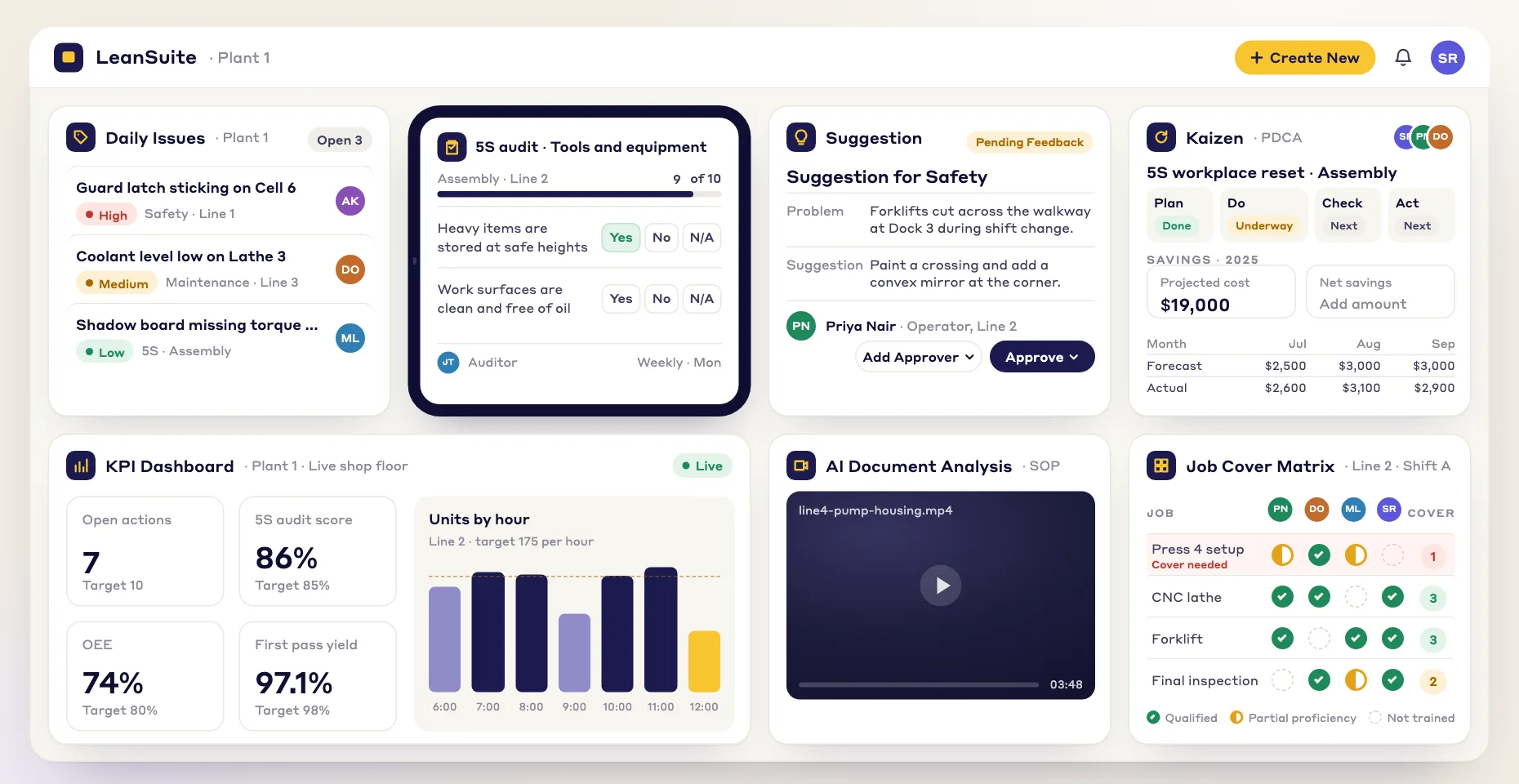
LeanSuite does not have a module called leader standard work. Leaders' routines run in Daily Standard Work, next to the audits, tier meetings and kaizen the routine is there to keep going.

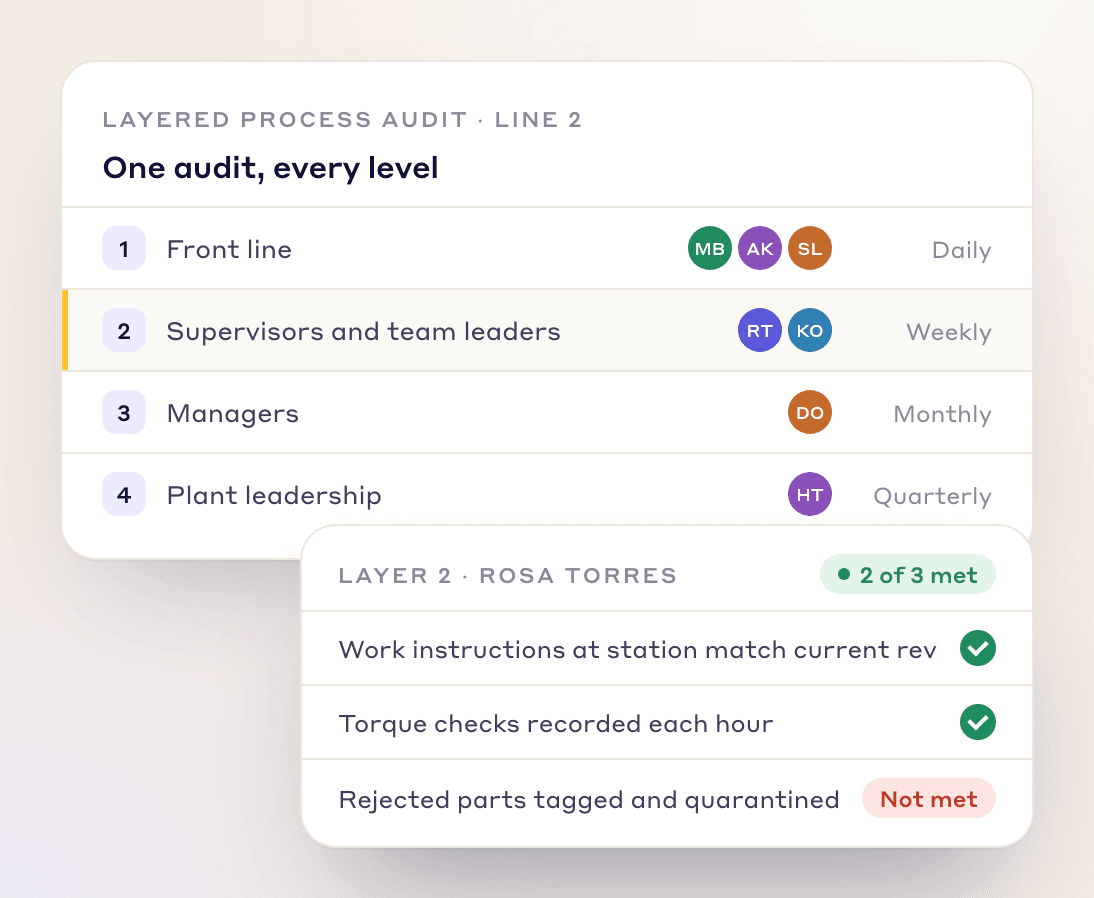
Layered process audit with four layers from front line to plant leadership, each on its own schedule, and a supervisor's audit results
  • Schedule each leader's checks

    Build a checklist or audit in Lean Creator, or let the AI draft it, and schedule it in Daily Standard Work to a person, a role or a machine with a repeat rule, from every shift to monthly.

  • See what is missed

    Each leader sees their checks on a calendar or Kanban board and gets an email reminder before one is due. Missed checks show in red, and a live dashboard shows completion across the plant.

  • Turn findings into actions

    Gemba walk checklists, layered process audits and standard work audits are done on a phone or tablet, with photos where required. A rule on an answer can raise a tag, an idea or a Kaizen, so a failed check becomes a tracked action.

  • Bring it to the tier meeting

    Daily Standard Work and audit results can be shown on Lean Studio tier meeting boards next to the KPIs, and Daily Issue Management escalates problems from tier 1 to tier 2 or 3.

See it on your own lines

Try the interactive demo in your browser with sample data, or pilot LeanSuite on your own lines for 90 days, with the setup done by our team. Comparing tools first? Read our guide to the best leader standard work software.

FAQ

Questions about leader standard work

Want every leader's routine scheduled and checked?

Bring the routines you run today, and we will show you on a call how they run in LeanSuite.