

Safety poster
Updated · Free to print and share
GHS hazard pictograms poster
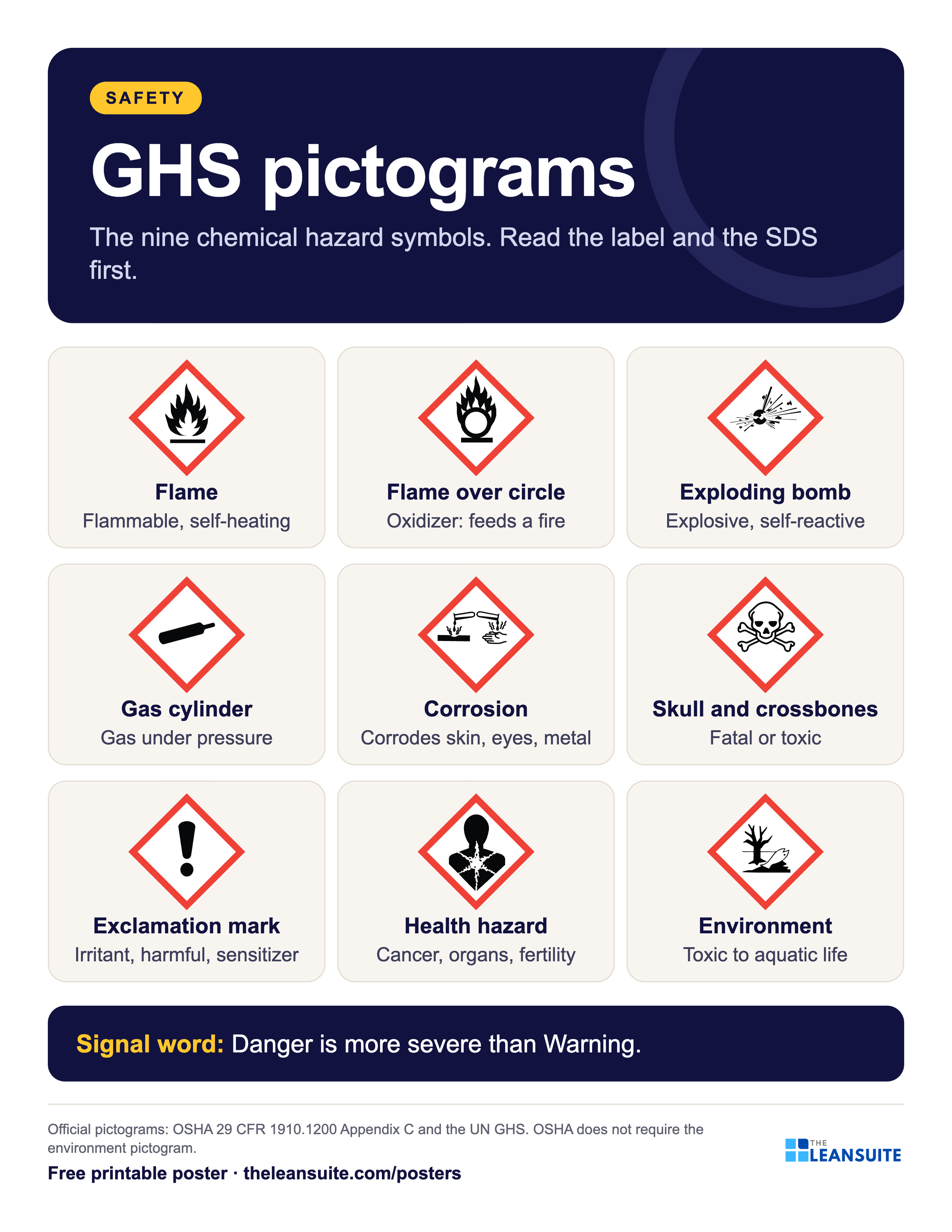
The Globally Harmonized System (GHS) puts the same hazard pictograms on chemical labels in most countries: a black symbol in a red-bordered diamond. This poster shows all nine with what each warns of, as set out in OSHA's Hazard Communication Standard, plus the other parts of the label to read: the signal word (Danger for the more severe hazards, Warning for the less severe), the hazard statements and the precautions. The pictograms are the official artwork as OSHA publishes it; the label on the container is what counts.
Download the poster
The PNG is free to download now. The print-ready vector PDFs open after a short form, once.
Free to print and share with your team. Enter your name and work email once to download.
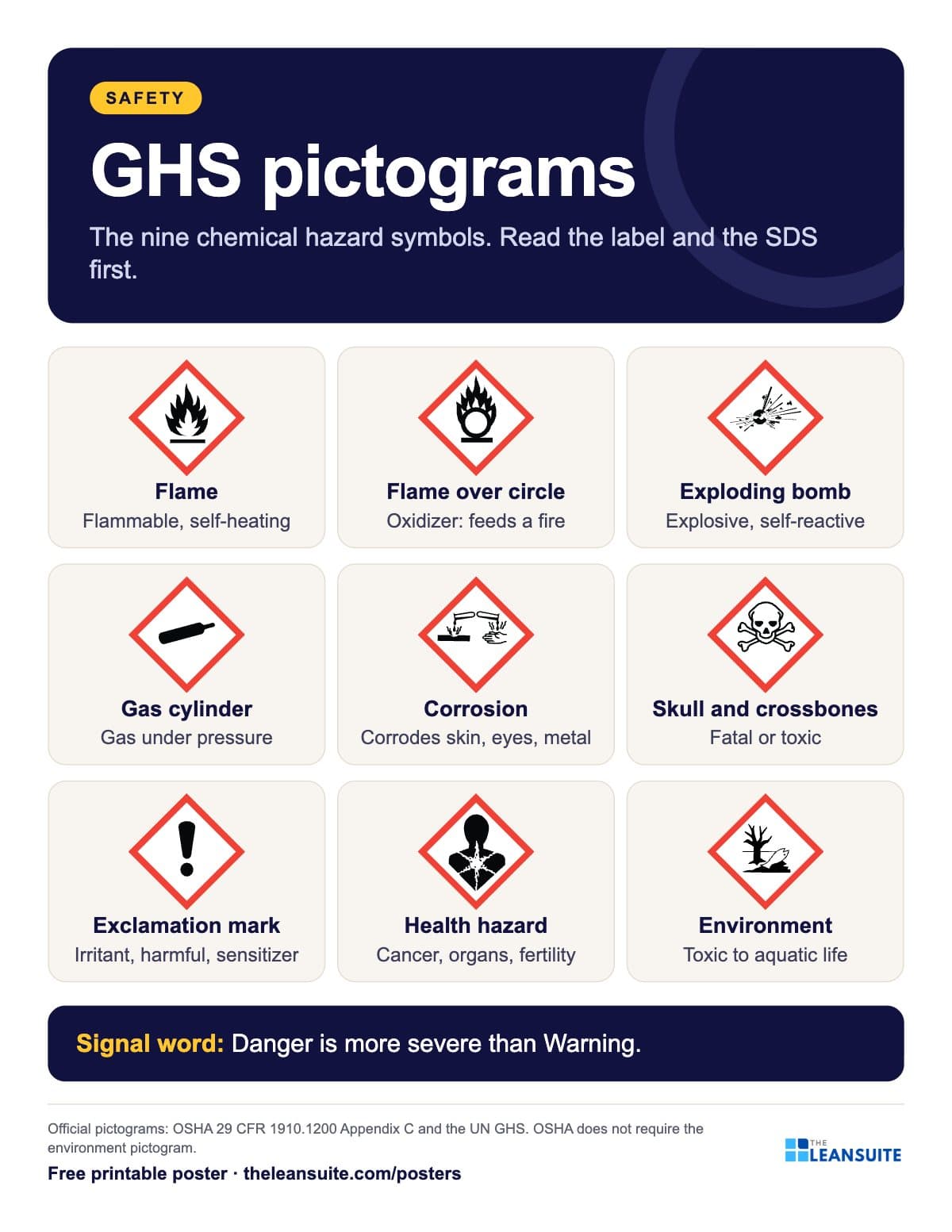 Nine red-bordered diamond symbols, from flame to skull and crossbones, each with what it warns of.
The words on the poster
GHS pictograms
The nine chemical hazard symbols. Read the label and the SDS first.
- Flame Flammable, self-heating
- Flame over circle Oxidizer: feeds a fire
- Exploding bomb Explosive, self-reactive
- Gas cylinder Gas under pressure
- Corrosion Corrodes skin, eyes, metal
- Skull and crossbones Fatal or toxic
- Exclamation mark Irritant, harmful, sensitizer
- Health hazard Cancer, organs, fertility
- Environment Toxic to aquatic life
- Signal word: Danger is more severe than Warning.
Official pictograms: OSHA 29 CFR 1910.1200 Appendix C and the UN GHS. OSHA does not require the environment pictogram.
On the floor
How to use it
Putting the GHS hazard pictograms poster to work
- 1
Post it in chemical stores, at dispensing points, in labs and maintenance shops.
- 2
Use it in hazard communication training with a real label from your site.
- 3
Ask: which pictograms are on the chemicals in this area, and where is the safety data sheet?
- 4
Pair it with the free chemical inventory and SDS register.
Which size to print
- 24 x 36 in or A2: a main wall or team board, read from a few metres away.
- 18 x 24 in or A3: a station or notice board. The A3 file also fits 11 x 17 in paper.
- Letter or A4: a clipboard, binder or handout, on any office printer.
Every PDF is vector, so it stays sharp at full size. Nothing runs to the edge of the page, so no bleed is needed.
Sources and notes
The pictograms on this poster are the official GHS artwork, taken unchanged from the files OSHA publishes for the Hazard Communication Standard; they are not redrawn. The full official chart is on OSHA's pictogram page and in the UN GHS, Annex 1. In the US, the environment pictogram is not required by OSHA's Hazard Communication Standard; elsewhere it is used for chemicals that are toxic to aquatic life.
- OSHA 29 CFR 1910.1200, Hazard Communication Standard, Appendix C: pictograms and the hazard classes each covers; signal words Danger and Warning.
- OSHA, Hazard Communication Standard pictograms: the official artwork used on this poster.
- United Nations, Globally Harmonized System of Classification and Labelling of Chemicals (GHS), Annex 1. The environment pictogram is not mandatory under OSHA's standard but is used in other GHS countries.
Templates, decks and guides to go with it
- Chemical inventory and SDS register templateA register of every chemical on site with its hazard class, safety data sheet and label, and a check that incompatible products are kept apart.
- Toolbox talk templateA record of a short safety talk: topic, key points, questions raised, actions and an attendee sign-in sheet.
- Safety audit checklistThirty-four plant-wide safety checks answered Yes, No or N/A, scored by area, with a risk rating and an action for every No.
- Topic: Safety managementEvery guide we have on the subject, sorted.
Terms on this poster
More safety posters
All posters PPE by zone poster
 Lockout tagout (LOTO) steps poster
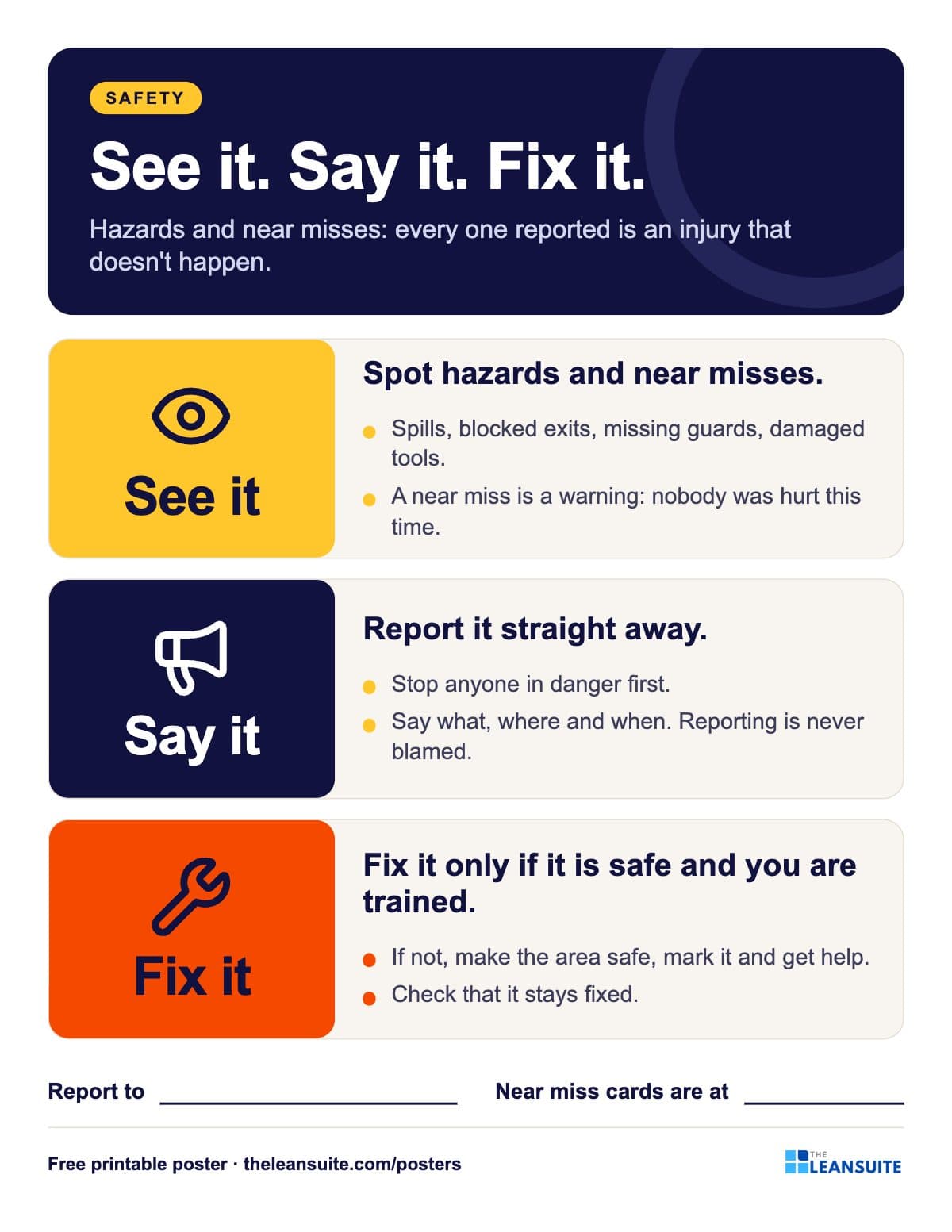 See it, say it, fix it safety poster
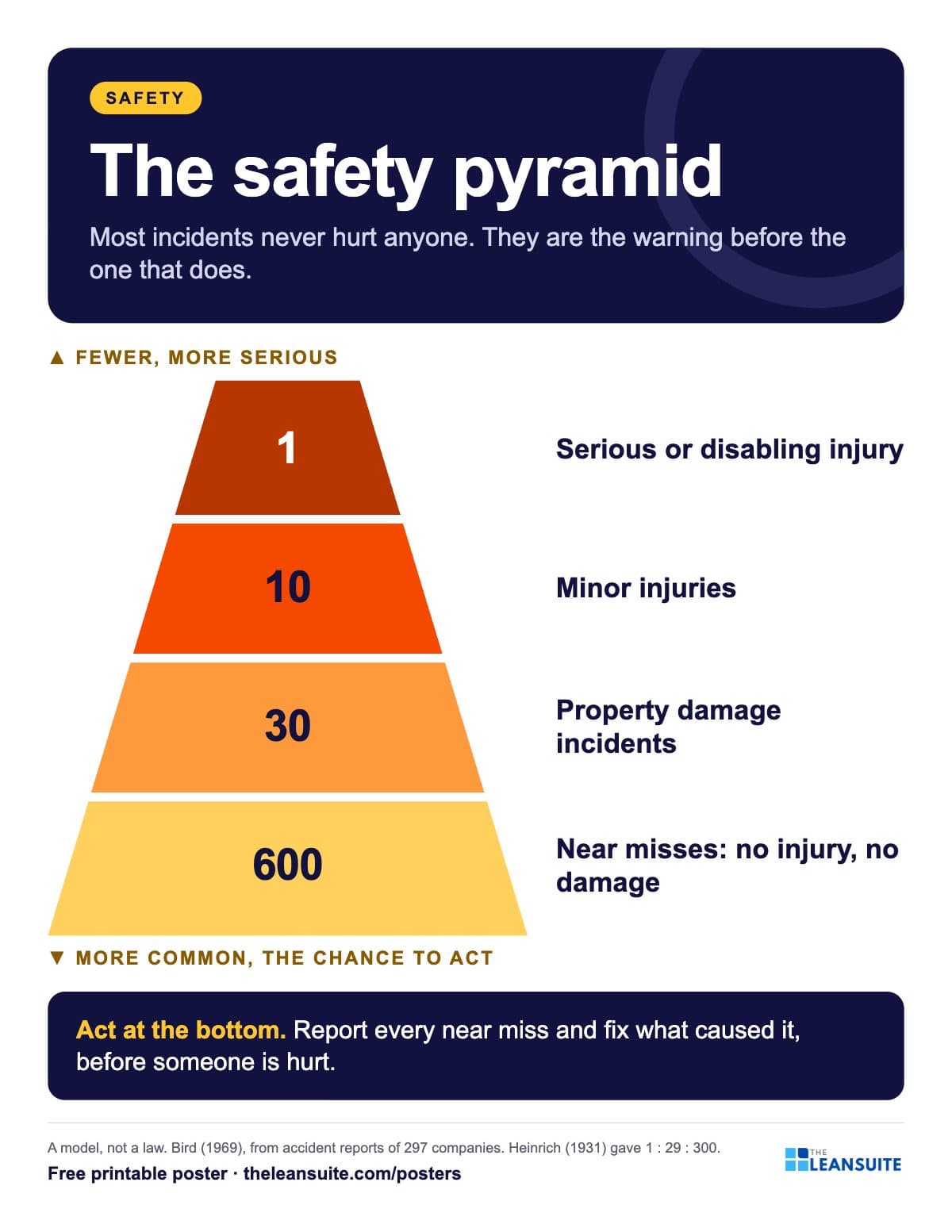 Safety pyramid poster (Bird's triangle)
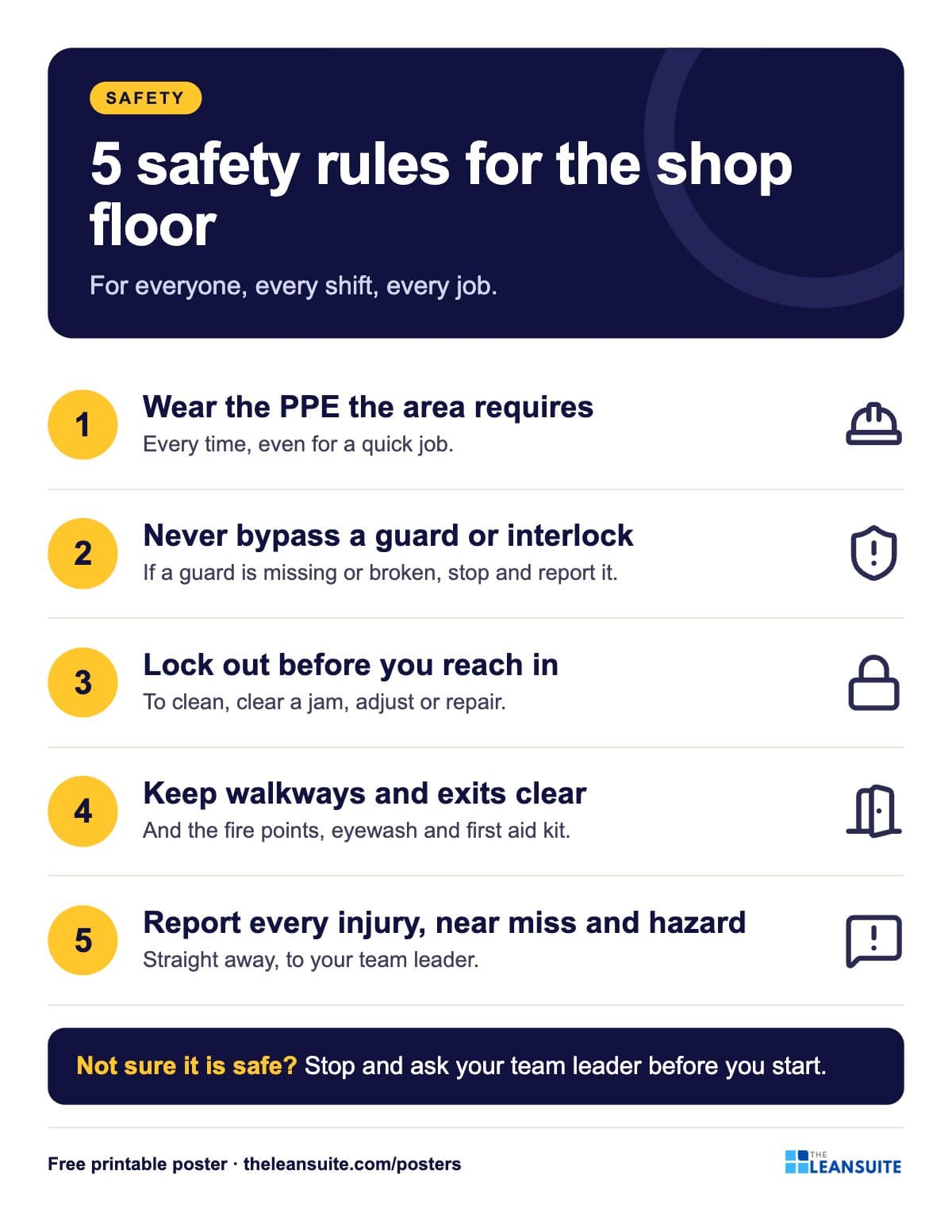 5 shop floor safety rules poster
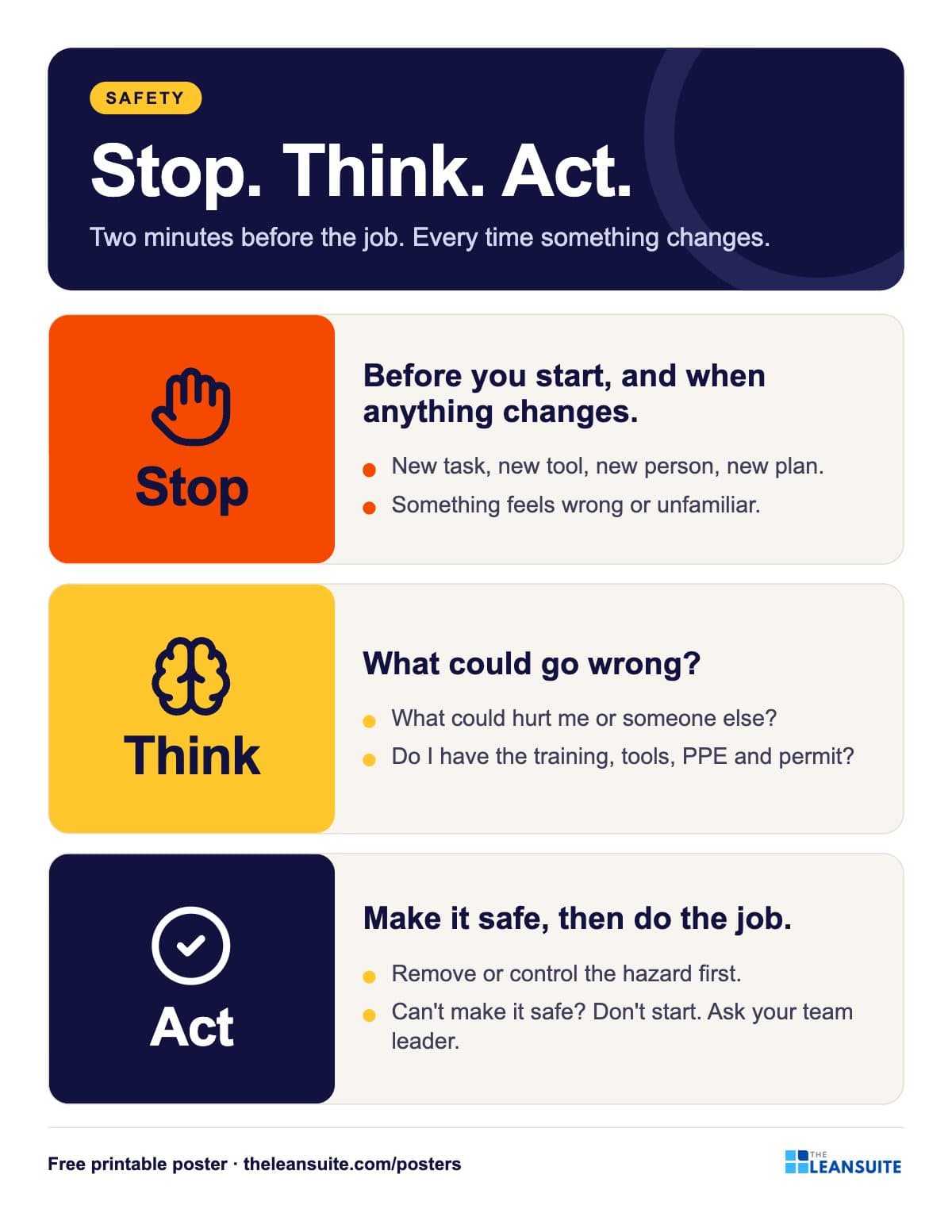 Stop, think, act safety poster
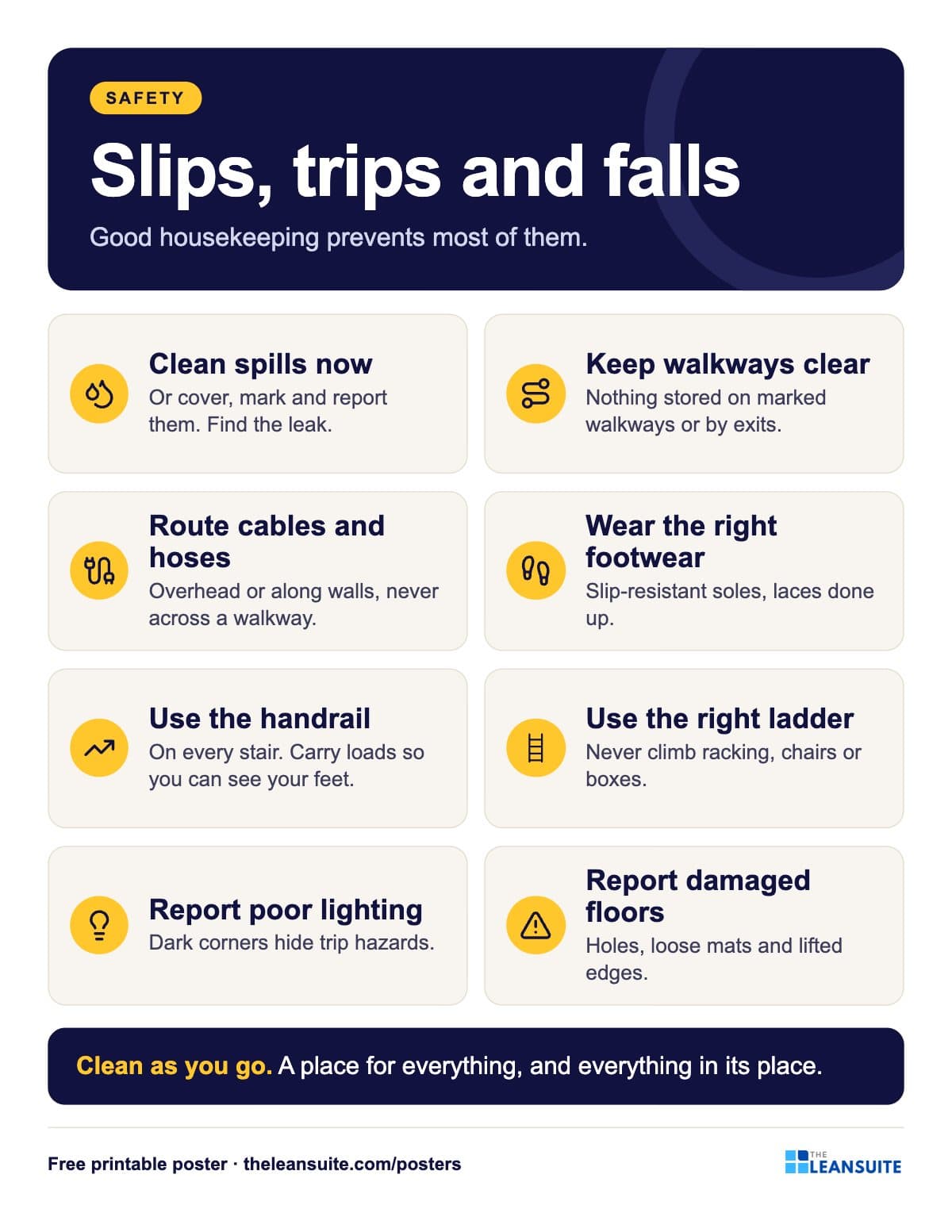 Slips, trips and falls housekeeping poster
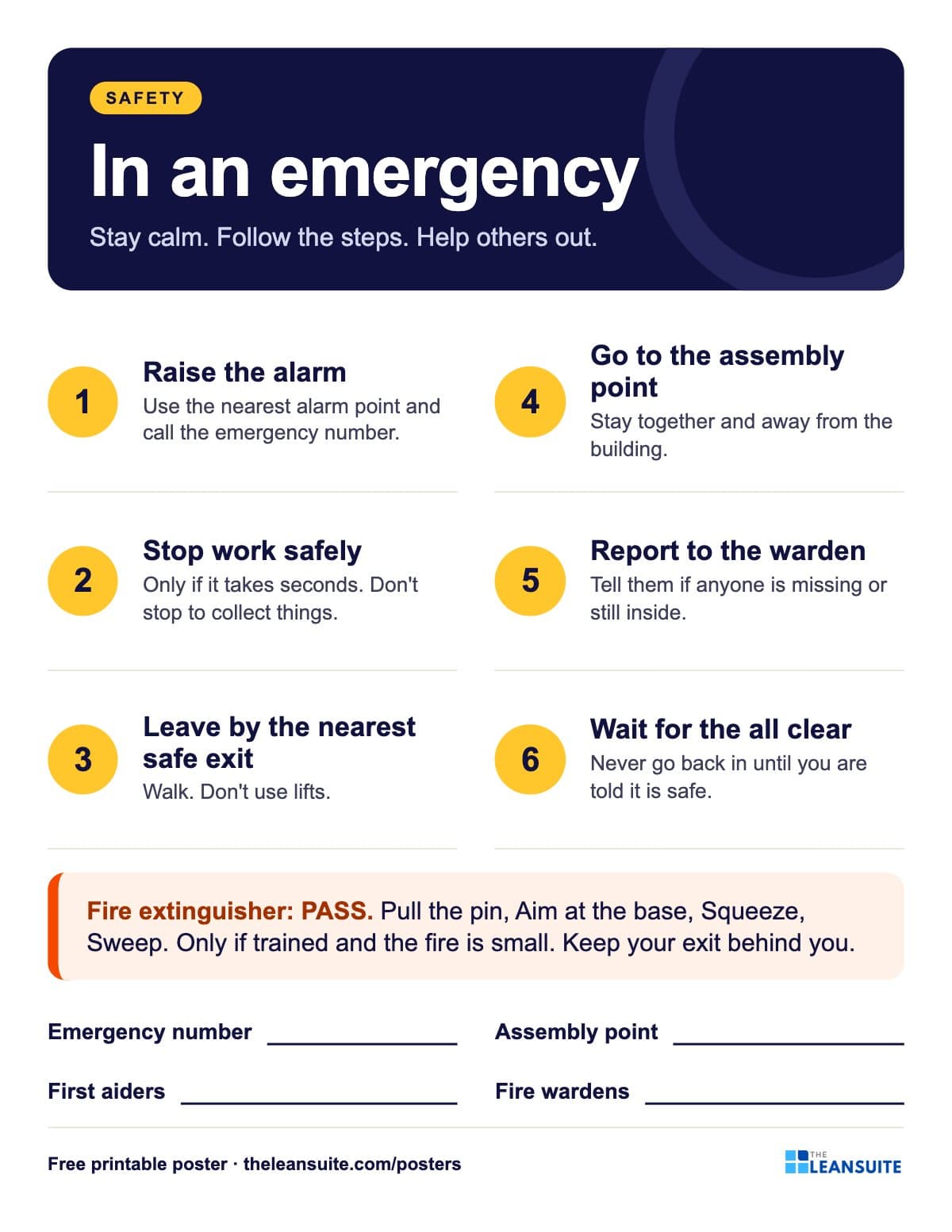 Emergency response poster
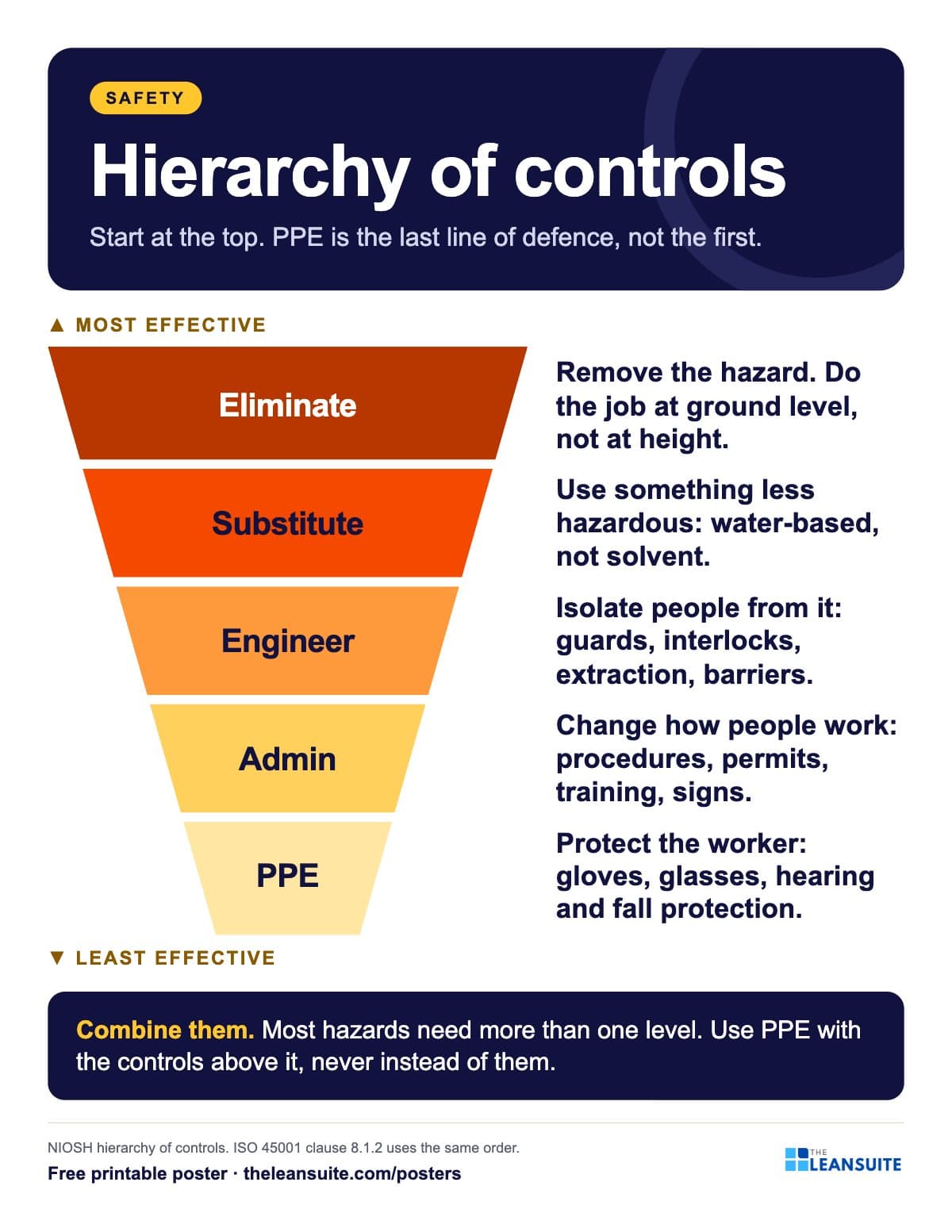 Hierarchy of controls poster
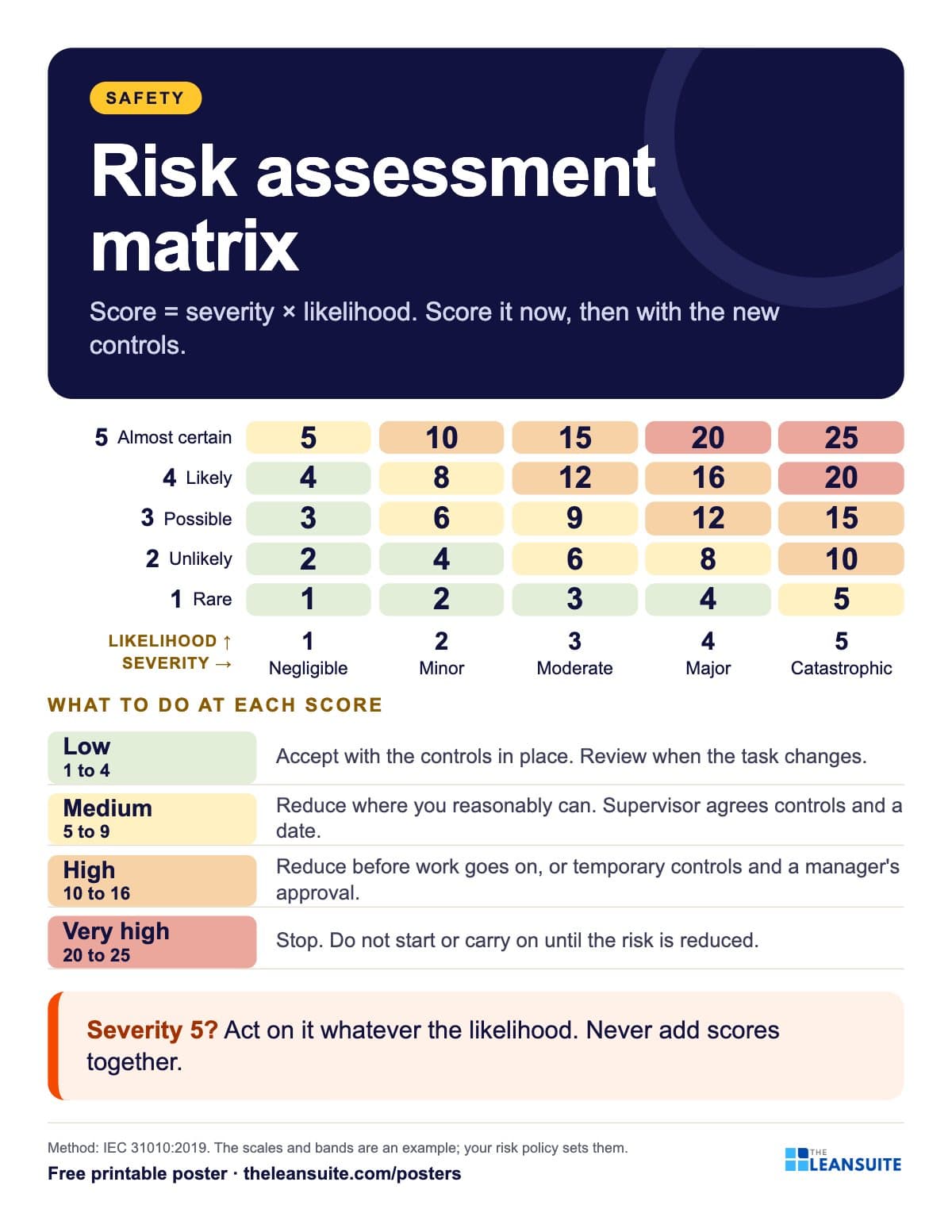 Risk assessment matrix poster (5 x 5)
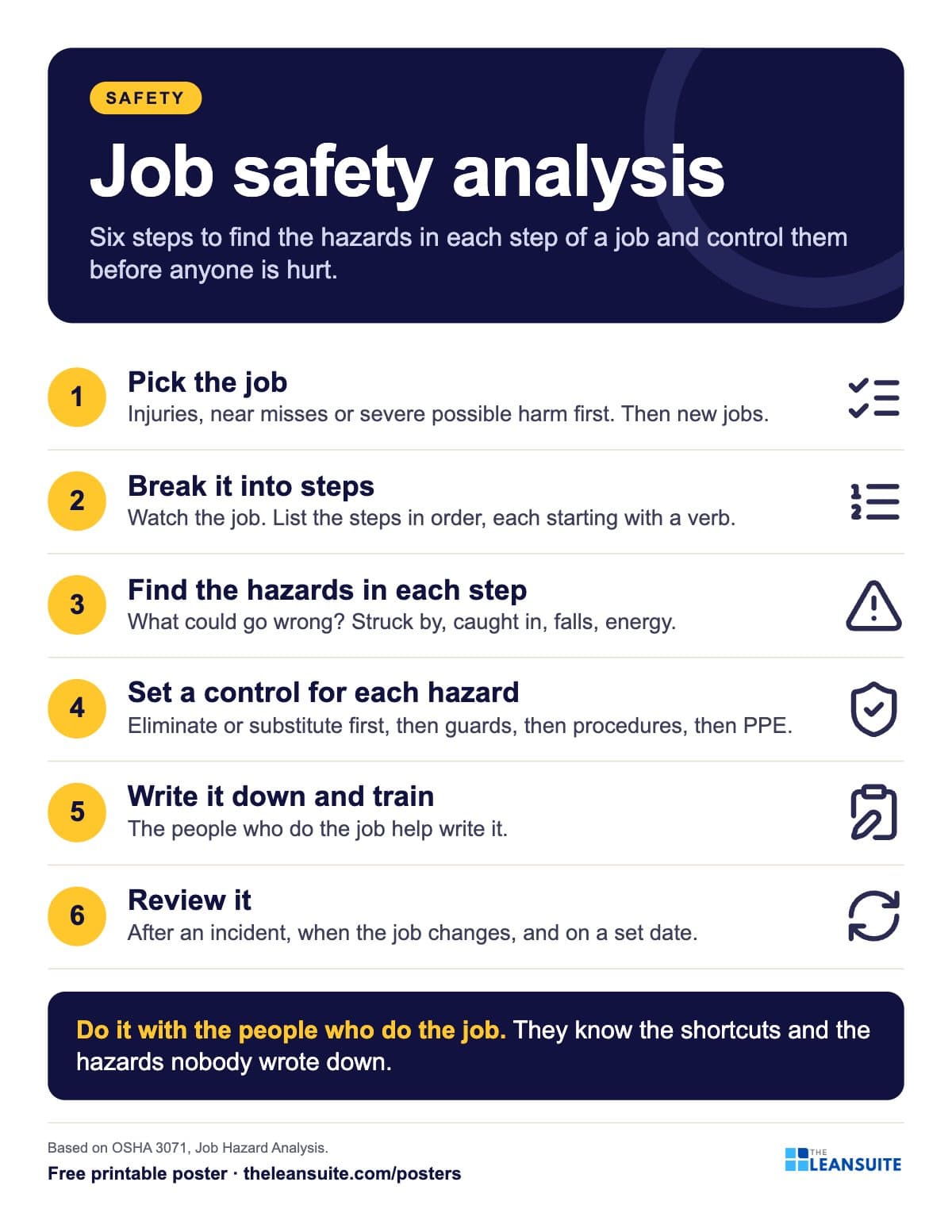 Job safety analysis (JSA) steps poster
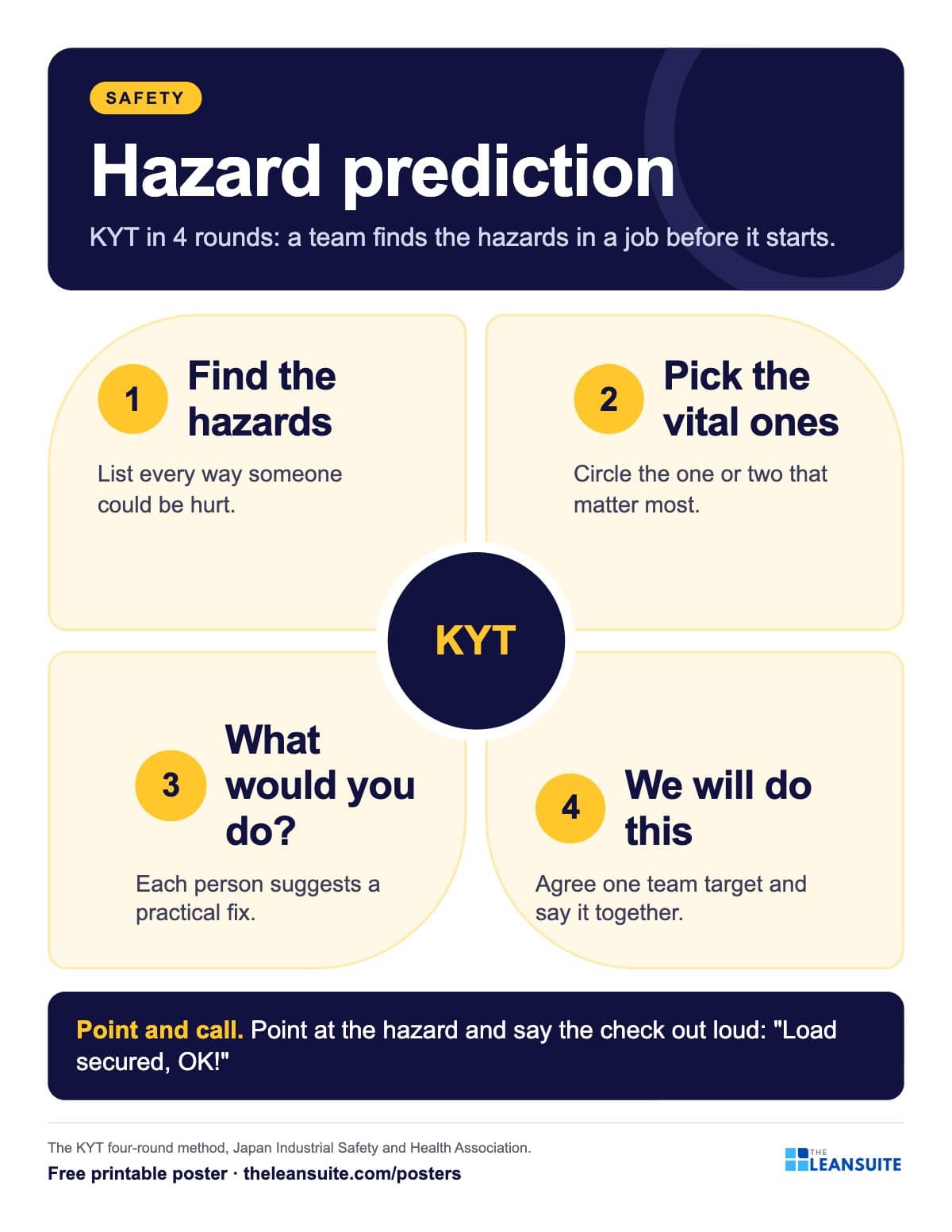 Hazard prediction (KYT) 4 rounds poster
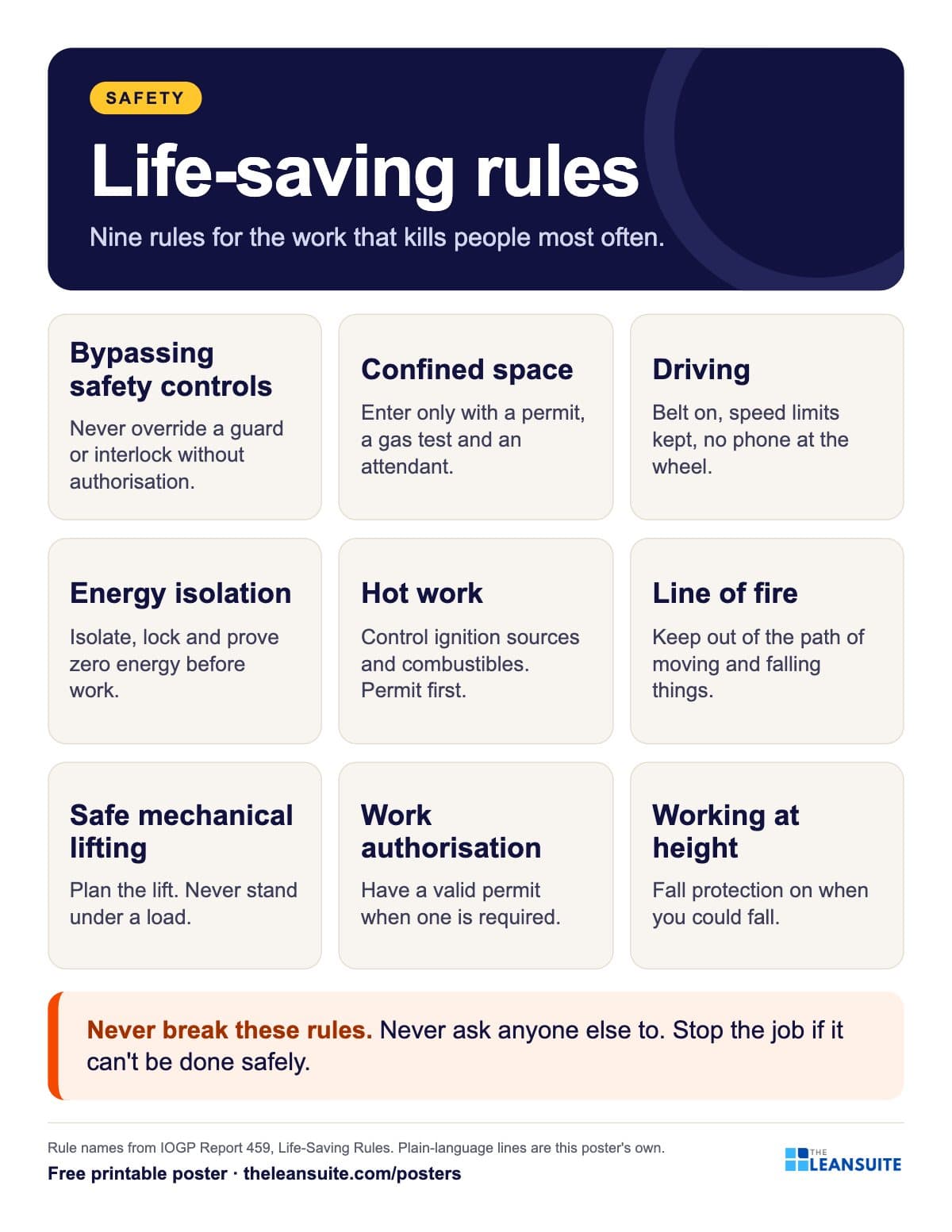 Life-saving rules poster
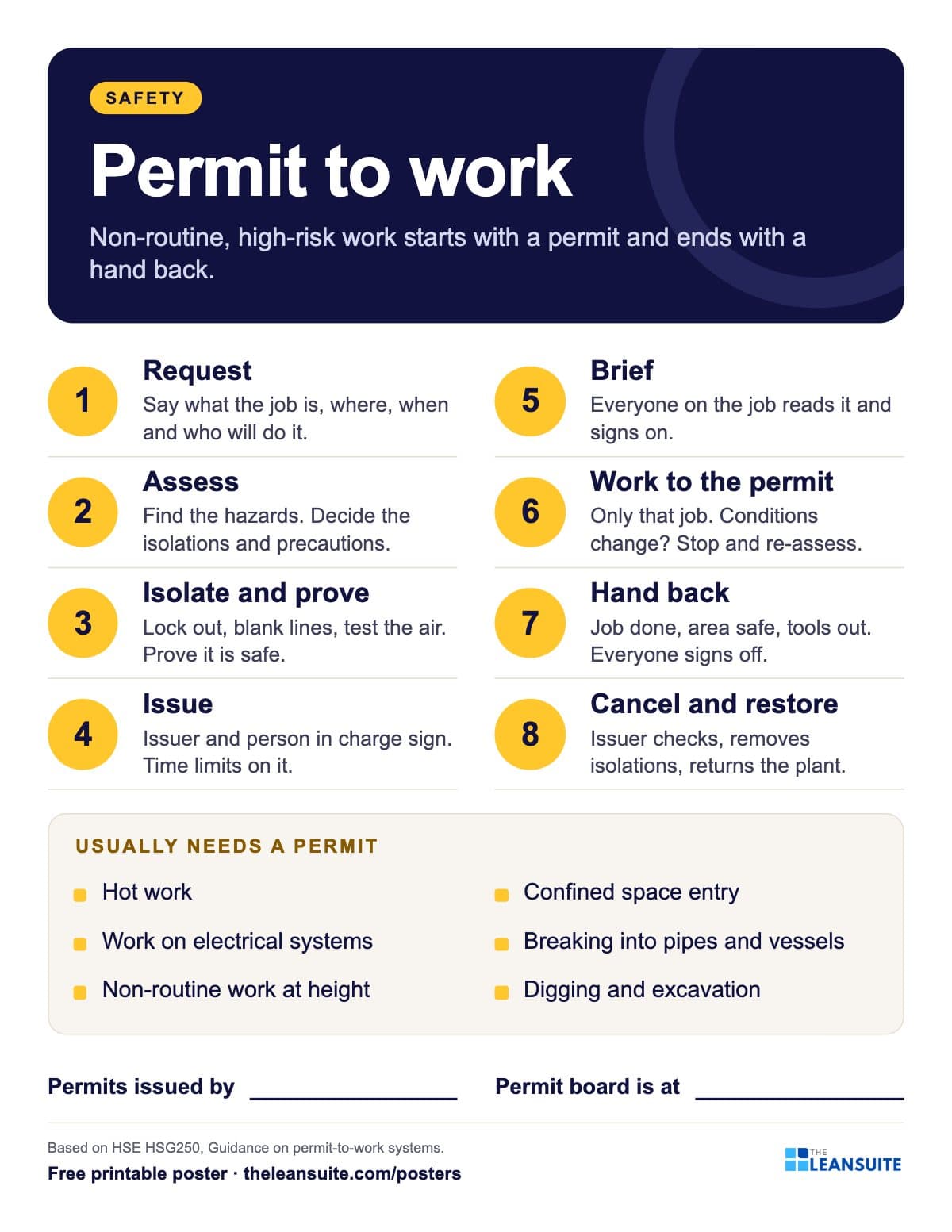 Permit to work poster
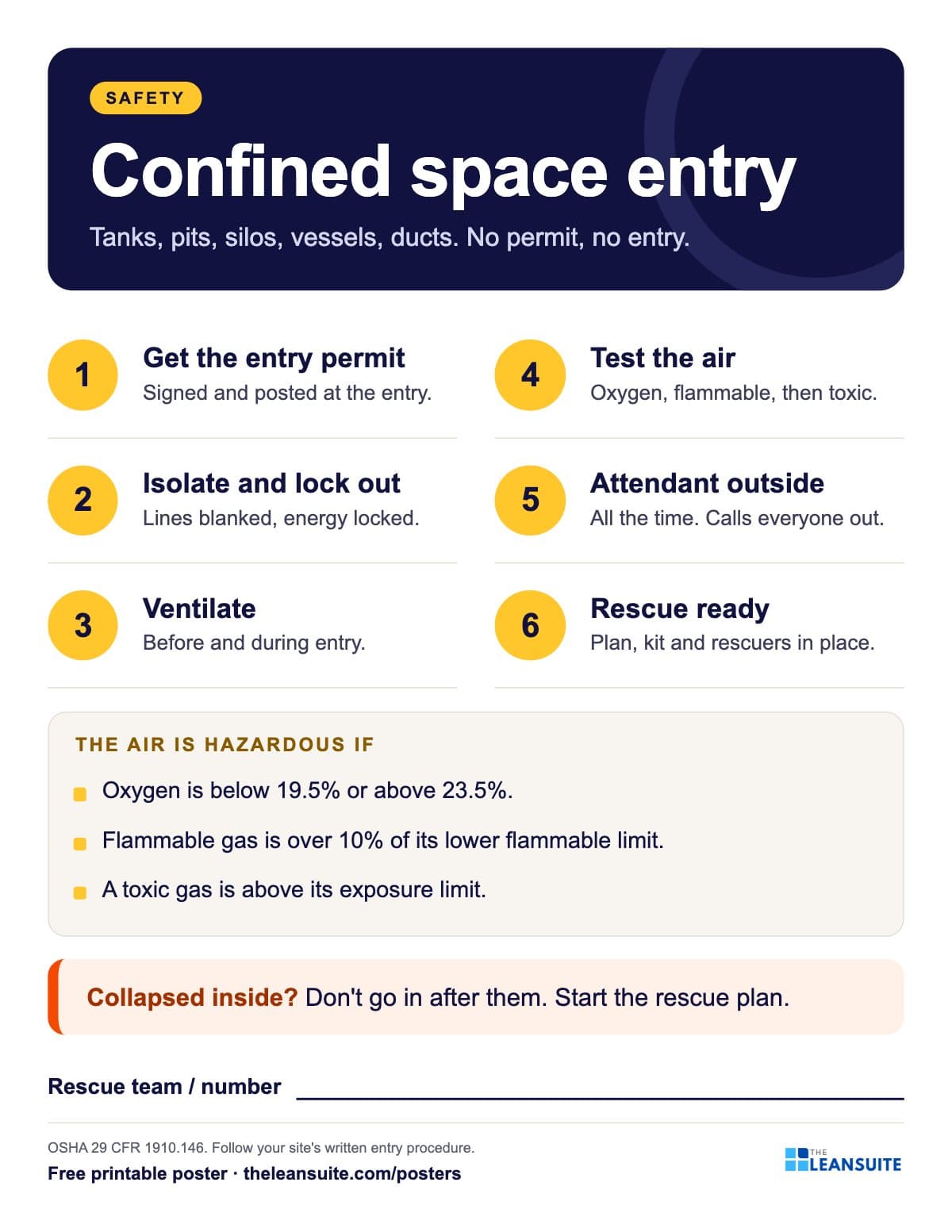 Confined space entry poster
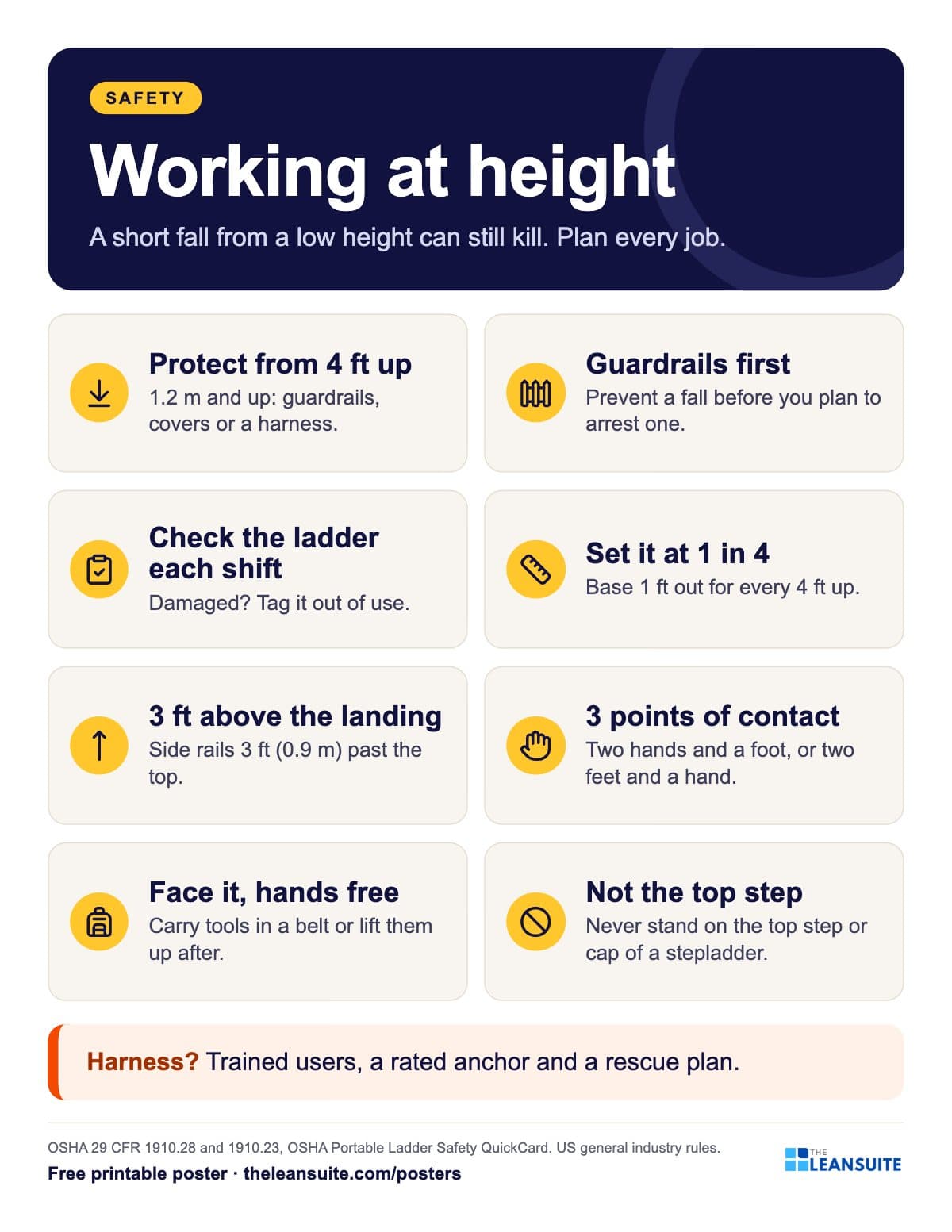 Working at height and ladder safety poster
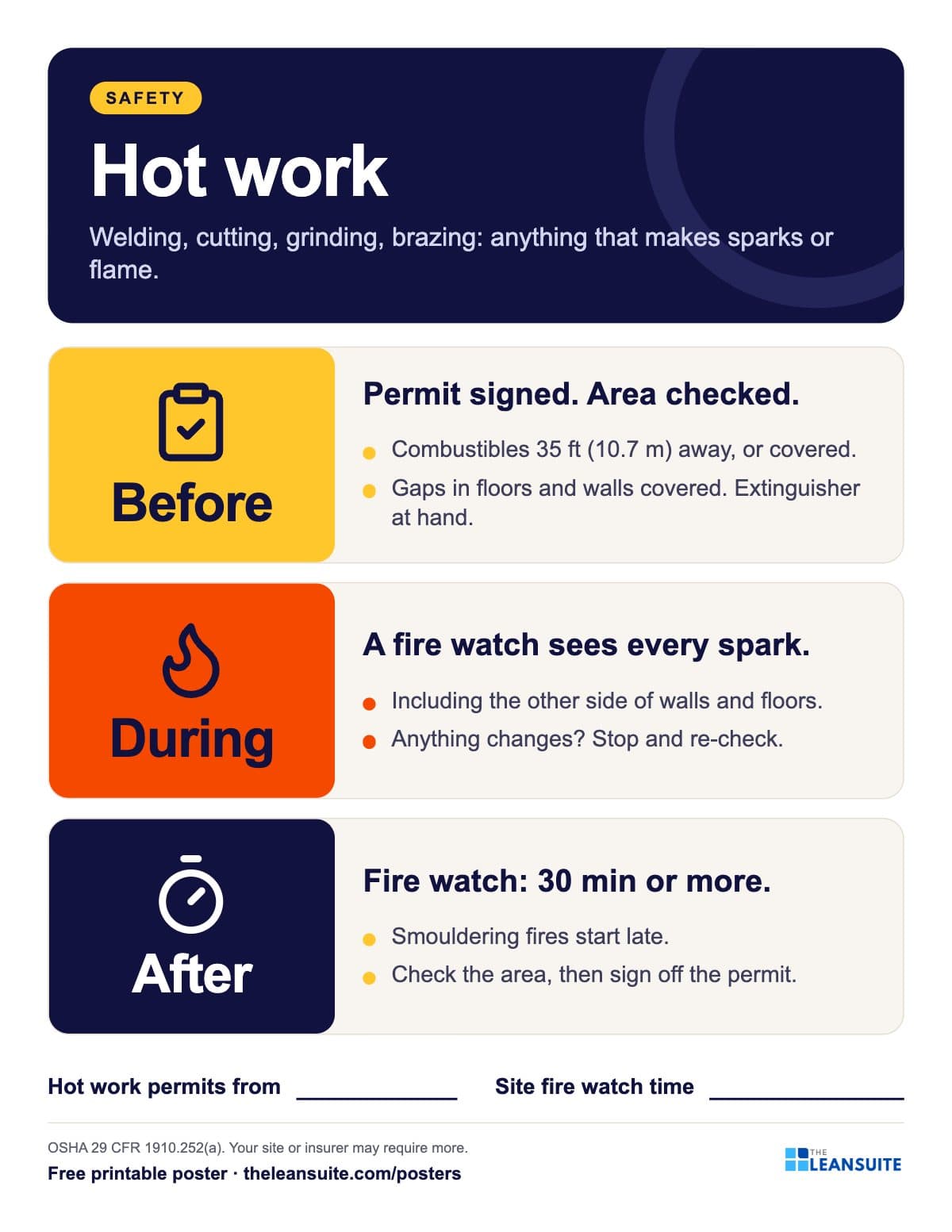 Hot work safety poster
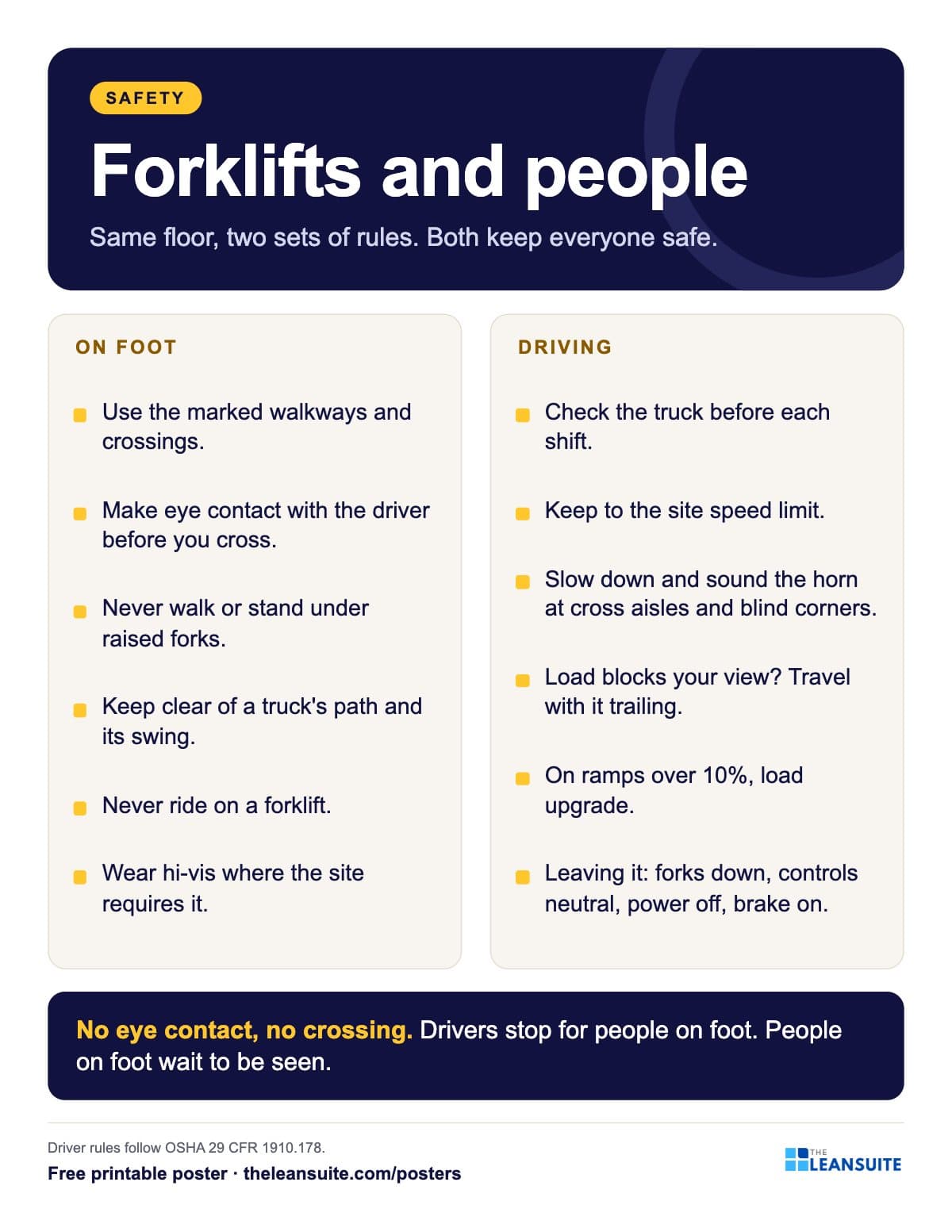 Forklift and pedestrian safety poster
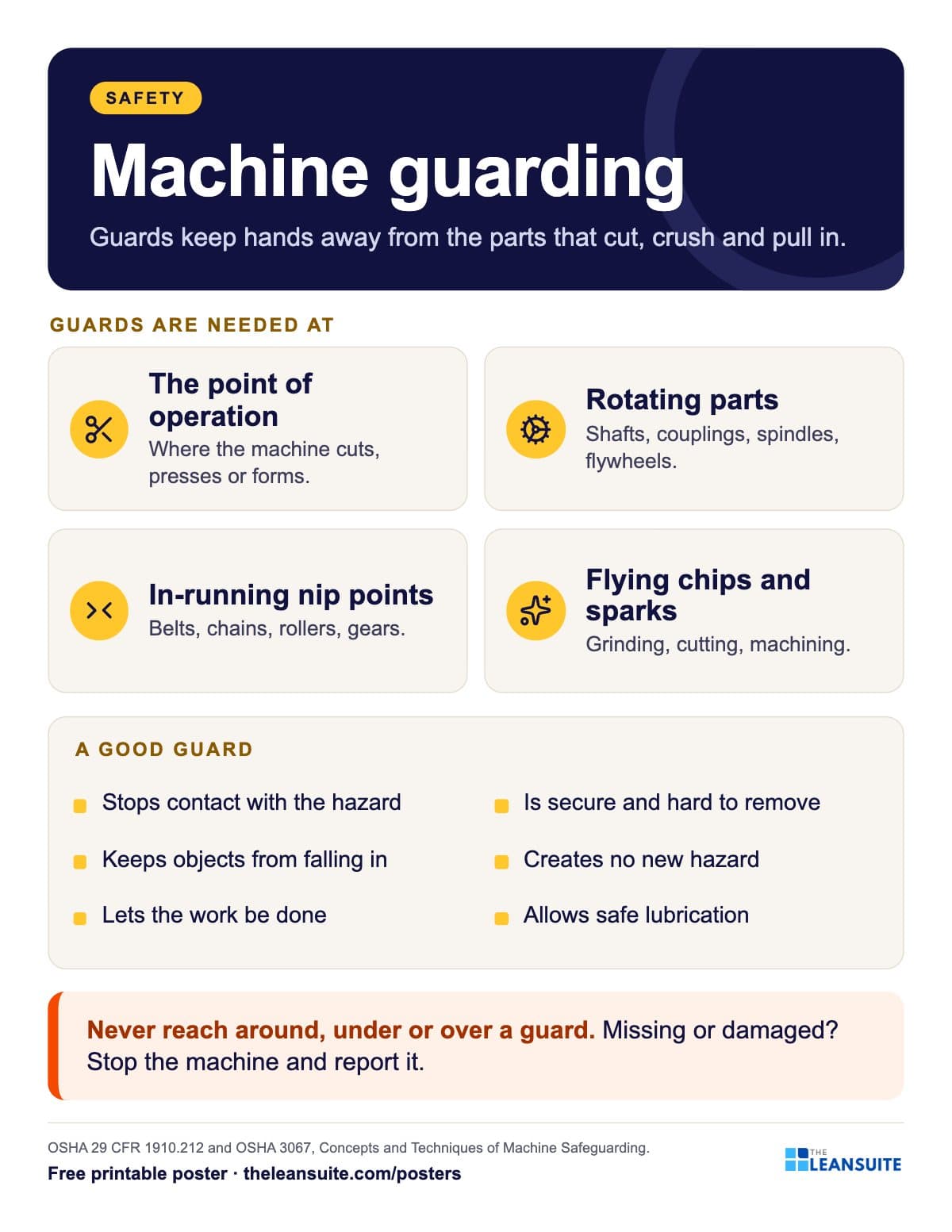 Machine guarding poster
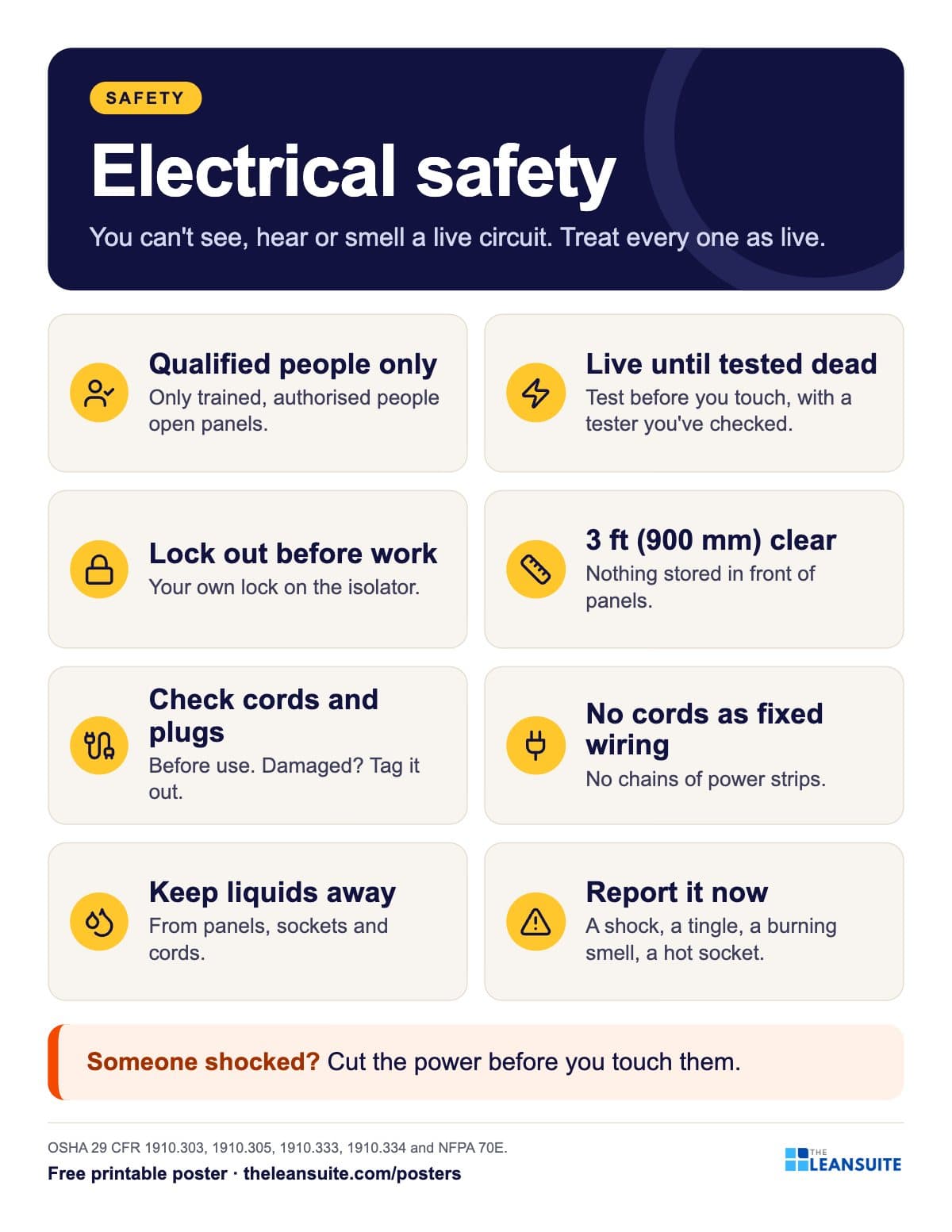 Electrical safety basics poster
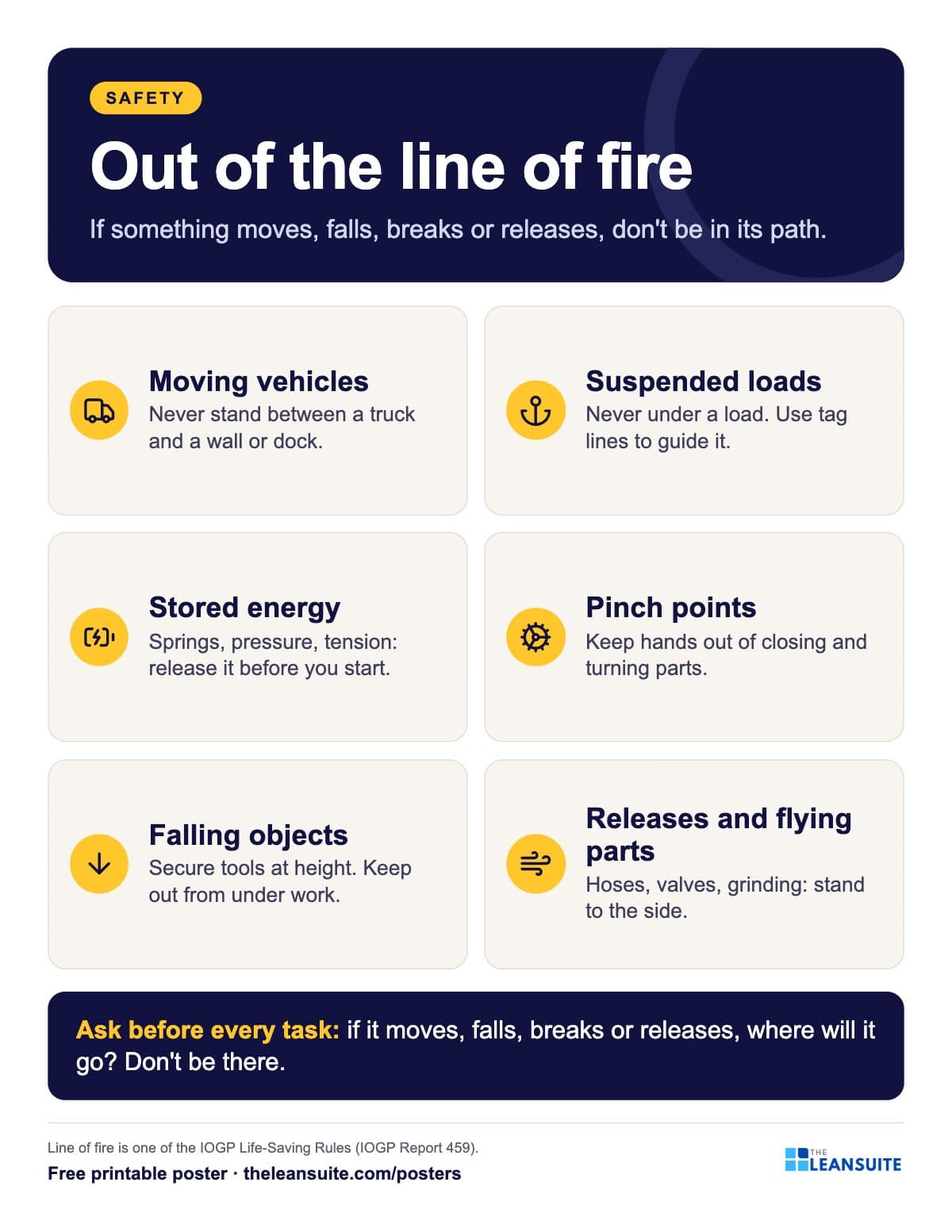 Line of fire poster
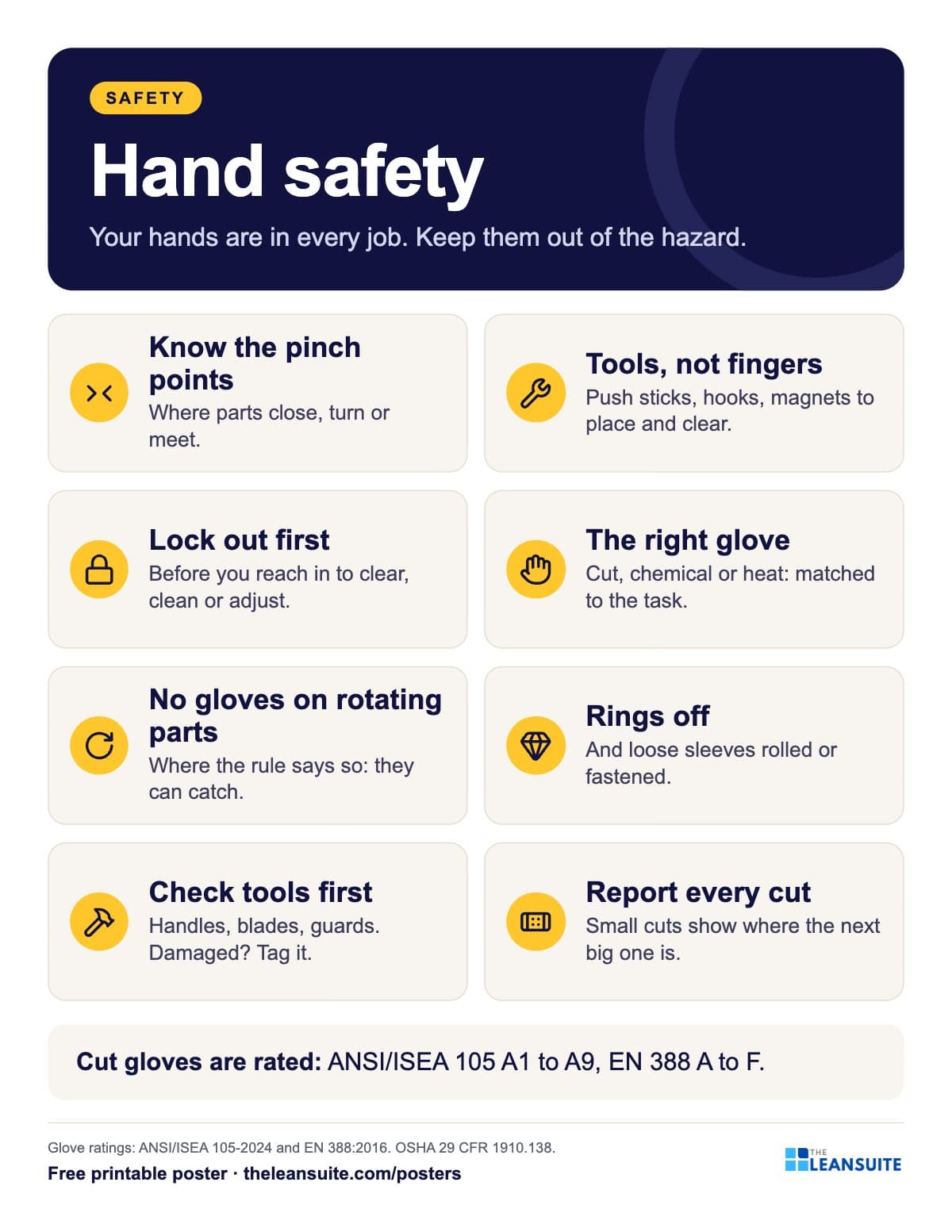 Hand safety poster
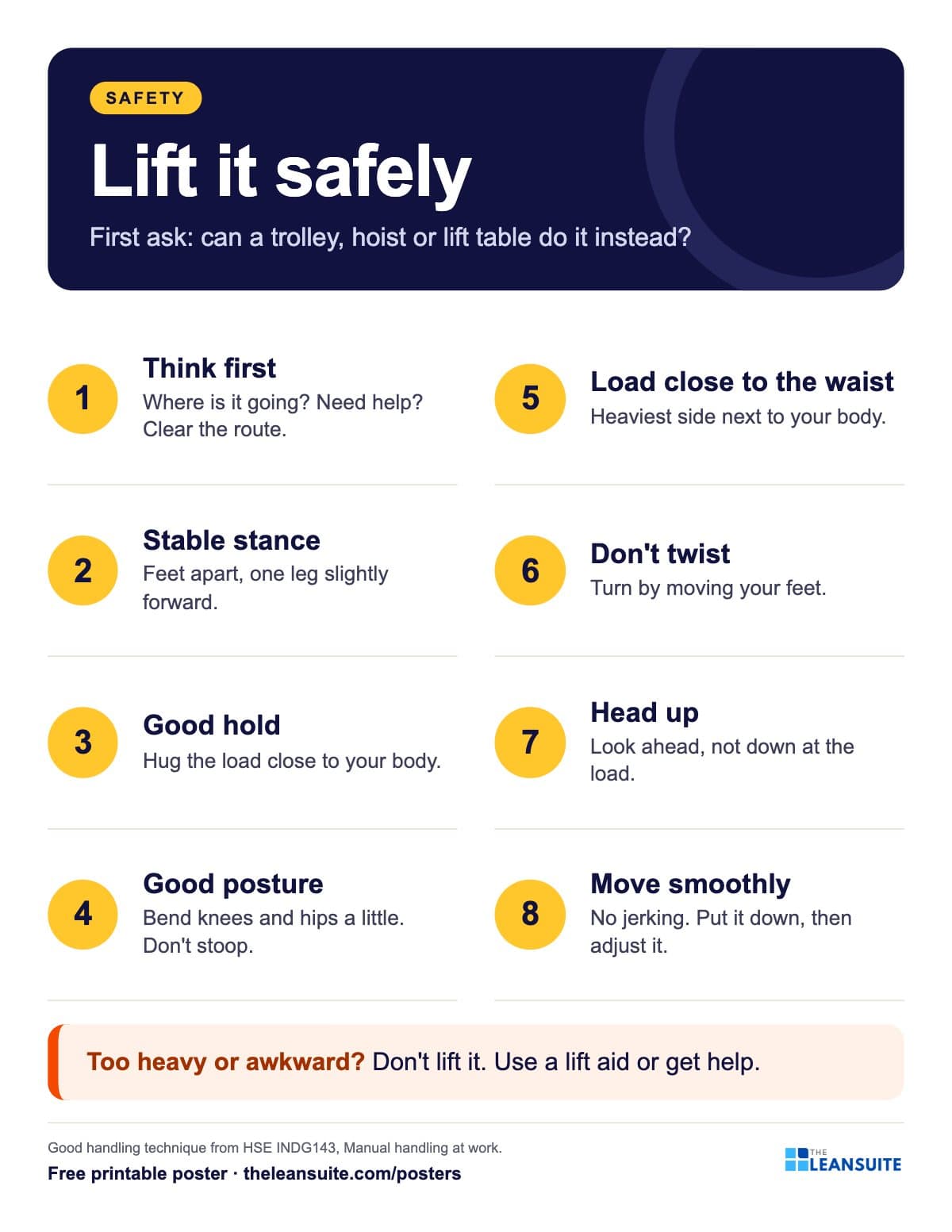 Safe lifting (manual handling) poster
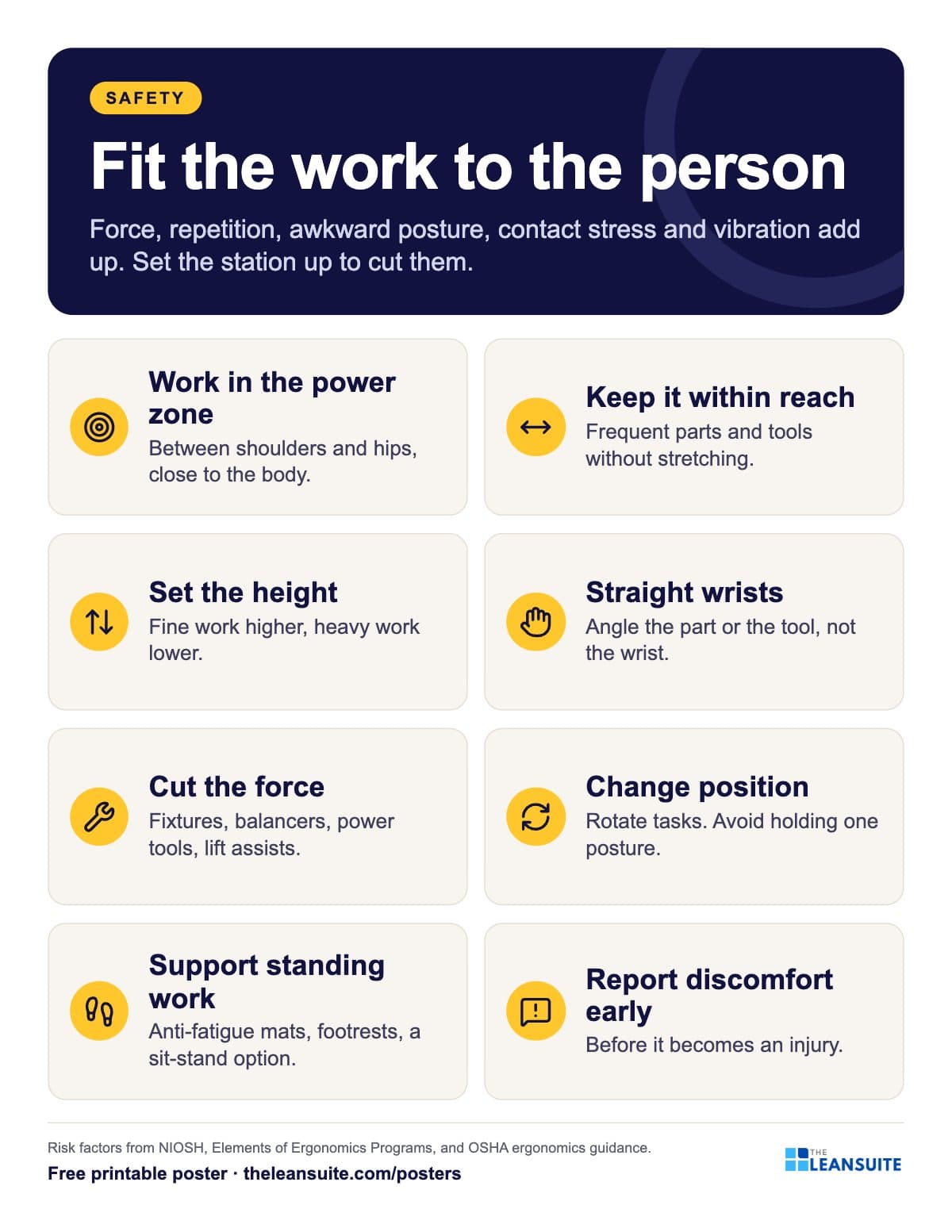 Workstation ergonomics poster
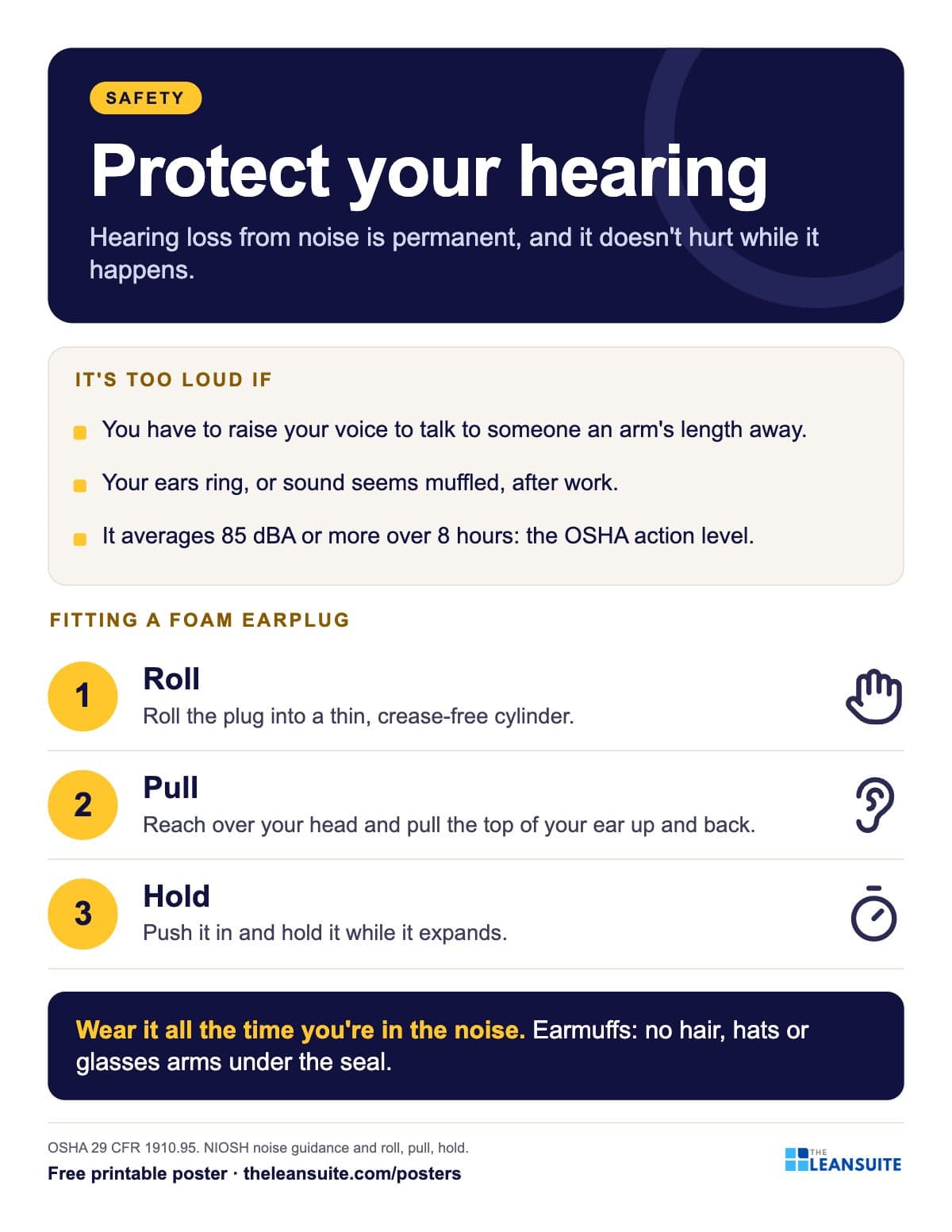 Hearing protection poster
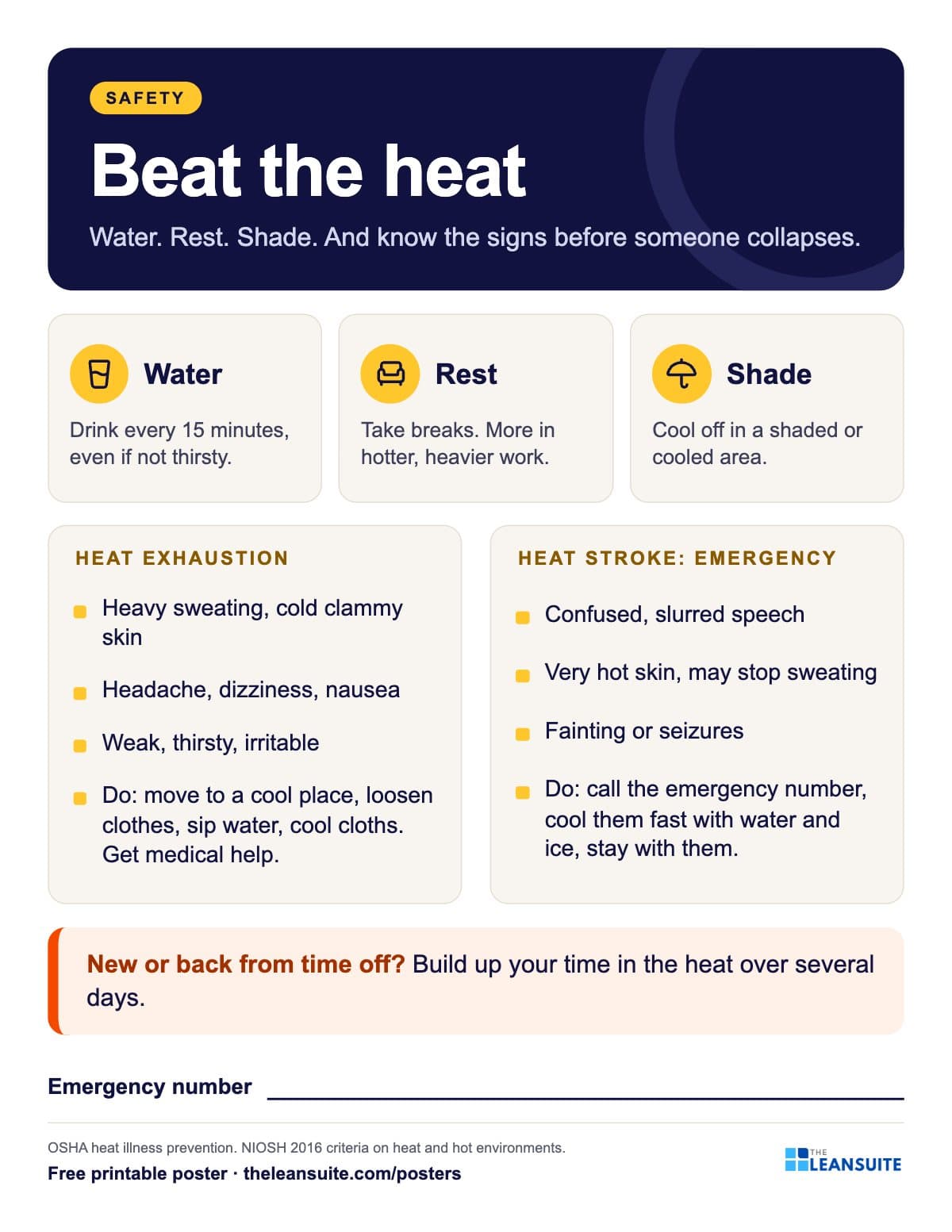 Heat stress poster
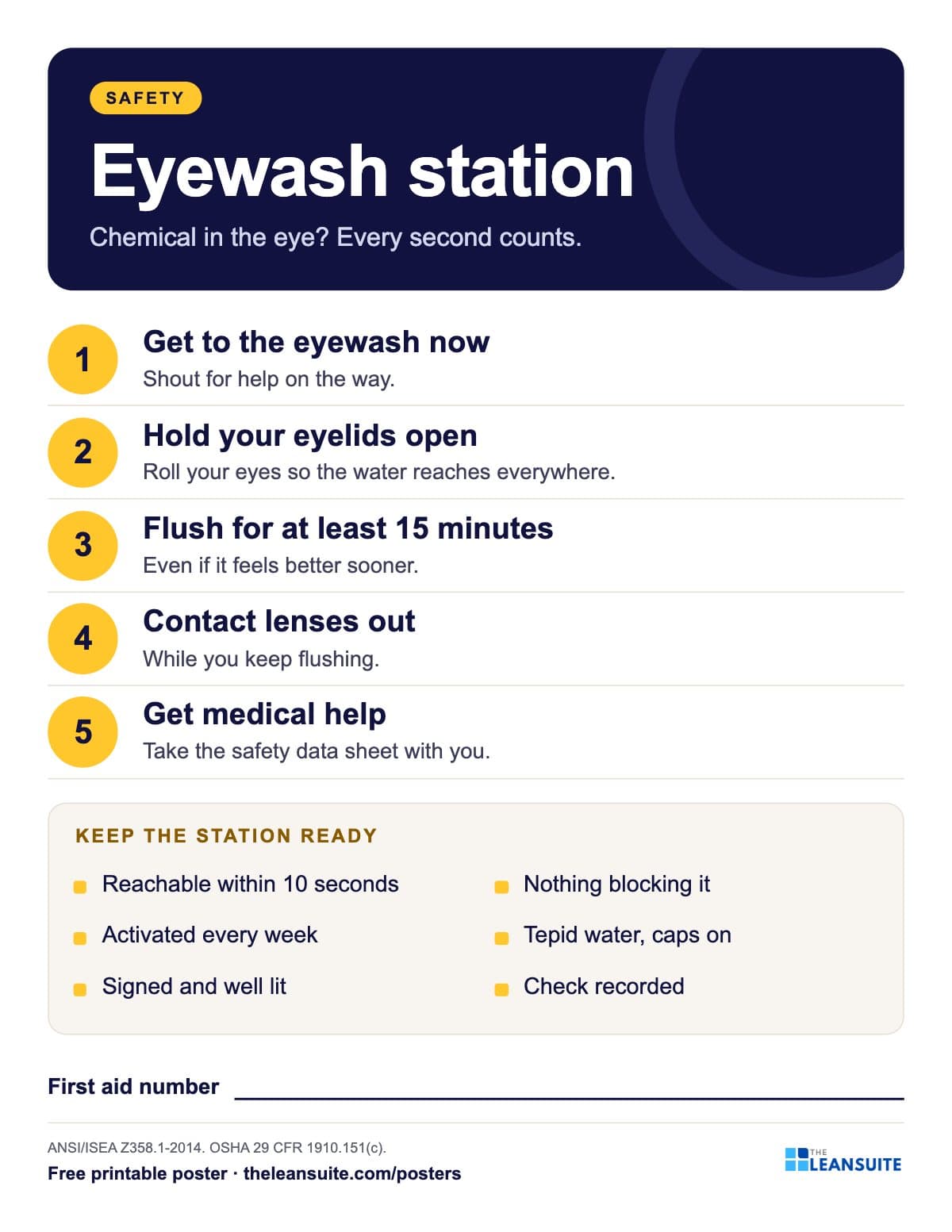 Eyewash station poster
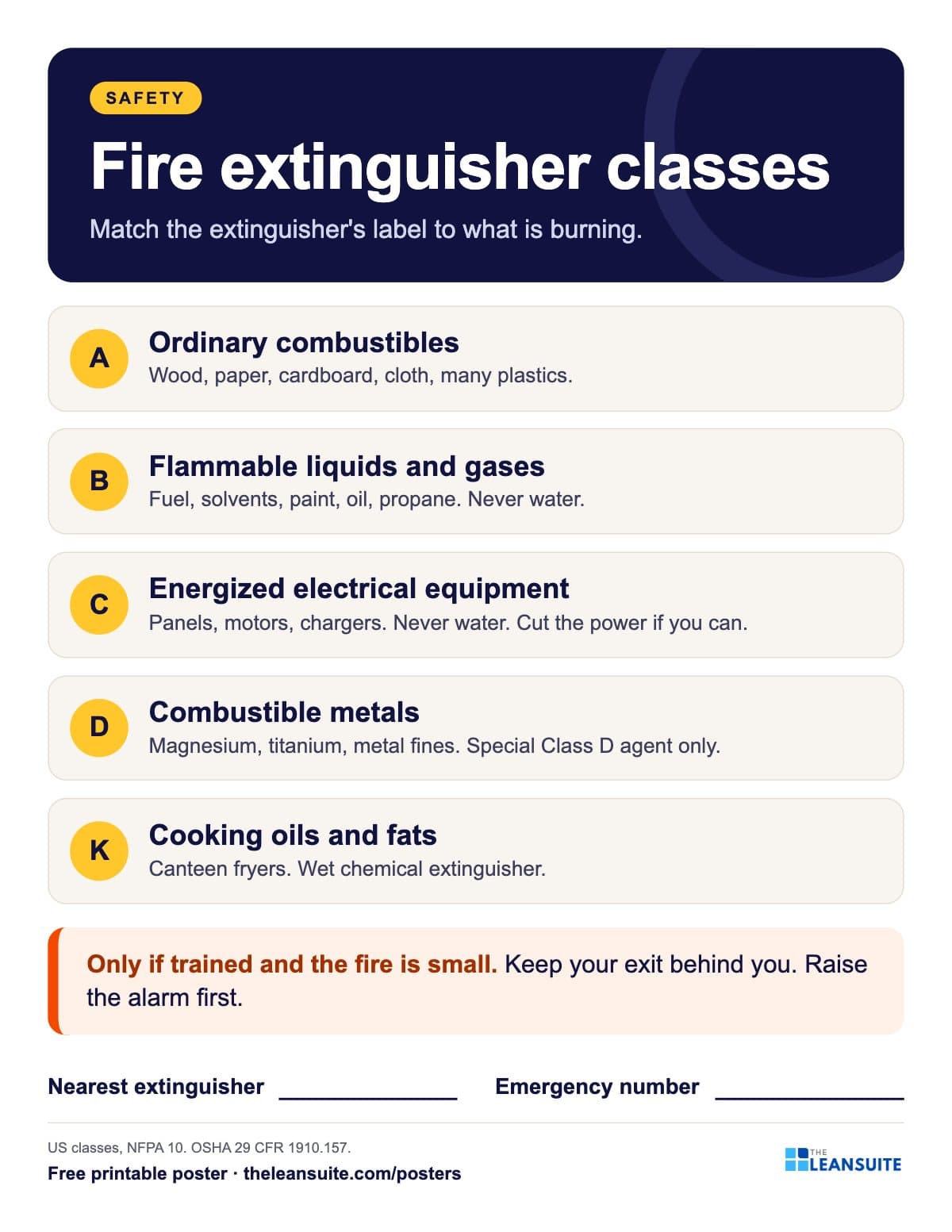 Fire extinguisher classes poster
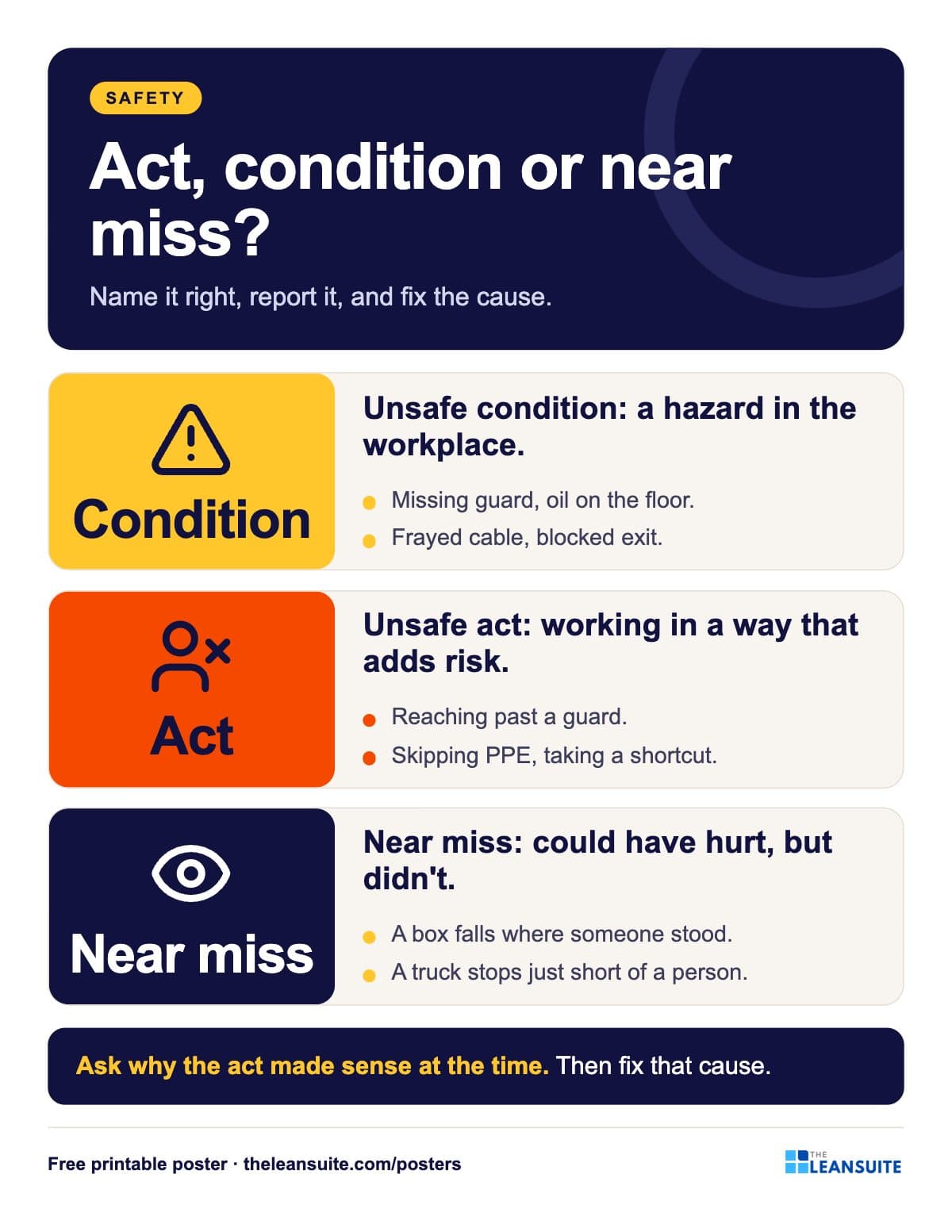 Unsafe acts and unsafe conditions poster
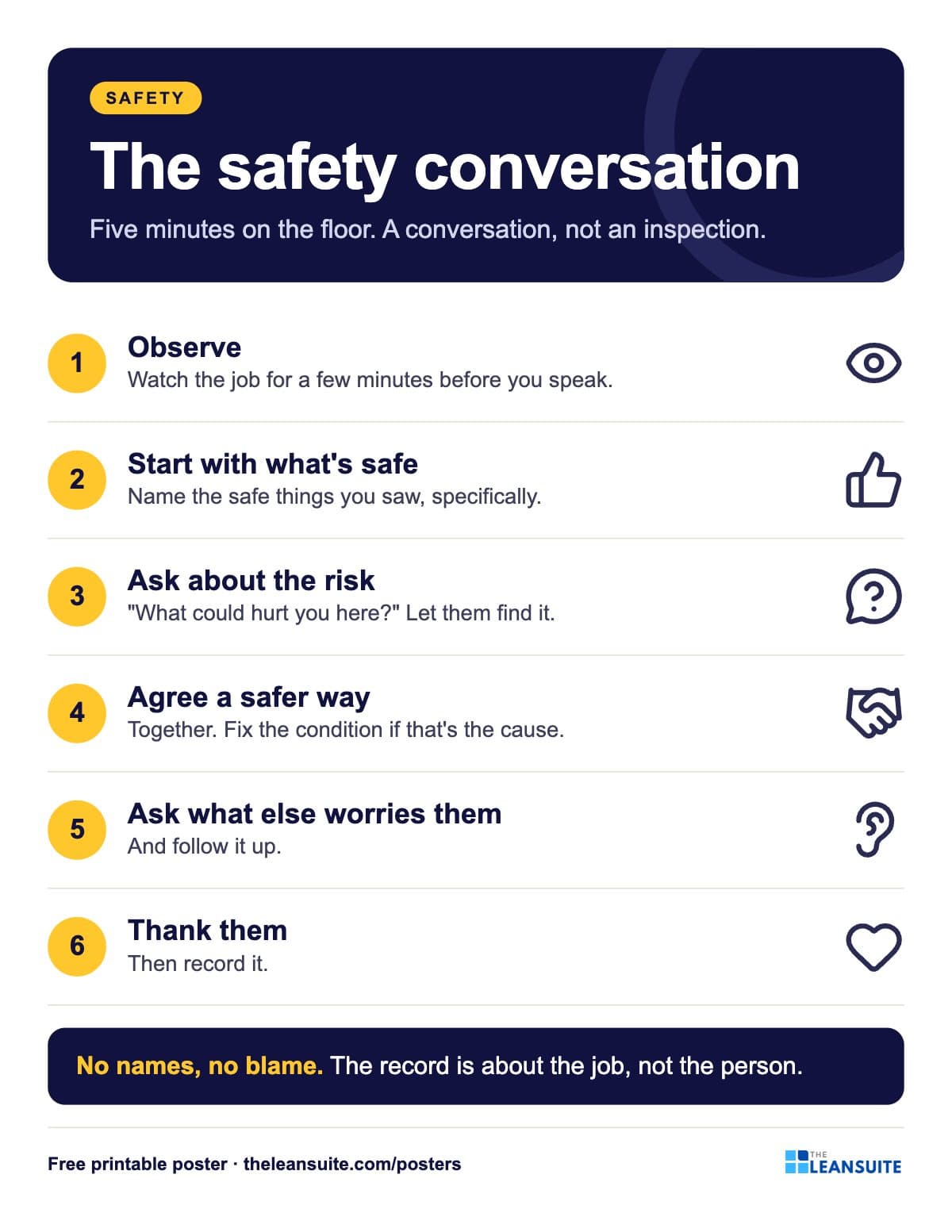 Safety observation conversation poster
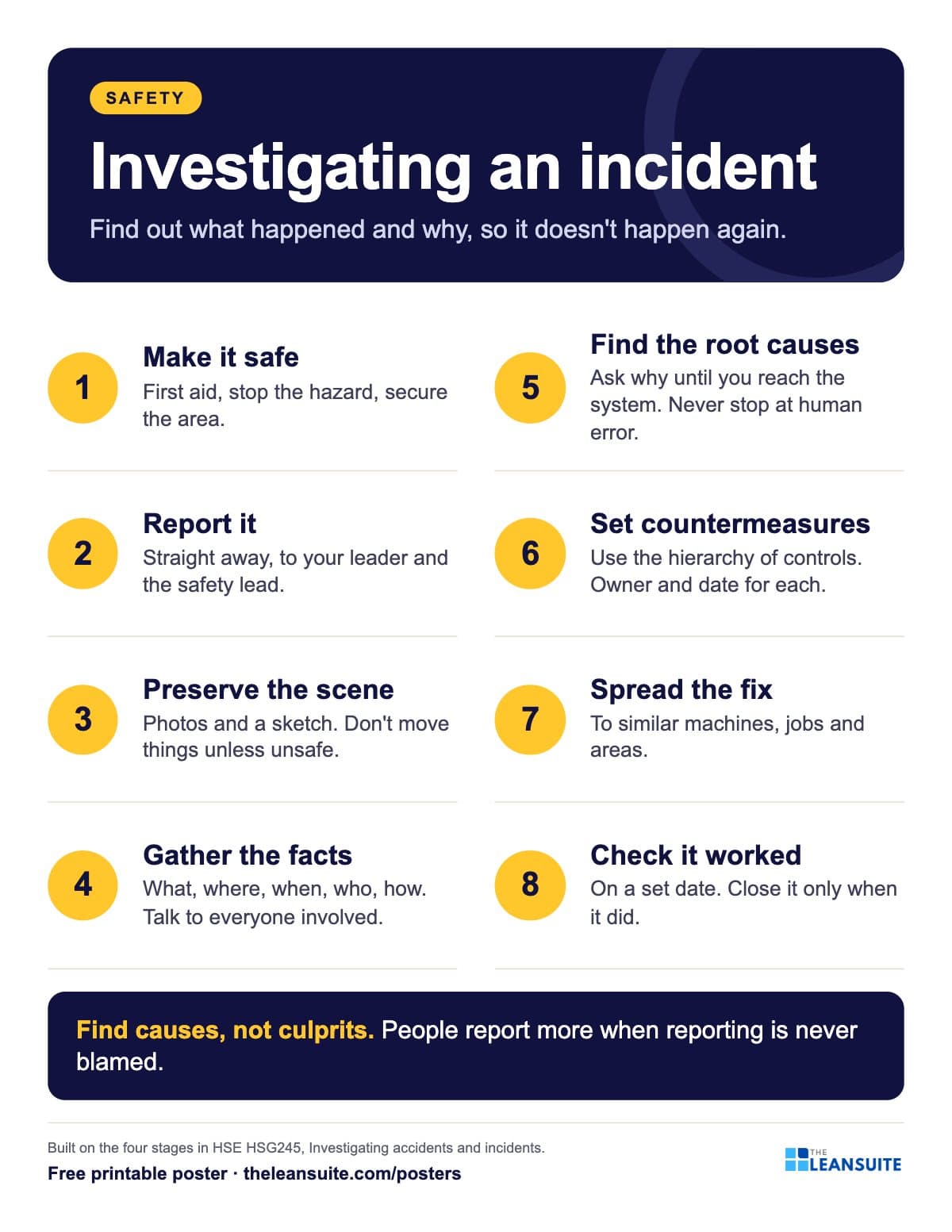 Incident investigation steps poster
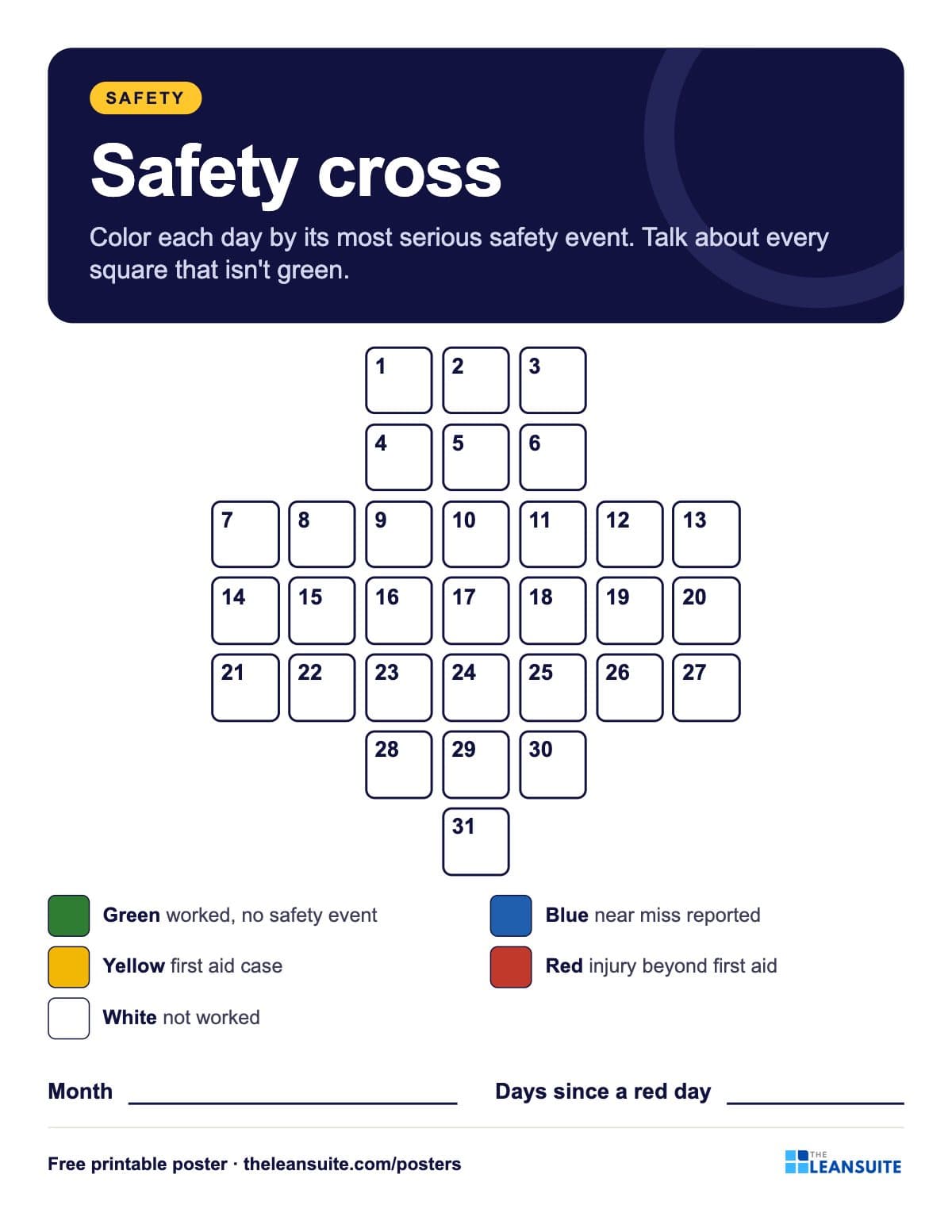 Safety cross calendar poster
A poster reminds. A routine makes it stick.
See how plants run their audits, improvements and follow-ups in LeanSuite, on a call built around your own problem.
Book a 45-minute demo